
Caustic Soda in Biodiesel Production: 2026 Technical Guide for Industrial Operations
- Chemical Basis: How Caustic Soda Catalyzes Biodiesel
- Multi‑Sector Roles of Caustic Soda in the Energy Transition
- Process Engineering: Optimizing NaOH‑Catalyzed Biodiesel
- Economics: NaOH vs. Alternative Biodiesel Catalyst Systems
- Handling High‑FFA Feedstocks with NaOH
- Supply Chain & Logistics for Industrial NaOH
- Policy‑Driven Economics and Carbon Credit Revenue
- Circular Economy Integration in NaOH‑Based Biorefineries
- Innovation Outlook (2025–2035) for NaOH‑Catalyzed Biodiesel
- Conclusion: Strategic Role of Caustic Soda in Industrial Biodiesel
- FAQ: Optimizing NaOH Use in Biodiesel Plants
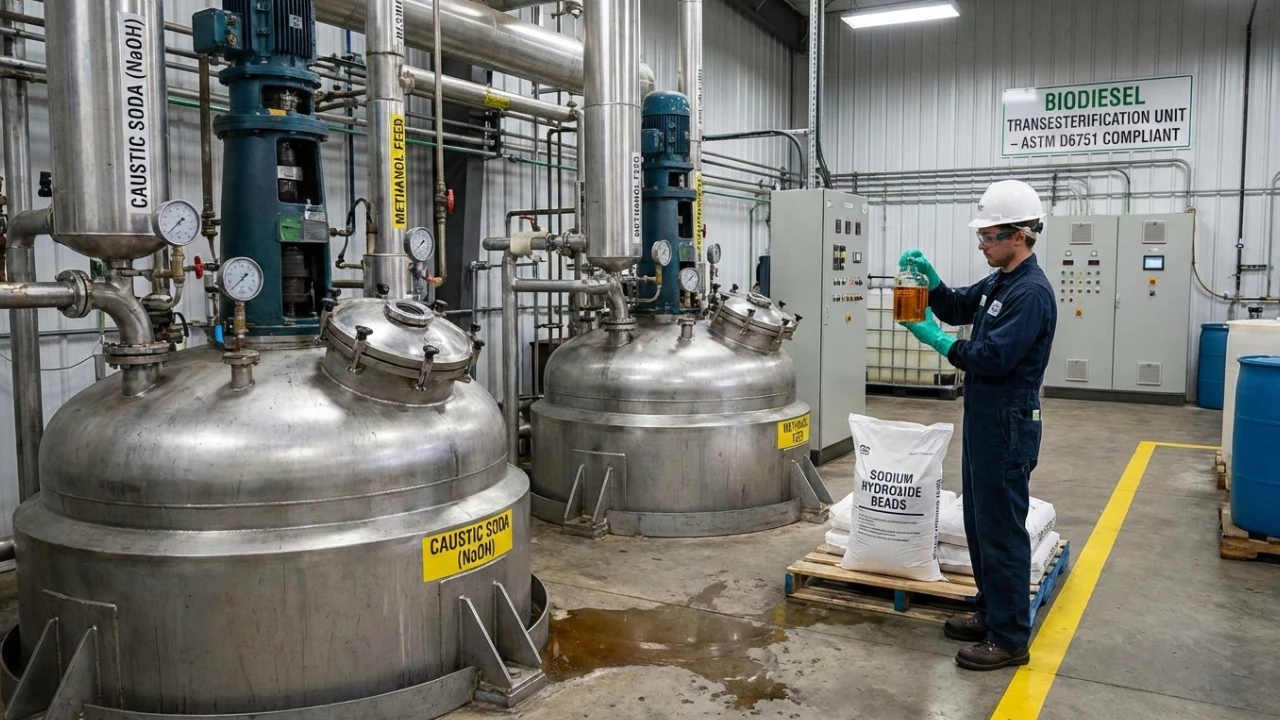
In the transition to low‑carbon energy, caustic soda biodiesel production is a cornerstone technology for converting lipids into standardized, renewable diesel fuel. Sodium hydroxide (NaOH) serves as a homogeneous base catalyst in transesterification, the reaction where triglycerides exchange alkoxy groups with a short‑chain alcohol (typically methanol) to form fatty acid methyl esters (FAME).
Beyond biodiesel, NaOH underpins multiple low‑carbon value chains, from waste valorization to advanced materials. Global NaOH demand for biofuel applications reached an estimated 4.1 million metric tons in 2024 and is projected to climb to 6.8 million metric tons by 2030, driven by stricter carbon‑intensity targets and biodiesel blending mandates above 10% in more than 40 countries.
[Learn more about sodium hydroxide]
Chemical Basis: How Caustic Soda Catalyzes Biodiesel
NaOH Production and Decarbonization
Most industrial NaOH is produced by the chlor‑alkali process, where an electric current passes through brine (NaCl solution) to yield chlorine gas, hydrogen, and caustic soda. The sector is shifting toward membrane‑cell electrolysis powered by renewable electricity, which significantly lowers the carbon footprint of caustic soda:
- Conventional diaphragm cell, grid‑powered: 1.4–1.6 t CO₂‑eq / t NaOH
- Renewable‑powered membrane cell (“green caustic soda”): < 0.3 t CO₂‑eq / t NaOH
This low‑carbon NaOH is increasingly preferred by biofuel producers targeting carbon‑negative or ultra‑low CI pathways, especially in the EU. Lithuanian biorefineries in the Kaunas Free Economic Zone, for example, are aligning with EU Taxonomy criteria by integrating green NaOH into their supply chains.
Base‑Catalyzed Transesterification Mechanism
In NaOH‑catalyzed FAME biodiesel production, the key reaction steps are:
- Methoxide formation
- Hydroxide ion (OH⁻) from NaOH deprotonates methanol (CH₃OH), forming methoxide (CH₃O⁻), a strong nucleophile.
- Nucleophilic attack on triglycerides
- Methoxide attacks the carbonyl carbon in triglyceride molecules, forming a tetrahedral intermediate.
- FAME and glycerol formation
- The intermediate collapses, releasing a fatty acid methyl ester and a diglyceride anion.
- This cycle repeats until all three fatty acid chains are converted, yielding FAME + glycerol.
From a chemistry perspective, caustic soda biodiesel production depends on keeping this reaction in the optimal regime with controlled feedstock quality, catalyst concentration, mixing, temperature, and residence time.
Multi‑Sector Roles of Caustic Soda in the Energy Transition
NaOH’s importance extends beyond biodiesel plants:
- Biofuel catalyst & pre‑treatment
- Main base catalyst for high‑yield FAME biodiesel.
- Used in saponification/degumming for feedstock pre‑cleaning.
- Critical mineral processing
- Reagent in alkaline leaching of lithium from spodumene.
- Used in the purification of nickel and cobalt for NMC battery cathodes.
- Emissions control
- Reactant in wet scrubbers for SO₂ and NOₓ removal in biomass and industrial combustion.
- Properly designed systems can achieve > 99% removal efficiency.
- Advanced materials
- Central to the Bayer process for alumina extraction from bauxite.
- Supports production of aluminum for EV chassis and wind turbine components.
Industrial caustic soda biodiesel production targeting ASTM D6751 / EN 14214 must tightly control core process variables. The table below summarizes key parameters for continuous‑flow systems.
Process Engineering: Optimizing NaOH‑Catalyzed Biodiesel
Critical Operating Parameters
Industrial plants targeting ASTM D6751 / EN 14214 biodiesel specifications must tightly control core process variables. The table below summarizes key parameters for continuous‑flow systems.
Key Parameters in NaOH‑Catalyzed Biodiesel Production
| Process Stage | Key Parameter | Optimal Range | Impact of Deviation | Monitoring / QC Method |
|---|---|---|---|---|
| Catalyst Preparation | NaOH Purity | ≥ 99% (low chloride) | Chlorides and metals cause corrosion & soap formation | ICP‑MS or ion chromatography |
| Methanol–NaOH Mix Temp | 25–30 °C | Too high → methanol loss; too low → incomplete dissolution | Jacketed reactor with temperature control | |
| Transesterification | Oil Acid Value (FFA) | < 0.5 mg KOH/g | > 1.0 → saponification, yield loss > 5% | Titration (AOCS Cd 3d‑63) |
| Residence Time | 60–75 minutes | Too short → low conversion; too long → higher OPEX | Online density/viscosity meters | |
| Mixing Shear Rate | 500–700 s⁻¹ | Insufficient mixing → mass‑transfer limitations | CFD design + power draw monitoring | |
| Separation & Purif. | Glycerol Settling Time | 4–8 hours at ~50 °C | Inadequate settling → FAME loss in glycerol phase | Gravity settlers or centrifuge (6000–8000 G) |
| Wash Water pH | 5.5–6.5 (slightly acidic) | Neutral pH less effective at removing soap & residual NaOH | Automated pH control loop | |
| Final Product Moisture | < 500 ppm | High moisture → microbial growth, filter clogging | Karl Fischer coulometric titration |
Maintaining these operating windows stabilizes conversion, minimizes rework, and protects downstream equipment.
Economics: NaOH vs. Alternative Biodiesel Catalyst Systems
In techno‑economic analyses of caustic soda biodiesel production, NaOH remains the benchmark catalyst system against which heterogeneous and enzymatic routes are compared. A 2024 TEA of a 50‑million‑gallon/year FAME plant shows the following:
Economic Comparison of Catalyst Systems
| Cost Component | NaOH Catalyst System | Heterogeneous Solid Catalyst | Enzymatic Catalyst System |
|---|---|---|---|
| Catalyst Cost (USD/gal biodiesel) | 0.08–0.12 | 0.18–0.28 | 0.35–0.55 |
| Capital Investment (reactor section) | Baseline | +25–40% | +60–100% |
| Energy Consumption (MJ/gal) | 12–15 | 8–10 | 5–7 |
| Byproduct Glycerol Purity (%) | 80–85 (crude) | 90–95 | > 98 (pharmaceutical‑grade) |
| Wastewater Generated (gal/gal) | 0.3–0.5 | 0.05–0.1 | < 0.02 |
| Estimated ROI Period (years) | 4–5 | 7–9 | 10+ |
Despite higher wastewater volumes and lower crude glycerol purity, NaOH remains the most cost‑effective catalyst for new biodiesel plants, particularly those processing diverse, price‑sensitive feedstocks common in Baltic markets.
Handling High‑FFA Feedstocks with NaOH
Low‑cost, high‑FFA feedstocks such as waste cooking oil (WCO), brown grease, and certain animal fats can significantly improve margins, but they cannot be fed directly into a base‑only process without substantial soap formation.
Standard Two‑Stage Acid–Base Process
- Stage 1 – Acid Esterification
- Catalyst: typically sulfuric acid.
- Temperature: ~60 °C.
- Objective: convert FFAs to FAME and reduce acid value to < 0.5 mg KOH/g.
- Stage 2 – Base Transesterification (NaOH)
- Pre‑treated oil is then processed under standard NaOH‑catalyzed conditions.
- This method handles feedstocks with up to ~20% FFA, expanding feedstock flexibility and improving waste‑diversion metrics—critical for circular‑economy initiatives in industrial clusters such as Klaipėda.
Supply Chain & Logistics for Industrial NaOH
Regional Market Dynamics
NaOH supply for biodiesel is influenced by:
- Sectoral demand shifts
- Growing demand for biofuels, battery materials, and alumina.
- Declining demand from some traditional sectors, like pulp and paper.
- Regional pricing
- North America: generally lower NaOH prices due to cheap natural gas and integrated chlorine markets.
- Asia: tighter margins and higher delivered costs in several regions.
- Europe/Baltics: delivered price strongly affected by logistics, energy prices, and REACH‑compliant production.
Logistics, Storage, and Security of Supply
- Form: typically 50% aqueous NaOH solution transported in tank cars, road tankers, or isotanks.
- Storage: lined carbon steel or stainless‑steel tanks, kept above 15 °C to prevent crystallization.
- Contracts: long‑term bulk contracts often use “hell or high water” clauses to guarantee supply continuity for continuous‑run biodiesel units.
Robust NaOH sourcing and storage strategies are as important as reactor design in avoiding unplanned downtime.
Policy‑Driven Economics and Carbon Credit Revenue
Regulatory frameworks can significantly improve the economics of NaOH‑catalyzed biodiesel:
- California LCFS example
- Each gallon of optimized FAME biodiesel can generate 1.5–2.0 LCFS credits, which traded around USD 80–100/credit in 2024.
- This revenue stream offsets a substantial portion of feedstock and catalyst costs.
- EU ETS and national schemes
- Documented use of green NaOH and high‑FFA waste feedstocks improves lifecycle carbon intensity.
- This can unlock additional credits or tax advantages in Lithuania and other EU states.
Circular Economy Integration in NaOH‑Based Biorefineries
Modern biorefineries increasingly use NaOH as a central node in circular resource management.
Glycerol Valorization
Crude glycerol (typically 80–85% purity) from NaOH‑catalyzed biodiesel can be upgraded to:
- Epichlorohydrin – precursor for epoxy resins, water‑treatment polymers.
- 1,3‑Propanediol – monomer for high‑performance bioplastics (e.g., PTT fibers).
- Syngas – via gasification, enabling hydrogen or methanol production and potentially closing the methanol loop.
Waste Stream Synergies
- Spent NaOH from biodiesel wash water can be neutralized and reused as a pH adjuster in anaerobic digesters treating plant residues.
- This integration supports renewable natural gas (RNG) generation and improves overall plant resource efficiency.
Innovation Outlook (2025–2035) for NaOH‑Catalyzed Biodiesel
Process Intensification
Emerging technologies include:
- Ultrasonic reactors and microwave‑assisted systems that:
- Cut transesterification time to under 10 minutes.
- Reduce NaOH usage by 15–20%.
- Improve conversion consistency for variable feedstocks.
Catalyst Recovery and Recycling
- Bipolar membrane electrodialysis (BMED) enables:
- NaOH regeneration from sodium‑rich wastewater streams.
- Energy efficiencies of > 70%.
- Significant reductions in fresh catalyst consumption and wastewater load.
Digital Twins and AI Optimization
- Plant‑wide digital twins using:
- Inline NIR spectroscopy,
- Real‑time density and viscosity,
- Feedstock quality data,
can dynamically optimize: - NaOH dosing,
- Methanol‑to‑oil ratios,
- Reaction temperature and residence time,
to maximize yield and minimize off‑spec product.
Electrofuel Integration
- Renewable electrolysis can co‑produce green hydrogen and NaOH.
- Green hydrogen plus captured CO₂ produces e‑methanol, which feeds back into biodiesel production with NaOH catalysis.
- This creates a fully electrified, near‑carbon‑neutral fuel pathway, now moving toward EU pilot demonstrations.
Conclusion: Strategic Role of Caustic Soda in Industrial Biodiesel
Caustic soda is more than a simple base catalyst—it is a strategic enabler of scalable, cost‑effective, and increasingly low‑carbon biodiesel production. Progress in:
- Low‑carbon (“green”) NaOH manufacturing,
- Advanced process control and digital optimization,
- Catalyst recovery and circular resource integration
ensure NaOH‑catalyzed biodiesel will remain competitive in the evolving energy mix
For Baltic and wider European biorefineries, securing REACH‑compliant, low‑carbon NaOH with reliable logistics is now a key competitive differentiator in the expanding biodiesel market.
FAQ: Optimizing NaOH Use in Biodiesel Plants
Q1: What is the optimal NaOH concentration for biodiesel production?
For continuous‑flow industrial plants, 0.5–1.0 wt% NaOH relative to oil weight is typical. The precise dosage depends on FFA level, water content, and target conversion. Always specify ≥ 99% purity NaOH.
Q2: How does caustic soda purity affect biodiesel yield?
Impurities such as chlorides, iron, and carbonates promote saponification and corrosion, often reducing yields by 5–8% and increasing maintenance. For premium fuel and minimal fouling, pharmaceutical‑grade NaOH (> 99.5%) is recommended.
Q3: What are key VASPVT safety requirements for NaOH in Lithuanian biodiesel plants?
Typical VASPVT requirements include:
- Secondary containment for NaOH storage tanks.
- Temperature monitoring to maintain > 15 °C.
- Emergency eyewash and shower stations within 10 m of handling points.
- Documented staff training on NaOH hazards and emergency procedures at least every 24 months.
Q4: Can NaOH be recovered from biodiesel wash water?
Yes. Bipolar membrane electrodialysis (BMED) can recover up to ~85% of NaOH from sodium‑rich wastewater with around 70% energy efficiency, typically reducing catalyst cost by USD 0.02–0.03 per gallon of biodiesel.
Q5: What is the maximum acceptable feedstock acid value for direct NaOH transesterification?
Feedstock acid value should be < 0.5 mg KOH/g to avoid excessive soap formation. Higher FFA levels require acid esterification pre‑treatment before the NaOH‑catalyzed step.