
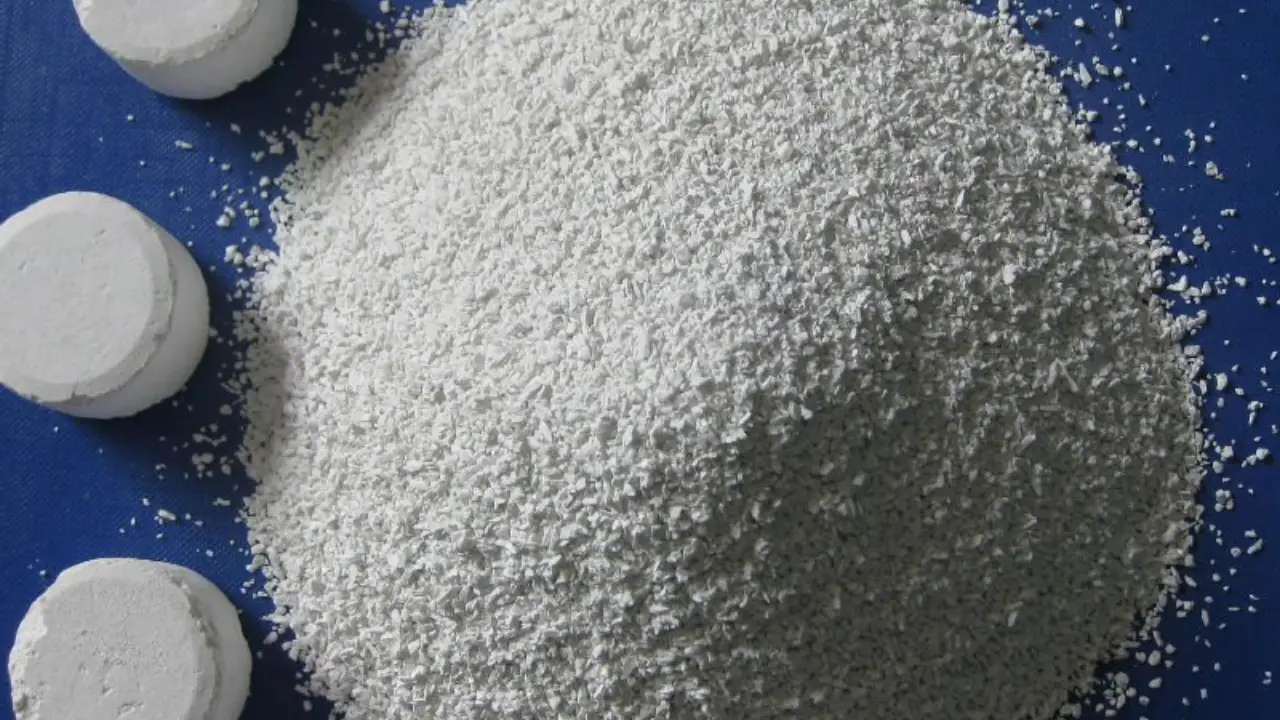
Calcium Hypochlorite Supplier and Exporter for Water Treatment and Industry
Content reviewed: 5 October 2026 · SUHA International Trading L.L.C., Dubai & Ankara
SUHA International Trading is a calcium hypochlorite supplier and exporter with offices in Dubai (UAE) and Ankara (Türkiye). We supply calcium hypochlorite with 65–70% available chlorine as granules, powder or tablets, packed in 25 kg, 45 kg or 50 kg drums, for municipal water treatment, swimming pools, industrial sanitation and bleaching. Minimum order is one full container load (1 × 20ft FCL), quoted FOB, CFR or CIF, with a certificate of analysis and SDS for every shipment.
Calcium hypochlorite (Ca(ClO)₂) is a premier disinfectant and bleaching agent, distinguished by its high available chlorine content (typically 65–70%), potent oxidizing capabilities and extended disinfection performance. Because it is a dry solid, it carries roughly five times more available chlorine per kilogram than liquid sodium hypochlorite and stores far longer – which is why water utilities, pool-chemical distributors and importers buy it by the container.
As a bulk calcium hypochlorite supplier, we handle grade selection, dangerous-goods documentation and booking with shipping lines, so you receive a compliant Class 5.1 cargo at your port – or, inside Türkiye, at your warehouse.
- FormulaCa(ClO)₂
- CAS No.7778-54-3
- HS code2828.10
- Available Cl65–70%
- UN / Class1748 / 2880 · 5.1
- MOQ1 × 20ft FCL
What Is Calcium Hypochlorite?
Calcium hypochlorite is an inorganic compound that presents as a white or grayish solid. When dissolved in water, it readily releases chlorine to form hypochlorous acid (HOCl), a powerful antimicrobial agent highly effective at neutralizing bacteria, viruses and algae. It offers an optimal balance of efficiency, safety and cost-effectiveness, making it one of the most trusted chlorine-based compounds in the world. In the trade it is also called cal hypo, chlorine granules, granular chlorine or pool shock.
Its disinfecting power depends on water pH: below about pH 7.5 most of the free chlorine is present as hypochlorous acid, the stronger disinfectant; at higher pH more of it becomes the weaker hypochlorite ion (OCl⁻). Because calcium hypochlorite is alkaline, pool and water-system operators check pH together with free-chlorine residual.
Calcium hypochlorite is not the same as bleaching powder (chlorinated lime). Bleaching powder has roughly 35% available chlorine; commercial calcium hypochlorite has 65–70%, so it needs about half the weight, storage space and freight for the same chlorine dose.
Key Properties of Calcium Hypochlorite
| Property | Value |
|---|---|
| Chemical Formula | Ca(ClO)₂ |
| Appearance | White or grayish granules, powder, or tablets |
| Chlorine Content | 65–70% (Standard Grade) |
| Solubility | 21 g/100 mL in water |
| pH (1% Solution) | 11–12 (mildly alkaline) |
| Odor | Characteristic chlorine scent |
| Oxidizing Ability | High, ensuring effective bleaching and disinfection |
Other reference data: molar mass 142.98 g/mol, density about 2.35 g/cm³, decomposition from about 175 °C. Solubility is quoted at 25 °C; commercial grades also contain a small insoluble fraction (see the technical data sheet below), so many operators dissolve granules in a separate tank and dose the clear solution.
How Calcium Hypochlorite Is Made: Manufacturer Routes
Calcium hypochlorite is synthesized through a controlled chemical reaction between chlorine gas and calcium hydroxide (slaked lime):
2Cl₂ + 2Ca(OH)₂ → Ca(ClO)₂ + CaCl₂ + 2H₂O
The crude product is filtered, dried, then granulated or pressed into tablets. Every calcium hypochlorite manufacturer uses one of two industrial routes, and the route largely decides the grade:
- Calcium process – chlorination of lime alone. Simpler, but it leaves more calcium chloride in the product, typically giving around 65% available chlorine.
- Sodium process – sodium hydroxide is used so that by-product chloride leaves as sodium chloride. It gives a purer product with up to about 70% available chlorine and better storage stability.
Buying from a manufacturer or from a calcium hypochlorite trading company? Producers usually sell a single plant's output under fixed terms; a trading company such as SUHA combines several approved sources, so we can match grade, form, packing and shipping date to your order and handle export documents from one desk.
Calcium Hypochlorite 65% and 70%: Grades, Granules and Tablets
As a calcium hypochlorite 65% supplier and calcium hypochlorite 70% supplier, we offer both strengths, so you can choose between lower cost per tonne and higher chlorine per kilogram.
High-Strength Grade (65-70%)
The most common and versatile grade, valued for its high concentration of available chlorine. It is ideal for large-scale applications such as municipal water treatment, commercial swimming pools and industrial sanitation, where maximum disinfecting power is required. Its high potency allows lower dosage rates, making it a cost-effective way to achieve reliable disinfection.
Medium-Strength Grade (40-60%)
This grade contains a lower concentration of active chlorine and is often blended with other stabilizers or agents. It is suited for less demanding applications, including residential pools, smaller-scale wastewater treatment and certain agricultural hygiene tasks.
Granules, powder and tablets
- Granular – the main export form. As a calcium hypochlorite granules supplier, we ship granules for shock chlorination, batch dosing and dissolving tanks.
- Powder – dissolves fastest; used in mixing tanks and bleaching.
- Tablets – slow-dissolving tablets for erosion feeders, pools and small water systems. As a calcium hypochlorite tablets supplier, we confirm tablet size and dissolution rate on the quotation.
Calcium hypochlorite compared with other chlorine sources
| Product | Form | Typical available chlorine | When buyers choose it |
|---|---|---|---|
| Calcium hypochlorite | Granules, powder, tablets | 65–70% | Concentrated, long shelf life, easy to ship and store; adds calcium hardness |
| Sodium hypochlorite | Liquid | About 10–15% | On-site pump dosing where liquid handling exists; loses strength faster in storage |
| TCCA (trichloroisocyanuric acid) | Tablets, granules | About 90% | Stabilised outdoor-pool chlorine; adds cyanuric acid, which builds up over time |
| Bleaching powder (chlorinated lime) | Powder | About 35% | Low-cost sanitation where strength and stability matter less |
Never mix calcium hypochlorite with TCCA or other chlorine products – see the safety section.
Technical Data Sheet: Calcium Hypochlorite 65–70%
These are the specification limits we supply against, including heavy-metal limits relevant to drinking-water use. The full analysis is also available as a PDF: Calcium Hypochlorite 65-70%.
| Physical & Chemical Properties | ISIRI Compliant Range | CCPC Product Range | Standard Reference |
|---|---|---|---|
| Active Chlorine_%W | Min 65 | Min 65 | ISIRI 7098 & 3352 |
| Sodium Chloride_%W | Max 20 | Max 10 | ISIRI 7098 |
| Solubility as Active Chlorine%W | Min 45.5 | Min 50 | ISIRI 7098 |
| Insoluble in Water_%W | Max 8 | Max 8 | ISIRI 7098 |
| Amount of Water_%W | 2 – 8 | 2 – 8 | ISIRI 7098 |
| Residue on 425 Micrometer Sieve_%W | Min 75 | Min 75 | ISIRI 7098 & 3352 |
| Residue on 2 mm Sieve_%W | Max 20 | Max 20 | ISIRI 7098 & 3352 |
| Cd_mg/Kg of Active Chlorine | Max 10 | Nil | ISIRI 7098 |
| Pb_mg/Kg of Active Chlorine | Max 15 | Nil | ISIRI 7098 |
| Ni_mg/Kg of Active Chlorine | Max 10 | Max 8 | ISIRI 7098 |
| Cr_mg/Kg of Active Chlorine | Max 15 | Max 12 | ISIRI 7098 |
| As_mg/Kg of Active Chlorine | Max 10 | Max 5 | ISIRI 7098 |
| Hg_mg/Kg of Active Chlorine | Max 7 | Max 5 | ISIRI 7098 |
| Sb_mg/Kg of Active Chlorine | Max 15 | Max 15 | ISIRI 7098 |
| Se_mg/Kg of Active Chlorine | Max 20 | Max 10 | ISIRI 7098 |
| Fe_%W | Max 0.5 | Max 0.15 | ISIRI 3352 |
| Appearance | White, Granulated | OK | ISIRI 7098 |
Each shipment is released with a certificate of analysis showing the actual lot results.
Calcium Hypochlorite 65-70% – product analysis (PDF)
Active chlorine · NaCl · solubility · water · sieve analysis · heavy metals · Fe
How Much Calcium Hypochlorite Do You Need?
For a quick estimate, every 1 mg/L (ppm) of chlorine in 1 m³ of water needs 1 g of available chlorine. Divide by the product strength to get the weight of calcium hypochlorite:
grams = volume (m³) × target dose (mg/L) ÷ available chlorine (as a fraction)
Theoretical dose only. Real demand is higher because organic matter, ammonia and sunlight consume chlorine – always confirm with a free-chlorine residual test and follow your local drinking-water or pool regulations.
Applications and Uses of Calcium Hypochlorite
1. Water Treatment and Purification
As a primary disinfectant for drinking water, municipal systems and swimming pools, calcium hypochlorite releases hypochlorous acid to eradicate bacteria and viruses. Its long shelf life makes it a standard choice for emergency and rural water chlorination. Water treatment is the largest end use, at almost half of global demand.
2. Industrial and Domestic Disinfection
Hospitals, food processing facilities and households rely on calcium hypochlorite to sanitize surfaces, equipment and wastewater.
3. Bleaching Agent
Its potent oxidizing properties make it a useful bleaching agent in the textile, paper and detergent manufacturing industries.
4. Agriculture
The agricultural sector uses calcium hypochlorite to disinfect irrigation systems, animal drinking water and farm equipment, promoting healthier environments for crops and livestock.
5. Food and Beverage Industry
It helps maintain hygienic processing environments by disinfecting food-contact surfaces, bottling lines and water systems used in beverage production.
6. Wastewater Treatment
Wastewater treatment plants use calcium hypochlorite to neutralize pathogens, oxidize organic matter and support overall sanitation efficiency.
Benefits of using calcium hypochlorite
- Powerful disinfection: effective against a broad spectrum of pathogens, including bacteria, viruses and fungi.
- Long shelf life: excellent stability when stored dry and cool.
- Cost-effective: a high concentration of available chlorine maximizes value per dose and per container.
- Versatile: suitable for a wide range of industries and environmental conditions.
- Reliable supply: available in several forms and packaging configurations for global distribution.
Bulk Packing and Container Loading
As a calcium hypochlorite bulk supplier, we offer 25 kg and 45 kg plastic drums, 50 kg HDPE drums or 1000 kg jumbo bags, customized to client specifications. All packaging is moisture-proof and labeled in compliance with international dangerous-goods transport regulations.
| Item | Details |
|---|---|
| Packing options | 25 kg and 45 kg plastic drums, 50 kg HDPE drums, 1000 kg jumbo bags |
| 20' FCL | Approximately 19.8–20 metric tons |
| 40' FCL | Approximately 24 metric tons |
| Labelling | Class 5.1 oxidizer, UN number, GHS hazard labels |
Shipping line rules for calcium hypochlorite
Calcium hypochlorite is a Class 5.1 oxidizer under the IMDG Code, and some shipping lines apply stricter acceptance rules than the code itself. Industry guidelines published by CINS and the International Group of P&I Clubs recommend plastic drums of no more than 45 kg, a reduced net weight per container and stowage shaded from heat. Depending on the carrier and route, the loadable weight per container can therefore be below the figures above – we confirm the accepted packing and weight with the line before we quote.
Estimate only. Final package and container counts are confirmed on the packing list for each contract.
Calcium Hypochlorite Supplier in Turkey
From our Ankara office we work as a calcium hypochlorite supplier in Turkey for both domestic buyers and export customers. Inside Türkiye we deliver to all 81 provinces; for export we load at Mersin, which makes us a practical calcium hypochlorite exporter in Turkey for buyers in Europe, the Middle East, Central Asia and Africa.
Domestic supply in Türkiye
- Delivery to all 81 provinces
- Drums for distributors, pool-chemical wholesalers and municipalities
- Customs tariff (GTİP): 2828.10
- Turkish-language SDS and labels on request
Calcium hypochlorite export from Turkey
- Loading at Mersin port
- FOB Mersin, CFR or CIF your port
- IMDG dangerous-goods booking and declaration
- Certificate of origin and lot certificate of analysis
Compliance in Türkiye
Chemicals placed on the Turkish market fall under KKDIK, Türkiye's chemical registration regulation; since 30 September 2026 every registrable substance needs a provisional or full registration number. Where calcium hypochlorite is sold as a disinfectant – for example for pools or drinking water – the final product also needs a biocidal product licence from the Ministry of Health. Ask us for the registration status of the lot offered before you contract.
Calcium Hypochlorite Wholesale for Distributors and Importers
With a dangerous-goods product, a good calcium hypochlorite supplier is judged on paperwork and shipping as much as on chlorine content. We work as a calcium hypochlorite trading company and bulk supplier, offering wholesale terms by the container:
Who we supply
- Water utilities and EPC contractors
- Calcium hypochlorite distributors and pool-chemical wholesalers
- Importers and re-exporters
- Textile, paper and detergent plants
- Food, beverage and livestock operations
Commercial terms
- MOQ: one full container load (1 × 20ft FCL)
- Incoterms: FOB, CFR or CIF
- Loading: Jebel Ali (UAE) or Mersin (Türkiye)
- Granular, powder or tablets
- Neutral or private-label drums on request
Shipping documents
- Commercial invoice and packing list
- Bill of lading
- Certificate of origin
- Certificate of analysis per lot
- Safety Data Sheet (SDS)
- IMDG dangerous goods declaration
Standards drinking-water buyers ask about
Tenders for drinking-water chlorination often reference EN 900 (calcium hypochlorite for water intended for human consumption), AWWA B300 (hypochlorites) or NSF/ANSI/CAN 60 certification. Tell us which your tender requires and we will confirm whether the offered lot meets it before contract.
What to include in your RFQ
- Grade and form: 65% or 70%, granular, powder or tablets
- Quantity in MT and number of containers
- Packing: 25 kg, 45 kg, 50 kg drums or jumbo bags
- Destination port (or Turkish city) and Incoterm
- Required standard or tender specification, if any
- Required shipment month
- Labelling language or private-label needs
- Preferred payment terms
Calcium Hypochlorite Price: What Drives It
There is no exchange-traded benchmark for calcium hypochlorite, so the price is set contract by contract. These are the factors behind every quotation:
- Available chlorine – 70% (sodium process) sells above 65% (calcium process).
- Form – tablets cost more than granules because of pressing and packing.
- Packing – drum size, private labelling and jumbo bags change cost per tonne.
- Chlorine, lime and energy costs – the main raw-material drivers at the producer.
- Freight – dangerous-goods surcharges and carrier weight limits for Class 5.1 cargo affect the delivered price per tonne.
- Season – northern-hemisphere pool season tightens supply in spring and summer.
- Trade measures – some importing countries apply anti-dumping or countervailing duties to certain origins, which changes the landed price.
Demand is rising: Grand View Research valued the global calcium hypochlorite market at about USD 746 million in 2025 and expects around 8.8% annual growth to 2033, with water treatment the largest application. For a firm calcium hypochlorite price, send your grade, quantity and destination – we reply with a dated quotation.
Handling, Storage, and Safety Guidelines
- Storage: Store in a cool, dry and well-ventilated area, out of direct sunlight, isolated from moisture, acids and flammable or organic materials. Keep drums tightly closed and upright.
- Handling: Always use appropriate personal protective equipment (PPE), including gloves, safety goggles and respiratory protection. Prevent direct contact with skin and eyes.
- Dissolving: Always add the product to water – never water to the product.
- Disposal: Dispose of in accordance with all local, state and federal environmental regulations.
Never mix calcium hypochlorite with:
- Acids – releases toxic chlorine gas
- Ammonia or ammonium compounds – forms toxic chloramines
- TCCA, dichlor or other chlorine products – can cause fire or explosion
- Oils, solvents, sugar, sawdust or other organic matter – fire risk
A Safety Data Sheet (SDS) is provided with every shipment to support regulatory compliance and safe handling.
Calcium Hypochlorite FAQ
What is calcium hypochlorite used for?
Calcium hypochlorite is mainly used to disinfect drinking water, swimming pools and wastewater. It is also used to sanitize surfaces and equipment in food, beverage and healthcare settings, to disinfect irrigation and livestock water, and as a bleaching agent in textile, paper and detergent manufacturing.
Is calcium hypochlorite the same as chlorine or bleach?
Calcium hypochlorite is a solid source of chlorine: in water it releases the same active disinfectant, hypochlorous acid, as household bleach. Household bleach is liquid sodium hypochlorite at a few percent strength, while calcium hypochlorite is a dry granule or tablet with 65–70% available chlorine.
Is calcium hypochlorite safe for drinking water?
Yes, when it is dosed correctly. Calcium hypochlorite is one of the most widely used chemicals for drinking-water disinfection. For potable use, check the heavy-metal limits on the technical data sheet and any standard your regulator or tender requires, such as EN 900, AWWA B300 or NSF/ANSI/CAN 60.
How much calcium hypochlorite do I need per 1,000 litres of water?
To raise 1,000 litres (1 m³) of water by 1 mg/L of chlorine you need about 1.4 g of 70% calcium hypochlorite or 1.5 g of 65%. For emergency household treatment, the US EPA suggests dissolving one heaping teaspoon of granular calcium hypochlorite in two gallons of water to make a stock solution, then adding one part of that solution to 100 parts of water.
Calcium hypochlorite or sodium hypochlorite – which is better?
Calcium hypochlorite is a solid with 65–70% available chlorine and a long shelf life, so it is cheaper to ship and store. Sodium hypochlorite is a liquid with about 10–15% available chlorine that is easy to pump but loses strength faster. Solid calcium hypochlorite suits remote sites, export and long storage; liquid suits plants with existing pump dosing.
What is the difference between 65% and 70% calcium hypochlorite?
The percentage is the available chlorine. 70% grades are usually made by the sodium process and contain less calcium chloride, so they are purer and more stable in storage. 65% grades are often made by the calcium process and cost slightly less per tonne.
Is calcium hypochlorite good for swimming pools?
Yes. Calcium hypochlorite is a common pool shock and daily chlorinator. It does not add cyanuric acid, unlike TCCA, but it does raise calcium hardness and pH, so pool operators monitor both.
Is calcium hypochlorite dangerous? Can it explode?
It is a strong oxidizer and corrosive. It can start fires or react violently if mixed with acids, ammonia, organic materials or other chlorine products such as TCCA, or if it is contaminated and heated. Stored cool, dry, sealed and separated from incompatible materials, and handled with gloves, goggles and respiratory protection, it is used safely worldwide.
How do you dissolve calcium hypochlorite?
Always add calcium hypochlorite to water, never water to the product. Stir in a clean plastic container, let the insoluble residue settle and dose the clear solution. Use a separate container that has never held acids or other chemicals.
What is the shelf life of calcium hypochlorite?
Stored sealed in a cool, dry place away from sunlight, calcium hypochlorite keeps its strength well and loses only a small amount of available chlorine per year. Heat, humidity and open drums speed up decomposition, so use stock first in, first out.
What is the price of calcium hypochlorite per ton?
Calcium hypochlorite price depends on available chlorine (65% or 70%), form (granules or tablets), packing, quantity, Incoterm and freight for Class 5.1 cargo. There is no public benchmark, so send your grade, quantity and destination for a dated quotation.
Should I buy from a calcium hypochlorite manufacturer or a supplier?
A manufacturer sells one plant's output on its own terms and minimums. A supplier or trading company sources from several approved producers, so it can offer both 65% and 70% grades, granules and tablets, mixed packing and flexible shipping dates, and handles export documents and dangerous-goods booking for you.
How do I choose a reliable calcium hypochlorite supplier?
A reliable calcium hypochlorite supplier publishes a technical data sheet, provides a certificate of analysis and SDS for every lot, packs in UN-approved moisture-proof drums, can book Class 5.1 dangerous-goods cargo with shipping lines and states MOQ, packing and container loading clearly.
Do you supply calcium hypochlorite in Turkey?
Yes. From our Ankara office we supply calcium hypochlorite to all 81 provinces of Türkiye, and as a calcium hypochlorite exporter we load at Mersin port, FOB, CFR or CIF.
What is the minimum order and how is calcium hypochlorite packed?
Our minimum order is one full container load (1 × 20ft FCL). We pack in 25 kg and 45 kg plastic drums, 50 kg HDPE drums or 1000 kg jumbo bags; a 20ft container carries approximately 19.8–20 metric tons and a 40ft approximately 24 metric tons, subject to the shipping line's rules for Class 5.1 cargo.
What is the HS code and UN number for calcium hypochlorite?
Calcium hypochlorite is classified under HS code 2828.10. For transport it is UN 1748 (dry) or UN 2880 (hydrated), Class 5.1 oxidizer. Its CAS number is 7778-54-3.
Is calcium hypochlorite the same as bleaching powder?
No. Bleaching powder (chlorinated lime) has roughly 35% available chlorine, while commercial calcium hypochlorite has 65–70%. Calcium hypochlorite therefore needs about half the weight for the same chlorine dose and stores better.
Request a Calcium Hypochlorite Quotation
Tell us the grade, form, quantity, packing and destination. As your calcium hypochlorite supplier, we will reply with a dated quotation, the technical data sheet and the SDS.
Email: info@causticsodaco.com