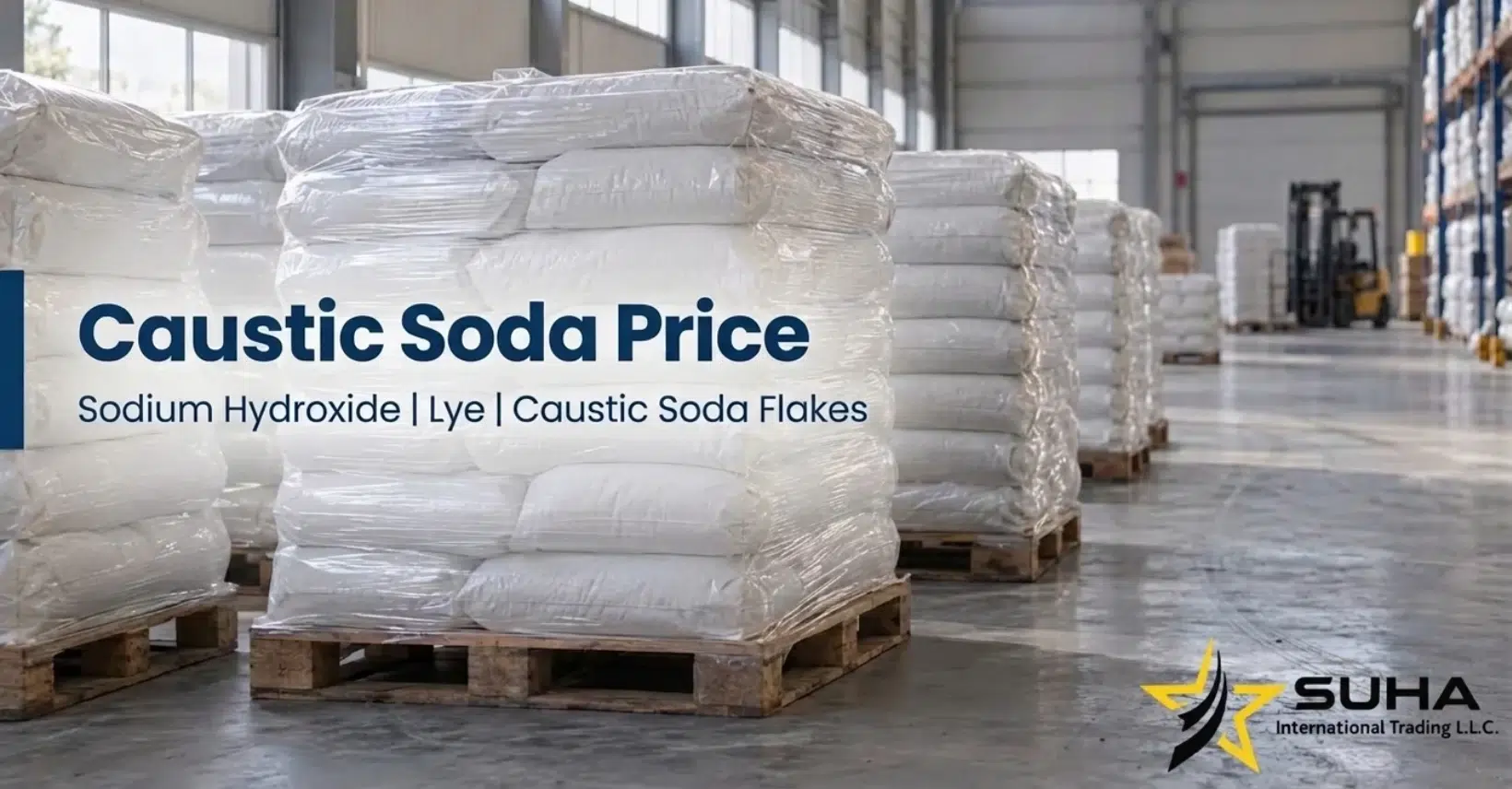
Caustic soda price per ton: FOB Jebel Ali & Mersin
Caustic soda (sodium hydroxide, NaOH) is quoted at $785–805/MT for flakes 98% (FOB Mersin $785, FOB Jebel Ali $805), $570–640/MT for pearls 99% and $270–340/MT for liquid NaOH 30–50% FOB Jebel Ali. These are SUHA International Trading's export levels, last moved on 5 October 2026. For the landed cost at your own port, see the caustic soda price by country page.
How much does caustic soda cost per ton today?
Caustic soda is traded per metric ton (MT), not per kilo. As of , indicative export prices are:
- Flakes, NaOH 98%: $785/MT FOB Mersin and $805/MT FOB Jebel Ali — about $0.79–0.81 per kg.
- Pearls, NaOH 99%: $570–640/MT FOB — about $0.57–0.64 per kg.
- Liquid, NaOH 30–50%: $270–340/MT of solution FOB Jebel Ali — about $0.27–0.34 per kg.
- Landed CIF: $785–1,090/MT for flakes across 165 import markets — see the caustic soda price by country page.
Assessed by the SUHA International Trading export desk from current offers for 1–3 container lots. Flakes rose $5/MT and pearls $10/MT on 5 October 2026; liquid is unchanged. Dubai, UAE & Ankara, Türkiye.
At a glance · USD per MT
FOB, including IMDG Class 8 port handling and export documents. CIF levels are on the price by country page.
Caustic soda price table — October 2026
Indicative FOB prices as reviewed on , including dangerous-goods port surcharges and the standard export document set.
| Product | Spec | Packing | Loading port | FOB price | vs September | Minimum order |
|---|---|---|---|---|---|---|
| Flakes | NaOH 98% min | 25 kg PP / 1 MT jumbo | Mersin (TR) Jebel Ali (UAE) | 785–805 USD/MTMersin 785 · Jebel Ali 805 | +0.6% | 1 FCL |
| Pearls | NaOH 99% min | 25 kg PP / 1 MT jumbo | Mersin (TR) Jebel Ali (UAE) | 570–640 USD/MT | +1.7% | 1 FCL |
| Liquid | NaOH 30–50% solution | ISO tank | Jebel Ali (UAE) | 270–340 USD/MT | 0.0% | 1 ISO tank |
← Swipe the table sideways to see every column.
Estimate your order value
FOB value only — ocean freight, insurance, duty and VAT are excluded. Buyers taking 3+ containers generally price at the lower end of each range.
Why these FOB levels differ from published spot indices
Published indices such as ICIS, ChemAnalyst or IMARC mostly track bulk contract cargoes and domestic assessments, which sit structurally below containerised business. Prices on this page are for containerised 1–3 FCL lots, and the FOB number already carries dangerous-goods port handling (UN 1823 / UN 1824, IMDG Class 8), 25 kg PP bagging, SGS/BV inspection readiness and the full export document set. That is a difference of trade format, not of product quality.
If you also buy soda ash or sodium hypochlorite, combining grades into one shipment usually improves the per-MT number.
Caustic soda price trend — August to October 2026
Our own FOB levels at each monthly review. Flakes and pearls firmed in October; liquid has held flat for three months.
Flakes 98% FOB ▲ +$5
Pearls 99% FOB ▲ +$10
Liquid 30–50% FOB → $0
USD per metric ton, FOB. Bars show each month's low–high band on a fixed scale per product (flakes $700–850, pearls $500–700, liquid $200–400), so a shift to the right is a price rise.
Why published caustic soda price indices disagree with each other
Before you benchmark a quotation against an index, check that the two describe the same thing. For the same quarter and the same country, two major providers can be several hundred dollars apart — because they measure different purity bases, trade formats and delivery terms.
| Country | ChemAnalyst Q2 2026 | IMARC Q2 2026 | Gap |
|---|---|---|---|
| United States | 589 USD/MT | 358 USD/MT | 1.6× |
| Japan | 451 USD/MT | 427 USD/MT | 1.1× |
| Brazil | 570 USD/MT | 643 USD/MT | 1.1× |
| Germany | 804 USD/MT | not published | — |
| Saudi Arabia | 631 USD/MT | not published | — |
The three questions to ask about any caustic soda number. First, what basis? A 50% liquid quoted per ton of solution is roughly half the price of the same NaOH quoted on a 100% dry basis. Second, what trade format? Bulk contract parcels of thousands of tons price well below containerised lots with bagging and dangerous-goods handling. Third, what Incoterm? An ex-works or domestic assessment carries no freight, no DG surcharge and no export documentation.
Until those three match, comparing two numbers tells you nothing. The figures on this page are stated unambiguously: USD per metric ton, FOB Jebel Ali or Mersin, containerised, one full container minimum, DG handling and export documents included.
Index figures above are the Q2 2026 quarterly assessments as published by each provider and are reproduced for methodological comparison only. They are not SUHA International Trading assessments and we do not resell index data — see the references at the foot of this page.
Detailed price by grade and form
Three commercial forms of the same compound. Purity, packing and freight economics decide which one is cheapest for your plant.
Caustic soda flakes price
The workhorse grade for soap and detergent production, textile mercerising and water treatment. No water weight, so it is normally the cheapest form to freight long distance.
- Spec
- NaOH 98% min
- FOB Mersin
- $785/MT
- FOB Jebel Ali
- $805/MT
- Packing
- 25 kg PP · 1 MT jumbo
- Minimum order
- 1 FCL (20ft or 40ft)
- Per 25 kg bag
- $19.63–20.13
- HS code
- 2815.11
Caustic soda pearls price
Higher purity, uniform particle size and far less dust on handling — the usual choice for food-grade processing, pharmaceutical work and automated dosing systems.
- Spec
- NaOH 99% min
- FOB
- $570–640/MT
- Loading
- Jebel Ali · Mersin
- Packing
- 25 kg PP · 1 MT jumbo
- Minimum order
- 1 FCL (20ft or 40ft)
- Per 25 kg bag
- $14.25–16.00
- HS code
- 2815.11
Liquid caustic soda price
Cheapest per ton of solution, but half of a 50% shipment is water. Best where you are near the port and already run dosing tanks — municipal water treatment, mineral processing and continuous plants.
- Spec
- NaOH 30–50% solution
- FOB Jebel Ali
- $270–340/MT
- Packing
- ISO tank only
- Minimum order
- 1 ISO tank
- Per kg of solution
- $0.27–0.34
- Contained NaOH basis
- ≈ $610/MT at 50%
- HS code
- 2815.12
Flakes or liquid — which is actually cheaper? Compare on contained NaOH, not on product weight. A 50% solution at $305/MT of solution is about $610 per MT of contained NaOH; flakes at the $795/MT mid-point with 98% purity work out to about $811 per MT of contained NaOH. So liquid looks cheaper at the loading port — but you then pay ocean freight, terminal handling, duty and inland haulage on the water as well, which is what flips the landed comparison. Well inland from the discharge port, flakes almost always win. Liquid wins near the port and on handling: no bag opening, no dust, no dissolving step, and no exotherm risk of the kind described in our guide to storing caustic soda safely. See also our flakes vs liquid comparison.
What the same cargo costs landed at your port
Add ocean freight on your lane to the FOB price and you get the CIF landed cost. Three worked examples for flakes 98%: the low end is FOB Mersin $785 plus low freight, the high end FOB Jebel Ali $805 plus high freight, for one 20ft FCL. Destination terminal handling, duty, VAT and inland delivery are excluded.
| Destination port | Country | Best origin | Est. freight | Indicative CIF | Transit |
|---|---|---|---|---|---|
| Mombasa | Kenya | Jebel Ali (UAE) | $70–90/MT | 855–895 USD/MT | 7–10 days |
| Lagos (Apapa) | Nigeria | Mersin (TR) | $130–170/MT | 915–975 USD/MT | 10–14 days |
| Alexandria | Egypt | Mersin (TR) | $40–60/MT | 825–865 USD/MT | 3–5 days |
Your port is probably one of the other 162
The full landed-cost table covers 165 import markets with the freight band, transit time, loading origin and destination conformity requirement for every lane, plus a calculator that adds your own duty and VAT. Read the caustic soda price by country guide.
Freight is an estimate and moves with carrier space, bunker levels and dangerous-goods acceptance. For a firm CIF number to your port, message the logistics desk on WhatsApp or use the enquiry form.
What is driving caustic soda prices in H2 2026?
Caustic soda and chlorine are co-produced in a fixed ratio — roughly 1.1 tonnes of NaOH per tonne of chlorine — so supply is set largely by chlorine and PVC economics, while demand comes from alumina, pulp and paper, textiles, soaps and water treatment. That mismatch is why the market behaves the way it does.
Downward pressure
- China holds an estimated 35–40% of world chlor-alkali capacity, and annual additions of around 5% have outpaced its own demand growth
- Softer alumina refining demand, including permanent refinery closures in Australia
- Pulp and paper mill closures and curtailments in North America through 2025–2026
- Competitive Asian import offers keeping European domestic levels under pressure
Upward pressure
- Electricity is 40–60% of chlor-alkali production cost, so power tariffs feed straight through
- Permanent European closures during 2025 — Fortischem, Spolana, Vencorex and Arkema Jarrie — with Dow signalling an exit from Schkopau by 2027
- The March 2026 Strait of Hormuz disruption, which lifted North American prices about 3.7% and triggered dozens of force majeure declarations across Asia and the Middle East
- Dangerous-goods handling adds roughly 15–30% over ordinary freight and is not easing
What to watch through Q4 2026
- Whether weak PVC margins force real chlor-alkali rate cuts rather than paper ones
- Alumina restarts or further closures — the single biggest demand swing factor
- Container availability for IMDG Class 8 on Gulf–West Africa lanes
- Regional power tariffs going into the northern winter
Q2 2026 set the tone for the second half. Published assessments for the quarter showed increases almost everywhere: the United States up about 7% quarter on quarter, Japan up roughly 11% on LNG-linked power costs, Saudi Arabia up about 13% on export pull, Brazil up around 15% on freight, and Germany up more than 50% as maintenance-driven tightness collided with the 2025 capacity closures. Q3 is normally the seasonally strongest quarter, when agricultural demand, restarting pulp procurement and peak textile production together typically add 3–8% to Asian FOB flake levels between late June and August.
That is the backdrop for October: our flakes and pearls levels moved up modestly on 5 October 2026, while Asian availability keeps a lid on further gains as the seasonal Q3 support fades.
Why buy from Jebel Ali or Mersin rather than direct from China? Chinese FOB numbers can look considerably cheaper on paper, but the delivered comparison changes once you add 30–45 day transit against 3–16 days from the Gulf or Türkiye, more working capital tied up in transit, letter-of-credit and re-routing risk, and destination restrictions on some Chinese-origin chemical shipments. For buyers running 1–3 containers at a time, these origins trade an FOB premium for short lead times, DG-compliant packing and documentation that clears without argument. More about how we work →
How these caustic soda prices are assessed
Transparency matters when a number goes straight into your costing sheet. Here is exactly what these figures represent.
Source of the numbers
Ranges are built from SUHA International Trading's own confirmed offers and concluded export business out of Jebel Ali and Mersin during the current month, then cross-checked against published regional indices.
What is included
FOB at the named loading port, DG port handling for IMDG Class 8, export packing as stated, and the standard document set: invoice, packing list, B/L, COA, safety data sheet and certificate of origin.
What is not included
Ocean freight and marine insurance (unless CIF), destination terminal handling, import duty, VAT, inland delivery, demurrage, and any third-party inspection you order. Lane-by-lane freight sits on the price by country page.
Update cycle
Reviewed at the start of each month and whenever the market moves more than about 3%. Last price change: 5 October 2026; last review: 17 October 2026; next scheduled review: early November 2026. Issued quotes are firm for 7 days, subject to stock. Checks on arrival are covered in how to check caustic soda quality.
Caustic soda price forecast for the rest of 2026
Projected FOB bands for Q4 2026. Asian oversupply and soft alumina and pulp demand cap the upside; power costs, the permanent European closures of 2025 and firm DG freight limit the downside. Treat these as planning ranges, not guarantees.
Procurement note: with the market range-bound rather than trending, buyers taking regular volume usually do better covering 50–60% on a quarterly contract and leaving the balance to spot, instead of trying to time a bottom. The CIF band above spans every destination in the price by country table, from the UAE at the bottom to deep-inland markets at the top.
Caustic soda prices, products and applications
Landed cost by destination, grade specifications and industry guides for everything we load from Jebel Ali and Mersin.
Prices
Products & grades
Uses & industry guides
Regional supply
Caustic soda price FAQ
The questions buyers ask most about NaOH pricing, packing, classification and shipping.
References
- ChemAnalyst — Caustic Soda Prices, Trends, Chart and Forecast (Q2 2026 regional assessments)
- IMARC Group — Caustic Soda Price Trend, Chart and Forecast (Q2 2026 regional assessments)
- Tradeasia — Caustic Soda Flakes Price Index 2026 and supply risk (European closures, Q3 seasonality)
- World Customs Organization Harmonized System — headings 2815.11 and 2815.12
- IMO International Maritime Dangerous Goods Code — UN 1823 and UN 1824, Class 8
Third-party index figures are cited for methodological comparison only and remain the property of their publishers. Prices quoted by SUHA International Trading on this page are our own export offers, last changed 5 October 2026 and reviewed 17 October 2026.