
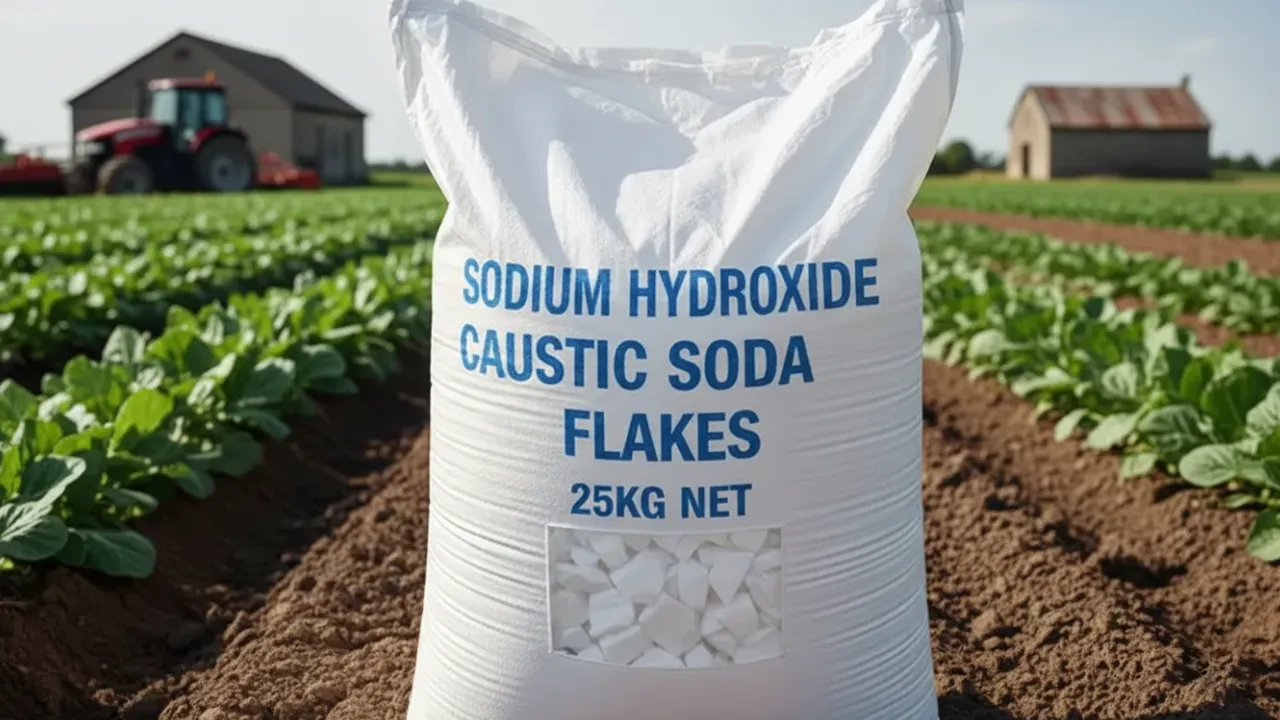
Caustic Soda in Agriculture — Professional Soil, Crop & Equipment Management
Sodium hydroxide (NaOH) is a powerful alkaline compound used for precise soil pH correction, fertilizer production, crop protection, and equipment sanitization. This professional guide covers agronomic principles, application rates, safety protocols, and best practices for 2025.
In short — caustic soda (NaOH, CAS 1310-73-2) is used in agriculture for soil pH correction, fertilizer production, pest and pathogen control, equipment cleaning, post-harvest processing, and crop residue management. It is supplied as flakes or pellets, both with high purity (98–99%). For precise application rates, always base decisions on a laboratory soil test and agronomist guidance. For current market levels, see our caustic soda price page.
Understanding Soil pH, CEC & Buffer Capacity
Soil acidity is a function of hydrogen ion activity in the soil solution. The pH scale is logarithmic, meaning soil at pH 5.0 is ten times more acidic than pH 6.0. But the amount of NaOH required to raise pH depends not only on the target pH but on the soil's cation exchange capacity (CEC) and buffer capacity. Sandy soils with low CEC require far less NaOH than clay soils with high CEC.
Cation exchange capacity represents the soil's ability to hold positively charged nutrients (Ca²⁺, Mg²⁺, K⁺, Na⁺) and hydrogen. Acidic soils have a high proportion of exchangeable H⁺ and Al³⁺. Sodium hydroxide neutralizes H⁺ and displaces exchangeable aluminum, but because sodium is monovalent, excessive use can raise the exchangeable sodium percentage (ESP) and degrade soil structure. This is why agronomic calculations must account for both pH correction and sodium risk.
Base saturation — the percentage of CEC occupied by calcium, magnesium, and potassium — is a better indicator than pH alone. Most crops perform well when base saturation is 70–90%. If pH is adequate but base saturation is low, gypsum (calcium sulfate) may be a better amendment than NaOH, because it supplies calcium without sodium.
Professional guidance: always request a soil test that includes pH (1:1 water and 1:1 CaCl₂), buffer pH, CEC, base saturation, and exchangeable sodium percentage. Use the results to determine whether NaOH, lime, or gypsum is the correct amendment. Do not rely on pH alone.
Chemical Properties Every Agronomist Should Know
Caustic soda is an inorganic strong base with the formula NaOH, produced by electrolysis of sodium chloride brine. Its high alkalinity makes it effective for acid neutralization, but its deliquescent nature demands sealed storage.
| Property | Value |
|---|---|
| Chemical name | Sodium hydroxide |
| Formula | NaOH |
| CAS number | 1310-73-2 |
| Molar mass | 39.997 g/mol |
| Melting point | 318–325 °C |
| Density (solid) | 2.13 g/cm³ |
| Heat of dissolution | −44.5 kJ/mol (exothermic) |
| UN number | UN 1823 (solid) / UN 1824 (solution) |
| IMDG class | Class 8 corrosive |
| OSHA PEL (airborne mist) | 2 mg/m³ |
| NIOSH IDLH | 10 mg/m³ |
Important: When dissolving caustic soda, always add it slowly to cold water while stirring — never the reverse. The reaction releases significant heat and can cause violent splattering if done incorrectly.
Flakes vs Pellets — Which Form Fits Your Operation?
Both forms deliver the same chemical action but differ in handling, dust generation, and precision. The choice affects dosing accuracy, worker exposure, and compatibility with automated equipment.
| Feature | Caustic Soda Flakes | Caustic Soda Pellets / Prills |
|---|---|---|
| Physical form | Thin, irregular solid flakes | Uniform, spherical beads |
| Dissolution rate | Very fast | Fast, controlled release |
| Dust generation | Low to moderate | Low (smooth, free-flowing) |
| Best for | Bulk soil treatment, manual mixing, batch tanks | Automated fertilizer blending, precision dosing, screw feeders |
| Packaging | 25–50 kg moisture-proof bags | 25 kg bags, bulk bags, or drums |
| Handling ease | Good for small operations | Excellent for automated systems |
| Price premium | Lower | Higher (purity and uniformity) |
Recommendation: For traditional farms and manual soil treatment, flakes are the economical choice. For precision agriculture, fertigation systems, or automated blending, pellets provide better consistency and lower dust exposure.
6 High-Impact Ways NaOH Is Used on Farms
From soil prep to post-harvest, sodium hydroxide touches nearly every stage of crop production. Here's how modern farms deploy it.
1. Precision Soil pH Correction
Acidic soils hinder nutrient uptake. Caustic soda raises pH quickly and precisely, improving root development and yield. Pair with soil sensors for optimal dosing.
98% flakes · 10–20% solution2. Fertilizer Formulation
Used to produce sodium-based fertilizers and adjust liquid fertilizer pH. It enhances nutrient solubility and release efficiency in the root zone.
99% pellets · custom formulations3. Pest & Pathogen Control
Diluted solutions sanitize soils, storage bins, and irrigation lines, reducing fungal and bacterial contamination without harsh synthetic pesticides.
98% flakes · 1–4% solution4. Equipment Cleaning & Sanitization
Removes fats, proteins, and organic residues from tanks, pipes, and machinery. Essential for dairy, post-harvest, and food processing hygiene.
98% flakes · 10–20% CIP5. Post-Harvest Processing
From peeling tomatoes to clarifying sugarcane juice, caustic soda speeds up processing while maintaining product quality and shelf life.
99% pellets · food-qualified6. Crop Residue Breakdown
Accelerates decomposition of crop residues, enhancing compost quality and returning organic matter to the soil. Supports regenerative agriculture.
98% flakes · controlled dosingFood-grade caution: For any application that may contact food, use only production qualified for that purpose. A 99% industrial assay does not automatically mean food grade. Confirm requirements with your supplier and regulatory body.
Planning NaOH Rates: From Soil Test to Dosage
Precise NaOH application rates require a laboratory soil test that includes buffer pH, CEC, and current exchangeable sodium. The table below provides illustrative starting points for raising pH from 5.0 to 6.5 in different soil textures. Actual rates must be confirmed by a qualified agronomist using your specific soil analysis.
| Soil Texture | Typical CEC (meq/100g) | Approx. NaOH (kg/ha) | Approx. NaOH (kg/acre) |
|---|---|---|---|
| Sand | 3–5 | 200–400 | 80–160 |
| Sandy loam | 6–10 | 400–800 | 160–320 |
| Loam | 10–18 | 800–1,400 | 320–560 |
| Clay loam | 18–25 | 1,400–2,200 | 560–880 |
For a more accurate calculation, use the formula:
NaOH (kg/ha) = [(target pH - current pH) × buffer coefficient × bulk density (g/cm³) × depth (cm) × 10]
The buffer coefficient is derived from the soil test and reflects the soil's resistance to pH change.
Always apply in split applications and retest after 2–4 weeks to avoid overshooting.
Sodium risk: Caustic soda adds sodium, not calcium. In soils with already elevated exchangeable sodium (> 6% ESP) or poor structure, NaOH may worsen dispersion and crusting. For such soils, consider lime or gypsum instead. Monitor SAR (sodium adsorption ratio) of irrigation water and soil ESP regularly.
Sodium Hydroxide vs Agricultural Lime: Which Is Right?
NaOH provides rapid pH correction but adds sodium, whereas lime (CaCO₃) is slower but supplies calcium. The choice depends on soil test results, crop sensitivity, and application timing.
| Criteria | Caustic Soda (NaOH) | Agricultural Lime (CaCO₃) |
|---|---|---|
| Speed of pH change | Days | Months to seasons |
| Neutralizing power (per kg) | ~1.25 kg CaCO₃ equivalent | Varies with purity (50–90% ECCE) |
| Cation added | Sodium (Na⁺) | Calcium (Ca²⁺) |
| Effect on soil structure | Can disperse if ESP rises | Improves aggregation via Ca²⁺ |
| Best for | Quick pH correction before planting, fertigation | Long-term pH management, calcium-deficient soils |
| Handling safety | Highly corrosive | Low to moderate dust hazard |
Professional note: Many agronomists use NaOH only as a short-term rescue treatment when planting cannot wait for lime. For sustainable soil health, combine rapid correction with a longer-term calcium-based strategy such as lime or gypsum.
Using NaOH in Fertigation and Material Compatibility
NaOH is highly soluble and can be injected into irrigation water for precise pH control, but strict material compatibility and safety rules apply.
| Material | Compatibility | Notes |
|---|---|---|
| High-density polyethylene (HDPE) | Excellent | Preferred for tanks and containers |
| Polypropylene (PP) | Excellent | Suitable for fittings and pumps |
| PVDF (Kynar) | Excellent | Use for high-purity or high-temp lines |
| Stainless steel 316 | Good | Suitable for concentrated solutions, no chloride pitting |
| EPDM / Viton seals | Good | Check temperature limits |
| Aluminum, galvanized steel | Not compatible | Rapid corrosion; never use |
| PVC (high temperature) | Not recommended | May soften above 50°C; use CPVC only with caution |
Fertigation guidance: Inject NaOH as a 10–20% solution into the irrigation line after all filters. Never mix with acid fertilizers, chlorine, or ammonium-based solutions in the same injection point. Check irrigation water SAR and soil ESP before use. Always use a backflow preventer and pH monitoring.
Handling & Storage on the Farm
Sodium hydroxide is a corrosive substance. Follow these updated safety guidelines to protect your team, livestock, and equipment.
Personal Protection
Always wear chemical-resistant gloves, goggles, face shield, long-sleeved clothing, and rubber boots. Keep an eyewash station within 10 metres of handling areas.
Storage
Store in a cool, dry, ventilated area away from acids and moisture. Use sealed corrosion-resistant containers. Keep away from children and untrained personnel.
First Aid
Skin or eye contact: flush with copious water for at least 15 minutes and seek medical attention. Never attempt to neutralize with acid.
Spill Response
Contain dry material and collect mechanically. Neutralize residues with a dilute weak acid to pH 6–8 before washing down, per SDS and local regulations.
Mixing rule: Always add caustic soda slowly to cold water with continuous stirring — never water to caustic soda. Dissolution is strongly exothermic and can boil and eject solution if reversed.
Storage Checklist
- Sealed original packaging, off the floor on pallets, away from walls
- Cool, dry, ventilated area below 30°C and 60% relative humidity
- Segregate from acids, organic materials, and flammable substances
- Label clearly with hazard symbols and UN 1823
- Keep an up-to-date Safety Data Sheet (SDS) accessible to all handlers
- Use HDPE or stainless steel containers only; never aluminum or galvanized
FAQ — Caustic Soda in Agriculture
What is caustic soda used for in agriculture?
Caustic soda (sodium hydroxide, NaOH) is used for soil pH correction, fertilizer production, pest and pathogen control, equipment cleaning and sanitization, post-harvest crop processing, and crop residue management. Its strong alkalinity helps neutralize acidic soils and improves nutrient availability.
How does caustic soda adjust soil pH?
Caustic soda raises soil pH by neutralizing acidity. When applied in controlled amounts to acidic soils, it improves nutrient absorption, root development, and crop productivity. Soil testing and agronomist guidance are essential to avoid over-application and sodium buildup.
What is the difference between caustic soda flakes and pellets?
Flakes are thin, irregular pieces that dissolve quickly and are suitable for manual handling and bulk soil treatment. Pellets (prills) are uniform, free-flowing beads ideal for mechanized fertilizer blending and controlled pH adjustment. Both deliver the same chemical action.
Is caustic soda safe for agricultural use?
Yes, when proper safety protocols are followed. Always wear appropriate PPE, avoid skin and eye contact, never mix with acids, and follow the safety data sheet (SDS). Training and emergency equipment are mandatory.
How should caustic soda be stored on a farm?
Store in a cool, dry, well-ventilated area away from acids and moisture. Use corrosion-resistant containers (HDPE or stainless steel), keep them tightly sealed, and restrict access to trained personnel only. Label clearly with hazard information.
What is the UN number for caustic soda?
The UN number for solid sodium hydroxide (caustic soda) is UN 1823, classified as Class 8 corrosive for transportation. For solutions, use UN 1824.
Request a Quotation, COA, TDS or SDS
Send your requirements and receive a firm, dated offer with packaging, loading configuration, and documentation costed in. We respond within 24 business hours.