
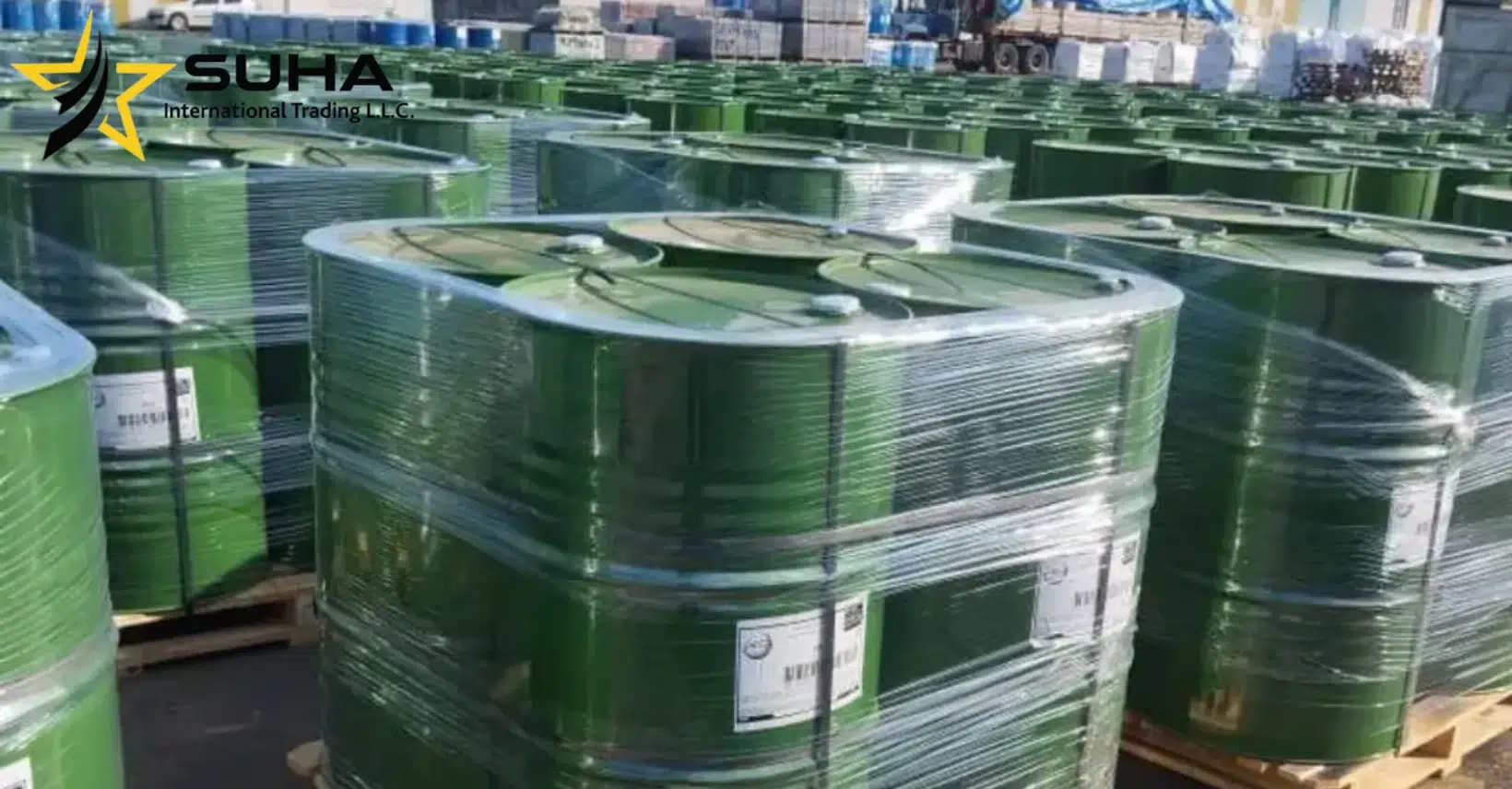
TEG · CAS 112-27-6 · Bulk export from Türkiye & UAE
Triethylene Glycol Supplier from Türkiye and the UAE: Bulk TEG with Lot COA
SUHA International is a triethylene glycol supplier exporting TEG (CAS 112-27-6) at 99.5% minimum purity from our offices in Dubai and Ankara. We supply gas processing plants, HVAC and dehumidification system makers, resin and plasticiser producers, ink and textile chemical blenders, and chemical distributors in ISO tanks, flexitanks, IBCs or steel drums, new or used. Every lot ships with its own certificate of analysis, loaded FOB Mersin or Jebel Ali or delivered by truck from Türkiye.
Short answer
Looking for a triethylene glycol supplier? We export industrial and dehydration-grade TEG at ≥ 99.5% purity (99.8% typical), clear and colourless, with a lot-level COA, TDS and MSDS. MOQ is 20 MT in bulk, or one 20ft container of drums. Packaging options are 22–24 MT ISO tanks, 20–24 MT flexitanks, 1,000–1,100 kg IBCs, and steel drums, either new or clean used drums at a lower cost. FOB, CFR, CIF and DAP terms are available, and a quote is returned within one business day.
Product overview
What Is Triethylene Glycol (TEG)?
Triethylene glycol (TEG), also called triglycol or 2,2′-(ethylenedioxy)diethanol, is a clear, colourless, nearly odourless and slightly viscous liquid with the formula C₆H₁₄O₄. It is hygroscopic, miscible with water, has a high boiling point of 285 °C and a very low vapour pressure. Those properties make it a stable liquid desiccant, humectant and high-boiling solvent.
TEG is made as a co-product of ethylene glycol production. Ethylene is oxidised to ethylene oxide, which is then hydrated to a mix of monoethylene glycol (MEG), diethylene glycol (DEG), triethylene glycol and heavier glycols. These are then separated by vacuum distillation. Because TEG is a smaller cut of every glycol plant's output, a reliable triethylene glycol supplier with steady access to producers matters more than it does for MEG.
Technical data
Triethylene Glycol Specifications and Properties
As a triethylene glycol supplier to gas processors and chemical makers, we publish the identification and typical property data for the TEG we export. The lot COA confirms the actual values for your shipment.
| Item | Detail |
|---|---|
| Chemical name | Triethylene glycol; 2,2′-(ethylenedioxy)diethanol |
| Synonyms | TEG, triglycol, 3,6-dioxaoctane-1,8-diol |
| CAS / EC (EINECS) | 112-27-6 · 203-953-2 |
| Formula / molecular weight | C₆H₁₄O₄ · 150.17 g/mol |
| HS code | 2909.49 |
| Transport classification | Not dangerous goods (no UN number) |
| Property | Value | Why it matters |
|---|---|---|
| Purity | ≥ 99.5% (99.8% typical) | Fewer lighter glycols means lower losses and higher regenerated purity |
| Appearance | Clear, colourless liquid | Colour or haze signals oxidation or contamination |
| Specific gravity @ 20 °C | 1.124–1.126 | Quick identity and dilution check on arrival |
| Boiling point | 285 °C | Low evaporation losses in hot service |
| Freezing point | −7 °C | Stays liquid in most climates; heat lines in cold sites |
| Flash point (closed cup) | 177 °C | High flash point for safer handling |
| Viscosity @ 20 °C | ≈ 49 cP | Pump and heat-exchanger sizing |
| Water, colour (APHA), acidity | Per lot COA | The three values dehydration buyers check first |
Swipe the tables sideways to see every column.
Need the full technical data sheet with test methods for tender pre-qualification?
Download TEG TDSApplications
Triethylene Glycol Uses: Where Our TEG Goes
Most of the TEG we ship goes into natural gas dehydration. The rest is spread across humidity control, plasticisers, resins and solvents. These are the main triethylene glycol uses among our buyers:
Natural Gas Dehydration
TEG is the standard liquid desiccant for drying natural gas to pipeline specification. It is regenerated at 200–204 °C and recirculated. TEG gas dehydration guide
HVAC and Liquid-Desiccant Dehumidification
TEG solutions absorb moisture from air in liquid-desiccant air-handling and industrial drying systems.
Plasticisers and Safety-Glass Interlayers
TEG esters are used as plasticisers for vinyl polymers, including the interlayer films used in laminated safety glass.
Unsaturated Polyester and Polyurethane Resins
As a glycol building block, TEG adds flexibility to unsaturated polyester resins, polyols and specialty adhesives.
Solvent and Humectant in Inks and Textiles
TEG slows drying and keeps dyes and inks in solution in printing inks and textile dyeing. TEG for textiles
Heat-Transfer, Hydraulic and Fog Fluids
TEG is used as a high-boiling component in heat-transfer and hydraulic fluid formulations, and as a base for stage fog fluids and air-sanitiser products.
Glycol comparison
TEG vs MEG vs DEG: Which Ethylene Glycol Fits Your Process?
Buyers comparing triethylene glycol suppliers often also need MEG or DEG. The three glycols share a chemistry but behave differently in service. Hygroscopicity falls as the molecule gets longer (MEG > DEG > TEG). TEG still wins in dehydration because it has the lowest vapour losses and survives the highest regeneration temperature.
| Property | TEG | MEG | DEG |
|---|---|---|---|
| CAS number | 112-27-6 | 107-21-1 | 111-46-6 |
| Molecular weight | 150.17 | 62.07 | 106.12 |
| Boiling point | 285 °C | 197 °C | 245 °C |
| Freezing point | −7 °C | −13 °C | −10.5 °C |
| Approx. thermal decomposition | ~206 °C | ~165 °C | ~164 °C |
| Volatility | Lowest | Highest | Medium |
| HS code | 2909.49 | 2905.31 | 2909.41 |
| Main uses | Gas dehydration, dehumidification, plasticisers | PET and polyester fibre, antifreeze, hydrate inhibition | Unsaturated polyester resin, polyurethane, solvents |
Swipe the table sideways to compare all three glycols.
Which Glycol Do You Need?
Pick your application and the finder shows which glycol buyers in that industry normally specify, and why.
Buyer's checklist
How to Choose a Triethylene Glycol Supplier: 7 Checks Before You Buy
TEG is a smaller co-product of every glycol plant. Spot cargoes vary more in quality and availability than MEG does. These seven checks separate a dependable triethylene glycol supplier, one that can deliver the same quality cargo after cargo, from a one-off TEG trader:
- Lot-level COA, not a generic datasheet. Ask for purity, water, colour (APHA), specific gravity and acidity measured on the lot you will receive.
- Purity and lighter glycols. For gas dehydration, specify ≥ 99.5% TEG. Excess MEG or DEG vaporises faster and degrades at lower temperature.
- Water content. TEG is hygroscopic. Water picked up in storage or in a poorly sealed tank becomes extra load on your regenerator.
- Clean, dedicated packaging. ISO tanks and flexitanks should be cleaned and certified for glycol service. For drums, choose new steel drums where appearance and absolute cleanliness matter, or clean used steel drums to save cost on industrial use.
- Complete documents. TDS, MSDS, COA, certificate of origin and the correct HS code (2909.49) avoid customs holds and support tender pre-qualification.
- Realistic logistics. Check the loading port, the transit time to your site and whether the supplier can deliver by road for overland markets.
- One supplier for the whole glycol set. If you also buy MEG, DEG, methanol or amines, consolidating them cuts bookings, paperwork and minimum orders.
Logistics
TEG Packaging, MOQ and Shipping from Mersin and Jebel Ali
| Packaging | Net per unit | Per container | Best for |
|---|---|---|---|
| ISO tank | 22–24 MT | 1 tank | Gas plants, repeat bulk deliveries, change-outs |
| Flexitank | 20–24 MT | 1 per 20ft | Lowest freight cost into a bulk tank |
| IBC tote | 1,000–1,100 kg | ≈ 18–20 per 20ft | Remote field sites, medium users |
| Steel drum, new | Per quote | Full 20ft load | Small units, spares stock, premium end uses |
| Steel drum, used | Per quote | Full 20ft load | Lower-cost option for industrial use |
Swipe the table sideways to see every column.
As a bulk triethylene glycol supplier, we ship in the format that fits your storage. MOQ: 20 MT for bulk (ISO tank or flexitank), or one full 20ft container of drums or IBCs. Terms: FOB Mersin or Jebel Ali, CFR, CIF and DAP, or by truck from Türkiye to Iraq, the Caucasus, Central Asia and Europe. TEG is not classified as dangerous goods, so it moves as general cargo.
TEG Order Planner
Enter the tonnage you need and choose a packaging type. The planner shows the number of units and containers.
Safety & storage
Triethylene Glycol Safety, Storage and Handling
TEG has low acute toxicity and a high flash point, and under EU CLP it is generally not classified as hazardous. It is still an industrial chemical. Avoid swallowing it and avoid eye contact, and always follow the SDS supplied with your lot.
Handling
- Wear chemical-resistant gloves and safety goggles
- Provide ventilation when TEG is heated or misted
- Keep away from strong oxidisers and strong acids
- Contain spills with absorbent material; TEG is water-miscible
Storage
- Closed stainless, lined or clean carbon steel tanks, or sealed steel drums
- Nitrogen-blanket bulk tanks to keep out moisture and oxygen
- Store at about 15–25 °C, away from direct heat and sunlight
- Shelf life ≥ 12 months in sealed original packaging
Spent TEG from gas dehydration can pick up benzene and other hydrocarbons, so dispose of or reclaim it under your local waste rules. Fresh TEG does not carry this issue.
Supplier
Your Triethylene Glycol Supplier with Offices in Türkiye and Dubai
We work from two offices: our head office in Business Bay, Dubai, and our Türkiye office in Ankara. You can meet the team, call in your own time zone, and load from the port closest to your market. More about SUHA International
Dubai Office
Office 2305, Burlington Tower,Business Bay, Dubai, United Arab Emirates Open in Google Maps
Ankara Office
Karşıyaka District, 749 Street, No 30,Gölbaşı, Ankara 06830, Türkiye Open in Google Maps
Meetings at either office are by appointment. WhatsApp is monitored seven days a week, and enquiries are answered within one business day.
Lot-level quality control
Each lot is released against its COA for purity, water, colour, specific gravity and acidity, and the COA travels with the cargo.
Two origins, two hubs
Supply from Türkiye and the UAE, loaded FOB Mersin or Jebel Ali, gives you a second route when one market tightens.
Every packaging format
ISO tanks, flexitanks, IBCs, and new or used steel drums, so the format matches your storage, from a gas plant to a remote wellsite.
Tender-ready documents
TDS, MSDS, COA and certificate of origin are ready for pre-qualification, customs and site HSE approval.
The whole glycol and amine set
TEG, MEG, DEG, MPG, methanol and MEA/DEA/TEA from one supplier, with one contact and fewer bookings.
Technical help
We can help size annual TEG make-up for dehydration units and match grade and packaging to your process.
Related products and guides
FAQ
Triethylene Glycol Supplier FAQ
What is triethylene glycol used for?
Triethylene glycol (TEG) is mainly used to dehydrate natural gas, where it absorbs water vapour in a contactor and is regenerated and reused. It is also used in liquid-desiccant dehumidification, as a plasticiser intermediate for vinyl polymers and safety-glass interlayers, in unsaturated polyester and polyurethane resins, as a solvent and humectant in inks and textile dyeing, and in heat-transfer, hydraulic and fog fluids.
Is triethylene glycol toxic?
TEG has low acute toxicity and a high flash point, and under EU CLP it is generally not classified as hazardous. It should still not be swallowed or allowed into the eyes. Use gloves and safety goggles when handling it, and follow the SDS supplied with each lot.
Is triethylene glycol the same as ethylene glycol?
No. Triethylene glycol (C₆H₁₄O₄) is a longer molecule made from three ethylene glycol units. Compared with ethylene glycol (MEG), it has a higher boiling point (285 °C vs 197 °C), much lower volatility and lower toxicity, which is why it is used for gas dehydration rather than antifreeze.
What is the difference between TEG, MEG and DEG?
MEG, DEG and TEG are one, two and three ethylene glycol units long. MEG is the most volatile and most hygroscopic, and it is used for PET, polyester fibre and antifreeze. DEG is used in polyester resins and solvents. TEG has the lowest volatility and the highest decomposition temperature (about 206 °C), which makes it the standard for natural gas dehydration.
Why is TEG used for natural gas dehydration?
TEG absorbs water strongly, has a high boiling point and can be regenerated at 200–204 °C without breaking down. This lets a dehydration unit reach 98.5–99.9% lean glycol purity with low glycol losses. The U.S. EPA notes that most dehydrators in the industry use TEG.
What purity of triethylene glycol do you supply?
We supply industrial and dehydration-grade TEG at 99.5% minimum purity (99.8% typical), clear and colourless. Water, colour (APHA), specific gravity and acidity are reported on the certificate of analysis for each lot.
What is the CAS number and HS code of triethylene glycol?
Triethylene glycol has CAS number 112-27-6 and EC (EINECS) number 203-953-2. It is generally classified under HS code 2909.49 and is not classified as dangerous goods for transport.
What is the minimum order quantity for TEG?
Our MOQ is 20 MT for bulk shipments in an ISO tank or flexitank, or one full 20ft container of steel drums or IBCs.
How is triethylene glycol packed for export?
TEG is shipped in 22–24 MT ISO tanks, 20–24 MT flexitanks, 1,000–1,100 kg IBC totes, or steel drums. We can ship TEG in new steel drums or, at a lower cost, in clean used steel drums.
Where do you ship triethylene glycol from?
We load TEG FOB Mersin (Türkiye) or FOB Jebel Ali (UAE), with CFR, CIF and DAP terms available. Overland markets such as Iraq, the Caucasus, Central Asia and Europe can be supplied by truck from Türkiye.
What documents come with a TEG shipment?
Each shipment includes a lot-level certificate of analysis, safety data sheet, commercial invoice, packing list, bill of lading or CMR, and certificate of origin. A technical data sheet is available for tender pre-qualification.
How should triethylene glycol be stored?
Store TEG in closed stainless, lined or clean carbon steel tanks or sealed steel drums at about 15–25 °C, ideally under a nitrogen blanket. TEG is hygroscopic, so keep containers sealed to stop it absorbing moisture. Shelf life is at least 12 months in sealed packaging.
Is triethylene glycol hygroscopic?
Yes. TEG readily absorbs water from air and gas, which is why it works as a liquid desiccant. MEG and DEG are even more hygroscopic, but TEG is preferred for dehydration because of its much lower volatility and higher thermal stability.
Can triethylene glycol be regenerated and reused?
Yes. In gas dehydration and dehumidification, TEG is continuously regenerated by heating it to drive off absorbed water, then reused. Fresh TEG is only needed to replace losses and for periodic change-outs.
What affects the price of triethylene glycol?
TEG prices follow ethylene and MEG markets, the operating rates of glycol plants (TEG is a co-product), freight and packaging. Bulk ISO tanks and flexitanks cost less per tonne than drums. Contact us with your volume, packaging and destination for a current FOB or CIF quote.
Where are your offices?
SUHA International Trading has its head office at Office 2305, Burlington Tower, Business Bay, Dubai, UAE, and a Türkiye office at Karşıyaka District, 749 Street, No 30, Gölbaşı, Ankara 06830. Meetings at both offices are by appointment.
How do I get a TEG quote?
Send us your required purity, monthly volume, packaging and destination port by WhatsApp at +971 50 720 9246 or by email at info@causticsodaco.com. We reply within one business day with a quote and a recent COA.
Request a Quote from Our Triethylene Glycol Supplier Team
Send us five details and our desk in Dubai or Ankara will reply within one business day with a FOB, CFR, CIF or DAP offer and a recent COA.
- Purity / grade required
- Monthly or annual tonnage
- ISO tank, flexitank, IBC or drums
- Destination port or site
- Incoterm and documents needed
References
- PubChem: Triethylene glycol, chemical and safety data
- ECHA: Triethylene glycol substance information
- U.S. EPA Natural Gas STAR: Glycol dehydrators
- Product data: SUHA International TEG technical data sheet (CAS 112-27-6, purity ≥ 99.5%)