
High Density Polyethylene (HDPE) Supplier – Film, Blow Molding, Injection & Pipe Grades
HDPE · PE-HD · CAS 9002-88-4 · HS 3901.20
High Density Polyethylene Supplier for Film, Blow Molding, Injection and Pipe
SUHA International Trading is a High Density Polyethylene supplier and exporter of virgin HDPE granules from Türkiye and the UAE. We ship film, blow molding, injection molding, pipe (PE80 and PE100) and extrusion grades in 25 kg bags or FIBC jumbo bags, with a Certificate of Analysis (COA) for every batch. Converters, pipe makers, distributors, importers and traders buy from us by the container.
Short answer
A reliable HDPE supplier ships the right grade for your process, with a batch COA, a TDS and full export documents. SUHA International supplies 20 HDPE grades across five process families, packed in 25 kg bags on 1,375 kg pallets or in FIBC jumbo bags. The minimum order is one full container load, loaded at Mersin or Jebel Ali and quoted FOB, CFR or CIF within 24 hours.
Fundamentals
What Is High Density Polyethylene (HDPE)?
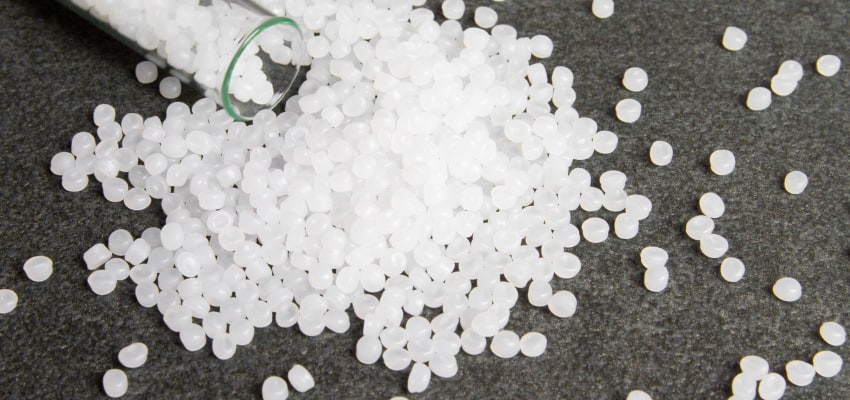
High density polyethylene, written HDPE or PE-HD, is a thermoplastic made by polymerising ethylene at low pressure with Ziegler-Natta or chromium catalysts. The result is long, mostly linear chains that pack tightly, giving a density of about 0.941 to 0.965 g/cm³. It is supplied as natural white granules (pellets), sometimes pre-coloured black for pipe.
HDPE is the stiffest and strongest of the common polyethylenes. It resists most acids, alkalis and solvents, absorbs almost no water and stays tough at low temperatures. That is why it is the standard resin for bottles, jerry cans, pressure pipe, crates and carrier bags.
Why converters use it
A high strength-to-weight ratio, good chemical resistance and easy processing on film, blow molding, injection and pipe lines.
What separates the grades
Melt flow index (MFI), density, molecular weight distribution and the additive package. Together they decide which process a grade runs on.
Where it sits among polyethylenes
HDPE is stiffer than LLDPE and LDPE. Our polyethylene overview compares all three.
Grade board
HDPE Grades We Supply
As a High Density Polyethylene supplier with a full range, we group our grades by process, because every HDPE grade is built for one job. A film resin that runs perfectly on a blown-film line will sag on a blow molding machine. Each grade code opens its own page with the full technical data sheet.
HDPE Film Grades
High molecular weight resin for thin, strong blown film: carrier bags, liners, shrink and food packaging film.
HDPE Blow Molding Grades
Resin with high melt strength and ESCR for bottles, jerry cans, drums and detergent or lubricant containers.
HDPE Pipe Grades
Pressure-pipe resin for water, gas, irrigation and industrial pipelines, including black PE100.
HDPE Injection Molding Grades
Easy-flow resin for crates, pallets, caps and closures, housewares and technical parts.
HDPE Extrusion & Multipurpose Grades
Grades for raffia and tape, sheet, profiles, UV-stabilised parts and general-purpose processing.
Running a grade from another producer? Send its TDS and we match it to an equivalent HDPE grade by MFI, density and additives, with both data sheets side by side.
HDPE Grade Finder
Choose what you make. The finder shows the grade family buyers usually start from, the typical MFI range and the main COA value to check.
Specifications
HDPE Specifications by Process
Three numbers decide whether an HDPE resin will run on your line: melt flow index, density and environmental stress crack resistance (ESCR). Lower MFI means higher molecular weight, more melt strength and tougher parts; higher MFI means easier flow and faster cycles. The ranges below are typical industry values. The binding values for your shipment are on the grade TDS and the batch COA.
| Process | Typical MFI | Typical density (g/cm³) | What matters most |
|---|---|---|---|
| Blown film | 0.03–0.1 g/10 min (190 °C/2.16 kg) | 0.948–0.956 | Bubble stability, dart impact, thin gauge |
| Blow molding | 0.2–1.0 g/10 min (190 °C/2.16 kg) | 0.950–0.962 | Parison stability, ESCR, top-load strength |
| Injection molding | 4–30 g/10 min (190 °C/2.16 kg) | 0.950–0.965 | Flow, low warpage, impact at low temperature |
| Pipe (PE80 / PE100) | 0.2–0.5 g/10 min (190 °C/5 kg) | 0.945–0.960 (base resin) | Long-term hydrostatic strength, slow crack growth |
| Raffia and tape | 0.5–1.2 g/10 min (190 °C/2.16 kg) | 0.950–0.956 | Draw ratio, tenacity, low fibrillation |
Properties common to HDPE grades
| Property | Typical value | Method |
|---|---|---|
| CAS number | 9002-88-4 (polyethylene) | — |
| HS code | 3901.20 (polyethylene, specific gravity ≥ 0.94) | — |
| Appearance | Natural white granules; black for some pipe grades | Visual |
| Density | 0.941–0.965 g/cm³ | ASTM D1505 / ISO 1183 |
| Melt flow index | Grade dependent, see table above | ASTM D1238 / ISO 1133 |
| Melting point | About 125–135 °C | DSC, ASTM D3418 |
| Tensile strength at yield | About 20–30 MPa, grade dependent | ASTM D638 / ISO 527 |
| ESCR | Grade dependent, highest in blow molding and pipe grades | ASTM D1693 |
| Water absorption | Below 0.01% | ASTM D570 |
| Transport class | Not dangerous goods | IMDG / ADR |
Values are typical ranges for orientation. Each grade page carries its own TDS, and each batch ships with its own COA.
Comparison
HDPE vs LDPE vs LLDPE: Which Polyethylene Do You Need?
All three are polyethylene, but chain structure changes how they behave. Pick HDPE when you need stiffness and strength, LDPE when you need softness and clarity, and LLDPE when you need tough, stretchy film.
| Property | HDPE | LLDPE | LDPE |
|---|---|---|---|
| Density (g/cm³) | ≈ 0.941–0.965 | ≈ 0.915–0.940 | ≈ 0.910–0.925 |
| Chain structure | Mostly linear, little branching | Linear with short branches | Highly branched |
| Stiffness | High | Medium | Low (soft, flexible) |
| Clarity | Opaque to translucent | Translucent | Good clarity |
| Typical products | Bottles, pipes, crates, carrier bags | Stretch and agricultural film | Shrink film, liners, coatings |
Read more in our guides to HDPE vs LDPE vs MDPE and the difference between LLDPE and LDPE.
Applications
HDPE Uses by Industry
HDPE is one of the most widely used plastics in packaging, construction and agriculture.
| Industry | Typical uses | Grade family |
|---|---|---|
| Flexible packaging | Carrier bags, liners, shrink and food packaging film | Film |
| Rigid packaging | Detergent, chemical and lubricant bottles, jerry cans, drums | Blow molding |
| Water and gas utilities | Pressure pipe, fittings, gas distribution lines | Pipe (PE80, PE100) |
| Agriculture | Irrigation and drip pipe, woven sacks, greenhouse parts | Pipe, extrusion |
| Logistics and household | Crates, pallets, buckets, caps and closures, housewares | Injection molding |
| Construction | Sheet, geomembrane, cable ducts, profiles | Extrusion, pipe |
| Woven packaging | Raffia, tape, woven sacks and big bags | Extrusion (raffia) |
Black PE100 pipe compounds rely on well-dispersed carbon black for UV protection.
Production
How HDPE Is Made
HDPE is produced at low pressure, unlike LDPE, which needs a high-pressure reactor.
- Feedstock. Ethylene from a steam cracker is purified, often with a small amount of comonomer such as butene or hexene.
- Polymerisation. Ethylene is polymerised at low pressure with Ziegler-Natta or chromium catalysts in a slurry, gas-phase or solution process.
- Grade design. Reactor conditions and comonomer set the molecular weight, MFI and density for film, blow molding, injection or pipe.
- Compounding and pelletising. The powder is melted with stabilisers and additives, extruded and cut into uniform granules.
- Testing and bagging. Each lot is tested for MFI, density and appearance, then packed in 25 kg bags or FIBC jumbo bags.
Supplier
Why Buyers Choose SUHA as Their HDPE Supplier
Many listings offer HDPE granules; few publish what a buyer needs to approve a supplier. Here is what you get from us on every order.
| What buyers check | What SUHA provides |
|---|---|
| Batch quality | A COA for every batch, with MFI, density and appearance results |
| Traceable origin | Virgin resin from named petrochemical producers; no blended or unverified lots |
| Right grade | 20 grades across film, blow molding, injection, pipe and extrusion, plus grade matching |
| Published packing | 25 kg bags, 55 bags (1,375 kg) per pallet, or FIBC jumbo bags |
| Supply security | Two loading origins, Türkiye and the UAE, plus road freight from Türkiye |
| Independent checks | SGS or Bureau Veritas inspection at loading, on request |
Quality
Quality, Test Methods and Shipping Documents
HDPE is approved on a few measured values. These are the methods our producers test against and the papers that travel with your cargo.
Test methods
MFI to ASTM D1238 or ISO 1133, density to ASTM D1505 or ISO 1183, ESCR to ASTM D1693. The method is stated on each COA.
Pipe classification
PE80 and PE100 refer to the minimum required strength (MRS) of the pipe material, 8 and 10 MPa, classified under ISO 9080 and ISO 12162.
Food contact
Where a grade is used for food packaging, ask us for the producer's food-contact declaration for your market before you order.
Documents with every shipment
- Certificate of analysis (COA) per batch
- Technical data sheet (TDS)
- Safety data sheet (SDS / MSDS)
- Commercial invoice and packing list
- Bill of lading, or CMR for road
- Certificate of origin
Procurement
HDPE Packing, MOQ and Container Loading
As an HDPE supplier and exporter, we pack every grade in 25 kg PE bags on shrink-wrapped pallets or in FIBC jumbo bags, labelled with grade, lot number and net weight. Containers are clean and dry so the resin reaches your silo free of moisture and dust. The minimum order is one full container load, 20ft or 40ft.
| Item | Details |
|---|---|
| Bags | 25 kg PE bags |
| Pallets | 55 bags per shrink-wrapped pallet (1,375 kg) |
| Jumbo bags | FIBC big bags for bulk handling |
| Minimum order | 1 FCL, 20ft or 40ft |
| Container load | Confirmed on the packing list for each grade and packing |
HDPE Bag and Pallet Planner
Enter the tonnage you need. The planner shows the number of 25 kg bags and 1,375 kg pallets.
Logistics
Shipping, Incoterms and Export Markets
We load sea cargo at Mersin in Türkiye or Jebel Ali in the UAE, and move cargo by truck from Türkiye to neighbouring markets. Transit times are estimates only and vary by destination and conditions.
Incoterms
FOB, CFR and CIF. CFR and CIF are quoted to your discharge port.
Two origins
FOB Mersin for Europe, the Black Sea, North Africa and the Mediterranean. FOB Jebel Ali for the Gulf, East Africa and South Asia.
Worldwide export
We ship to Africa, the Middle East, Europe, Asia and the Americas.
Related polymers and regional supply
Pricing
What Sets the Price of HDPE per Ton?
We quote each order on request, because the bulk HDPE price moves week by week with ethylene and regional polymer markets. Any HDPE supplier who quotes one price without knowing your grade and port is guessing.
Grade
Pipe and specialty blow molding grades usually cost more than general film or injection grades.
Producer origin
Resin from different producers trades at different levels for the same grade family.
Volume
Multi-container and contract orders are priced below single-container spot orders.
Incoterm and freight
FOB, CFR and CIF prices differ by sea freight, insurance and the destination port.
Packing
25 kg bags on pallets and FIBC jumbo bags carry different packing costs.
Send your grade, monthly volume and port, and our export desk replies within 24 hours with a firm price per ton and the grade TDS.
Request a priceBuyer checklist
How to Choose a High Density Polyethylene Supplier
Before you approve any High Density Polyethylene supplier, ask for these six things. A reliable exporter can provide all of them before shipment.
- The TDS for the exact grade, not a generic data sheet
- A recent COA showing MFI, density and test methods
- The producer and origin of the resin
- Confirmation that the resin is virgin, not recycled or blended
- Packing, pallets and net weight per container in writing
- Loading port, Incoterm and the full document list
Handling
Storage and Handling of HDPE Granules
HDPE is stable and non-hazardous; good practice simply keeps the granules clean and dry until they reach your hopper.
Storage
Keep bags indoors on pallets in a dry, clean, ventilated warehouse.
Sunlight and heat
Avoid direct sun and heat sources, which can degrade unstabilised resin over time.
Contamination
Keep bags closed until use and avoid mixing lots or grades in one hopper.
Stock rotation
Use older lots first and keep the COA with each lot for traceability.
Supplier
HDPE Supplier with Offices in Dubai and Türkiye
SUHA International Trading supplies HDPE to converters, importers and distributors from two offices: our head office in Business Bay, Dubai, and our Türkiye office in Ankara. You can meet us, call us in your time zone, and load from the port closest to your market. More about our company
Dubai Office
Office 2305, Burlington Tower,Business Bay, Dubai, United Arab Emirates Open in Google Maps
Ankara Office
Karşıyaka District, 749 Street, No 30,Gölbaşı, Ankara 06830, Türkiye Open in Google Maps
Meetings at either office are by appointment. Content reviewed 8 November 2026 by the SUHA International polymer desk.
FAQ
HDPE Supplier FAQ
What does a High Density Polyethylene supplier provide to bulk buyers?
A High Density Polyethylene supplier provides virgin HDPE granules matched to a process: film, blow molding, injection molding, pipe or raffia. SUHA International supplies bulk HDPE in 25 kg bags or FIBC jumbo bags with a Certificate of Analysis for every batch, from one full container load, loaded at Mersin (Türkiye) or Jebel Ali (UAE) and quoted FOB, CFR or CIF.
Which HDPE grades do you supply?
We supply film grades (HDPE 7000F, EX5, HFI5110), blow molding grades (HBM5510, HBM5520, HBM4265, HBM5020, HB0035, BL3, BL4), pipe grades (PE100, PE100N, HEX4460 PE80, 7700), injection molding grades (HI0500, HD 6070UA) and extrusion or multipurpose grades (5000S, EX3, 5030SA, HD52505 UV). Equivalent grades from other producers can be matched on request.
What is HDPE and what is it used for?
High density polyethylene (HDPE) is a thermoplastic made by polymerising ethylene at low pressure, giving long, mostly linear chains and a density of about 0.941 to 0.965 g/cm³. It is stiff, tough and chemical-resistant, so it is used for bottles and jerry cans, pressure pipe, crates and caps, carrier bags, raffia and geomembrane.
What is the difference between HDPE, LDPE and LLDPE?
HDPE has a density of about 0.941 to 0.965 g/cm³ and a mostly linear chain, which makes it stiff, strong and chemical-resistant. LDPE, at about 0.910 to 0.925 g/cm³, is highly branched, soft and clear. LLDPE sits in between, with short branches that give tough, puncture-resistant film.
How do I choose between film, blow molding, injection and pipe grades?
Start from your process and the melt flow index (MFI) your machines need. Film and pipe grades have very low MFI for melt strength, blow molding grades have low MFI for parison stability, and injection molding grades have higher MFI to fill moulds quickly. Send us your current grade or TDS and we will propose a matching HDPE grade.
What are the CAS number and HS code for HDPE?
Polyethylene is CAS 9002-88-4. HDPE in primary forms is classified under HS code 3901.20, which covers polyethylene with a specific gravity of 0.94 or more.
What is the minimum order and how is HDPE packed?
The minimum order is one full container load, 20ft or 40ft. HDPE granules are packed in 25 kg PE bags on shrink-wrapped pallets of 55 bags (1,375 kg) or in FIBC jumbo bags, then loaded into clean, dry containers.
What is the price of HDPE per ton?
HDPE price per ton depends on grade, producer origin, quantity, Incoterm and destination freight, and it follows ethylene and regional polymer markets week by week. We quote a firm FOB, CFR or CIF price per metric ton within 24 hours of receiving your grade, quantity and destination port.
Which documents come with each HDPE shipment?
Each shipment comes with a commercial invoice, packing list, bill of lading or CMR, certificate of origin and a Certificate of Analysis for the batch. The TDS and SDS are shared before contract, and independent SGS or Bureau Veritas inspection at loading can be arranged on request.
Is HDPE classified as dangerous goods for shipping?
No. HDPE granules are not classified as dangerous goods for sea or road transport, so they ship in standard dry containers or trucks without IMDG or ADR labelling.
How should HDPE granules be stored?
Store bags indoors on pallets in a dry, clean and ventilated warehouse, away from direct sunlight and heat sources. Keep bags closed until use so the granules stay free of dust and moisture, and use older lots first.
Which Incoterms and loading ports do you offer?
We quote FOB, CFR and CIF. Sea cargo loads at Mersin (Türkiye) or Jebel Ali (UAE), and cargo from Türkiye can also move by truck to neighbouring markets. Transit times are estimates only and vary by destination and conditions.
Can you supply HDPE for distributors and traders?
Yes. We work with converters, distributors, importers and traders, and can arrange neutral packing, consistent monthly lots and documentation suited to re-export.
Talk to Our HDPE Export Desk
Send us five details and our desk in Dubai or Ankara will reply with the matching grade, its TDS and a FOB Mersin or Jebel Ali offer.
- Grade or process
- MFI and density range
- Packing: bags or FIBC
- Quantity and containers
- Destination port