
Pellets & Liquid for Industry & Infrastructure
High-purity calcium chloride exported from ISO-certified plants in Turkey and our Dubai hub. Three grades — flakes 77–80%, pellets 94–97%, liquid 30–40% — shipped to industrial buyers worldwide with a Certificate of Analysis on every lot and a firm FOB/CIF price in 24 hours.
Quick Answer
Calcium chloride is the common trade name for calcium dichloride (CaCl₂), a highly soluble, hygroscopic inorganic salt (CAS 10043-52-4) used for de‑icing, dust control, concrete acceleration, oilfield brines, food processing (E509), and desiccation. SUHA International exports it in three forms — flakes at 77–80%, pellets at 94–97% and liquid at 30–40% — from ISO-certified plants in Turkey and the UAE, with a Certificate of Analysis on every lot and a firm FOB/CIF quote within 24 hours.
- Chemical: CaCl₂ (calcium dichloride)
- CAS: 10043-52-4
- HS Code: 2827.20 / 2815.12
- UN No.: 1823 (solid) / 1824 (liquid)
- Hazard: Class 8 — Corrosive
- MOQ: 24 MT (one 20′ FCL)
What Is Calcium Chloride? — CaCl₂, E509 & De-icing Salt Explained
Calcium chloride (CaCl₂) is a highly soluble, hygroscopic inorganic salt widely used across industrial, commercial, food, and oil & gas sectors. Due to its strong moisture-absorbing capacity, exothermic dissolution, and freezing point depression properties, calcium chloride is considered one of the most versatile and performance-driven chloride salts available.
As a specialised Calcium Chloride Supplier, we understand that buyers need more than just a chemical; they need a reliable partner who guarantees purity, consistency, and supply security. Our CaCl₂ is sourced from premium manufacturers and is available in three main forms: flakes (77–80%) for cost‑effective de‑icing and dust control; pellets (94–97%) for high‑purity oilfield and industrial applications; and liquid solutions (30–40%) for ready‑to‑use food processing, wastewater treatment, and spray systems.
Calcium chloride was first isolated from brine in the early 19th century, but its industrial significance grew with the development of refrigeration and winter road maintenance. Today, global demand for CaCl₂ exceeds 15 million metric tonnes per year, driven by de‑icing, dust suppression, oilfield brines, food processing, and concrete acceleration. As a Calcium Chloride Supplier with dual export hubs in Turkey and the UAE, SUHA International delivers consistent quality to bulk buyers in 40+ countries across Europe, Asia, Africa, and the Americas.
Chemical Identity & Classification — Calcium Chloride (CaCl₂)
| Parameter | Data | Notes / Regulatory Ref. |
|---|---|---|
| IUPAC Name | Calcium Dichloride | — |
| Trade Names | Calcium Chloride · Ice-Melt Salt · De-icing Salt · E509 | All refer to CaCl₂ |
| Chemical Formula | CaCl₂ | Mol. weight: 110.98 g/mol |
| CAS Number | 10043-52-4 | EINECS: 233-140-8 |
| Available Grades | Flakes 77–80% · Pellets 94–97% · Liquid 30–40% | COA per production lot |
| Appearance | White flakes, pellets, or clear liquid | — |
| Melting Point (Anhydrous) | ~772°C (1,422°F) | Solid CaCl₂ |
| Boiling Point (Anhydrous) | ~1,935°C (3,515°F) | Solid CaCl₂ |
| Density (Anhydrous) | 2.15 g/cm³ | At 20°C |
| Solubility in Water (20°C) | ~74.5 g/100 mL | Highly soluble |
| pH (typical solution) | 8–9 | Mildly alkaline |
| Effective Ice-Melting Temperature | Down to −25°C (−13°F) | — |
| Food Additive Code | E509 (GRAS by FDA) | — |
| HS Code (solid) | 2827.20 | Export classification |
| HS Code (liquid) | 2815.12 | Export classification |
| UN Number (solid) | UN 1823 | Dangerous goods |
| UN Number (liquid) | UN 1824 | Dangerous goods |
| Hazard Class | 8 — Corrosive | IMDG Code / ADR |
| GHS Pictograms | GHS05 (Corrosion) · GHS07 (Health hazard) | EU CLP EC 1272/2008 |
| Shelf Life (solid) | ~24 months | Sealed, dry storage |
| Shelf Life (liquid) | ~12 months | Sealed HDPE/steel containers |
Three Grades of Calcium Chloride — Which One Fits Your Process?
Not all calcium chloride is interchangeable. The right grade reduces handling cost, dosing errors and off-spec risk. Use the guide below or call our technical desk — we'll recommend the correct form for your application before you commit to an order.
Calcium Chloride Flakes
- Standard export grade, most competitively priced
- White, free-flowing irregular flakes
- Cost-effective for large-scale de-icing
- Dust suppression on unpaved roads, mines, quarries
- Concrete acceleration in cold weather
- Rapid dissolution in water
- 25 kg HDPE bags · 1 MT FIBC bulk sacks
Calcium Chloride Pellets
- High-purity, low-dust, uniform particle size
- Oilfield operations — drilling, completion, workover
- High-purity brine systems
- Desiccant manufacturing
- Low dust and predictable dissolution
- Ideal for automated dosing systems
- 25 kg bags · 1 MT FIBC · bulk containers
Liquid Calcium Chloride
- Ready-to-use — no dissolving, no dust exposure
- Food and beverage processing (E509)
- Wastewater treatment
- Dust control via spray systems
- Pre-wet de-icing applications
- IBC 1,000 L · HDPE drums 200 L · ISO tanks
Key Technical Properties of Calcium Chloride
Understanding these properties helps you select the right grade and form for your application — a crucial factor when evaluating a Calcium Chloride Supplier.
▶ High Solubility & Exothermic Dissolution
Calcium chloride dissolves rapidly in water, releasing heat. This exothermic reaction enables faster ice melting compared to sodium chloride and works efficiently at extremely low temperatures — down to approximately −25°C (−13°F).
▶ Hygroscopic & Deliquescent Nature
CaCl₂ actively absorbs moisture from the air and can dissolve in the absorbed water, making it a powerful dust suppressant and desiccant for humidity control in packaging and storage. It can absorb multiple times its own weight in water.
▶ Freezing Point Depression
Aqueous solutions of calcium chloride significantly lower the freezing point of water — down to approximately −25°C (−13°F), outperforming many alternative salts.
▶ pH & Density
- pH (typical solution): 8–9 (mildly alkaline)
- Density (anhydrous): ~2.15 g/cm³
- Density of saturated brine: up to ~1.40 g/mL
Industrial Uses of Calcium Chloride — Sector by Sector
Calcium chloride is among the most versatile industrial chemicals. Below is how it functions in each major sector — with dedicated guides for technical buyers and procurement engineers.
De‑Icing & Ice Melt
Calcium chloride is the preferred de-icing chemical for critical infrastructure, airports, and highways. Works at temperatures as low as −25°C, melts ice faster than rock salt, and reduces the need for repeated applications.
Dust Suppression
On unpaved roads, construction sites, and mining haul roads, calcium chloride attracts moisture from the air and binds fine particles, reducing airborne dust by 50–80%. Improves air quality, safety, and regulatory compliance.
Oil & Gas Industry
Calcium chloride brines are essential for wellbore stability, pressure control, and shale inhibition in drilling, completion, and workover operations. High-purity pellets (94–97%) are used to formulate brines up to 11.6 ppg.
Food & Beverage (E509)
Food-grade calcium chloride (E509) is GRAS by the FDA. Used as a firming agent in canned vegetables, a coagulant in cheese and tofu production, an electrolyte fortifier in sports drinks, and a water hardness adjuster in brewing.
Construction — Concrete Acceleration
In cold‑weather concreting, calcium chloride reduces initial setting time by 30–50% at ~2% by weight of cement, enabling earlier finishing and strength development. Not recommended for prestressed concrete or structures with embedded aluminium.
Desiccant & Moisture Control
Due to its strong affinity for water, calcium chloride is widely used in packaging desiccants, air dryers, and container moisture control to protect electronics, pharmaceuticals, and sensitive goods.
Application Matrix — Industry · CaCl₂ Function · Recommended Grade
| Industry | Key Function | Recommended Grade | Typical Concentration |
|---|---|---|---|
| De‑icing / Road Maintenance | Ice melt, pre-wetting | Flakes 77–80% | Bulk solid or brine |
| Dust Suppression | Bind fine particles | Flakes / Liquid | 1–2 lbs/sq yd or brine |
| Oil & Gas | Drilling fluids, packer fluids | Pellets 94–97% | Brine 11.6 ppg |
| Food Processing | Firming, coagulating, fortifying | Food-grade liquid / pellets | Application-specific |
| Construction | Concrete acceleration | Flakes 77–80% | ~2% by weight of cement |
| Desiccant / Drying | Moisture absorption | Pellets 94–97% | Solid or sachet |
Calcium Chloride vs Sodium Chloride (Rock Salt)
For harsh winter conditions and performance‑sensitive applications, calcium chloride is the clear winner — and a reliable Calcium Chloride Supplier ensures you get the right grade for your climate and operational needs.
| Feature | Calcium Chloride (CaCl₂) | Sodium Chloride (NaCl) |
|---|---|---|
| Lowest Effective Temperature | −25°C (−13°F) | ~−9°C (15°F) |
| Melting Speed | Fast (exothermic) | Slower (no heat release) |
| Corrosiveness | Moderate | Generally higher |
| Environmental Impact | Moderate (chlorides) | Higher chloride load in runoff |
| Best Use Case | Extreme cold, critical surfaces | General roads in milder climates |
How Is Calcium Chloride Produced?
Understanding the production method matters for procurement: it determines purity and suitability for food-grade or industrial applications. SUHA International sources from ISO-certified producers using both routes described below.
Neutralisation Process
Calcium chloride can be produced by reacting limestone or calcium hydroxide with hydrochloric acid:
CaCO₃ + 2 HCl → CaCl₂ + H₂O + CO₂
This process is commonly used for high-purity food-grade and pharmaceutical-grade
calcium chloride (typically >99% purity after further processing).
Solvay Process (Byproduct)
Calcium chloride is also obtained as a byproduct of the Solvay process for sodium carbonate (soda ash) production. This route often supplies industrial-grade calcium chloride for de-icing, dust control, and brine uses.
Purification Steps:
- Filtration
- Evaporation and concentration
- Crystallisation and drying
- Final processing into flakes, pellets, or liquid solutions
Packaging Options, Storage & Shelf Life
Proper packaging is the first line of defence for CaCl₂ quality in transit. Every shipment of calcium chloride from SUHA International uses moisture-resistant, IMDG-compliant packaging with batch ID, manufacturing date and shelf-life label on every unit.
| Grade | Packaging Format | Net Weight | Container Load (approx.) |
|---|---|---|---|
| Flakes / Pellets | HDPE bag with PE inner liner | 25 kg | ~800 bags / 20 FCL |
| Flakes / Pellets | Jumbo bag (FIBC), palletized | 500–1,000 kg | 20–25 jumbo bags / 20 FCL |
| Liquid CaCl₂ | HDPE drum | 200–220 L | ~80 drums / 20 FCL |
| Liquid CaCl₂ | IBC (Intermediate Bulk Container) | 1,000 L | ~20 IBCs / 20 FCL |
| Liquid CaCl₂ | ISO tank container | 20–23 MT | 1 ISO tank = 1 × 20' FCL |
Shelf life: Calcium chloride flakes and pellets are stable for approximately 24 months from the production date when stored sealed in original packaging in a cool (≤30°C), dry, ventilated warehouse away from moisture, CO₂ and acids. Liquid CaCl₂ solution has a shelf life of approximately 12 months in sealed HDPE or stainless-steel containers. Calcium chloride is hygroscopic, so keep containers sealed at all times outside active use.
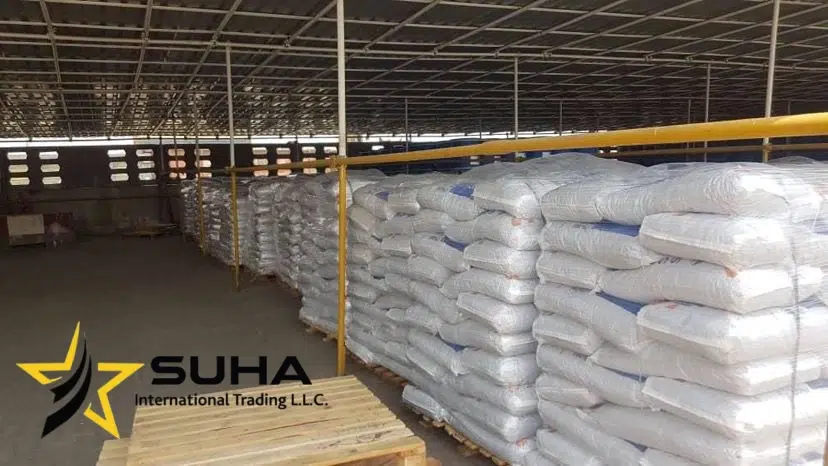
Storage recommendations: Store in a cool, dry, well‑ventilated area, away from moisture. Keep containers tightly sealed to prevent caking. Use corrosion‑resistant materials (plastic, coated steel, stainless steel). Palletize bags to avoid direct contact with floors. Rotate stock regularly (FIFO recommended every 6–12 months).
Global Logistics & Export Terms for Calcium Chloride
SUHA International exports calcium chloride from two origins — Turkey and UAE — giving buyers access to the fastest shipping lane for their destination and a built-in contingency if one corridor is disrupted.
| Parameter | Details |
|---|---|
| Loading Ports — Turkey | Mersin · Izmir · Istanbul · Derince · Samsun |
| Loading Ports — UAE | Jebel Ali (Dubai) · Khalifa Port (Abu Dhabi) |
| Incoterms Available | FOB · CFR · CIF · CPT · DAP · DDP |
| Destination Regions | Europe · Balkans · Middle East · Africa · Asia · Americas |
| Container Types | 20′ FCL (dry for solids) · 20′ ISO tank (liquid) · FTL road tanker |
| Transit Times (approx.) | 5–7 days to SE Europe · 10–14 days Mediterranean · 20–28 days Far East |
| MOQ — Packed | 24 MT — one 20′ FCL (sample quantities on request) |
| MOQ — Bulk Liquid | 24 MT — one ISO tank container or road tanker |
| Payment Terms | T/T · L/C at sight · D/P |
| Dangerous Goods | IMDG Class 8 — UN 1823 (solid) / UN 1824 (liquid) |
Get a Firm Calcium Chloride Quote — Within 24 Hours
Tell us your grade, volume, delivery point and Incoterm. Our export desk returns a bankable FOB or CIF offer with unit price, container value, payment terms and shipping schedule. No ballpark figures — a number you can take to budget approval.
Why Source Calcium Chloride From SUHA International?
Procurement managers don't worry about price lists — they worry about stockouts, off-spec batches and documentation failures at customs. SUHA International is structured to remove exactly those risks.
Safe Handling & Compliance — Calcium Chloride (CaCl₂)
Calcium chloride is a mild corrosive. Every shipment includes a full SDS/MSDS prepared to GHS/CLP standards. See the authoritative hazard data at PubChem — Calcium Chloride and regulatory guidance at the European Chemicals Agency (ECHA).
Hazard Classification
GHS05 — Corrosive (skin irritation, eye damage). UN 1823 (solid) / UN 1824 (solution), IMDG / ADR Hazard Class 8. Store away from acids, oxidizers and reactive metals.
Required PPE
Safety goggles or face shield, chemical-resistant gloves, dust mask or NIOSH‑approved respirator where dust or mist is present. Protective clothing in high-exposure environments.
Storage Requirements
Cool (≤30°C), dry, well‑ventilated warehouse. Keep containers sealed to prevent moisture absorption and caking. Segregate from acids, organic materials and reactive metals.
Regulatory Framework
EU CLP Regulation EC 1272/2008; REACH (Regulation EC 1907/2006); IMO IMDG Code (sea transport); ADR (road transport — Europe). Food‑grade E509 approved under EU and FDA regulations.
Speak With Our
Export Team
We respond to calcium chloride export inquiries within 24 business hours — usually the same day. For urgent or large-volume requirements, WhatsApp is the fastest channel.
Include These Details for the Fastest Quote
FAQ — Calcium Chloride (CaCl₂)
What is calcium chloride and what is its chemical name?
Calcium chloride is the industrial trade name for calcium dichloride (CaCl₂), CAS number 10043-52-4. It is also known as E509 (food additive) and de-icing salt. It is a highly soluble, hygroscopic inorganic salt widely used for de‑icing, dust suppression, concrete acceleration, oilfield brines, food processing, and desiccation.
What grades of calcium chloride does SUHA International supply?
We supply three commercial grades: calcium chloride flakes at 77–80% purity (cost-effective for de-icing and dust control); calcium chloride pellets at 94–97% purity (high-purity, low-dust for oilfield and industrial applications); and liquid calcium chloride at 30–40% solution (ready-to-use for food processing, wastewater treatment, and spray systems). A Certificate of Analysis (COA) ships with every production lot.
What is the difference between calcium chloride flakes and pellets?
Both are solid calcium chloride. Flakes (77–80% purity) are irregular chips, cost-effective for large-scale de-icing, dust suppression, and concrete acceleration. Pellets (94–97% purity) are uniform micropearls, virtually dust-free, with predictable dissolution — preferred for oilfield operations, high-precision industrial processes, and desiccant manufacturing where low dust and consistent quality are critical.
What is the HS Code and UN number for calcium chloride?
Calcium chloride (CaCl₂) is classified under HS Code 2827.20 for solid grades (flakes and pellets) and HS Code 2815.12 for aqueous liquid solution. For dangerous-goods transport, solid CaCl₂ is UN 1823 and liquid solution is UN 1824, both under IMDG / ADR Hazard Class 8 — Corrosive.
What is the minimum order quantity (MOQ) for bulk calcium chloride export?
The minimum order quantity (MOQ) is 24 MT (metric tonnes). For packed solid grades (25 kg bags or jumbo bags) this is one 20-foot full container load (FCL); for bulk liquid CaCl₂ it is one ISO tank container. Smaller sample quantities can be arranged on request for qualification before a commercial order.
How is calcium chloride produced?
Calcium chloride is produced by two primary methods: (1) the neutralisation process — reacting limestone or calcium hydroxide with hydrochloric acid (high-purity food-grade); and (2) as a byproduct of the Solvay process for soda ash production (industrial-grade for de-icing and dust control). Purification steps include filtration, evaporation, crystallisation and drying into flakes, pellets or liquid solutions.
What documents are included with each calcium chloride shipment?
Every export shipment includes: Certificate of Analysis (COA) for the specific production lot; Safety Data Sheet (SDS/MSDS) to GHS/CLP standards; Commercial Invoice; Packing List; Bill of Lading (B/L); Certificate of Origin (CO); and IMDG Class 8 dangerous-goods documentation for sea freight. Third-party inspection reports (SGS, BV, Intertek) can be added on request.
What is the shelf life of calcium chloride and how should it be stored?
Calcium chloride flakes and pellets have a shelf life of approximately 24 months when stored sealed in original packaging in a cool (≤30°C), dry, well‑ventilated area away from moisture, CO₂ and acids. Liquid CaCl₂ is stable for approximately 12 months in sealed HDPE or steel containers. Material that still meets specification on reanalysis may be used beyond these dates.
🔗 Related Products & Technical Guides
External Authority References (opens in new tab):