
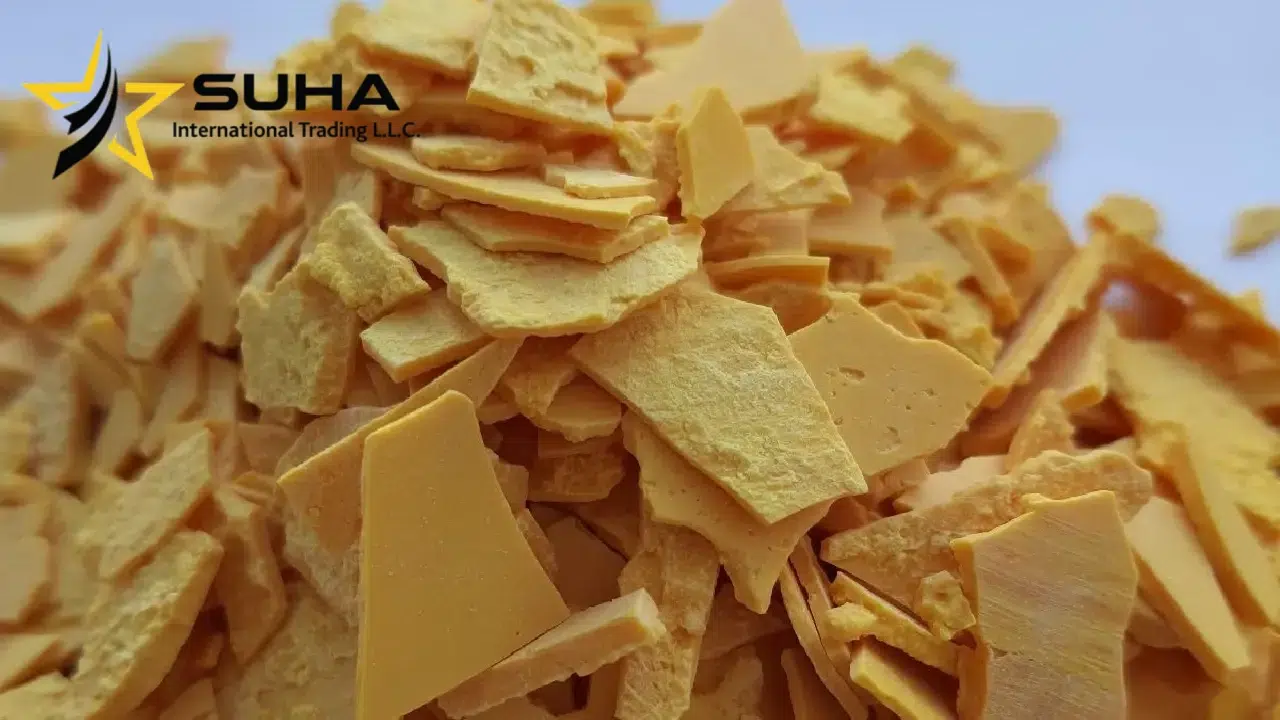
Sodium Sulfide (Na₂S) 60% Flakes — Export Supply at a Glance
SUHA International supplies sodium sulfide as 60% active-content yellow flakes with iron guaranteed at 10 ppm maximum, exported from Jebel Ali (UAE) and Mersin (Türkiye) in 25 kg bags, 150 kg drums or 1 MT jumbo bags. The minimum order is one 20ft container, about 20 MT, and in-stock material normally loads within 7–10 working days of order confirmation. Every container ships with a batch certificate of analysis, an SDS, and the IMDG documentation that UN 1849 Class 8 sea freight requires.
Sodium sulfide and sodium sulphide are the same compound — American and British spellings of Na₂S, CAS 1313-82-2. This page is written for the three people who actually buy it: the tannery or mill technician who cares about iron and active content, the importer who cares about landed cost per active kilogram, and the trader who needs documents that clear customs the first time.
Maintained by the export desk of SUHA International Trading L.L.C. · Dubai, UAE & Ankara, Türkiye · Last reviewed .
- Product
- Sodium sulfide (Na₂S) 60% flakes
- CAS number
- 1313-82-2
- HS code
- 2830.10
- UN / class
- UN 1849 · IMDG Class 8
- Active content
- 60 ± 2% Na₂S
- Iron (Fe)
- ≤ 10 ppm, per batch
- Appearance
- Yellow to light amber flake
- Packing
- 25 kg bag · 150 kg drum · 1 MT FIBC
- MOQ
- 20 MT (1×20ft FCL)
- Loading ports
- Jebel Ali (AE) · Mersin (TR)
- Incoterms
- FOB · CFR · CIF · CPT
- Payment
- T/T · L/C at sight · D/P
- Lead time
- 7–10 working days, ex stock
- Shelf life
- 12–24 months, sealed
What Is Sodium Sulfide (Na₂S)?
Sodium sulfide is an inorganic alkali sulfide, formula Na₂S, CAS 1313-82-2. In commercial trade it is almost never anhydrous: the material that moves in containers is the hydrated salt, sold on its active Na₂S content — conventionally 60% — as yellow to amber flakes. The yellow colour comes from trace polysulfides formed during production, not from contamination.
Three properties explain every industrial use on this page: strong alkalinity (pH 11–13 in solution), powerful reducing action, and a high affinity for metal ions. That combination is what breaks keratin bonds in a beam house, restores a flotation response on an oxidised ore surface, dissolves lignin in a Kraft digester, and drops dissolved heavy metals out of an effluent stream as insoluble sulfides.
Technical specification — Na₂S 60% industrial flake
| Parameter | Specification | Test method | Why it matters to you |
|---|---|---|---|
| Na₂S active content | 60 ± 2% | Titrimetric | The only figure your dosing is really based on |
| Iron (Fe) | ≤ 10 ppm | ICP-OES | Above ~15 ppm, tanneries risk iron staining on crust |
| Sodium sulfite (Na₂SO₃) | ≤ 2.0% | Titrimetric | Rising sulfite means the lot has seen air — it is an age indicator |
| Sodium carbonate (Na₂CO₃) | ≤ 0.5% | Titrimetric | Carbonate build-up affects liquor chemistry in pulping |
| Water-insoluble matter | ≤ 12% | Gravimetric | Tonnage you pay freight on and then filter out |
| Appearance | Yellow to light amber flake | Visual | Deep red or brown usually signals higher iron |
| pH (1% solution, 25 °C) | 11.0 – 13.0 | pH meter | Strongly alkaline — dictates PPE and materials of construction |
| Solubility in water (20 °C) | ~180 g/L | — | Dissolution is exothermic; add flake to water, never the reverse |
| Bulk density | ~1,600 kg/m³ | ISO 758 | Determines silo and container loading plans |
| CAS / HS / UN | 1313-82-2 · 2830.10 · UN 1849 | — | Customs classification and dangerous-goods filing |
| Shelf life | 12 – 24 months | — | Only in sealed original packing, away from air and moisture |
← Swipe the table sideways to see every column.
Values are contractual minimums and typical figures. The measured values for your specific container are stated on the batch certificate of analysis; the full technical data sheet and SDS are sent with the quotation, before you order.
The grade landscape — what "sodium sulphide" can mean on an offer sheet
Two offers that both say "sodium sulphide 60%" are not necessarily the same material. Before comparing prices, establish which of these you are being quoted.
| Grade / form | Typical active content | Where it is specified | Buyer note |
|---|---|---|---|
| Yellow flake — low iron (our standard) | 60%, Fe ≤ 10 ppm | Leather, pulp, chemical synthesis | The grade to insist on wherever colour of the end product matters |
| Red flake | 60%, higher Fe | Mining flotation, some dyeing | Cheaper; acceptable only where iron is process-irrelevant |
| High-concentration flake | 62–65% | Freight-sensitive long-haul buyers | Fewer tons for the same active delivery — compare per active kg |
| Liquid Na₂S | ~10–35% solution | Plants with tank storage and local supply | Rarely economic to ship intercontinentally — you pay freight on water |
| Sodium hydrosulfide (NaHS) | 70% flake / 45% solution | Some flotation and tannery circuits | A different compound, not a drop-in substitute — trial before switching |
CONFIRM: red flake, 62–65% and NaHS are described here as market grades we can source on request. If any of them is not something you want to be asked for, delete that row.
Where Sodium Sulphide Is Used — and How Much It Consumes
Below are the industries we supply, what Na₂S actually does in each, and the complementary chemicals from our range that sit alongside it in the same process.
Leather dehairing — beam house
Sodium sulphide cleaves the disulfide bonds in keratin, dissolving hair at the follicle without attacking the grain, normally alongside lime in the liming float. Iron is the parameter that decides whether a lot is usable: our ≤10 ppm Fe specification protects the colour of the finished crust.
Mining — sulfidization & flotation
Na₂S sulfidizes the oxidised surface of lead, copper, zinc and gold-bearing minerals so that xanthate collectors can attach. Dosage is circuit-specific and pH-sensitive, which is why it is usually run with soda ash for conditioning. We supply both from one contract.
Kraft pulp & paper
Combined with caustic soda it forms white liquor, the cooking liquor of the Kraft process. The sulfide ion accelerates lignin fragmentation while sparing cellulose, which is what gives Kraft pulp its strength. Mills buy Na₂S as make-up against recovery-cycle losses.
Effluent — heavy-metal removal
Metal sulfides are far less soluble than metal hydroxides, so sulfide precipitation pulls lead, copper, nickel, chromium and zinc to lower residual concentrations than lime alone, and works across a wider pH band. Dosing control matters: excess sulfide is itself a discharge problem.
Textile — sulfur dye reduction
Na₂S reduces insoluble sulfur dyes to their soluble leuco form so they can penetrate cotton before re-oxidation fixes the shade. Downstream scouring and finishing typically use LABSA and SLES.
Chemical synthesis
A workhorse reducing and sulfurising agent for dye intermediates, rubber chemicals, thiols and sulfur-containing specialities — and the reagent behind polyphenylene sulfide chemistry. Purity and batch-to-batch consistency matter more here than in any other application.
Typical consumption benchmarks by process
Procurement teams sizing an annual contract usually need a consumption figure before they have a trial result. These are the ranges most commonly seen in practice — starting points for a budget, not a recipe.
| Process | Indicative dosage (60% flake) | Dosage basis | Main variable |
|---|---|---|---|
| Leather dehairing (beam house) | ~1.5 – 3.0% | On soaked hide weight, with lime | Hide type, hair density, float ratio |
| Kraft pulping (white liquor) | Make-up to hold 25–35% sulfidity | Liquor chemistry, not tonnage of wood | Recovery-cycle sulfur losses |
| Oxide ore sulfidization | ~0.3 – 3 kg per tonne of ore | Per tonne of ore treated | Degree of oxidation, pulp pH, staging |
| Sulfur dyeing | Set against dye weight and shade depth | Per dyebath | Dye class and required depth of shade |
| Heavy-metal precipitation | ~1.1 – 1.5× stoichiometric | On dissolved metal load | Metal mix, competing ions, residual limit |
These ranges are indicative and vary widely between plants. Confirm by laboratory or pilot trial before contracting an annual volume — we can supply a sample lot from the same production source as the bulk material for that purpose.
What Drives the Sodium Sulfide Price — and How to Compare Offers
Na₂S is quoted in US dollars per metric ton against a written specification, normally FOB the loading port or CFR/CIF your discharge port. There is no published index, and a headline per-ton number is the least useful figure on an offer sheet. Compare on the two calculations below instead.
Compare cost per active kilogram, not per ton
One metric ton of 60% flake contains 600 kg of active Na₂S. So:
Cost per kg active Na₂S = (price per MT) ÷ 600
Run the same division with the actual assay on the certificate of analysis, not the nominal grade. An offer at 58% assay is 3.4% more expensive per active kilogram than the same money at 60%, before any freight difference. Where insoluble matter is high, add that too: material that never dissolves is tonnage you paid ocean freight on and then filtered out.
Then compare landed cost, not FOB
A 20ft container carries about 20 MT. Ocean freight, marine insurance, terminal handling, duty and inland delivery are charged per container, not per ton — so they fall as a per-ton cost when the container is fully loaded and rise sharply on part loads. Ask for the FOB and the CFR side by side to your own port; the gap between them is the number that decides your real cost.
The variables that move a Na₂S quotation
CONFIRM: this page deliberately carries no price band, because none has been verified for publication. If you want an indicative USD/MT range published here — the way the polyethylene wax price page does it — send the figures and it can be added, with schema offers to match.
How to Read a Na₂S Certificate of Analysis
A certificate of analysis is only useful if you know which lines can hurt you. Five checks take about a minute and catch most of what goes wrong with imported sodium sulphide.
Match the batch number to the bags
The lot number on the certificate must appear on the bags inside the container. A certificate with no traceable batch reference is a specification sheet, not a batch result — and it proves nothing about what you received.
Read active content against your contract minimum
"60%" on an offer and "60% minimum" in a contract are different commitments. Check whether the assay is at the top or bottom of the tolerance band, and recalculate your cost per active kilogram from the actual number.
Check iron in ppm, not as a pass/fail tick
For tannery use, the difference between 8 ppm and 18 ppm is the difference between clean crust and staining you cannot correct. Insist on a figure, not the word "low".
Use sulfite as the age indicator
Sodium sulfite rises as the material oxidises in air. A high sulfite result on a supposedly fresh lot means the product has been stored open, repacked, or is older than stated — and its active content will keep falling in your warehouse.
Treat insoluble matter as a freight line
At 12% insolubles, roughly 2.4 MT of a 20 MT container is material you will filter out. Price it as waste plus disposal, not as product, when you compare two offers.
CONFIRM: ISO 9001, ISO 14001, REACH and Halal badges from the previous version have been removed. Put back only the ones you hold a current certificate for, and name the certifying body — unverifiable badges are an E-E-A-T liability, not an asset.
Packing Options and Container Loadout
All sodium sulfide shipments move under the IMDG Code as UN 1849, Hazard Class 8. Choose packing on how the material will be handled at your end — not on price per bag alone, because handling losses and moisture ingress cost more than the packing ever does.
| Packing | Units per 20ft FCL | Payload | Best suited to |
|---|---|---|---|
| 25 kg PP/PE bags with PE liner | 800 bags | 20 MT | Tanneries, distributors, manual handling, mixed storage |
| 150 kg sealed steel drums | ~133 drums | ~20 MT | Long transit, humid climates, remote sites, slow consumption |
| 1,000 kg FIBC jumbo bags | 20 bags | 20 MT | Kraft mills and concentrators with forklift or hoist handling |
Palletising costs payload: expect a lower net weight per container when bags are palletised and stretch-wrapped. State in your enquiry whether your warehouse needs pallets or unloads loose, and the loading plan is built accordingly.
From enquiry to delivery
Send the enquiry
By contact form, WhatsApp or email, stating grade, tonnage per shipment and per year, destination port, incoterm, packing and application.
Receive a formal offer within 24 hours
Unit price in USD/MT, total container value, loading port, incoterm, validity period, payment terms and shipment window — with the TDS and the COA format attached, so your technical team can approve in parallel with your finance team.
Confirm order and terms
T/T, irrevocable L/C at sight, or D/P. For first orders the usual structure is 30% advance with the balance against a copy of the bill of lading. Repeat buyers can discuss extended terms.
Pre-shipment inspection — optional
SGS or Bureau Veritas at the warehouse before loading, at buyer's cost. Recommended for first orders and for any L/C transaction where the inspection certificate is a required document.
Loading and departure
Typically 7–10 working days from confirmed order on stock material. The full document set is issued and sent electronically within 24 hours of vessel departure.
Transit and after-sales
Container and B/L references shared for tracking, with support on documentation queries, port-agent coordination and clearance until the container is in your yard.
Safe Handling and Storage of Na₂S
Sodium sulphide is corrosive and moisture-reactive, classified UN 1849, IMDG Class 8. In contact with acid it releases hydrogen sulfide. A full SDS ships with every order and precedes it on request; the summary below is orientation, not a substitute for the SDS or for your own site risk assessment.
Classification
Corrosive to skin and eyes, acutely toxic, hazardous to aquatic life. UN 1849, IMDG Class 8. Segregate from acids, oxidising agents and ammonium salts in storage and during sea transit.
Hydrogen sulfide risk
Any acid contact liberates H₂S — flammable, highly toxic, and treacherous because olfactory fatigue removes the warning smell at exactly the concentrations that matter. Use fixed or personal gas detection in enclosed spaces; never rely on smell. H₂S exposure data (PubChem).
Required PPE
Chemical-resistant nitrile or neoprene gloves, sealed splash goggles, chemical-resistant coveralls, and acid-gas cartridge respiratory protection or SCBA in confined spaces. Emergency eyewash and shower within ten seconds of any handling point.
Storage
Cool, dry, ventilated, below about 35 °C, sealed, out of sunlight. Air exposure oxidises Na₂S to sulfite and then thiosulfate, steadily lowering active content — an opened bag is a decaying asset. Sealed original packing holds specification for 12–24 months. Na₂S chemical data (PubChem).
Ready to source sodium sulphide in container volume?
Send grade, annual tonnage, destination port, packing and preferred incoterm. You get a formal FOB or CIF offer within 24 hours, with the technical data sheet and the certificate-of-analysis format attached.
Speak to the export desk
Sodium sulfide enquiries are answered within one working day, usually faster. For urgent requirements or tender deadlines, WhatsApp is the quickest channel.
💬 WhatsApp — fastest response+971 50 720 9246 ✉ Email — formal RFQ and documentsinfo@causticsodaco.comInclude these nine lines and your quote arrives same day
- Grade: Na₂S 60% yellow flake, or the specification you currently buy
- Iron limit: the maximum ppm your process tolerates
- Quantity: tonnage per shipment and per year
- Destination: discharge port and country
- Incoterm: FOB, CFR, CIF or CPT
- Packing: 25 kg bags, 150 kg drums or 1 MT FIBC — palletised or loose
- Application: leather, mining, pulp, textile, effluent or synthesis
- Inspection: SGS or BV required, yes or no
- Payment: T/T, L/C at sight or D/P — and spot versus contract
FAQ — Sodium Sulfide Supplier
What is the minimum order quantity for sodium sulfide?
The standard MOQ is 20 metric tons — one 20ft full container load of Na₂S 60% flakes. Buyers running 5–20 containers a month are quoted on long-term contract terms. Trial quantities of 5–10 MT can be arranged in selected markets, though the per-ton cost is higher, because part-load freight and documentation are spread over less tonnage.
What purity and grade of sodium sulphide do you export?
The standard export grade is 60% active content, yellow flake, hydrated form, with iron guaranteed at ≤10 ppm, sulfite ≤2% and water-insoluble matter ≤12%. Every shipment carries a batch certificate of analysis with measured values — not a template. Red flake and higher-concentration grades can be sourced on request.
How do I calculate the real cost of sodium sulfide?
Compare cost per kilogram of active Na₂S, not per ton of product. One metric ton of 60% flake holds 600 kg of active Na₂S, so the active cost is the per-ton price divided by 600. A cheaper 58% offer can cost more per active kilogram than a 60% one. Insoluble matter belongs in the same calculation: material that never dissolves is tonnage you paid freight on and then filtered out.
Why does iron content matter so much for tanneries?
Iron in the sulfide reacts with sulfur species in the hide and leaves dark iron-sulfide staining that survives into the finished crust, where it cannot be corrected without downgrading the hide. Tannery-grade material is specified at ≤10 ppm Fe. Flake colour is a rough field indicator — pale yellow suggests low iron, deep red or brown the opposite — but only the certificate of analysis confirms it.
How much sodium sulfide will my process consume?
Typical starting points: leather dehairing about 1.5–3.0% of 60% flake on soaked hide weight alongside lime; Kraft mills dose to hold white liquor sulfidity around 25–35%; oxide-ore sulfidization commonly runs from a few hundred grams to about 3 kg per tonne of ore; effluent precipitation around 1.1–1.5× the stoichiometric requirement of the target metal. Every one of these must be confirmed by trial.
How quickly can you ship from Türkiye or the UAE?
On stock material, loading and shipment are normally completed within 7–10 working days of order confirmation and deposit receipt, from Jebel Ali or Mersin. Faster loading can sometimes be arranged against available stock. Transit time depends on routing and is stated on the offer.
What documents come with each shipment?
Certificate of analysis, safety data sheet, commercial invoice, packing list, bill of lading, certificate of origin (Türkiye or UAE), and the IMDG dangerous-goods declaration required for UN 1849 Class 8 sea freight. SGS or Bureau Veritas pre-shipment inspection is available at the buyer's request and cost.
What is the HS code for sodium sulfide?
Sodium sulfide falls under HS 2830.10. Several countries extend the heading to eight or ten digits — China uses 2830.10.10, for example — so confirm the national extension with your own customs broker before filing. Export documentation from Türkiye and the UAE is prepared under the correct classification on our side.
How should sodium sulphide be stored?
Cool, dry, well-ventilated, below about 35 °C, in tightly sealed original packing, segregated from acids and oxidising agents, out of direct sunlight. Air exposure oxidises Na₂S to sulfite and then thiosulfate, lowering active content. Sealed flakes normally hold specification for 12–24 months.
How do I read a sodium sulfide certificate of analysis?
Five lines: active content against your contracted minimum; iron in ppm; sodium sulfite as the oxidation indicator; water-insoluble matter as the freight-waste indicator; and the batch number, which must match the number printed on the bags in the container. A certificate with no traceable batch number is not a batch certificate.
Do you ship sodium sulfide to Africa and South Asia?
Yes — both are core markets. Regular destinations include South Africa, Nigeria, Kenya, Tanzania, Ghana, Ethiopia, Zambia, DR Congo, Mozambique, Uganda, India, Bangladesh, Pakistan and Vietnam, served from Jebel Ali and Mersin. Freight and transit time are quoted per destination port on CFR or CIF terms.
What payment terms are available for bulk orders?
T/T (typically 30% advance, balance against B/L copy), irrevocable L/C at sight from a prime bank, or D/P through a correspondent bank. Buyers with a completed shipment history can discuss extended terms.
Related products and references
External references