
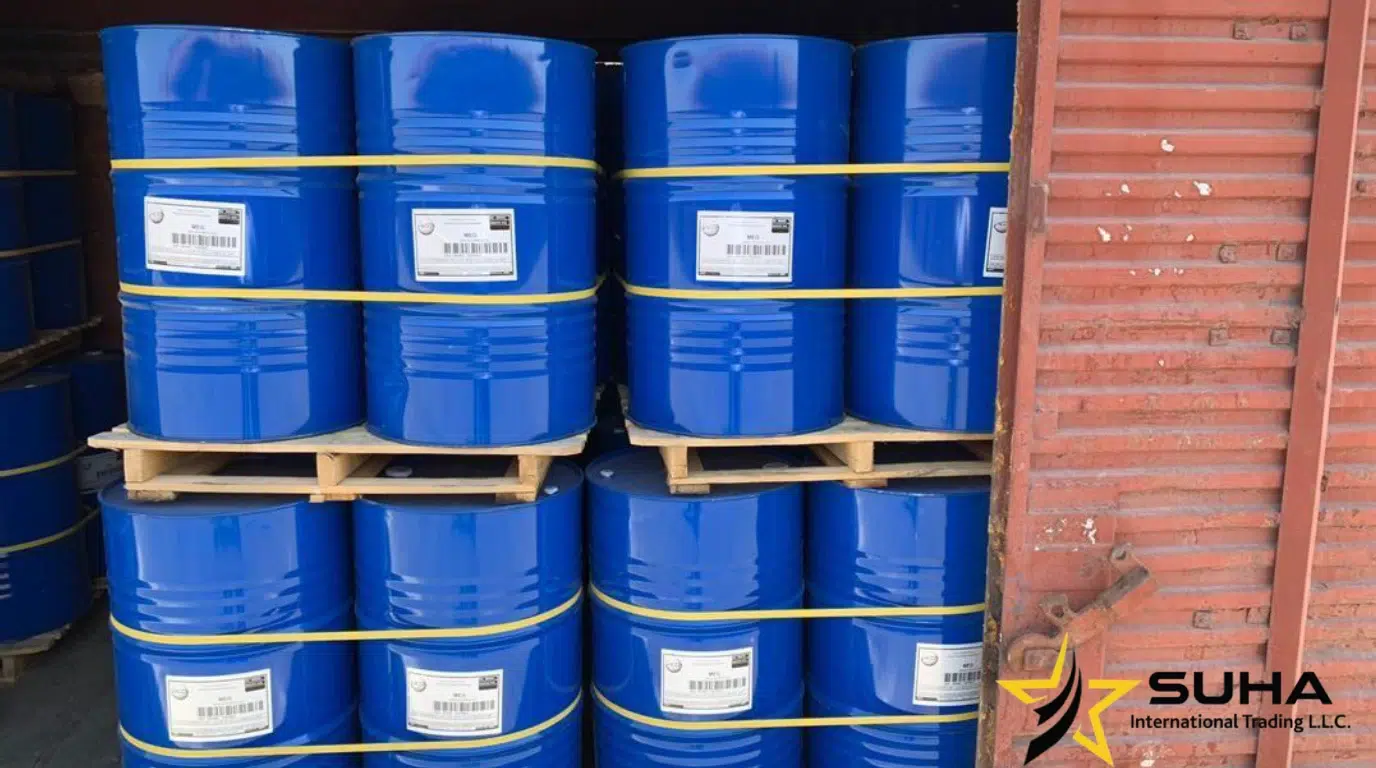
What Is Ethylene Glycol?
Ethylene glycol (C₂H₆O₂) is a clear, odourless, slightly sweet and viscous liquid, the simplest diol and the world's highest-volume glycol. It is made from ethylene oxide and used mainly to produce PET and polyester and as the base of engine antifreeze. Ethylene glycol is harmful if swallowed.
In trade, ethylene glycol is usually called monoethylene glycol (MEG) or mono ethylene glycol. These are not different products: MEG, mono ethylene glycol, ethylene glycol, EG, glycol, ethane-1,2-diol and 1,2-ethanediol all mean the same molecule, CAS 107-21-1. The word "mono" only separates it from its heavier relatives, diethylene glycol (DEG) and triethylene glycol (TEG). Together, MEG, DEG and TEG are called the ethylene glycols, and this guide covers all three.
- C₂H₆O₂HOCH₂CH₂OH
- 62.07 g/molMolar mass
- CAS 107-21-1EC 203-473-3
- 197.3 °CBoiling point
- -12.9 °CFreezing point
- HS 2905.31Customs heading
Types of Ethylene Glycol: MEG, DEG and TEG
There are three commercial ethylene glycols: monoethylene glycol (MEG), diethylene glycol (DEG) and triethylene glycol (TEG). All three come out of the same reaction of ethylene oxide with water; MEG is the main product, while DEG and TEG are heavier co-products with higher boiling points and stronger water absorption.
Used alone, "ethylene glycol" means MEG. Buyers searching for ethylene glycol vs diethylene glycol or mono ethylene glycol vs ethylene glycol are usually asking which member they need. MEG is the base unit; DEG and TEG are two and three units joined by ether links, which raises the boiling point and water absorption.
| Property | MEG | DEG | TEG |
|---|---|---|---|
| Formula | C₂H₆O₂ | C₄H₁₀O₃ | C₆H₁₄O₄ |
| CAS number | 107-21-1 | 111-46-6 | 112-27-6 |
| HS code | 2905.31 | 2909.41 | 2909.49 |
| Molar mass | 62.07 g/mol | 106.12 g/mol | 150.17 g/mol |
| Boiling point | ≈ 197 °C | ≈ 245 °C | ≈ 285 °C |
| Freezing point | ≈ -13 °C | ≈ -10.5 °C | ≈ -7 °C |
| Water absorption | Moderate | High | Very high |
| Share of output | Main product | Co-product | Co-product |
| Main uses | PET, polyester, antifreeze | Resins, polyols, plasticizers, solvents | Gas dehydration, plasticizers |
| Supply page | MEG supplier | DEG supplier | TEG supplier |
A product sold as "mix glycol" or "MEG/DEG blend" is a mixture, not a separate chemical. Ask for the MEG and DEG content on the certificate of analysis before buying it for coolant, where DEG is limited. See diethylene glycol in antifreeze for those limits.
Monoethylene Glycol (MEG): Formula and Properties
The formula of ethylene glycol is C₂H₆O₂ (HOCH₂CH₂OH): two carbon atoms, each carrying a hydroxyl group. Those two -OH groups make it fully miscible with water, very hygroscopic, high-boiling and slow to evaporate.
| Property | Value |
|---|---|
| Chemical formula | C₂H₆O₂ (HOCH₂CH₂OH) |
| Molar mass | 62.07 g/mol |
| IUPAC name | Ethane-1,2-diol |
| CAS number | 107-21-1 |
| EC number | 203-473-3 |
| HS code | 2905.31 |
| Appearance | Clear, colourless, odourless, slightly viscous liquid with a sweet taste |
| Boiling point | ≈ 197.3 °C |
| Freezing point | ≈ -12.9 °C |
| Density at 20 °C | ≈ 1.113 g/cm³ (1,113 kg/m³) |
| Viscosity at 25 °C | ≈ 16 mPa·s |
| Flash point (closed cup) | ≈ 111 °C |
| Auto-ignition temperature | ≈ 398 °C |
| Vapour pressure at 20 °C | ≈ 0.06 mmHg (low volatility) |
| Solubility in water | Fully miscible |
| Transport | Not regulated as dangerous goods (IMDG, ADR, IATA) |
Need the purity, water, DEG and colour limits that apply to a shipment rather than the pure substance? The grade specifications for fiber-grade and antifreeze-grade product are on our monoethylene glycol supplier page, together with the MEG technical data sheet (PDF).
Diethylene Glycol (DEG): Properties and Uses
Diethylene glycol (DEG, C₄H₁₀O₃) is two ethylene glycol units joined by an ether bond. It boils at about 245 °C, absorbs more water than MEG and is used mainly in polyester resins, polyurethane polyols, plasticizers and solvents.
| Property | Value |
|---|---|
| Formula | C₄H₁₀O₃ (HOCH₂CH₂OCH₂CH₂OH) |
| Molar mass | 106.12 g/mol |
| CAS number | 111-46-6 |
| HS code | 2909.41 |
| Boiling point | ≈ 245 °C |
| Freezing point | ≈ -10.5 °C |
| Density at 20 °C | ≈ 1.118 g/cm³ |
| Hazard | Harmful if swallowed (H302); kidney damage on repeated ingestion (H373) |
What is diethylene glycol used for?
- Unsaturated polyester resins and polyurethane polyols for composites, coatings and foams.
- Plasticizers and solvents: an intermediate for plasticizers and a solvent for dyes, inks and resins.
- Textiles: a humectant, lubricant and conditioning agent in fiber processing. See diethylene glycol in textiles.
- Paints and coatings: a coalescent and freeze-thaw additive. See DEG in paints and coatings.
- Antifreeze: present only as a limited impurity or minor component. See diethylene glycol in antifreeze.
- Brake fluids and gas dehydration in some formulations and smaller units.
DEG is harmful if swallowed and must never be used in food, medicines or toothpaste. Contamination of medicines with DEG has caused fatal poisonings, so pharmaceutical and food producers test glycerin and propylene glycol for it.
For grades, packing and quotes, see our diethylene glycol supplier page.
Triethylene Glycol (TEG): Properties and Uses
Triethylene glycol (TEG, C₆H₁₄O₄) is three ethylene glycol units joined by ether bonds. It boils at about 285 °C and is the most hygroscopic of the three, which makes it the standard liquid for drying natural gas.
| Property | Value |
|---|---|
| Formula | C₆H₁₄O₄ |
| Molar mass | 150.17 g/mol |
| CAS number | 112-27-6 |
| HS code | 2909.49 |
| Boiling point | ≈ 285 °C |
| Freezing point | ≈ -7 °C |
| Density at 20 °C | ≈ 1.125 g/cm³ |
| Water absorption | Very high (strongly hygroscopic) |
What is triethylene glycol used for?
- Natural gas dehydration: TEG contactors strip water vapour from gas before pipelines and processing. See TEG for gas dehydration.
- Plasticizers: an intermediate for plasticizers used in PVB laminating film and other polymers.
- Solvents and humectants in inks, adhesives and industrial formulations.
- Hydraulic and brake fluids as a glycol component.
For grades, packing and quotes, see our triethylene glycol supplier page.
How Is Ethylene Glycol Made?
Ethylene glycol is made in two steps: ethylene is oxidised over a silver catalyst to ethylene oxide, and the ethylene oxide is then hydrated to ethylene glycol. DEG and TEG form as by-products and are separated by distillation.
- Thermal hydration (conventional): ethylene oxide reacts with a large excess of water. Around 90% of the glycol formed is MEG; the rest is DEG and TEG.
- Catalytic route via ethylene carbonate: Shell's OMEGA ("Only MEG Advantage") process first reacts ethylene oxide with CO₂ to ethylene carbonate, then hydrolyses it. Shell reports conversion efficiency above 99% to MEG, against about 90% for the thermal route.
- Coal-to-MEG: in China, a large share of capacity makes ethylene glycol from coal-based syngas via dimethyl oxalate, without ethylene.
- Bio-MEG: ethylene from sugarcane or other bio-ethanol gives a renewable-carbon MEG used in some "plant-based" PET bottles.
What Is Ethylene Glycol Used For?
Most ethylene glycol goes into polyester: PET bottle resin, polyester fiber and film. The next largest use is engine antifreeze and coolant, followed by heat-transfer fluids, gas hydrate inhibition, resins, paints and de-icing fluids.
PET and polyester
Reacted with PTA to make PET for bottles, textiles and film. Requires fiber-grade (polyester-grade) MEG.
Antifreeze and coolant
Mixed with water and corrosion inhibitors to protect engines from freezing and boiling.
Heating and HVAC systems
Inhibited glycol-water loops in chillers, hydronic heating, snow-melt and solar thermal systems.
Gas hydrate inhibition
Injected into gas wells and pipelines to stop ice-like hydrates from blocking flow. Gas drying uses TEG instead.
Paint and coatings
Freeze-thaw stabiliser and open-time extender in water-based and latex paints.
Unsaturated polyester resins
A glycol building block for fiberglass composites, gel coats and cast resins.
Aircraft and runway de-icing
A base fluid in some aircraft de-icing formulations.
Capacitors and brake fluid
A solvent in electrolytic capacitor electrolytes and a component of some glycol brake fluids.
Ethylene Glycol as Antifreeze: How Much to Use
A 50/50 mixture of ethylene glycol and water protects to about -37 °C. More glycol helps only up to about 60–70%; above that the freezing point rises again, and pure ethylene glycol freezes at about -13 °C.
| Ethylene glycol in water | Approx. freezing point |
|---|---|
| 30% | ≈ -15 °C |
| 40% | ≈ -24 °C |
| 50% | ≈ -37 °C |
| 60% | ≈ -52 °C |
| 100% (pure) | ≈ -13 °C |
Finished coolant also contains corrosion inhibitors and usually a bittering agent. Mixing ratios, inhibitor packages and the impurity limits for coolant blenders are covered in our guide to antifreeze grade MEG.
Ethylene Glycol vs Propylene Glycol
Both are glycols used for freeze protection, but they are not interchangeable. The deciding factor is usually toxicity, not performance.
| Property | Ethylene glycol (MEG) | Propylene glycol (MPG) |
|---|---|---|
| Formula / CAS | C₂H₆O₂ / 107-21-1 | C₃H₈O₂ / 57-55-6 |
| Toxicity | Harmful if swallowed | Low toxicity; permitted in food and pharma |
| Freeze protection | Slightly better at the same % | Slightly lower; needs a higher % |
| Heat transfer | Better (lower viscosity) | Lower (more viscous when cold) |
| Typical price | Usually lower | Usually higher |
| Best for | Engine coolant, closed industrial loops, PET | Food plants, potable-water areas, cosmetics |
If a leak could reach food, drinking water, children or animals, choose monopropylene glycol (MPG). For engine coolant and closed industrial loops, ethylene glycol is the standard choice.
Is Ethylene Glycol Toxic? Safety and Handling
Yes. Ethylene glycol is harmful if swallowed. The body converts it into acids that can damage the kidneys and nervous system. If anyone may have swallowed it, call emergency services or a poison control centre immediately; treatment works best when started early.
- GHS classification: H302 harmful if swallowed; H373 may cause damage to organs (kidneys) through prolonged or repeated exposure if swallowed. Signal word: Warning.
- Children and pets: its sweet taste is the main hazard. Store it in labelled, closed containers out of reach, and clean up spills at once.
- Skin and air: it is poorly absorbed through skin and has low vapour pressure, so inhalation at room temperature is limited. Use gloves and eye protection and ventilate when heating or spraying.
- Environment: it biodegrades in water and soil within days to weeks, but bulk spills must still be contained and kept out of drains.
- Storage: keep closed and dry in stainless steel, aluminium or lined carbon steel, and avoid galvanised (zinc) surfaces. It absorbs moisture from air.
Buying Ethylene Glycols in Bulk: MEG, DEG and TEG
Buyers purchase each glycol separately by the container load: MEG in fiber grade (99.9% min) for PET and polyester or antifreeze grade (99.5% min) for coolant, and DEG or TEG to the purity on the supplier's specification.
- MEG fiber grade99.9% min, PET & polyester
- MEG antifreeze99.5% min, coolant
- MEG · DEG · TEGOne supply base
- 1 FCLMOQ, 20ft or 40ft
- Türkiye · UAEMersin / Jebel Ali
- COA per lotSDS with every shipment
SUHA International supplies all three ethylene glycols from Türkiye and the UAE, so they can be quoted together on one enquiry: monoethylene glycol (MEG), diethylene glycol (DEG) and triethylene glycol (TEG), plus monopropylene glycol (MPG).
Ethylene Glycol FAQ
What is ethylene glycol?
Ethylene glycol is a colourless, odourless, slightly sweet and viscous liquid with the formula C2H6O2 (HOCH2CH2OH). It is the simplest diol, made from ethylene oxide, and is used mainly to make PET and polyester and as the base of engine antifreeze. It is harmful if swallowed.
Is ethylene glycol the same as monoethylene glycol (MEG)?
Yes. Monoethylene glycol (MEG), mono ethylene glycol and ethylene glycol all name the same chemical, CAS 107-21-1. Traders add 'mono' to separate it from diethylene glycol (DEG) and triethylene glycol (TEG), and 'ethylene glycols' in the plural refers to that whole family.
What is the chemical formula of ethylene glycol?
The chemical formula of ethylene glycol is C2H6O2, written structurally as HOCH2CH2OH: two carbon atoms, each carrying one hydroxyl (-OH) group. Its molar mass is 62.07 g/mol and its IUPAC name is ethane-1,2-diol.
What is ethylene glycol used for?
Most ethylene glycol is used to make polyester fiber and PET resin for bottles, film and packaging. It is also the base of engine antifreeze and coolant, a heat-transfer fluid in HVAC and solar systems, a gas hydrate inhibitor in oil and gas, a freeze-thaw stabiliser in water-based paint and an intermediate for resins and de-icing fluids.
Is ethylene glycol toxic?
Yes. Ethylene glycol is harmful if swallowed and its metabolites can damage the kidneys and nervous system. Its sweet taste makes accidental poisoning of children and pets a real risk. Anyone who may have swallowed it needs emergency medical help immediately, because treatment works best when started early.
What is the boiling point and freezing point of ethylene glycol?
Pure ethylene glycol boils at about 197.3 °C and freezes at about -12.9 °C. Mixed with water it freezes far lower: a 50/50 mixture by volume protects to about -37 °C, which is why coolant is sold as a glycol-water blend.
What is the density of ethylene glycol?
The density of ethylene glycol is about 1.113 g/cm3 at 20 °C, which equals about 1,113 kg/m3. It is heavier than water and fully miscible with it.
What are the types of ethylene glycol?
The ethylene glycol family has three commercial members: monoethylene glycol (MEG), diethylene glycol (DEG) and triethylene glycol (TEG). MEG is the single unit and the highest-volume product; DEG and TEG are two and three units linked by ether bonds and are made as co-products in the same plants.
What is diethylene glycol (DEG) used for?
Diethylene glycol is used mainly in unsaturated polyester resins and polyurethane polyols, as a plasticizer intermediate, as a solvent and humectant in textiles, inks and paints, and in some brake fluids and gas dehydration units. It is harmful if swallowed and must never be used in food, medicine or toothpaste.
What is triethylene glycol (TEG) used for?
Triethylene glycol is used mainly to dry natural gas, because it absorbs water strongly and has a high boiling point. It is also used as a plasticizer intermediate, a solvent, a humectant and a component of hydraulic and brake fluids.
What is the difference between ethylene glycol and diethylene glycol?
Ethylene glycol (MEG, C2H6O2) is a single glycol unit; diethylene glycol (DEG, C4H10O3) is two units joined by an ether link. DEG boils higher (about 245 °C), absorbs more water and is used in resins, plasticizers and solvents, while MEG is used for PET and antifreeze.
Ethylene glycol vs propylene glycol: which is better for antifreeze?
Ethylene glycol gives slightly better freeze protection and heat transfer at the same concentration and usually costs less, so it dominates engine coolant. Propylene glycol is far less toxic, so it is chosen where leaks could reach food, drinking water, children or animals.
How is ethylene glycol made?
Ethylene is oxidised over a silver catalyst to ethylene oxide, which is then reacted with water to give ethylene glycol, with DEG and TEG as by-products. Catalytic routes such as Shell's OMEGA process go through ethylene carbonate and convert over 99% to MEG. Ethylene glycol is also made from coal-based syngas in China and from bio-ethanol.
Why is ethylene glycol used in paint?
In water-based and latex paints, ethylene glycol acts as a freeze-thaw stabiliser, so the can survives frost in storage, and it slows drying slightly to extend wet edge and open time while the paint is applied.
What is the HS code of MEG, DEG and TEG?
Monoethylene glycol (ethanediol) is classified under HS code 2905.31, diethylene glycol (2,2'-oxydiethanol) under 2909.41, and triethylene glycol under 2909.49. Countries add further digits to these six-digit headings, so confirm the full national tariff line with your customs broker.
Where can I buy ethylene glycol in bulk?
Industrial buyers purchase ethylene glycol by the container load from producers or from export suppliers. SUHA International supplies MEG, DEG and TEG from Türkiye and the UAE in drums, IBC tanks and flexitanks, with a certificate of analysis for every lot.