
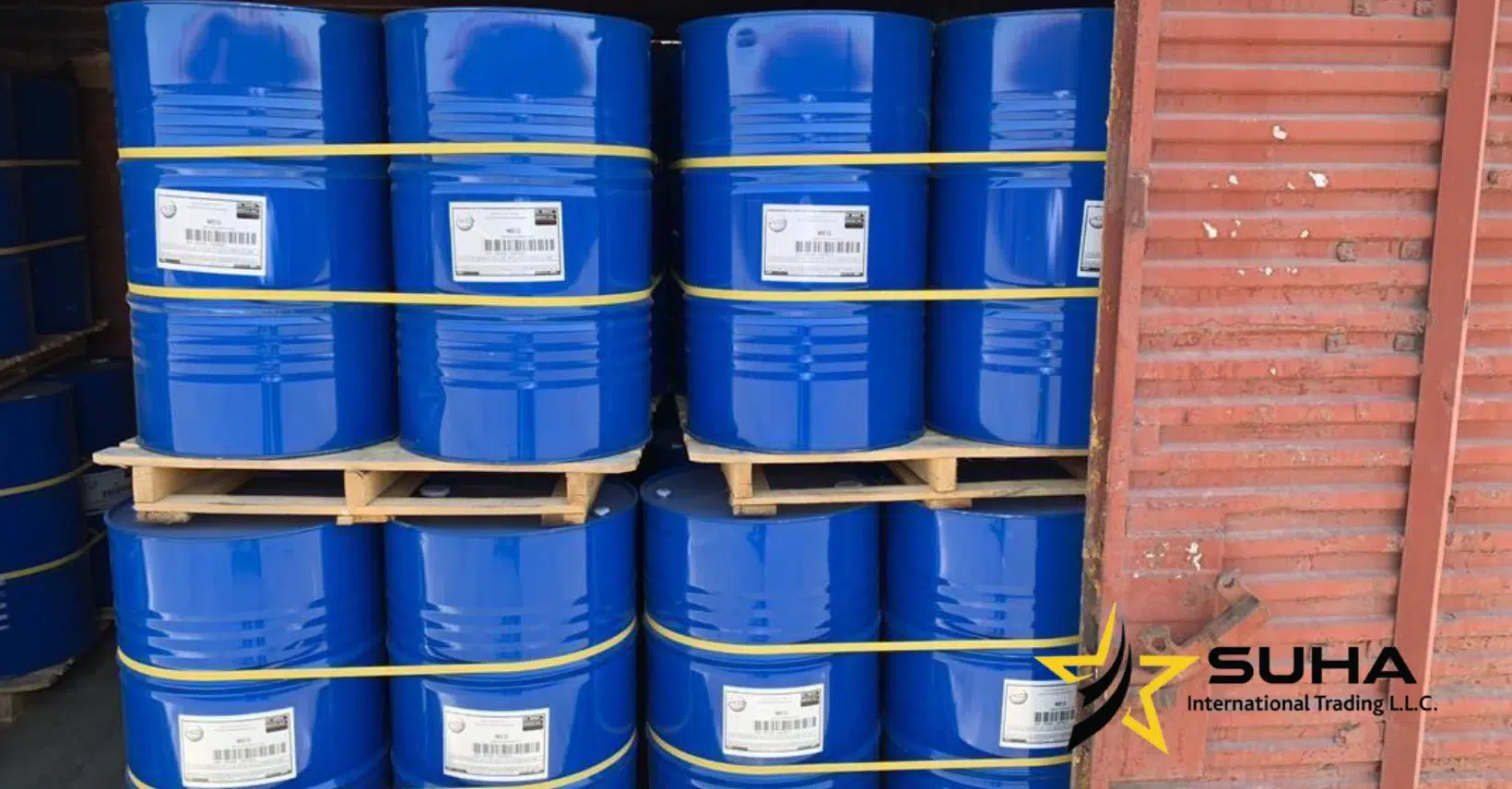
Gas processing chemicals · Bulk TEG from Türkiye & Dubai
Triethylene Glycol for Gas Dehydration: Process, Specifications and Bulk TEG Supply
Triethylene glycol for gas dehydration is the liquid desiccant that removes water vapour from natural gas before it enters a pipeline, LNG train or processing plant. Wet gas flows up through a contactor while lean TEG flows down, absorbs the water, and is then regenerated by heat and returned to the column. The cycle runs continuously, so the purity and stability of the TEG you buy directly controls the dew point you achieve and how much glycol you lose. This guide is for gas plant operators, oil and gas service companies, EPC contractors and chemical distributors who buy triethylene glycol in ISO tanks or drums.
Short answer
TEG is the standard glycol for natural gas dehydration because it holds water strongly, has a high boiling point (285 °C) and can be regenerated at up to about 204 °C without breaking down. That lets a simple unit reach 98.5–99% lean glycol, and 99.9% or more with stripping gas, for a water dew point depression of roughly 25–75 °C. Typical design figures are a TEG circulation of 2–6 US gal per lb of water removed (about 3 gal/lb is the common rule of thumb), a reboiler at 200–204 °C, and make-up losses of around 0.1 US gal per MMscf of gas in a well-run unit. For dehydration service, buy TEG at 99.5% purity or higher with low water and a lot-level COA.
- Why natural gas must be dehydrated
- Why TEG, not MEG or DEG
- How a TEG dehydration unit works
- Design numbers and dew point
- TEG circulation and make-up calculator
- TEG specification to buy
- Glycol quality in service
- Troubleshooting
- TEG losses and make-up
- Storage and packaging
- HS code and documents
- Our offices in Türkiye and Dubai
- FAQ
Fundamentals
Why Natural Gas Must Be Dehydrated Before Transport
Natural gas leaves the reservoir saturated with water vapour. A typical gas stream at around 70 bar and 38 °C can carry about 60 lb of water per million standard cubic feet (MMscf). As the gas cools and pressure changes along a pipeline, that water condenses, and three expensive things happen:
- Hydrates form. Water and light hydrocarbons combine into ice-like solids that block pipelines, valves and instruments, often well above 0 °C at high pressure.
- Corrosion accelerates. Free water dissolves CO₂ and H₂S into acids that attack carbon steel from the inside.
- Capacity drops. Liquid slugs reduce flow and damage compressors and downstream equipment.
That is why sales-gas contracts set a maximum water content. In North America it is commonly 4–7 lb/MMscf (about 64–112 mg/Sm³). Elsewhere it is often written as a water dew point at a stated pressure. Glycol dehydration, and specifically triethylene glycol for gas dehydration, is the most common way to meet that limit, and the U.S. EPA notes that most dehydrators in the industry use TEG.
Glycol selection
Why Triethylene Glycol Is the Standard for Gas Dehydration
Any ethylene glycol absorbs water, but engineers choose triethylene glycol for gas dehydration because only TEG combines strong water affinity, low losses and a high enough decomposition temperature to regenerate it to high purity in a simple reboiler. The comparison below shows why TEG took over from diethylene glycol in absorption service, and where monoethylene glycol still fits.
| Property | MEG | DEG | TEG | Tetraethylene glycol |
|---|---|---|---|---|
| Boiling point | 197 °C | 245 °C | 285 °C | ~314 °C |
| Approx. thermal decomposition | ~165 °C | ~164 °C | ~206 °C | ~238 °C |
| Achievable lean purity (simple reboiler) | Low | Moderate | 98.5–99% | High |
| Vaporisation losses | Highest | Moderate | Low | Lowest |
| Viscosity / cost | Lowest | Low | Moderate | Highest |
| Main gas-field use | Hydrate inhibition (injected) | Older absorption units, hydrate inhibition | Absorption dehydration, the industry standard | Hot gas or special cases |
Swipe the table sideways to compare all glycols.
TEG vs MEG: dehydration or hydrate inhibition?
The two do different jobs. TEG dehydrates: it removes water vapour in a contactor so the gas leaves dry. MEG inhibits hydrates: it is injected into wet gas or multiphase pipelines, often subsea, to lower the hydrate temperature, and is then recovered in a MEG regeneration unit. Many fields use both: MEG in the flowlines and a TEG dehydration unit at the plant. For quick, temporary or low-volume hydrate control, operators also inject methanol.
TEG vs solid desiccants
Molecular sieves reach far lower water levels (below 0.1 ppm) and are required upstream of cryogenic NGL and LNG plants. For pipeline-spec gas, a TEG unit costs much less to build and run, and many LNG plants use TEG upstream of the sieves to cut their load.
Process
How a TEG Dehydration Unit Works, Step by Step
A natural gas dehydration unit using TEG is a closed loop with an absorption side at pipeline pressure and a regeneration side near atmospheric pressure:
- Inlet scrubber. Separates free liquids, condensate, salt water, compressor oil and any amine carry-over before they reach the glycol. Most glycol problems start with a weak inlet scrubber.
- Contactor (absorber). Wet gas rises through bubble-cap trays or structured packing while lean TEG flows down and absorbs water. Dry gas leaves the top through a mist eliminator.
- Rich glycol to the flash tank. Water-rich TEG drops to a flash tank at low pressure, which releases dissolved methane and light hydrocarbons that can be used as fuel instead of being vented.
- Filtration. Particle filters remove solids and corrosion products. A carbon filter removes dissolved hydrocarbons and degradation products that cause foaming.
- Lean/rich heat exchange. Hot lean glycol pre-heats the cold rich glycol, cutting reboiler fuel substantially.
- Still column and reboiler. The reboiler heats the TEG to about 200–204 °C and the water boils off through the still column. Stripping gas or vacuum pushes lean purity above about 99%.
- Surge tank and pump. Regenerated lean TEG is cooled and pumped back to the top of the contactor, and the cycle repeats.
Design data
TEG Dehydration Design Numbers: Lean Purity, Dew Point and Circulation
Three numbers decide how dry the gas gets: how pure the lean TEG is, how much of it you circulate, and how many contact stages the column gives you. Lean purity is the strongest lever, and it depends on the quality of the triethylene glycol for gas dehydration you start with as well as on the regenerator.
| Lean TEG (wt %) | Dew point depression | How it is usually reached |
|---|---|---|
| 98.5% | ≈ 25–30 °C | Atmospheric reboiler, no stripping gas |
| 99.0% | ≈ 35–40 °C | Atmospheric reboiler at its practical limit |
| 99.5% | ≈ 50–55 °C | Modest stripping gas |
| 99.9% | ≈ 65–75 °C | Stripping gas, typically 30–60 Sm³ per m³ TEG |
| 99.95%+ | ≈ 80–90 °C | Enhanced stripping, vacuum or proprietary regeneration |
Swipe the table sideways to see every column.
Reboiler temperature
Hot enough to boil water out, but below the point where TEG degrades into acids (about 206 °C). Running hotter for extra purity damages the glycol.
Circulation rate
About 3 US gal of TEG per lb of water removed is the classic starting point. Over-circulating wastes fuel and raises losses without drying the gas much more.
Contactor
That typically means 6–8 bubble-cap trays or 3–5 m of structured packing, at around 30–50 °C gas inlet temperature.
Lean glycol temperature
Keeping lean TEG slightly warmer than the gas prevents hydrocarbons condensing in the contactor, which causes foaming.
Figures are typical engineering ranges used for screening. Final design should come from a process simulation with a glycol-specific property package and the licensor's or EPC's data.
Calculator
TEG Circulation and Make-Up Calculator for Gas Dehydration
Use this to estimate how much triethylene glycol your dehydration unit circulates and how much fresh TEG you need to buy each year to replace losses. It turns the design rules of thumb into an annual procurement figure.
TEG Circulation & Annual Demand Estimator
Enter your gas rate and water contents. Defaults are a typical saturated pipeline gas treated to a 7 lb/MMscf specification.
The estimator uses TEG density 1.125 kg/L and 3.785 L per US gal. It covers make-up only; add the initial fill (contactor, reboiler, surge tank and piping inventory) for a new unit or a full change-out.
Purchasing
TEG Specification for Gas Dehydration: What to Put on the Purchase Order
Fresh triethylene glycol for gas dehydration sets the starting quality of your glycol dehydration loop. Water, lighter glycols and contaminants in the make-up TEG lower achievable lean purity, raise losses and shorten glycol life. These are the parameters dehydration buyers specify, with our standard grade alongside:
| Parameter | Why it matters in dehydration | What to ask for | Our TEG |
|---|---|---|---|
| TEG purity | Lighter glycols (MEG, DEG) vaporise faster and degrade at lower temperature | ≥ 99.5 wt% | ≥ 99.5% (99.8% typical) |
| Water content | Water in fresh TEG is extra load on the regenerator | A low maximum (for example ≤ 0.1 wt%) | Per lot COA |
| Colour (APHA / Pt-Co) | Dark colour can signal oxidation or contamination | Low APHA, clear and colourless | Clear, colourless; per COA |
| Specific gravity @ 20 °C | A quick identity and dilution check on arrival | 1.124–1.126 | 1.124–1.126 |
| Acidity / pH | Acidic glycol corrodes carbon steel in the reboiler | Near neutral | Per lot COA |
| Chlorides and ash | Salts deposit on reboiler fire tubes and cause hot spots | Very low | Per lot COA |
| Appearance | Haze or particles indicate contamination | Clear, free of suspended matter | Clear liquid |
Swipe the table sideways to see every column.
Our TEG data: CAS 112-27-6, EINECS 203-953-2, molecular weight 150.17, boiling point 285 °C, freezing point −7 °C, flash point 177 °C (closed cup), viscosity about 49 cP at 20 °C. Full product data is on our triethylene glycol supplier page.
Operations
Glycol Quality in Service: pH, Contamination and Foaming
Once TEG is in the loop, it slowly picks up hydrocarbons, salts, solids and acids. Regular glycol analysis, often monthly, tells you when to filter, adjust pH or replace part of the inventory with fresh TEG:
| Check | Typical target | What a bad result means |
|---|---|---|
| pH | ≈ 7.0–8.5 | Below about 6.5: acid gas pick-up or thermal/oxidative degradation, which corrodes steel. Above about 9: amine carry-over from an upstream sweetening unit, which causes foaming |
| Lean TEG purity | As designed | Low: reboiler too cold, stripping gas low, or the still column flooded |
| Hydrocarbons | As low as possible | Condensate in the glycol: weak inlet scrubber or cold lean glycol, which leads to foaming and losses |
| Chlorides / salts | Very low | Produced water reaching the contactor: fouling, hot spots and fire-tube failure |
| Solids | Low | Corrosion products or sludge: filter change-out and check pH |
| Foam tendency | Low and stable | Contamination: carbon filtration, a defoamer trial and a hunt for the source |
| Colour | Light | Dark brown or black: degradation or heavy contamination, so plan a partial or full change-out |
Swipe the table sideways to see every column.
Low pH is usually corrected with a small, controlled dose of an alkaline buffer. Triethanolamine (TEA) is a common choice. If pH runs high from amine carry-over, look upstream: the amine contactor in an MEA or DEA gas sweetening unit, or its outlet separator, is the usual source.
Troubleshooting
TEG Dehydration Troubleshooting: Wet Gas, Foaming and High Glycol Loss
| Symptom | Likely cause | Fix |
|---|---|---|
| Gas off-spec (wet) | Low lean purity, low circulation, hot inlet gas, or damaged trays/packing | Check reboiler temperature and stripping gas, raise circulation, cool the inlet gas, inspect internals |
| Foaming in the contactor | Hydrocarbons, amine, solids or degradation products in the glycol | Improve inlet separation, service carbon and particle filters, trial a defoamer, keep lean glycol warmer than the gas |
| High TEG losses | Foaming carry-over, high gas velocity, worn mist pad, or high still-column temperature | Fix foaming, check the mist eliminator, control still-column top temperature, check for leaks |
| Low pH and corrosion | Acid gas pick-up, or overheating and oxidation of the TEG | Buffer the pH, keep the reboiler at or below 204 °C, nitrogen-blanket the storage tanks |
| Dark, sludgy glycol | Thermal degradation, salt or long service life | Partial or full change-out with fresh TEG, plus filtration |
| Reboiler fire-tube hot spots | Salt or sludge deposits | Remove the source of salt water, clean the tubes, replace contaminated glycol |
| Still column flooding | Hydrocarbons flashing in the still, or excessive circulation | Improve flash-tank separation and reduce circulation to design |
Swipe the table sideways to see the fixes.
Procurement planning
TEG Losses and Make-Up: How Much Triethylene Glycol to Buy
Every TEG dehydration unit loses glycol continuously and needs regular make-up. Losses come from four places:
- Vaporisation into the dry gas leaving the contactor. This is small for TEG, which is a key reason it is preferred over DEG.
- Mechanical carry-over as droplets or foam, usually the largest and most controllable loss.
- Still-column losses when the still top runs too hot and TEG leaves with the water vapour.
- Leaks, filter changes and degradation, including glycol removed during partial change-outs.
A well-run unit typically loses around 0.1 US gal of TEG per MMscf of gas treated. Units with foaming or carry-over problems can lose several times that. When you budget triethylene glycol for gas dehydration, plan on make-up plus a periodic partial or full change-out. Many operators keep at least one ISO tank or a stock of drums on site so a foaming event or a change-out never stops the unit. Use the calculator above to turn your gas rate into an annual tonnage.
Logistics
Storing and Shipping Bulk TEG for Dehydration Units
TEG is hygroscopic: it pulls moisture from the air, which is exactly why it dries gas. In storage, that same property quietly lowers its purity. Oxygen and heat also start the oxidation that produces acids. Good storage keeps fresh TEG at its delivered quality:
Storage good practice
- Use closed stainless steel, lined or clean carbon steel tanks
- Nitrogen-blanket bulk tanks to keep out moisture and oxygen
- Store at about 15–25 °C, away from direct heat
- Keep drums and IBCs sealed until use; reseal part-used drums
- Use within the shelf life (≥ 12 months sealed)
Packaging we ship
- ISO tank: 22–24 MT, best for plant make-up and change-outs
- Flexitank: 20–24 MT, lowest cost into a bulk tank
- IBC: 1,000–1,100 kg, easy for remote field sites
- Drums: 220 kg, for small units and spares stock
- MOQ 20 MT; FOB Mersin or Jebel Ali, or by truck from Türkiye
TEG is not classified as dangerous goods for transport, so it ships as general cargo by sea or road. On the SDS it carries H302 (harmful if swallowed) and H319 (causes serious eye irritation), so use gloves and eye protection when you charge the unit.
Compliance
Triethylene Glycol HS Code, COA and Export Documents
| Item | Detail |
|---|---|
| CAS / EINECS | 112-27-6 · 203-953-2 |
| HS code | 2909.49 |
| Certificate of Analysis | Purity, water, colour, specific gravity and acidity for the actual lot |
| MSDS / SDS | Required by customs, by the site HSE team and for tender pre-qualification |
| Shipping set | Commercial invoice, packing list, bill of lading or CMR, and certificate of origin |
| Tender documents | TDS, MSDS and a sample COA can be supplied for pre-qualification packages |
Standards and references used in this guide
- GPSA Engineering Data Book, Section 20 (Dehydration): glycol properties, circulation and design guidance
- U.S. EPA Natural Gas STAR: glycol dehydrators, flash tank separators and circulation optimisation
- Published engineering guidance on TEG contactor and regenerator design, including lean purity, dew point depression and reboiler limits
- Product data: SUHA International TEG technical data (CAS 112-27-6, purity ≥ 99.5%)
- Design figures are typical screening ranges and must be confirmed by process simulation and the unit licensor or EPC
Supplier
Triethylene Glycol Supplier for Gas Dehydration, with Offices in Türkiye and Dubai
SUHA International Trading supplies triethylene glycol for gas dehydration to gas processing plants, oilfield service companies, EPC contractors and chemical distributors across the Middle East, Africa, Central Asia and Europe. We work from two offices: our head office in Business Bay, Dubai, and our Türkiye office in Ankara. More about our company
Dubai Office
Office 2305, Burlington Tower,Business Bay, Dubai, United Arab Emirates Open in Google Maps
Ankara Office
Karşıyaka District, 749 Street, No 30,Gölbaşı, Ankara 06830, Türkiye Open in Google Maps
Meetings at either office are by appointment. WhatsApp is monitored seven days a week, and enquiries are answered within 24 business hours.
Dehydration-grade TEG
Purity of 99.5% minimum (99.8% typical), clear and colourless, with a lot-level COA for every shipment.
Bulk or drums
ISO tanks and flexitanks for plants, IBCs and drums for remote wellsite units and spares stock.
Two loading hubs
FOB Jebel Ali for Gulf, East African and Asian gas fields. FOB Mersin and road from Türkiye for the Caspian, Central Asia, Iraq and Europe.
Tender-ready documents
TDS, MSDS, COA and certificate of origin, ready for pre-qualification and customs.
The whole gas-processing set
TEG, MEG, methanol and MEA/DEA amines from one supplier, with one contact and fewer bookings.
Make-up planning
Tell us your gas rate and we will help you size annual make-up and change-out volumes.
Related gas processing chemicals
FAQ
Triethylene Glycol for Gas Dehydration: Frequently Asked Questions
Why is triethylene glycol used for gas dehydration?
Triethylene glycol (TEG) has a strong affinity for water, a high boiling point of 285 °C and a decomposition temperature of about 206 °C. It can be regenerated to 98.5–99.9% purity in a reboiler at 200–204 °C with low vaporisation losses, which makes it the most economical liquid desiccant for drying natural gas to pipeline specification.
How does TEG gas dehydration work?
Wet gas flows up through a contactor while lean TEG flows down and absorbs water vapour. The water-rich TEG passes through a flash tank and filters, is heated in a reboiler to about 200–204 °C to boil off the water, and the regenerated lean TEG is cooled and pumped back to the contactor in a continuous loop.
What is the maximum reboiler temperature for TEG?
TEG reboilers normally run at 200–204 °C. TEG begins to degrade thermally at about 206 °C, forming acids that corrode carbon steel and darken the glycol, so the reboiler should not exceed about 204 °C.
What is the typical TEG circulation rate?
Typical TEG circulation is 2–6 US gallons of glycol per pound of water removed (about 17–50 litres per kg), with about 3 gal/lb as the common rule of thumb. Raising circulation beyond the design point adds fuel use and losses without much extra drying.
What lean TEG concentration do I need?
It depends on the dew point depression required. Roughly, 98.5 wt% lean TEG gives about 25–30 °C of depression, 99.0% about 35–40 °C, 99.5% about 50–55 °C and 99.9% about 65–75 °C. Above about 99% you need stripping gas, vacuum or an enhanced regeneration process.
How much TEG is lost in a dehydration unit?
A well-run TEG dehydration unit typically loses around 0.1 US gallon of TEG per MMscf of gas treated. Units with foaming, carry-over or a hot still column can lose several times more, so make-up volumes should be planned from the actual loss rate.
What is the difference between TEG and MEG in gas processing?
TEG is used to dehydrate gas in a contactor, removing water vapour so the gas leaves dry. MEG is injected into wet gas or multiphase pipelines to inhibit hydrate formation and is then recovered in a MEG regeneration unit. Many fields use MEG in flowlines and a TEG unit at the plant.
Why is TEG preferred over DEG for dehydration?
TEG has a higher boiling point and a higher decomposition temperature (about 206 °C versus about 164 °C for DEG), so it can be regenerated to higher purity with lower vaporisation losses. That gives a lower water dew point and lower glycol consumption.
What causes foaming in a TEG contactor?
Foaming is usually caused by contaminants in the glycol: liquid hydrocarbons, amine carry-over from a sweetening unit, fine solids, or degradation products. Better inlet separation, carbon and particle filtration, keeping lean glycol slightly warmer than the gas, and a controlled defoamer dose are the usual fixes.
What pH should TEG be kept at?
In-service TEG is typically kept at a pH of about 7.0–8.5. Low pH indicates acid gas pick-up or degradation and causes corrosion, and is often corrected with a small dose of an alkaline buffer such as triethanolamine. High pH usually indicates amine contamination.
What purity of TEG should I buy for gas dehydration?
For dehydration service, buy TEG with a purity of at least 99.5 wt%, low water content, low colour and a lot-level certificate of analysis. Lighter glycols and water in fresh TEG reduce achievable lean purity and increase losses.
Is TEG better than molecular sieves for gas dehydration?
For pipeline-specification gas, a TEG unit is far cheaper to build and operate. Molecular sieves reach much lower water levels and are required upstream of cryogenic NGL and LNG plants, where TEG is often used first to reduce the load on the sieves.
How should bulk TEG be stored?
Store TEG in closed stainless, lined or clean carbon steel tanks, ideally under a nitrogen blanket to keep out moisture and oxygen, at about 15–25 °C. Keep drums and IBCs sealed, as TEG is hygroscopic and absorbs moisture from the air.
What is the HS code for triethylene glycol?
Triethylene glycol (CAS 112-27-6) is generally classified under HS 2909.49. It is not classified as dangerous goods for transport and ships as general cargo by sea or road.
What is the minimum order for TEG?
Our minimum order for triethylene glycol is 20 MT, supplied in ISO tanks (22–24 MT), flexitanks (20–24 MT), IBCs (1,000–1,100 kg) or 220 kg drums, loaded FOB Mersin or Jebel Ali or delivered by truck from Türkiye.
Where are your offices?
SUHA International Trading has its head office at Office 2305, Burlington Tower, Business Bay, Dubai, UAE, and a Türkiye office at Karşıyaka District, 749 Street, No 30, Gölbaşı, Ankara 06830. Meetings at both offices are by appointment.
Can I get a TEG sample and COA before ordering?
Yes. We supply a sample with its certificate of analysis, plus TDS and MSDS for tender pre-qualification. Contact us on WhatsApp at +971 50 720 9246 or by email at info@causticsodaco.com.
Request a Quote for Triethylene Glycol for Gas Dehydration
Send us five details and our desk in Dubai or Ankara will reply with a current COA and a FOB Mersin or Jebel Ali offer for dehydration-grade TEG.
- Annual or per-order tonnage
- ISO tank, flexitank, IBC or drums
- Required purity and water limit
- Destination port or field site
- Tender documents needed