Sodium Hydroxide in Cosmetics: Is It Safe for Your Skin?
You pick up a moisturizer, flip it over, and see sodium hydroxide on the label — the same compound used in drain cleaners. We break down the actual science, FDA & EU regulations, and why sodium hydroxide in cosmetics is not only safe but often essential.
Direct Answer: Yes, sodium hydroxide in cosmetics is completely safe. In finished skincare products, it is used in trace amounts (usually 0.01–0.1%) strictly to balance pH levels or facilitate saponification in soap. By the time the product reaches your skin, the raw lye has either been completely neutralized or consumed by chemical reactions.
What Is Sodium Hydroxide in Cosmetics?
Sodium hydroxide — chemical formula NaOH, commonly known as lye or caustic soda — is a highly alkaline compound with a pH of 14 in its pure form. In the beauty and personal care industry, it functions primarily as a pH adjuster, saponification agent, and emulsion stabilizer.
When formulators discuss sodium hydroxide in cosmetics, they are rarely talking about a free, active compound sitting in your jar. In a finished product, sodium hydroxide reacts with acids or fats in the formula, effectively neutralizing itself. What reaches your skin is the buffered, pH-adjusted product, not raw lye. The ingredient that enters the manufacturing process is not the same ingredient that ends up on your skin.
INCI Names to Know
- Sodium Hydroxide (Standard INCI name)
- Caustic Soda / Lye / Soda Lye
- Sodium Hydrate (Industrial datasheets)
Common Mislabeling Alert: Some sources incorrectly list "ascorbyl palmitate" as an alternate name for sodium hydroxide. This is factually wrong. Ascorbyl palmitate is a fat-soluble vitamin C ester.
Why pH Matters in Skincare
Your skin's surface maintains a naturally acidic pH of roughly 4.5–5.5, known as the acid mantle. This protective layer regulates moisture and defends against bacteria. When a cosmetic product has a pH that's too far outside this range, it can compromise the skin barrier or render active ingredients useless.
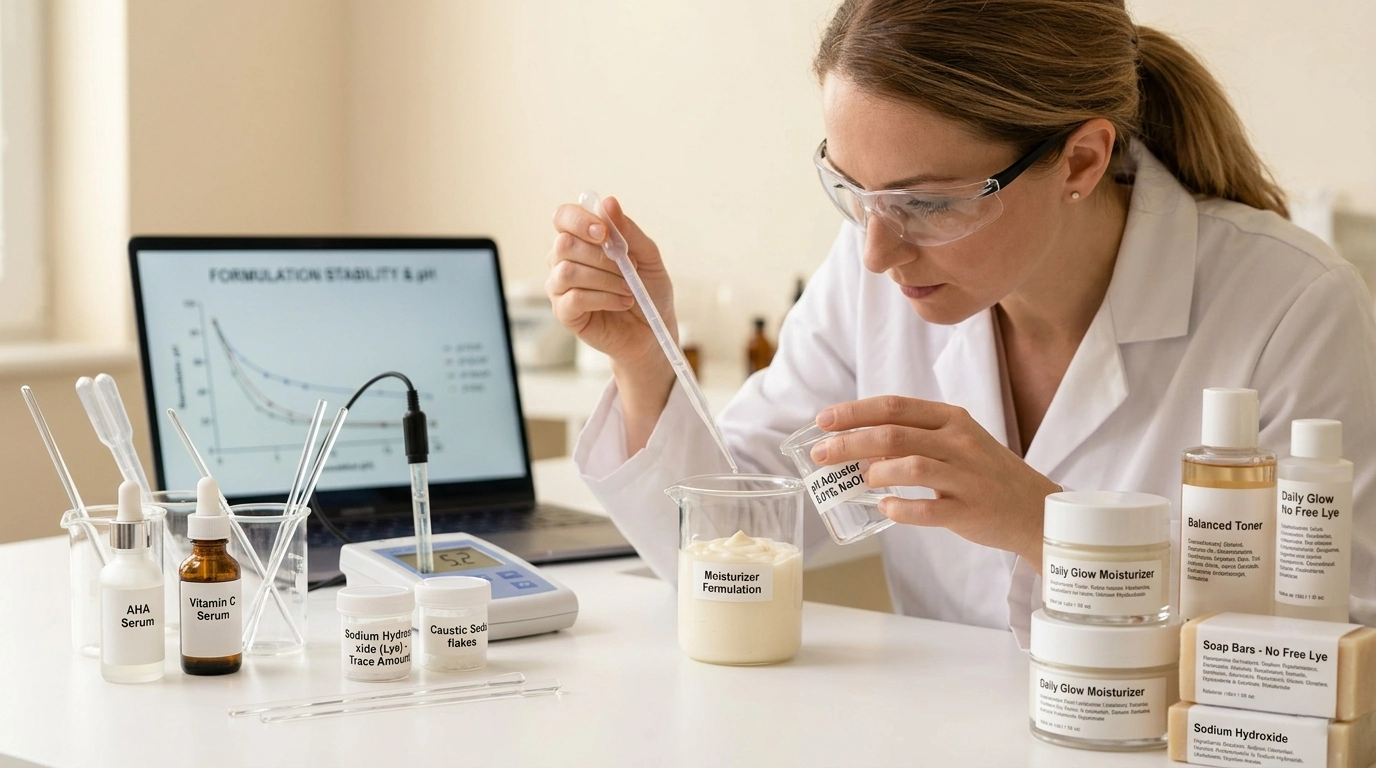
This is where sodium hydroxide in cosmetics earns its keep: tiny, precisely measured amounts raise the pH of acidic formulas just enough to bring them into the safe zone for skin contact, ensuring products like vitamin C serums and AHAs work without causing chemical burns.
7 Key Uses of Sodium Hydroxide in Beauty Products
1. pH Adjustment in Serums
Active ingredients like AHAs and vitamin C must be formulated at specific pH levels. At 0.01–0.1%, NaOH neutralizes excess acidity safely.
2. Saponification (Soap)
Bar soap cannot be made without an alkali. NaOH reacts with fats/oils to produce soap and glycerin. The lye is fully consumed.
3. Chemical Peels
In professional peels (1–5%), NaOH acts as a keratolytic agent, breaking dead skin cell bonds. Strictly for dermatologist use.
4. Hair Relaxers
Lye-based relaxers use NaOH to break hair's keratin bonds. Consumer products are capped at 2%, professional up to 4.5%.
5. Cuticle Softeners
Nail cuticle solvents are limited to 5% NaOH under EU regulations to dissolve excess tissue safely.
6. Emulsion Stabilization
Helps maintain viscosity in lotions and foundations, creating an environment that slows microbial growth naturally.
7. Alcohol Denaturation
Alters ethanol's character so it is no longer drinkable, meeting legal requirements for cosmetic alcohol.
Is Sodium Hydroxide in Cosmetics Safe?
The independent Cosmetic Ingredient Review (CIR) Expert Panel concluded that sodium hydroxide is safe in current practices when formulated to be non-irritating. The key principle is dose-response.
| Product Type | Typical NaOH Level | Risk Level |
|---|---|---|
| Daily moisturizer/serum | 0.01–0.1% | Negligible |
| Gentle cleanser | 0.05–0.5% | Very low |
| At-home chemical exfoliants | 1–2% | Low (follow directions) |
| Professional chemical peels | 3–5% | Moderate (pro only) |
| Consumer hair relaxers | Up to 2% | Moderate |
| Soap making (Raw Input) | 10–30% | Neutralized in final product |
Real-World Concentration Data (CIR Industry Survey)
Beyond typical formulation ranges, the Personal Care Products Council's concentration-of-use survey — reviewed by the CIR Expert Panel in its Safety Assessment of Inorganic Hydroxides — reports the actual maximum levels manufacturers use across product categories:
| Category | Exposure Type | Max. Reported Use |
|---|---|---|
| Lipstick | Leave-on | Up to 0.26% |
| Face/neck formulation | Leave-on | Up to 6.9% |
| "Other" skin care preparation | Leave-on / rinse-off | Up to 10% |
| Bath soaps & detergents | Rinse-off | Up to 12.9% |
These are industry-reported maximum use levels from a formulation survey, not a recommended safety ceiling — a product's overall pH and buffering system determine whether a given concentration is non-irritating, not the raw percentage alone.
Caution: While safe, it may trigger a reaction in highly sensitive individuals (hives, redness). Always perform a 24-hour patch test before using new products.
FDA & EU Regulations on NaOH
🇪🇺 EU Annex III
Enforces hard legal limits: Max 5% in cuticle solvents; max 2% consumer / 4.5% pro for hair straighteners. Final pH must remain below 11 for standard cosmetics (up to pH 12.7 in depilatories). View EU Regulation 1223/2009.
🇺🇸 US FDA & MoCRA
Cosmetic ingredients don't require FDA premarket approval — color additives are the only exception. Since the 2022 Modernization of Cosmetics Regulation Act (MoCRA), manufacturers are legally required to substantiate ingredient safety themselves — which is exactly where independent reviews like the CIR's come in.
5 Myths About Sodium Hydroxide in Cosmetics
"Any product with lye will burn my skin."
Fact: At 0.05% in a serum, sodium hydroxide is less irritating than the citric acid found in most Vitamin C products. The dose makes the poison.
"It's an industrial chemical with no place in natural beauty."
Fact: NaOH is approved for USDA Certified Organic soap production because it disappears entirely during saponification.
"If my soap doesn't list lye, the brand is hiding something."
Fact: INCI rules require listing final ingredients. Since lye becomes soap and glycerin, listing it would be scientifically inaccurate.
"It's the exact same thing as drain cleaner."
Fact: Drain cleaners use 30–50% NaOH. Cosmetics use 0.01–5%. Comparing the two is like comparing a drop of water to a tsunami.
"No-lye relaxers are always safer."
Fact: No-lye relaxers use calcium hydroxide but operate at the same high pH levels (12–13). Neither is categorically safer.
For Formulators: Sourcing Raw Sodium Hydroxide
If you are a manufacturer looking for high-purity NaOH for cosmetic or soap production, explore our product grades:
Frequently Asked Questions
Is sodium hydroxide in cosmetics bad for sensitive skin?
No. For most sensitive skin types, trace amounts used for pH adjustment (0.01–0.1%) pose no meaningful risk, provided the overall formula is gentle. Always patch test.
Does sodium hydroxide in soap damage skin?
No. In a properly cured soap, no free lye remains — only fatty acid salts and glycerin.
Can I use skincare with sodium hydroxide while pregnant?
Standard cosmetics containing trace sodium hydroxide are not a known concern. Consult your OB-GYN before using high-concentration peels.
What is the highest concentration of sodium hydroxide reported in real cosmetic products?
CIR's industry survey found reported levels ranging from about 0.26% in lipstick up to roughly 12.9% in rinse-off bath soaps, with the highest leave-on use at about 6.9% in a face/neck formulation. These are maximum reported use levels, not general safety thresholds — the finished product's overall pH still determines whether it's non-irritating.
Should You Avoid Sodium Hydroxide?
No — and the science firmly backs this up. The function of sodium hydroxide in cosmetics is largely invisible to the consumer, but its effects are everywhere: in the serum that doesn't sting, the cleanser that doesn't strip your acid mantle, and the bar soap that lathers without irritating. It isn't a loophole; it is a precisely controlled, genuinely essential part of modern beauty formulation.
Bulk NaOH Supplier for Cosmetic Manufacturing
Looking for a reliable sodium hydroxide supplier for soap making or cosmetic formulation? We export high-purity NaOH from UAE & Turkey that strictly meets EU and FDA standards.