
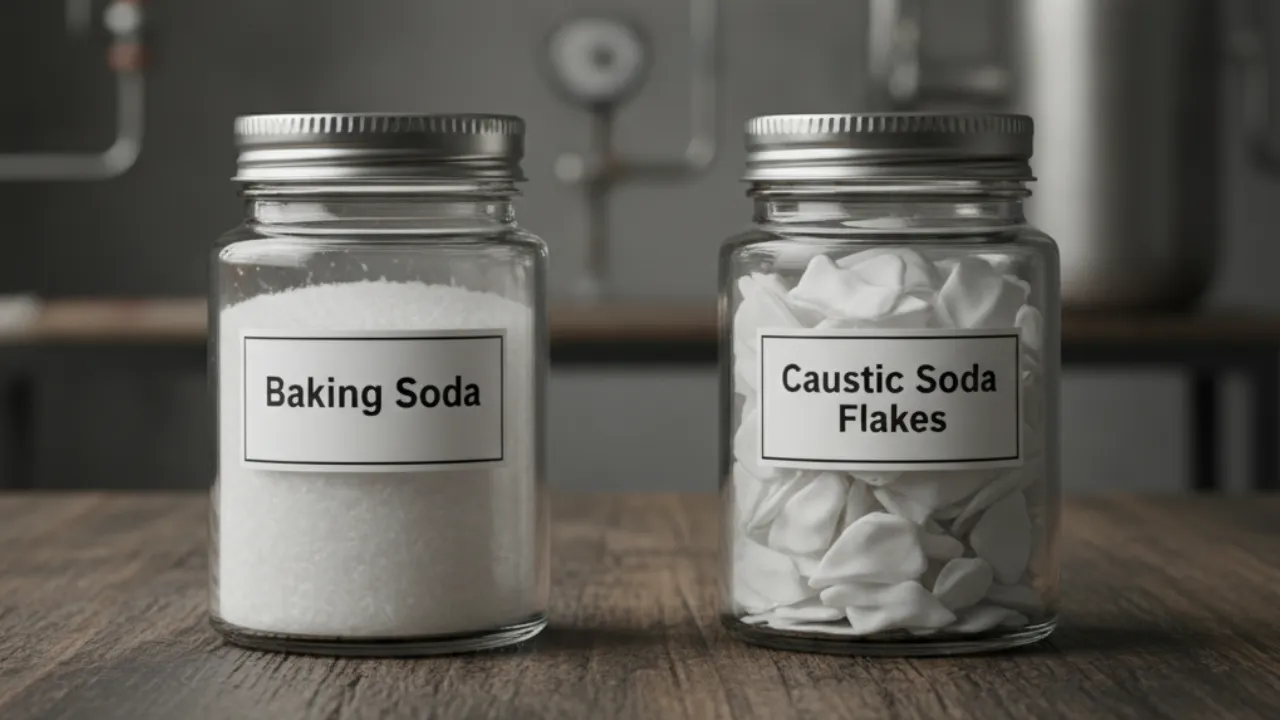
Caustic Soda vs Baking Soda: Are They the Same?
Short answer: no. They share the word “soda” and both are white solids, but caustic soda is sodium hydroxide (NaOH), a corrosive strong base, and baking soda is sodium bicarbonate (NaHCO3), a food-safe salt. This guide compares them on pH, strength, uses, hazards, storage, first aid and disposal — and shows how to tell two white powders apart without risking a burn.
Quick answer — Caustic soda and baking soda are not the same chemical. Caustic soda is sodium hydroxide (NaOH, CAS 1310-73-2), a strong base that reads about pH 13.5 in a 1% solution and burns skin, eyes and airways on contact. Baking soda is sodium bicarbonate (NaHCO3, CAS 144-55-8), a weak base and buffer that reads about pH 8.3 and is safe enough to eat. One is an industrial corrosive; the other is a food ingredient.
They are never interchangeable. Substituting baking soda for caustic soda fails the job; mistaking caustic soda for baking soda causes chemical burns and, if swallowed, is a medical emergency.
Is Caustic Soda the Same as Baking Soda?
No. Caustic soda is sodium hydroxide (NaOH) and baking soda is sodium bicarbonate (NaHCO3) — two different compounds with two different ions doing the work. Caustic soda carries the hydroxide ion (OH−) and behaves as a strong base; baking soda carries the bicarbonate ion (HCO3−) and behaves as a weak buffer. That single structural difference drives everything else on this page.
The confusion is understandable. Both are white, both contain sodium, and both inherited the historic word “soda” from an era when the term covered any sodium compound used for cleaning or medicine. But the resemblance stops at appearance. Below is why the mix-up happens so often, and why it matters more than almost any other chemical naming confusion in a workshop or kitchen.
A shared historic name
“Soda” once referred to any sodium compound used for washing or medicine. Hydroxide, bicarbonate and carbonate all kept the traditional label even after chemistry separated them into compounds with wildly different strengths.
Nearly identical appearance
Both are white solids. Without a label, a glance cannot tell caustic soda flakes from baking soda powder. This is exactly why any unlabelled white powder in an industrial setting must be treated as hazardous until identified.
Overlapping cleaning roles
Both appear on cleaning-product labels — baking soda as a gentle abrasive, caustic soda as the active ingredient in drain and oven cleaners. Seeing both in the same aisle reinforces the false idea that they are grades of one product.
What Each Chemical Actually Is
Caustic soda is produced by electrolysing brine in the chlor-alkali process, which also yields chlorine and hydrogen. Baking soda is produced by carbonating a soda ash solution, either as a Solvay-process intermediate or from mined trona ore. Different origins, different molecules, different jobs.
Caustic Soda
Sodium hydroxide — strong corrosive base
- Molar mass 40.00 g/mol
- Strong base; dissociates completely in water
- White translucent flakes, pearls or solid blocks
- Dissolves with strong heat release (exothermic)
- Highly hygroscopic — absorbs water and CO2 from air
- Corrosive to skin, eyes, aluminium, zinc and tin
- Melting point 318 °C; stays strongly alkaline when molten
- UN 1823 (solid) / UN 1824 (solution), IMDG Class 8, PG II
- HS 2815.11 (solid) / 2815.12 (aqueous)
Baking Soda
Sodium bicarbonate — mild, food-safe salt
- Molar mass 84.01 g/mol
- Weak base and buffer; only partial dissociation
- Fine, opaque white crystalline powder
- Dissolves slowly with little temperature change
- Essentially non-hygroscopic under normal storage
- Non-corrosive; mildly abrasive; FDA GRAS status
- Decomposes to Na2CO3 from about 80–100 °C
- Not classified as dangerous goods for transport
- HS 2836.30
What Is the Difference Between Caustic Soda and Baking Soda?
Strength is the difference that matters. Caustic soda dissociates completely in water and attacks fats, proteins and skin tissue on contact. Baking soda only partially dissociates and acts as a buffer, so it is mild enough to eat. Because pH is logarithmic, the gap between 8.3 and 13.5 is more than five orders of magnitude in hydroxide activity — not a difference of degree, but of kind.
| Property | Caustic Soda (NaOH) | Baking Soda (NaHCO3) |
|---|---|---|
| Chemical name | Sodium hydroxide | Sodium bicarbonate |
| Also called | Lye, caustic, sodium hydrate | Bicarbonate of soda, bicarb |
| CAS number | 1310-73-2 | 144-55-8 |
| Molar mass | 40.00 g/mol | 84.01 g/mol |
| Base strength | Strong base | Weak base / buffer |
| pH (1% solution, ~25 °C) | ~13.5 | ~8.3 |
| Dissociation in water | Complete | Partial; forms a buffer |
| Heat on dissolving | Strongly exothermic | Slightly endothermic |
| Reaction with acids | Vigorous, highly exothermic | Mild; releases CO2 gas |
| Effect on skin | Deep liquefactive burns | Mild irritation at worst |
| Corrosivity to metals | Attacks aluminium, zinc, tin | Non-corrosive |
| Thermal behaviour | Melts at 318 °C, stays alkaline | Decomposes from ~80–100 °C to Na2CO3 |
| Food status | Process aid only (21 CFR 184.1763, 173.315) | Direct food ingredient, GRAS (21 CFR 184.1736) |
| Hazard classification | GHS Skin Corr. 1A, Eye Dam. 1 — “Danger” | Not classified as hazardous |
| Occupational limit | OSHA PEL 2 mg/m³ (8-hr TWA); NIOSH IDLH 10 mg/m³ | No specific PEL; nuisance dust only |
| Household suitability | Not for routine home use | Common, safe household product |
| Main industries | Pulp & paper, refining, alumina, textiles, soap | Food, pharma, animal feed, flue-gas treatment |
Values are typical reference figures for industrial-grade material and are given for comparison, not for specification. Always work from the Safety Data Sheet and Certificate of Analysis for the batch you hold.
Where Washing Soda Fits Between Them
There is a third compound in this family, and it sits in the middle. Washing soda — also sold as soda ash — is sodium carbonate (Na2CO3), with a solution pH near 11. It is more alkaline and more aggressive than baking soda, yet far weaker than caustic soda. Most three-way confusion in cleaning and pool chemistry comes from not knowing this middle step exists.
The three are chemically linked, not just similarly named. Heat baking soda to roughly 80–100 °C and it decomposes into sodium carbonate, water and carbon dioxide; the conversion runs faster near 200 °C. That is why a tray of baking soda left in a hot oven turns into washing soda. Crucially, the reaction stops there. No amount of heating converts baking soda into caustic soda — sodium hydroxide is only made by electrolysis or by reacting soda ash with slaked lime, never in a kitchen.
| Common name | Compound | Solution pH | Typical role |
|---|---|---|---|
| Baking soda | NaHCO3 | ~8.3 | Food, gentle cleaning, antacid |
| Washing soda / soda ash | Na2CO3 | ~11 | Laundry, glass, water hardness, pH-up |
| Caustic soda | NaOH | ~13.5 | Pulp, refining, saponification, heavy degreasing |
If a process calls for “soda” without naming the compound, stop and check which one. Dosing soda ash where caustic soda was specified will under-treat the batch; dosing caustic soda where soda ash was specified can overshoot pH badly and damage equipment or product.
Is Lye the Same as Caustic Soda?
Yes, in almost every practical context. When a soap recipe, a pretzel recipe or a drain-cleaner label says “lye”, it means sodium hydroxide — the same chemical as caustic soda. The word can also cover potassium hydroxide (KOH), sometimes called potash lye, which is used for soft and liquid soaps. What lye never means is baking soda.
This matters because a large share of the caustic soda vs baking soda confusion arrives through the word “lye”. A home soap maker reading that lye is needed for saponification may reach for baking soda on the assumption that both are kitchen sodas. The result is not soap: without a strong hydroxide there is no saponification at all, only an oily emulsion that never sets.
Where Each One Is Actually Used
Strength dictates application. Caustic soda flakes do the heavy industrial work; baking soda handles the gentle, everyday and food-safe jobs. The lists below are where each compound earns its place — and they barely overlap.
Caustic Soda Uses
Strong base for heavy processing
- Pulp & paper — delignification in the Kraft process
- Petroleum refining — caustic washing and mercaptan removal
- Alumina — dissolving bauxite in the Bayer process
- Soap and detergent — saponification of fats and oils
- Textiles — scouring and mercerising of cotton
- Water treatment — pH correction and metal precipitation
- Food processing aid — fruit peeling, pretzel and olive treatment
Baking Soda Uses
Mild, food-safe and versatile
- Baking — leavening agent that releases CO2
- Household cleaning — gentle abrasive and deodoriser
- Personal care — toothpaste, mouthwash, mild scrub
- Medical — OTC antacid and clinical bicarbonate solutions
- Fire suppression — Class B/C dry chemical extinguishers
- Flue-gas treatment — dry sorbent injection for acid gases
- Animal feed — rumen buffer in dairy rations
Everyday products where caustic soda is already in your home
Most people never buy sodium hydroxide by name, yet it is the active ingredient in crystal and gel drain openers, most heavy-duty oven cleaners, and paint and varnish strippers. It is also what gives lye-dipped pretzels their dark, glossy crust. Recognising it on a label — listed as sodium hydroxide, lye, or caustic soda — is the simplest way to avoid treating it as an ordinary household powder.
Can I Use Baking Soda Instead of Caustic Soda?
No. Baking soda cannot replace caustic soda in saponification, drain clearing, pulp digestion or industrial degreasing. It does not hydrolyse fats and it cannot dissolve hair, grease or organic blockages. The substitution either fails outright or, in a plant, leaves an incomplete reaction that becomes its own hazard.
The reverse substitution is worse. Using caustic soda where baking soda was intended — in food, in a cleaning paste, in anything touching skin — causes chemical burns. There is one narrow overlap: both are alkaline, so both will raise the pH of a solution. But raising pH by a controlled step with a buffer and driving it to 13 with a strong base are different operations with different consequences.
Safety: The Difference That Sends People to Hospital
Caustic soda is classified under GHS as Skin Corrosion Category 1A with the signal word “Danger”, and appears in the OSHA occupational chemical database with a permissible exposure limit of 2 mg/m³ as an 8-hour time-weighted average. Baking soda needs no special protection for normal use. Treat any unlabelled white powder as hazardous until it is positively identified.
Caustic soda PPE
Splash goggles plus a face shield, nitrile or neoprene gloves (often double-gloved), a chemical-resistant apron and boots, and respiratory protection wherever dust or mist can form during transfer or bag emptying.
NaOH first aid
Skin or eyes: flush with running water for at least 30 minutes, removing contaminated clothing while flushing, then seek medical care. Never try to neutralise a burn — the reaction adds heat to an already injured area.
NaOH storage
Airtight, corrosion-resistant containers away from moisture and CO2, segregated from acids, aluminium, zinc and organics, with secondary containment and an eyewash station within ten seconds of the work area.
Baking soda handling
FDA GRAS under 21 CFR 184.1736. No special PPE for household quantities; a dust mask is sensible when handling bulk bags. Store dry and away from strong acids, which will trigger vigorous CO2 release.
If caustic soda is swallowed, it is a medical emergency. Sodium hydroxide causes immediate liquefactive burns to the mouth, throat and oesophagus. Do not induce vomiting — bringing the material back up burns the same tissue a second time. Do not give vinegar, lemon juice or any “neutraliser”: that reaction generates heat inside the injured tract.
Call your local poison centre or emergency number immediately, and take the product label or Safety Data Sheet with you.
Can baking soda neutralise a caustic soda spill?
Not on skin, and it is not the right tool on surfaces either. On skin, the rule is absolute: flush with running water, never neutralise. On a floor or bench, contain the spill, dilute it, then use a weak acid such as citric or acetic acid rather than a second alkali, and verify the runoff reaches pH 6 to 9 before disposal. Baking soda is itself a base, so it works slowly and inefficiently against a strong hydroxide while releasing CO2 — the wrong response in a confined space.
How to Tell Them Apart Without Getting Burned
Never by taste or touch. With gloves and eye protection, four checks separate the two reliably: appearance, heat of dissolution, reaction with vinegar, and a pH strip. The pH test is the only one that is conclusive on its own.
Appearance
Caustic soda appears as larger flakes, pearls or pellets that look slightly translucent or waxy, and it clumps as it draws moisture from the air. Baking soda is a fine, powdery, opaque white crystal that stays free-flowing.
Heat on dissolving
Add a small amount to water — never water to the solid. Caustic soda dissolves quickly and the container becomes noticeably hot. Baking soda dissolves slowly with no perceptible temperature rise, or a very slight cooling.
Reaction with vinegar
Baking soda fizzes vigorously, releasing carbon dioxide. Caustic soda shows little visible bubbling; the reaction mainly generates heat as the acid is neutralised.
pH test — the conclusive check
A dilute NaOH solution drives pH paper to deep blue or purple at pH 13–14. A NaHCO3 solution reads light blue or green at pH 8–9. No other pair of readings comes close.
Which Is Greener?
Baking soda, clearly. It is non-toxic to aquatic life at ordinary levels, does not bioaccumulate, and needs no special treatment before disposal. Caustic soda is energy-intensive to produce and its high-pH effluent must be neutralised to roughly pH 6–9 before it reaches a drain or watercourse.
The production gap is the larger part of the story. Caustic soda comes from the chlor-alkali process, which is electricity-hungry and co-produces chlorine gas that has to be captured and sold or consumed on site. Sodium bicarbonate is made by carbonating soda ash and is increasingly used to capture acid gases rather than create them — dry sorbent injection on industrial flue stacks uses NaHCO3 to strip SO2 and HCl.
For industrial users of NaOH, the practical obligations are consistent worldwide: labelled and segregated storage, trained handlers, written neutralisation procedures, pH-monitored effluent, and spill response equipment sized for the largest container on site.
Need Caustic Soda or Baking Soda in Bulk?
We supply and export both sides of this comparison — sodium hydroxide in flakes, pearls and liquid, and sodium bicarbonate in technical and food grades — from Turkey and Dubai, UAE, with a Certificate of Analysis per batch and a formal FOB or CIF quotation within 24 business hours.
Source Caustic Soda and Baking Soda From One Supplier
Whichever side of this comparison your process needs, our export desk answers every enquiry within 24 business hours — usually much sooner. For urgent supply or large-volume tenders, WhatsApp is the fastest channel.
WhatsApp — fastest response channel +971 50 720 9246 ✉ Email — enquiries and formal quotations info@causticsodaco.comInclude this for the fastest quotation
Caustic Soda vs Baking Soda — FAQ
Is caustic soda the same as baking soda?
No. Caustic soda is sodium hydroxide (NaOH), a strongly corrosive base with a pH near 13.5 in a 1% solution. Baking soda is sodium bicarbonate (NaHCO₃), a mild, food-safe salt with a pH near 8.3. They share the word "soda" and both are white solids containing sodium, which is why they are confused, but they are different compounds with different hazards.
What is the main difference between caustic soda and baking soda?
Strength. Caustic soda dissociates completely in water and behaves as a strong base, so it dissolves fats, proteins and skin tissue on contact. Baking soda only partially dissociates and acts as a buffer, so it is mild enough to eat. On the logarithmic pH scale the gap between 8.3 and 13.5 is more than five orders of magnitude in hydroxide activity.
Can I use baking soda instead of caustic soda?
No. Baking soda is far too weak to replace caustic soda in saponification, drain clearing, pulp digestion or industrial degreasing. It will not hydrolyse fats or dissolve organic blockages. Substituting it either fails the process outright or, in an industrial setting, leaves an incomplete reaction that creates its own hazard.
Is baking soda caustic?
No. "Caustic" means capable of burning or corroding living tissue. Baking soda is alkaline but not caustic: it holds FDA GRAS status under 21 CFR 184.1736 and is used in food, toothpaste and antacids. Prolonged skin contact with a paste can cause mild irritation, but it does not burn tissue the way sodium hydroxide does.
Is lye the same as caustic soda?
Yes, in ordinary use. "Lye" in soap making, food processing and drain cleaners almost always means sodium hydroxide, the same chemical as caustic soda. The word can also refer to potassium hydroxide (KOH), sometimes called potash lye, which is used for soft and liquid soaps. Lye is never baking soda.
Can baking soda neutralise a caustic soda spill?
Not on skin, and it is not the right choice on surfaces either. Never neutralise a chemical burn on skin: the reaction releases heat and adds a thermal injury to the chemical one, so flush with running water only. For a spill on a floor or bench, contain it, dilute it, then use a weak acid such as citric or acetic acid and confirm the runoff reaches pH 6 to 9 before disposal.
What happens if someone swallows caustic soda thinking it is baking soda?
It is a medical emergency. Sodium hydroxide causes immediate liquefactive burns to the mouth, throat and oesophagus. Do not induce vomiting, because bringing the material back up burns the same tissue a second time. Do not attempt to neutralise it with vinegar or juice. Call your local poison centre or emergency number immediately and take the product label or SDS with you.
Does heating baking soda turn it into caustic soda?
No. Between roughly 80 and 100 °C baking soda decomposes into sodium carbonate, water and carbon dioxide, and the conversion runs faster near 200 °C. Sodium carbonate is washing soda or soda ash, with a pH around 11 in solution — more alkaline than baking soda and irritating to skin, but still far weaker than sodium hydroxide. Heating never produces caustic soda.
How can I tell caustic soda and baking soda apart?
Never by taste or touch. Caustic soda usually appears as translucent flakes, pearls or pellets, dissolves quickly and releases obvious heat, and reads pH 13 to 14 on test paper. Baking soda is a fine opaque powder, dissolves slowly with almost no temperature change, fizzes strongly with vinegar, and reads pH 8 to 9. Treat any unlabelled white powder as hazardous until it is identified.
Do you supply both caustic soda and baking soda?
Yes. SUHA International supplies and exports caustic soda as sodium hydroxide flakes, pearls and liquid, and sodium bicarbonate in technical and food grades, from Turkey and Dubai, UAE. Every batch ships with a Certificate of Analysis, and a formal FOB or CIF quotation is issued within 24 business hours.
References
- PubChem CID 14798 — Sodium hydroxide
- PubChem CID 516892 — Sodium bicarbonate
- OSHA Occupational Chemical Database — Sodium hydroxide
- 21 CFR 184.1736 — Sodium bicarbonate (GRAS)
- 21 CFR 184.1763 — Sodium hydroxide
- 21 CFR 173.315 — Chemicals used in peeling fruits and vegetables
Content reviewed 10 September 2026 by the SUHA International technical desk. Figures are typical reference values for comparison and do not replace the Safety Data Sheet or Certificate of Analysis for a specific batch.