
Caustic soda, also known as sodium hydroxide (NaOH), is one of the most essential industrial chemicals produced worldwide. Understanding how caustic soda is made provides valuable insight into one of the most important processes in modern chemistry. From paper manufacturing to water treatment, this versatile chemical compound plays a critical role across dozens of industries.
In this comprehensive guide, we’ll explore the caustic soda production process step by step, including the primary manufacturing methods, raw materials required, environmental considerations, and safety protocols. Whether you’re an industry professional, a chemistry student, or simply curious about sodium hydroxide production, this article covers everything you need to know.
What Is Caustic Soda?
Caustic soda is a strong alkaline substance that appears as white flakes, pellets, or a concentrated liquid solution. It’s highly corrosive and extremely soluble in water, producing significant heat upon dissolution. Chemically known as sodium hydroxide (NaOH), its production is closely tied to the chlor-alkali industry, where it’s generated alongside chlorine gas and hydrogen gas.
The global demand for caustic soda exceeds 80 million metric tons annually, driven by its critical role in manufacturing soaps, detergents, textiles, aluminum, and hundreds of other products. But how is caustic soda made on such a massive industrial scale? The answer lies primarily in the electrolysis of brine — a process that has been refined over more than a century.
Key Properties of Caustic Soda
| Property | Detail |
|---|---|
| Chemical Formula | NaOH |
| Molecular Weight | 40 g/mol |
| Appearance | White solid (flakes/pellets) or clear liquid solution |
| Melting Point | 318°C (604°F) |
| pH | ~14 (strongly alkaline) |
| Solubility | Highly soluble in water (exothermic reaction) |
The History of Caustic Soda Production
The production of caustic soda dates back to the early 19th century. The earliest methods involved reacting sodium carbonate (soda ash) with calcium hydroxide (slaked lime) through what was known as the lime-soda process or Leblanc process. However, this approach was highly inefficient, produced significant pollution, and couldn’t meet growing industrial demand.
The real breakthrough came in the 1890s when the electrolytic chlor-alkali process was developed. Initially, mercury cell technology dominated the industry. Over the following decades, the process evolved through three distinct generations:
- 1890s–1960s: Mercury cell technology dominated
- 1960s–1980s: Diaphragm cell technology gained popularity
- 1980s–Present: Membrane cell technology became the modern standard
Today, nearly 99.5% of all caustic soda is produced via electrolytic methods, with membrane cells accounting for the majority of new installations worldwide. The European Union banned mercury cell technology entirely in 2017, accelerating the global transition toward cleaner, more efficient production methods.
Raw Materials Used to Make Caustic Soda
Before understanding how caustic soda is made, it’s important to know what raw materials are required. The caustic soda manufacturing process relies on surprisingly simple inputs:
Primary Raw Materials
- Sodium Chloride (NaCl): Common salt — either mined as rock salt or obtained from seawater evaporation — serves as the primary feedstock. Approximately 1.5 tons of salt are needed to produce one ton of caustic soda.
- Water (H₂O): Purified water is essential both as a solvent for creating brine and as a reactant in the electrolysis process.
- Electricity: The electrolysis process is energy-intensive, requiring approximately 2.5–3.0 MWh of electricity per ton of caustic soda produced.
Secondary Materials
- Ion-exchange resins for brine purification
- Hydrochloric acid and sodium hydroxide for pH adjustment during brine treatment
- Membrane materials (perfluorosulfonic acid polymers like Nafion®) for modern electrolytic cells
Primary Methods of Caustic Soda Production
When asking how is caustic soda made, the answer depends on which electrolytic cell technology is used. While the historical lime-soda process still exists for small-scale applications, the dominant technique is electrolysis of brine (sodium chloride solution). There are three main electrolytic cell types, each with distinct advantages and limitations.
Mercury Cell Process
In this older method, brine is electrolyzed using a mercury cathode. Sodium dissolves into the mercury to form sodium amalgam, which is then reacted with water in a separate vessel called a decomposer to produce high-purity caustic soda.
| Aspect | Detail |
|---|---|
| Purity | Very high (~50% NaOH directly) |
| Energy Consumption | High (~3.4 MWh/ton) |
| Environmental Impact | Severe — mercury pollution |
| Current Status | Phased out in EU (2017); declining globally |
Diaphragm Cell Process
This method uses an asbestos or synthetic polymer diaphragm to separate the anode and cathode compartments within the electrolytic cell. Brine flows through the diaphragm from the anode side to the cathode side, where caustic soda forms.
| Aspect | Detail |
|---|---|
| Purity | Lower (~12% NaOH, requires evaporation) |
| Energy Consumption | Moderate (~2.9 MWh/ton) |
| Environmental Impact | Moderate — asbestos concerns |
| Current Status | Still used in some regions; declining |
Membrane Cell Process
The membrane cell process is the modern industry standard and the most common method for understanding how caustic soda is made today. It employs a selective ion-exchange membrane (typically Nafion® or Flemion®) to separate the anode and cathode compartments.
| Aspect | Detail |
|---|---|
| Purity | High (~30–35% NaOH directly) |
| Energy Consumption | Lowest (~2.5 MWh/ton) |
| Environmental Impact | Minimal — no mercury or asbestos |
| Current Status | Industry standard for all new plants |
Comparison of All Three Methods
| Feature | Mercury Cell | Diaphragm Cell | Membrane Cell |
|---|---|---|---|
| NaOH Purity | ★★★★★ | ★★☆☆☆ | ★★★★☆ |
| Energy Efficiency | ★★☆☆☆ | ★★★☆☆ | ★★★★★ |
| Environmental Safety | ★☆☆☆☆ | ★★★☆☆ | ★★★★★ |
| Operating Cost | High | Medium | Low |
| Capital Cost | Medium | Low | High |
| Industry Trend | Declining | Declining | Growing |
Step-by-Step Caustic Soda Production Process
Now let’s examine exactly how caustic soda is made through the membrane cell method — the most widely used technology in modern sodium hydroxide production. The process involves four main stages, from raw material preparation to final product packaging.
Step 1: Brine Preparation and Purification
The caustic soda production process begins with preparing high-quality brine:
- Dissolution: Sodium chloride (NaCl), either as rock salt or solar salt, is dissolved in purified water to create a saturated brine solution containing approximately 300–310 grams of NaCl per liter.
- Primary Purification: The brine undergoes chemical treatment to remove impurities such as calcium, magnesium, iron, and sulfates. This typically involves adding sodium carbonate and sodium hydroxide to precipitate impurities as insoluble salts.
- Filtration: The precipitated impurities are removed through clarification and filtration.
- Secondary Purification: The brine passes through ion-exchange columns to reduce calcium and magnesium levels to below 20 parts per billion (ppb). This ultra-purification is critical because even trace impurities can damage the expensive membrane cells.
Why brine purity matters: A single milligram of calcium per liter can reduce membrane lifespan by up to 50%, costing hundreds of thousands of dollars in premature replacements.
Step 2: Electrolysis in Membrane Cells
This is the core stage where caustic soda is made through electrochemical reactions:
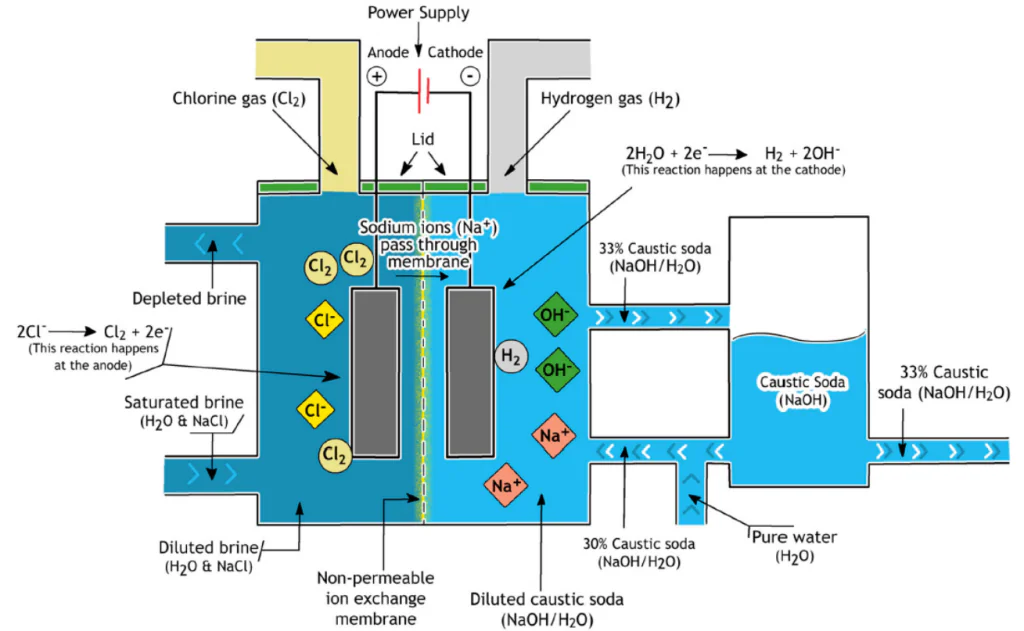
- Cell Setup: Purified brine is fed into the anode compartment of the electrolytic cell. The anode is typically made of titanium coated with ruthenium oxide, while the cathode is nickel or nickel-coated steel. A perfluorosulfonic acid membrane separates the two compartments.
- Anode Reaction (Oxidation): At the anode, chloride ions lose electrons to form chlorine gas:
2Cl⁻ → Cl₂ + 2e⁻
- Ion Migration: Sodium ions (Na⁺) migrate through the ion-exchange membrane from the anode compartment to the cathode compartment. The membrane selectively allows only positive sodium ions to pass while blocking chloride ions and chlorine gas.
- Cathode Reaction (Reduction): At the cathode, water molecules gain electrons to form hydrogen gas and hydroxide ions:
2H₂O + 2e⁻ → H₂ + 2OH⁻
- Caustic Soda Formation: The hydroxide ions combine with the sodium ions that have migrated through the membrane to form sodium hydroxide (NaOH) — caustic soda.
The overall reaction that shows how caustic soda is made:
2NaCl + 2H₂O → 2NaOH + Cl₂ + H₂
The process operates at 80–90°C with a voltage of 3–4 volts per cell. Modern chlor-alkali plants use hundreds of cells connected in series (called electrolyzers) to achieve economical production volumes.
Step 3: Concentration and Purification
The caustic soda solution produced in the membrane cells has a concentration of approximately 30–35% NaOH. Depending on the desired final product, further processing is required:
- 50% Liquid Caustic Soda: The solution is concentrated through multi-effect vacuum evaporation to reach 50% NaOH concentration. This is the most commonly traded form.
- Solid Caustic Soda (Flakes): The 50% solution is further concentrated and cooled on a flaking drum to produce solid flakes containing 98–99% NaOH.
- Solid Caustic Soda (Pellets/Prills): The concentrated solution is sprayed into a prilling tower where it solidifies into small, uniform pellets.
- 70–73% Caustic Soda: Some applications require this intermediate concentration, achieved through additional evaporation.
Throughout concentration, the solution is monitored for purity. The membrane cell process inherently produces high-purity caustic soda, but trace amounts of sodium chloride (typically <50 ppm) and sodium chlorate may require additional removal for pharmaceutical or food-grade applications.
Step 4: Byproduct Handling and Recovery
The caustic soda manufacturing process generates two valuable byproducts that are captured and utilized rather than wasted:
- Chlorine Gas (Cl₂): Collected from the anode compartment, dried, compressed, and used in manufacturing PVC (polyvinyl chloride), water disinfection, solvents, and various organic chemicals. Approximately 0.88 tons of chlorine are produced per ton of caustic soda.
- Hydrogen Gas (H₂): Collected from the cathode compartment and used as fuel for steam generation within the plant, as a chemical feedstock, or increasingly sold for clean energy applications. Approximately 0.025 tons of hydrogen are produced per ton of caustic soda.
- Depleted Brine: The brine leaving the anode compartment still contains significant sodium chloride. It is dechlorinated, re-saturated with fresh salt, and recycled back to the electrolysis cells, minimizing waste and reducing raw material costs.
Energy Efficiency and Environmental Impact
Understanding how caustic soda is made also means understanding the environmental footprint of its production. The chlor-alkali process is one of the most electricity-intensive industrial chemical processes.
Energy Consumption
| Technology | Electricity (MWh/ton NaOH) | Trend |
|---|---|---|
| Mercury Cell | 3.3–3.6 | Declining |
| Diaphragm Cell | 2.8–3.1 | Stable |
| Membrane Cell | 2.4–2.7 | Improving |
Innovations in advanced membrane materials and electrode coatings have reduced energy consumption by approximately 30% since the 1970s. Modern oxygen-depolarized cathode (ODC) technology promises further reductions of up to 30% beyond current membrane cell performance.
Environmental Improvements
The industry has made significant progress in reducing its environmental impact:
- Mercury Elimination: The EU’s complete ban on mercury cell technology in 2017 eliminated the largest source of industrial mercury emissions in Europe. Other regions are following suit.
- Asbestos Phase-Out: Synthetic polymer diaphragms are replacing asbestos-based materials in remaining diaphragm cell plants.
- Brine Recycling: Modern plants recycle 95%+ of their brine, dramatically reducing salt consumption and wastewater discharge.
- Renewable Energy Integration: Leading manufacturers are increasingly powering electrolysis with solar, wind, and hydroelectric energy, moving toward carbon-neutral caustic soda production.
- Waste Heat Recovery: Heat generated during electrolysis and evaporation is captured and reused, improving overall plant energy efficiency by 10–15%.
Applications of Caustic Soda
Once you understand how caustic soda is made, it’s equally important to know where it’s used. Sodium hydroxide is one of the most versatile industrial chemicals, with applications spanning virtually every manufacturing sector.
Pulp and Paper Industry
Caustic soda is used in the kraft pulping process to break down lignin and separate cellulose fibers from wood chips. It’s also essential for bleaching pulp to produce white paper products. This sector accounts for approximately 30% of global caustic soda consumption.
Alumina and Aluminum Production
In the Bayer process, caustic soda dissolves aluminum oxide (alumina) from bauxite ore, separating it from iron oxide and other impurities. This is a critical step in producing the aluminum used in everything from beverage cans to aircraft components.
Soaps and Detergents
Caustic soda is the essential reagent in saponification — the chemical reaction between fats/oils and an alkali that produces soap. Both bar soaps and liquid detergents rely on sodium hydroxide in their manufacturing.
Chemical Manufacturing
NaOH serves as a fundamental reagent in producing thousands of chemicals, including organic intermediates, dyes, pharmaceuticals, and agrochemicals. It’s used in neutralization reactions, pH adjustment, and as a catalyst.
Water and Wastewater Treatment
Municipal and industrial water treatment facilities use caustic soda to adjust pH levels, precipitate heavy metals, and regenerate ion-exchange resins used in water softening and demineralization.
Textile Industry
In textile manufacturing, caustic soda is used for mercerization (treating cotton fibers to increase strength, luster, and dye absorption) and in various dyeing and finishing processes.
Petroleum and Natural Gas
The oil and gas industry uses caustic soda for refining crude oil, removing sulfur compounds, and treating drilling mud. It helps neutralize acids produced during petroleum processing.
Food Processing
Food-grade caustic soda is used for cleaning and peeling fruits and vegetables, curing olives, processing cocoa, and producing caramel coloring. It’s also used in cleaning-in-place (CIP) systems for food processing equipment.
Safety Considerations in Handling Caustic Soda
Caustic soda is classified as a severely corrosive substance that can cause serious chemical burns on contact with skin, eyes, and mucous membranes. Anyone involved in caustic soda production, transport, or use must follow strict safety protocols.
Personal Protective Equipment (PPE)
- Chemical-resistant goggles or face shield
- Neoprene or PVC gloves rated for alkaline chemicals
- Chemical-resistant apron and boots
- Respiratory protection when handling dry caustic soda (dust) or in poorly ventilated areas
Storage Requirements
- Store in compatible containers made of stainless steel, high-density polyethylene (HDPE), or fiberglass-reinforced plastic
- Avoid aluminum, zinc, tin, and galvanized containers — caustic soda reacts with these metals, producing flammable hydrogen gas
- Maintain storage temperatures above 12°C (54°F) for 50% solution to prevent crystallization
- Ensure secondary containment (bunding) to capture spills
Emergency Response
- Skin contact: Immediately flush with large quantities of water for at least 20 minutes
- Eye contact: Flush with water for at least 30 minutes and seek immediate medical attention
- Spills: Contain with inert absorbent material, neutralize carefully with a weak acid, and dispose of according to local regulations
Frequently Asked Questions
The two main byproducts are chlorine gas (Cl₂) and hydrogen gas (H₂). Both are valuable industrial chemicals rather than waste products. Chlorine is used in PVC manufacturing, water disinfection, and chemical production. Hydrogen is used as clean fuel and in chemical synthesis. Approximately 0.88 tons of chlorine and 0.025 tons of hydrogen are produced per ton of caustic soda.
They are completely different chemicals. Caustic soda is sodium hydroxide (NaOH), a strong and highly corrosive alkali used in heavy industrial applications. Baking soda is sodium bicarbonate (NaHCO₃), a mild and safe alkaline compound used in cooking, cleaning, and personal care. Caustic soda has a pH of approximately 14, while baking soda has a pH of about 8.3. For more information (Click Here)
Yes. Caustic soda is classified as a severely corrosive substance. It can cause serious chemical burns to skin, eyes, and mucous membranes on contact. Ingestion can be fatal. However, when handled properly with appropriate personal protective equipment — including chemical-resistant gloves, goggles, and protective clothing — it can be used safely in industrial and commercial settings.
Caustic soda is used in a wide range of industries. The most common applications include paper and pulp manufacturing, aluminum production, soap and detergent making, water treatment, textile processing, petroleum refining, and food processing. It is one of the most versatile industrial chemicals in the world, with global demand exceeding 80 million metric tons annually.
Yes. Caustic soda is simply the common industrial name for sodium hydroxide (NaOH). Other widely used names include lye, soda lye, and sodium hydrate. All of these names refer to the exact same chemical compound with the formula NaOH.
Caustic soda is primarily made from sodium chloride (common salt) and water. These simple raw materials undergo electrolysis in the chlor-alkali process, where electrical energy splits them into sodium hydroxide (caustic soda), chlorine gas, and hydrogen gas. Approximately 1.5 tons of salt are required to produce one ton of caustic soda.
Conclusion
Understanding how caustic soda is made reveals one of the most fundamental and fascinating processes in industrial chemistry. The chlor-alkali electrolysis method — particularly using modern membrane cell technology — transforms simple salt and water into one of the world’s most essential chemicals while simultaneously producing valuable chlorine and hydrogen byproducts.
From the initial brine preparation and purification through the electrochemical reactions in membrane cells to the final concentration and packaging, every step in the caustic soda production process has been optimized over more than a century of continuous improvement. Today’s membrane cell plants represent the pinnacle of efficiency, producing high-purity sodium hydroxide with minimal environmental impact.
As global demand continues to grow — driven by expanding applications in aluminum production, water treatment, chemical manufacturing, and sustainable energy — the caustic soda industry continues to innovate. Advanced membrane materials, oxygen-depolarized cathodes, and renewable energy integration promise an even cleaner and more efficient future for caustic soda manufacturing.
Whether you’re sourcing caustic soda for your business or studying industrial chemistry, we hope this comprehensive guide has answered your questions about how this essential chemical is produced.
Looking for a reliable caustic soda supplier? [Contact Us Today] to discuss your requirements and get a competitive quote.