
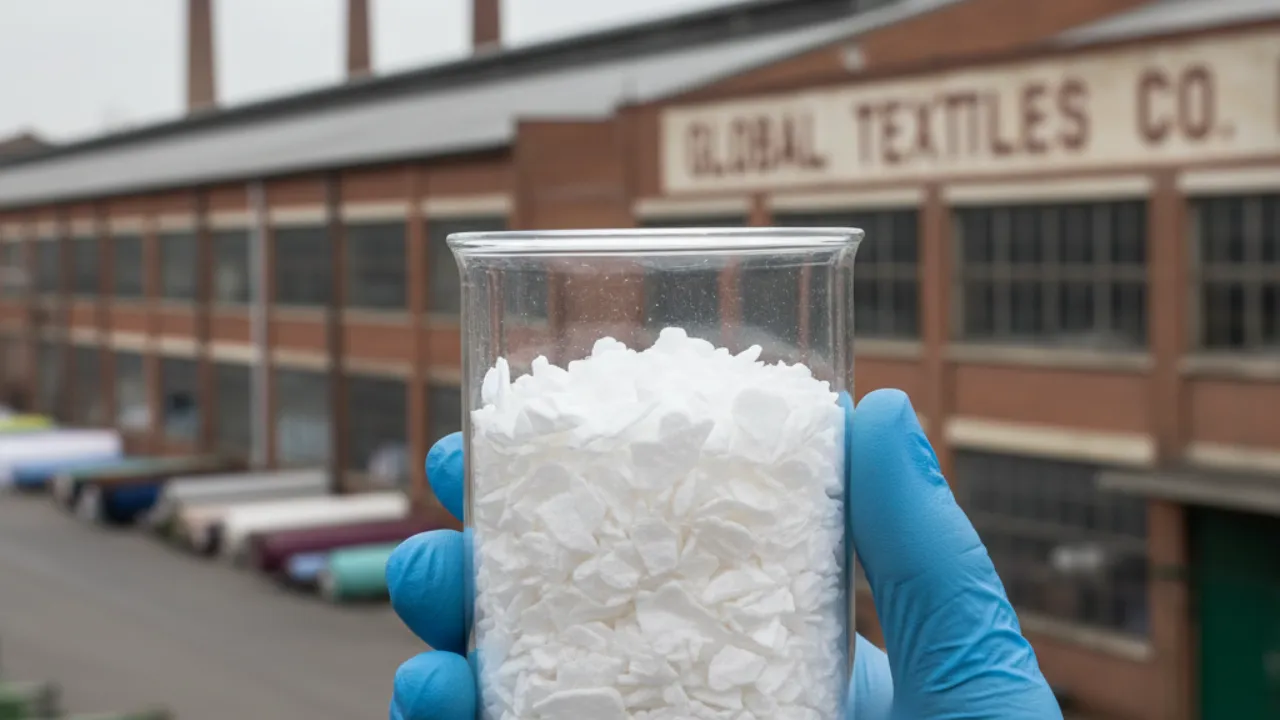
- What Is Caustic Soda and Why Does Textile Processing Depend on It?
- Key Applications of Caustic Soda in Textile Manufacturing
- Choosing the Right Grade of Caustic Soda for Textile Processing
- Benefits of Using Caustic Soda in Fabric Production
- Safety, Handling, and Environmental Considerations
- Future Trends: Sustainable Caustic Soda Usage in Textiles
- Conclusion
- Reach Out
- Top Products
- Contact Us
Caustic Soda for Textile Processing: What It Does and Why Mills Depend on It
Content reviewed: 28 October 2026 · SUHA International Trading L.L.C., Dubai & Ankara
Caustic soda for textile processing is sodium hydroxide (NaOH), the strong alkali that cotton mills use to scour, mercerise, bleach and dye cellulose fibres. It removes waxes and pectins, swells cotton for lustre and strength, activates hydrogen peroxide bleaching, fixes reactive dyes and dissolves vat and indigo dyes with hydrosulphite. It suits cotton, linen and viscose – but it destroys wool and silk.
Caustic soda is also called sodium hydroxide, NaOH, lye or caustic. Textile mills buy it as flakes, pearls (prills) or liquid lye, and use it at almost every wet-processing stage for cotton. SUHA International Trading supplies membrane-grade caustic soda for textile mills, dyehouses and chemical distributors, loading at Mersin (Türkiye) and Jebel Ali (UAE).
- FormulaNaOH
- CAS No.1310-73-2
- HS code2815.11 / .12
- Grades98% · 99%
- UN / Class1823 / 1824 · 8
- MOQ1 FCL
Why the Textile Industry Uses Caustic Soda
Cotton is about 90% cellulose, but raw cotton also carries natural waxes, pectins, proteins, seed-coat fragments and, on woven fabric, size from weaving. Water alone cannot remove them, and dyes cannot penetrate evenly while they remain. Caustic soda solves this because it is:
- The strongest common alkali – a 1% NaOH solution has a pH of about 13.4, high enough to saponify waxes and break down pectins.
- Able to swell cellulose – at mercerising strength it changes the cotton fibre itself, something no weaker alkali can do.
- Fully soluble and easy to dose – 111 g dissolves in 100 mL of water at 20 °C, and liquid lye is pumped straight into dosing systems.
- Cheap per unit of alkalinity – it is made in very large volumes by the chlor-alkali industry and traded worldwide.
| Property | Value |
|---|---|
| Chemical name | Sodium hydroxide, NaOH |
| Molar mass | 40.00 g/mol |
| Melting point | 318 °C |
| Solubility in water | 111 g/100 mL at 20 °C (strongly exothermic) |
| pH of 1% solution | About 13.4 |
| Commercial forms | Flakes 98–99%, pearls 99%, liquid lye 30–50% |
| Production route | Electrolysis of brine (membrane cell) |
Uses of Caustic Soda in the Textile Industry, Stage by Stage
In a cotton or cotton-blend mill, caustic soda for textile wet processing appears at five of the eight main stages:
- SingeingBurns off surface fibres. No caustic.
- DesizingRemoves starch or PVA size; caustic is used in oxidative or combined desize-scour.
- ScouringHot caustic removes waxes, pectins and oils so fabric becomes absorbent.
- BleachingCaustic sets the pH that activates hydrogen peroxide.
- MercerisingConcentrated caustic swells cotton for lustre, strength and dye uptake.
- DyeingFixes reactive dyes; dissolves vat, indigo and sulphur dyes.
- PrintingAlkali in reactive print pastes; mainly soda ash or bicarbonate.
- FinishingNeutralising, softening, resin finishing. Caustic must be fully washed out first.
Textile scouring with caustic soda
Scouring – also called kier boiling or alkaline boiling – treats greige cotton with dilute caustic soda near the boil, together with a wetting agent and detergent. NaOH saponifies the natural waxes into soluble soaps, dissolves pectins and hemicelluloses and loosens seed-coat fragments. The result is fabric that absorbs water instantly and dyes evenly. Polyester-cotton blends are scoured with milder alkali and shorter times, because hot caustic attacks polyester.
Exact concentration, temperature and time depend on the machine (kier, J-box, pad-steam, jet), the fabric and the auxiliaries, so mills set their own recipes with their dyehouse chemist or auxiliary supplier.
Textile Mercerisation: The Largest Single Use of Caustic Soda
Mercerisation (also spelled mercerization) treats cotton yarn or fabric with concentrated caustic soda – typically 20–26% NaOH – while it is held under tension, then washes the alkali out. John Mercer discovered the treatment in 1844; Horace Lowe found in 1889 that tension produces the silk-like lustre that mercerised cotton is known for.
The caustic swells each cotton fibre so that its flat, twisted shape becomes round. On washing, the cellulose re-forms in a different crystal structure (cellulose II), which gives:
- A higher, silk-like lustre
- Higher tensile strength
- Better dye uptake, so less dye is needed for the same depth of shade
- Better dimensional stability and lower shrinkage
Mercerising is where a cotton mill's caustic volume is concentrated. A 2025 review in the Euro-Mediterranean Journal for Environmental Integration puts mercerising consumption at 170–350 g of caustic soda per kg of fabric (Musaoglu & Unlu, 2025). Most mills therefore recover the weak lye from the washers by evaporation and reuse it, which cuts both caustic purchases and the alkali load in the effluent.
Caustic soda concentration: %, Baumé, Twaddell and g/L
Mercerising and dosing lines often measure lye strength in degrees Baumé (°Bé) or Twaddell (°Tw). This conversion table is calculated from standard NaOH solution densities at 20 °C:
| NaOH % w/w | Specific gravity | °Baumé | °Twaddell | g NaOH per litre |
|---|---|---|---|---|
| 10% | 1.109 | 14.2 | 21.8 | 111 |
| 16% | 1.175 | 21.6 | 35.0 | 188 |
| 20% | 1.219 | 26.1 | 43.8 | 244 |
| 24% | 1.263 | 30.2 | 52.6 | 303 |
| 28% | 1.306 | 34.0 | 61.3 | 366 |
| 50% (liquid lye) | 1.525 | 49.9 | 105.1 | 763 |
°Bé = 145 − 145 ÷ SG · °Tw = 200 × (SG − 1) · g/L = % × SG × 10.
Caustic Soda in Textile Bleaching with Hydrogen Peroxide
Hydrogen peroxide is the standard bleach for cotton, and caustic soda is what makes it work. Peroxide is stable in neutral water; adding NaOH raises the pH to about 10.5–11, where peroxide forms the perhydroxyl ion (HOO⁻) that oxidises the natural colour in cotton.
How caustic soda and hydrogen peroxide react: H₂O₂ + NaOH → Na⁺ + HOO⁻ + H₂O. Too little caustic and bleaching is slow; too much, or traces of iron or copper, and peroxide decomposes fast, wasting chemical and attacking the cellulose (pinholes and strength loss). Mills therefore add a stabiliser – sodium silicate or an organic stabiliser – and control iron in both the water and the caustic soda.
Scouring and bleaching are often combined in one bath on modern continuous ranges, which reduces water and energy use.
Caustic Soda in Textile Dyeing
Reactive dyeing of cotton
Reactive dyes bond chemically to cellulose only under alkaline conditions. Soda ash is the usual fixing alkali; caustic soda, alone or mixed with soda ash, is used where a higher pH is needed – for low-reactivity dyes, deep shades, short fixing times and cold pad-batch dyeing, often with sodium silicate. Alkali is usually added in portions so the dye fixes evenly instead of hydrolysing in the bath.
Vat and indigo dyeing: caustic soda and hydrosulphite
Vat dyes – including indigo for denim – are insoluble in water. Sodium hydrosulphite (sodium dithionite) reduces them to a soluble "leuco" form, but only in a strongly alkaline bath, and caustic soda supplies that alkalinity. The dissolved leuco dye penetrates the cotton and is then oxidised back to its insoluble coloured form inside the fibre. Without enough caustic, the hydrosulphite decomposes and the dye precipitates. Sulphur dyes follow a similar alkaline reduce-and-oxidise route.
Polyester weight reduction
Hot caustic soda slowly hydrolyses polyester from the surface. Mills use this deliberately – "alkali weight reduction" or "denier reduction" – to give polyester a softer, silk-like handle. The same reaction is why caustic must be controlled carefully on polyester-cotton blends.
Soda Ash vs Caustic Soda for Textile Processing
Soda ash (sodium carbonate, Na₂CO₃) and caustic soda (sodium hydroxide, NaOH) are both textile alkalis, but they are not interchangeable. Caustic soda is much stronger; soda ash is a milder, buffered alkali.
| Point | Caustic soda (NaOH) | Soda ash (Na₂CO₃) |
|---|---|---|
| Alkali strength | Strong; 1% solution about pH 13.4 | Moderate; 1% solution about pH 11.5, buffered |
| Scouring cotton | Standard choice; removes waxes and pectins fully | Milder scour, used for delicate goods or as a helper |
| Mercerising | The only practical alkali | Cannot mercerise |
| Peroxide bleaching | Main pH regulator | Sometimes used as a buffer |
| Reactive dyeing | Deep shades, low-reactivity dyes, cold pad-batch | The usual fixing alkali; easier pH control |
| Vat and indigo dyeing | Required with hydrosulphite | Too weak |
| Wool and silk | Destroys them | Used carefully, e.g. in silk degumming |
| Handling | Corrosive (Class 8); heat on dissolving | Irritant; not dangerous goods for transport |
Most cotton mills buy both. SUHA supplies caustic soda and soda ash, so both can be combined in one supply plan.
Which Fibres Can Be Treated with Caustic Soda?
Caustic soda is a cellulose chemical. On protein fibres it is destructive, and several textile guides get this wrong.
| Fibre | Caustic soda | What happens |
|---|---|---|
| Cotton | Suitable | Scoured, bleached, mercerised and dyed with NaOH |
| Linen, hemp, ramie | Suitable | Treated like cotton; milder conditions for linen |
| Viscose, modal, lyocell | With care | Regenerated cellulose swells strongly and loses strength in concentrated caustic; milder alkali is used |
| Polyester | With care | Hot caustic hydrolyses the surface – used on purpose for weight reduction, damaging if uncontrolled |
| Nylon (polyamide) | Resistant | Fairly resistant to alkali under normal processing |
| Wool | Do not use | Hot caustic dissolves wool keratin. Wool carbonising uses dilute sulphuric acid, not caustic |
| Silk | Do not use | Caustic hydrolyses silk fibroin. Silk is degummed with soap or a mild carbonate alkali |
Caustic soda for clothes at home? No. Caustic soda for textile use is an industrial process chemical, run in closed machines with controlled washing and neutralising. In a household washing machine – top-loading or front-loading – it can burn skin, ruin wool, silk and elastane, fade colours and damage aluminium parts. For home laundry, use detergent or washing soda (sodium carbonate).
Caustic Soda for Textile Mills: Grades, Forms and Specifications
Textile-grade caustic soda is not a separate chemical – it is high-purity NaOH whose impurities are low enough not to cause faults in bleaching and dyeing. Membrane-cell caustic soda, which SUHA supplies, is the grade most mills prefer.
Caustic soda flakes 98% / 99%
The most traded form for textile mills that dissolve their own lye. Easy to store and ship in 25 kg bags.
Caustic soda pearls 99% (prills)
Free-flowing beads that dose accurately and dissolve evenly – favoured for automatic dosing and smaller batches.
Liquid caustic soda (lye)
Ready to pump into dosing and mercerising systems with no dissolving step. Shipped in ISO tanks.
What to check on the certificate of analysis
| Parameter | Why it matters in the mill |
|---|---|
| NaOH assay | Sets the real alkali you pay for and dose; 98% and 99% flakes, 99% pearls |
| Iron (Fe) | The key parameter: iron catalyses peroxide decomposition, causing pinholes, weak spots and yellowing |
| Sodium carbonate (Na₂CO₃) | Shows CO₂ pick-up; reduces effective alkalinity |
| Sodium chloride (NaCl) | Low in membrane grade; matters for recovery loops and effluent salt |
| Heavy metals (Cu, Ni) | Copper also catalyses peroxide decomposition |
| Insolubles and appearance | Specks and residue can mark fabric and block nozzles |
Guaranteed limits for each form are in our technical data sheets: flakes TDS, pearls TDS and liquid caustic soda TDS. Every lot ships with a certificate of analysis.
How Much Caustic Soda Does a Textile Mill Need?
For procurement planning, mercerising is the line that decides volume. This estimator uses the 170–350 g of caustic soda per kg of fabric reported for mercerising (Musaoglu & Unlu, 2025), before any lye recovery.
Estimate of gross caustic demand as 100% NaOH, before lye recovery, which can return much of it to the line. One 20ft container of flakes carries about 25 MT (1,000 × 25 kg bags). Confirm your own consumption with your process team.
Buying Caustic Soda for Textile Mills in Bulk
SUHA International Trading is a caustic soda supplier and exporter for the textile industry – mills, dyehouses, denim and knit processors, and the distributors that serve them. We are a trading company, not a chlor-alkali producer: we source membrane-grade NaOH from approved producers and handle documents and logistics from Dubai and Ankara.
Products
- Caustic soda flakes 98% and 99%
- Caustic soda pearls 99%
- Liquid caustic soda (lye)
- Soda ash for reactive dyeing
Commercial terms
- MOQ: one full container load (20ft or 40ft)
- Packing: 25 kg bags, palletised or inside jumbo bags; liquid in ISO tanks
- FOB Mersin or Jebel Ali, CFR or CIF your port
- Sea freight and road freight from Türkiye
Documents
- Commercial invoice and packing list
- Bill of lading or CMR
- Certificate of origin
- Certificate of analysis per lot
- SDS and dangerous-goods declaration (UN 1823 solid / UN 1824 solution, Class 8, PG II)
Supplying textile hubs in Türkiye, the Gulf and worldwide
From Ankara we deliver to textile mills in all 81 Turkish provinces, including the major cotton-processing centres, and by road to neighbouring markets. From Dubai we serve all seven emirates and the Gulf. By sea from Mersin and Jebel Ali we export to textile-producing countries in South Asia, Southeast Asia, Africa, Europe and the Americas.
What to include in your RFQ
- Form and grade: flakes 98% or 99%, pearls 99%, or liquid
- Monthly volume and number of containers
- Packing: palletised bags, bags in jumbo bags, or ISO tank
- Destination port or city and Incoterm
- Any iron or heavy-metal limit your bleaching process needs
- Start month and contract length
Safe Handling of Caustic Soda in Textile Plants
Caustic soda is classified as Skin Corrosion 1A (H314) – it causes severe skin burns and eye damage – and Metal Corrosion 1 (H290). Textile workers handle it daily, so the basics matter:
- PPE: chemical goggles and face shield, alkali-resistant gloves, apron and boots. Eyewash and safety shower within reach of every dissolving and dosing point.
- Dissolving: always add caustic to water slowly while stirring – never water to caustic. Dissolving releases a lot of heat and can boil and spatter.
- Storage: keep bags dry, closed and off the floor, away from acids, and away from aluminium, zinc and tin, which caustic attacks with release of hydrogen.
- Spills: contain the spill, sweep up solid caustic dry into labelled containers, then dilute the residue with plenty of water. Neutralise only dilute residues, slowly – adding acid to concentrated caustic generates heat.
- First aid: rinse skin or eyes with running water for at least 15 minutes and get medical help.
- Effluent: neutralise alkaline wastewater to the pH your discharge permit sets before release.
Full guidance is in our caustic soda MSDS (PDF).
Caustic Soda Demand in the Textile Chemicals Market
Grand View Research values the global textile chemicals market at about USD 28.6 billion in 2025, rising to about USD 40.4 billion by 2033 (4.4% a year), with Asia Pacific holding about 58% of revenue. Pretreatment – scouring, bleaching and mercerising, where most caustic soda is used – is one of the main segments.
Wet processing is resource-heavy: the 2025 review by Musaoglu and Unlu reports around 55 L of water and 8–20 kWh of energy per kg of textile. That is why mills are combining scour-bleach steps, using enzymatic scouring for some goods and recovering mercerising lye – changes that reduce, but do not remove, the need for caustic soda.
Sources: Grand View Research, Textile Chemicals Market report; N. Musaoglu & D. Unlu, "Caustic in textile processes and environmentally responsible solutions: a mini-review", Euro-Mediterranean Journal for Environmental Integration 10 (2025), doi:10.1007/s41207-025-00801-6.
Caustic Soda for Textile: FAQ
What is caustic soda used for in the textile industry?
Caustic soda (sodium hydroxide) is used to scour cotton, mercerise cotton yarn and fabric, set the pH for hydrogen peroxide bleaching, fix reactive dyes, dissolve vat and indigo dyes with hydrosulphite, and reduce the weight of polyester. Mercerising and scouring use the most.
Why is caustic soda used in scouring?
Caustic soda saponifies the natural waxes in cotton into soluble soaps and dissolves pectins and other impurities. This makes the fabric absorbent so that bleaching and dyeing are even.
What concentration of caustic soda is used for mercerisation?
Mercerisation typically uses 20–26% sodium hydroxide, applied to cotton under tension and then washed out. In degrees Baumé, 20% NaOH is about 26 °Bé and 24% is about 30 °Bé at 20 °C.
What happens when caustic soda and hydrogen peroxide are mixed?
Caustic soda raises the pH so that hydrogen peroxide forms the perhydroxyl ion (HOO⁻), the active bleaching species for cotton. Too much alkali or traces of iron or copper make peroxide decompose quickly, which wastes it and can damage the fibre, so mills add a stabiliser.
Why are hydrosulphite and caustic soda used together?
In vat and indigo dyeing, sodium hydrosulphite reduces the insoluble dye to a soluble leuco form, and caustic soda provides the strong alkalinity that reaction needs. The dissolved dye enters the cotton and is then oxidised back to its insoluble colour inside the fibre.
What is the difference between soda ash and caustic soda in textile processing?
Caustic soda (NaOH) is a strong alkali used for scouring, mercerising, peroxide bleaching and vat dyeing. Soda ash (Na₂CO₃) is a milder, buffered alkali and the usual fixing agent for reactive dyes. Soda ash cannot mercerise cotton, and most mills buy both.
Can caustic soda be used on wool or silk?
No. Hot caustic soda dissolves wool keratin and hydrolyses silk fibroin. Wool is carbonised with dilute sulphuric acid, and silk is degummed with soap or a mild carbonate alkali.
Can caustic soda be used to wash clothes?
Not at home. Caustic soda for textile processing is used in controlled industrial machines. In a household washing machine, top-loading or front-loading, it can burn skin, damage wool, silk and elastane, fade colours and corrode aluminium parts. Use detergent or washing soda instead.
Which is better for textile mills: caustic soda flakes, pearls or liquid?
Liquid lye suits large mills with storage tanks and pumped dosing. Flakes are the most traded solid form for mills that dissolve their own lye. Pearls flow freely and dose accurately, which suits automatic dosing and smaller batches.
What is textile-grade caustic soda?
Textile-grade caustic soda is high-purity NaOH, usually from membrane-cell production, with low iron, low heavy metals and low carbonate, so it does not cause faults in peroxide bleaching or dyeing.
Why does iron content in caustic soda matter for textiles?
Iron catalyses the decomposition of hydrogen peroxide during bleaching. Excess iron causes pinholes, weak spots and yellowing on cotton, so bleaching mills check the iron figure on every certificate of analysis.
How much caustic soda does a textile mill use?
Mercerising is the largest use. A 2025 review reports 170–350 g of caustic soda per kg of mercerised fabric, so a line mercerising 10 tonnes a day needs roughly 1.7–3.5 tonnes of NaOH a day before lye recovery.
Can caustic soda be recovered in textile mills?
Yes. Weak lye from mercerising washers can be concentrated by evaporation and reused on the line. Recovery reduces caustic purchases and the alkali load in the effluent.
Is caustic soda harmful to cotton?
Not when it is controlled. Cotton tolerates caustic soda well, which is why it is scoured and mercerised with it. Problems come from oxygen and heat during hot caustic treatment, or from peroxide decomposition, which weakens the cellulose.
Can caustic soda be used on polyester?
With care. Hot caustic soda hydrolyses polyester from the surface. Mills use this on purpose for alkali weight reduction, which gives a softer, silk-like handle, but uncontrolled exposure weakens polyester and polyester-cotton blends.
Is caustic soda dangerous for textile workers?
Yes. It is classified Skin Corrosion 1A (H314) and causes severe burns and eye damage. Workers need goggles, a face shield, alkali-resistant gloves and clothing, and an eyewash and safety shower nearby. Caustic must always be added to water, never water to caustic.
What is the HS code and UN number for caustic soda?
Solid caustic soda is HS 2815.11 and liquid caustic soda (lye) is HS 2815.12. For transport, solid is UN 1823 and solution is UN 1824, both Class 8, packing group II. The CAS number is 1310-73-2.
Are you a caustic soda manufacturer for textiles?
No. SUHA International Trading is a supplier and exporter, not a chlor-alkali producer. We source membrane-grade caustic soda from approved producers and supply textile mills and distributors with documents and logistics from Dubai and Ankara.
What is your minimum order for caustic soda for textile use?
Our minimum order is one full container load, 20ft or 40ft. Solid caustic soda is packed in 25 kg bags, palletised or inside jumbo bags, and liquid caustic soda ships in ISO tanks.
Do you supply caustic soda to textile mills in Türkiye?
Yes. From Ankara we deliver caustic soda to textile mills in all 81 Turkish provinces and ship by road to neighbouring markets. We also export by sea from Mersin and Jebel Ali.
Request a Quote for Caustic Soda for Textile Use
Fill in the form and send it by email or WhatsApp. We reply with a dated quotation, the TDS and the SDS.
Email: info@causticsodaco.com · WhatsApp: +971 50 720 9246 · Ankara office