Caustic Soda in Metal Processing: Cleaning, Etching, Plating and Refining
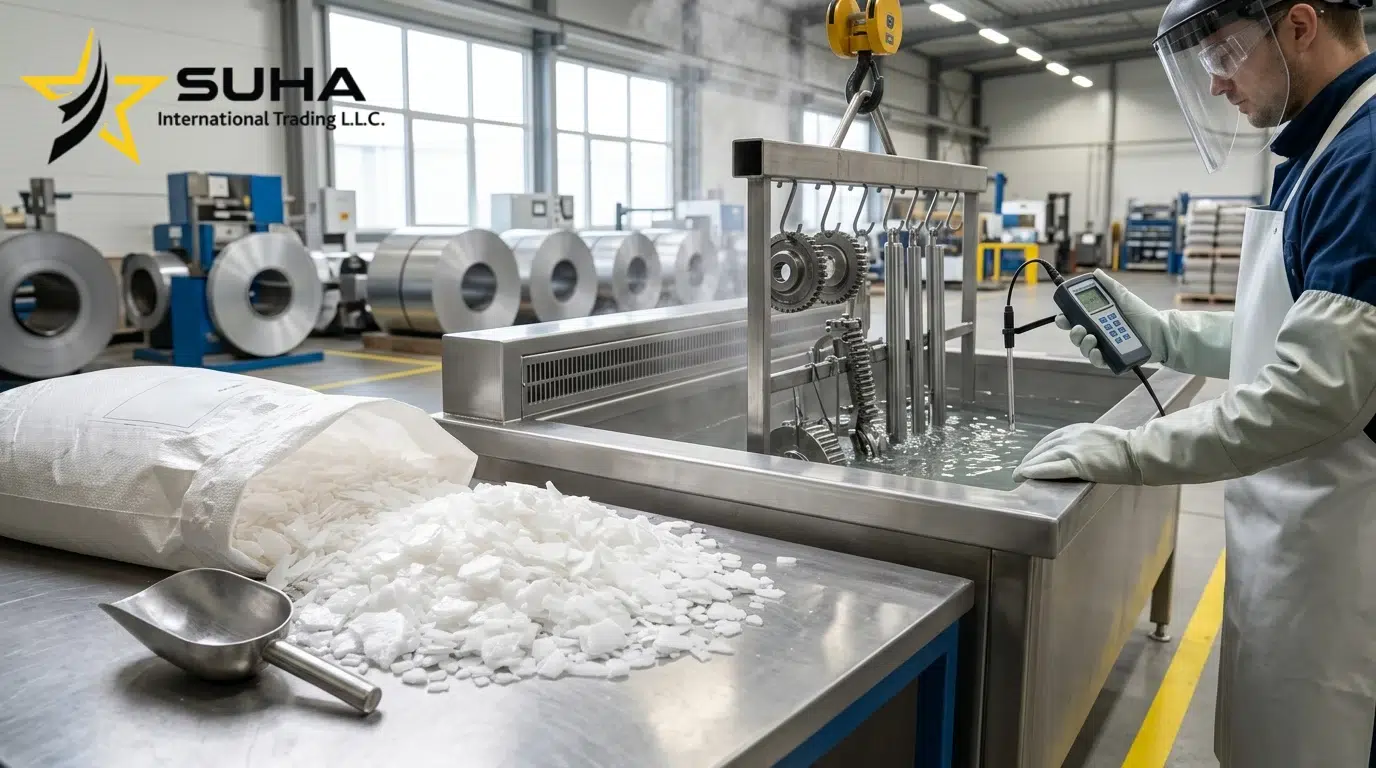
What is caustic soda used for in metal processing?
Caustic soda — sodium hydroxide, NaOH, also called lye — is the main alkali of the metals industry and of metal surface treatment. It dissolves alumina from bauxite in the Bayer process, strips oil and grease from steel and aluminium before coating, etches aluminium ahead of anodising, runs alkaline zinc and tin plating baths, cleans aluminium extrusion dies, sets pH in hydrometallurgy and battery recycling, and precipitates dissolved metals out of finishing wastewater as hydroxides.
Most uses need only a dilute bath — typically 20–150 g/L NaOH at 50–90 °C — while alumina refining runs concentrated caustic liquor in pressurised digesters. Plants buy it as flakes 98–99%, pearls 99% or 48–50% liquid, choosing on dissolving equipment, dosing method and freight.
- Chemical
- Sodium hydroxide, NaOH
- CAS · EC
- 1310-73-2 · 215-185-5
- HS code
- 2815.11 solid · 2815.12 liquid
- Hazard
- Skin Corr. 1A · Eye Dam. 1
- Transport
- UN 1823 / UN 1824 · Class 8
- Exposure limit
- 2 mg/m³ (OSHA, ACGIH)
Caustic soda in metal processing: applications, concentrations and temperatures
Typical operating windows from published practice. Exact figures depend on the alloy, the soil or ore, the proprietary additives in a formulated bath and the line speed — treat them as starting points to confirm with your chemical supplier or process licensor.
| Application | What NaOH does | Typical NaOH level | Temperature |
|---|---|---|---|
| Bayer process (alumina) | Dissolves aluminium hydroxide from bauxite as sodium aluminate | concentrated liquor | ~140–150 °C gibbsite; 200–280 °C boehmite / diaspore |
| Alkaline cleaning and degreasing | Saponifies fats and oils, lifts soils from steel | 20–100 g/L | 60–90 °C |
| Aluminium etching (pre-anodise) | Removes the oxide film and a thin metal layer for a uniform matt surface | 40–100 g/L | 50–70 °C |
| Alkaline non-cyanide zinc plating | Electrolyte and complexing medium for zinc as zincate | 100–150 g/L | 20–35 °C |
| Alkaline tin (stannate) plating | Free caustic keeps sodium stannate stable | ~7–15 g/L free | 60–80 °C |
| Electroless copper | Holds the pH the formaldehyde reducer needs | pH 12–13 | 25–50 °C |
| Extrusion die cleaning | Dissolves aluminium left in steel extrusion dies | 20–30% w/w | 70–90 °C |
| Paint and coating stripping | Hot caustic breaks down organic coatings on steel | 10–30% w/w | 80–100 °C |
| Hydrometallurgy and recycling | Neutralises, raises pH and precipitates metal hydroxides | pH control | ambient–80 °C |
| Wastewater treatment | Precipitates Zn, Ni, Cu, Cr(III) as hydroxides | pH 8.5–10.5 | ambient |
Scroll the table sideways to see every column.
Why caustic soda works in metal processing
Sodium hydroxide is a strong base: a 1% solution sits near pH 13.4, and it stays fully dissociated in water. Three properties make it useful on a metals line. It saponifies animal and vegetable fats into water-soluble soap, so it lifts drawing compounds and greases. It dissolves amphoteric oxides — aluminium, zinc, tin and lead oxides form soluble aluminates, zincates, stannates and plumbites — which is the basis of both the Bayer process and aluminium etching. And it precipitates most other metals as insoluble hydroxides, which is how finishing plants clean their effluent through hydroxide precipitation.
Dissolving solid NaOH releases about 44.5 kJ per mole (roughly 1,100 kJ per kg), so a make-up tank can boil locally if flakes are dumped in fast. Always add caustic to water, slowly and with stirring, never water to caustic. Solid NaOH is hygroscopic and absorbs carbon dioxide from air, forming sodium carbonate, which is why bags must stay sealed.
How caustic soda is made
Nearly all modern sodium hydroxide comes from membrane-cell chlor-alkali electrolysis of purified brine, which produces a 30–33% solution plus chlorine and hydrogen. The solution is evaporated to 48–50% liquid, and further to anhydrous melt that is cooled into flakes or prilled into pearls. Membrane-grade product is low in sodium chloride and iron — the two impurities that matter most in plating and stainless-steel service.
Which metals does caustic soda react with?
The most searched question about caustic soda in metal processing, and the one that decides tank materials, jig materials and which parts can go into a caustic bath.
| Metal | Reaction with NaOH | What it means in practice |
|---|---|---|
| Aluminium | Rapid 2Al + 2NaOH + 6H₂O → 2Na[Al(OH)₄] + 3H₂ | Used on purpose for etching and extrusion-die cleaning; releases hydrogen and heat |
| Zinc and galvanised steel | Attacked forms sodium zincate + H₂ | Strips galvanising; the basis of alkaline zinc plating baths |
| Tin and lead | Attacked forms stannate / plumbite | Basis of alkaline tin plating; keep solder away from hot caustic |
| Brass | Zinc phase attacked | Avoid for caustic valves and fittings |
| Copper and bronze | Slow fairly resistant to dilute caustic | Tarnishes; not recommended for hot concentrated service |
| Carbon steel and iron | Resistant at moderate temperature | Standard tank material; caustic embrittlement risk when hot and stressed |
| Stainless steel | Resistant in dilute caustic | Stress-corrosion cracking possible in hot concentrated caustic |
| Nickel | Highly resistant | Material of choice for hot, concentrated caustic evaporators |
| Magnesium and titanium | Resistant at ambient | Titanium is attacked by hot concentrated caustic |
The rule of thumb: metals whose oxides are amphoteric — aluminium, zinc, tin and lead — dissolve in caustic soda; iron, nickel and most stainless steels do not. That is why sodium hydroxide can clean a steel part without harming it but will eat an aluminium one.
Caustic soda in metal refining: the Bayer process and hydrometallurgy
Bayer process for alumina
Alumina refining is the largest single metals use of caustic soda. Ground bauxite is digested in hot caustic liquor in pressurised vessels: gibbsitic bauxite at about 140–150 °C, boehmitic and diasporic ores at 200–280 °C. The aluminium hydroxide dissolves as sodium aluminate; iron oxides, titania and silica-bearing residues settle out as red mud. The clarified liquor is cooled and seeded so that aluminium hydroxide precipitates, which is then calcined at roughly 1,000–1,100 °C to smelter-grade alumina.
Most of the caustic is recovered and recycled to digestion, so a refinery buys make-up caustic to replace what is lost to red mud (mainly as sodium aluminosilicate “desilication product”) and to the product. Bauxite with more reactive silica therefore consumes more caustic per tonne of alumina.
Base-metal hydrometallurgy
In leach circuits sodium hydroxide is mainly a neutralising and precipitating agent. Nickel and cobalt are recovered from sulfate leach solutions as mixed hydroxide precipitate (MHP) at around pH 7–8.5, with NaOH, magnesia or lime as the base. Zinc can be leached directly from oxidic materials such as electric-arc-furnace dust in strong caustic, where it dissolves as zincate while iron stays behind. In gold cyanidation, caustic or lime holds the slurry at pH 10–11 so that cyanide stays in solution rather than escaping as hydrogen cyanide gas.
Battery recycling
Lithium-ion recycling uses caustic soda twice: a dilute alkaline wash can dissolve aluminium foil and current-collector residues from shredded “black mass”, and in the refining stage NaOH raises pH to precipitate nickel, cobalt and manganese as hydroxides or to make precursor material for new cathodes. Both steps call for low-impurity, membrane-grade caustic.
Caustic soda for metal cleaning, aluminium etching and electroplating
Alkaline cleaning and degreasing
Heavy-duty alkaline cleaners for steel are built on sodium hydroxide, usually with silicates, phosphates, chelants and surfactants. Typical baths run 20–100 g/L NaOH at 60–90 °C, by immersion, spray or electrocleaning, for a few minutes. Caustic saponifies fatty soils; the surfactants handle mineral oils. A good clean is checked simply by the water-break test: a continuous water film after rinsing means the surface is free of oil. Strong straight caustic is not used on aluminium, zinc or brass, which it attacks — those metals get mild or inhibited alkaline cleaners.
Aluminium etching before anodising
Etching in 40–100 g/L NaOH at 50–70 °C removes the natural oxide and a thin layer of metal, hiding extrusion die lines and giving the even matt or satin finish that anodising then preserves. Etch depth is controlled by time, temperature and free caustic, typically a few micrometres. Additives such as sodium gluconate keep dissolved aluminium in solution and stop hard scale forming on tank walls. After etching, the part carries a dark “smut” of alloying elements that is removed in a nitric or sulfuric acid desmut before anodising.
Electroplating baths
Alkaline non-cyanide zinc baths carry roughly 100–150 g/L NaOH with zinc as sodium zincate; they give better thickness distribution into recesses than acid zinc, which is why they are common for fasteners and brackets. Alkaline tin uses sodium stannate with a small excess of free caustic, around 7–15 g/L, to keep the stannate stable. Electroless copper for printed circuit boards and plating on plastics relies on NaOH to hold pH 12–13, where the formaldehyde reducer works. In every case chloride and iron in the caustic end up in the deposit or the bath, so plating shops specify low-impurity grades.
Aluminium extrusion die cleaning
Extrusion plants remove aluminium left inside steel dies by soaking them in hot caustic soda, typically 20–30% NaOH at 70–90 °C. The aluminium dissolves; the tool steel does not. Die-cleaning tanks release large volumes of hydrogen and caustic mist, so they need strong extraction and must be kept away from ignition sources.
Paint stripping, descaling and rust
Hot caustic solutions of about 10–30% NaOH near the boil strip paint, powder coat and carbonised deposits from steel jigs, hooks and parts. Caustic soda is not a pickling acid: rust and mill scale are normally removed with hydrochloric or sulfuric acid, and caustic is used before pickling to degrease, or in alkaline derusting baths where it is combined with chelating agents such as sodium gluconate, sometimes with electrolytic current. On its own, sodium hydroxide removes oil, grease and paint far better than it removes rust.
Caustic soda compared with other cleaning alkalis
Sodium hydroxide is rarely used alone in a modern cleaner. It supplies the free alkalinity and saponifying power; milder builders buffer the bath, soften water and protect light metals.
| Alkali | Strength | Typical role | Safe on aluminium and zinc? |
|---|---|---|---|
| Caustic soda (NaOH) | Very strong, pH 13–14 | Heavy-duty steel cleaning, saponification, paint stripping, etching | No |
| Caustic potash (KOH) | Very strong | Similar to NaOH; potassium soaps are more soluble, at higher cost | No |
| Soda ash (Na₂CO₃) | Moderate, pH ~11 | Buffer and builder in milder cleaners | With inhibitors |
| Sodium metasilicate | Strong | Builder and corrosion inhibitor for light metals | Yes, in formulated cleaners |
| Trisodium phosphate | Moderate | Builder, water softening, rinsability | With care |
Caustic soda in metal-finishing wastewater treatment
Finishing effluent is usually acidic and carries dissolved metals. Raising the pH with caustic soda precipitates them as hydroxides that settle or filter out as sludge.
| Metal | Approximate optimum pH | Note |
|---|---|---|
| Chromium(III) | 8–9 | Hexavalent chromium must first be reduced to Cr(III) |
| Copper | 9–10 | Chelating agents from electroless baths hold copper in solution |
| Zinc | 9–9.5 | Amphoteric — redissolves as zincate if pH runs too high |
| Nickel | 10–10.5 | Needs a higher pH than most other metals |
| Aluminium | 6.5–7.5 | Amphoteric — dissolves again above about pH 8.5 |
Because the best pH differs by metal, mixed effluent is treated at a compromise pH, sometimes in two stages. Compared with lime, caustic soda dissolves instantly, doses precisely through a metering pump and adds no calcium to the sludge, so the sludge volume is smaller — at a higher chemical cost per unit of alkalinity. Discharge limits are set locally; in the United States the metal-finishing effluent guidelines (40 CFR Part 433) are the reference.
Neutralisation arithmetic: 1 kg of sulfuric acid needs 0.82 kg of NaOH (2 × 40 ÷ 98), and 1 kg of hydrochloric acid needs 1.10 kg. At 98–99% assay, that is about 0.83 kg and 1.11 kg of flakes respectively.
Tank and piping materials for caustic soda service
Caustic attacks some metals violently and cracks others under stress at temperature. Material choice depends on concentration and temperature together.
| Material | Suitability | Watch-out |
|---|---|---|
| Carbon steel | Standard for storage and dilute baths at moderate temperature | Caustic stress-corrosion cracking (“caustic embrittlement”) at higher temperature and concentration; stress-relieve welds in hot service |
| Stainless steel 304 / 316 | Good in dilute and moderate caustic | Can crack in hot concentrated caustic; chlorides worsen pitting |
| Nickel 200 / 201 and nickel alloys | Preferred for hot, concentrated caustic such as evaporators | Higher cost; specify where steel fails |
| PP, HDPE, PVC, FRP (suitable resin) | Common for dilute baths, day tanks and dosing lines | Temperature limits of each plastic; check resin type for FRP |
| Aluminium, zinc, galvanised steel, tin, brass | Not suitable | Rapid attack with hydrogen gas evolution — never use for caustic tanks, fittings or tools |
Safety when using caustic soda in metal processing
Hazards
- Causes severe skin burns and serious eye damage (GHS Skin Corr. 1A, Eye Dam. 1); eye contact can blind within seconds
- Reacts with aluminium, zinc and tin to release flammable hydrogen
- Strong heat release on dissolving and on contact with acids
- Exposure limit 2 mg/m³ for mist and dust (OSHA PEL, ACGIH ceiling); NIOSH IDLH 10 mg/m³
Controls
- Chemical goggles plus face shield, alkali-resistant gloves, apron and boots when handling bags or liquid
- Local exhaust over hot caustic tanks; covers or floating balls to cut mist
- Eyewash and safety shower within a few seconds’ reach; flush eyes and skin with water for at least 15 minutes and get medical help
- Bunded storage, segregation from acids and from aluminium or zinc parts
This is a summary, not a substitute for the safety data sheet. Train operators on the SDS for the exact product supplied and on your site’s emergency procedure.
Buying caustic soda for metal processing: flakes, pearls or liquid
The same NaOH arrives in three forms. The right one depends on how you dissolve and dose it, and how far it travels.
| Form | Packing | FOB Mersin USD/MT | Best for |
|---|---|---|---|
| Flakes NaOH 98–99% | 25 kg PP bags, palletised + shrink-wrapped, or in 1 MT jumbo bags | 840 | Cleaning, etch and plating make-up; effluent plants that dissolve on site |
| Pearls NaOH 99% | 25 kg PP bags, palletised + shrink-wrapped, or in 1 MT jumbo bags | 570–640 | Automated feeders, low-dust handling, 99% minimum specifications |
| Liquid NaOH 48–50% | IBC tanks or PE drums, packing included | 600 | Direct dosing by pump with no dissolving step |
For plating and stainless-steel service, ask for the certificate of analysis to show sodium chloride, iron and sodium carbonate, not only the NaOH assay. On a contained-NaOH basis, flakes and pearls are cheaper than packed liquid; liquid saves the dissolving step and the dust. Prices are indicative FOB Mersin for one full container and rose in November 2026 on higher raw-material and energy costs linked to the closure of the Strait of Hormuz.
Bath make-up example: a 1,000-litre aluminium etch tank at 60 g/L needs 60 kg of NaOH — about 61 kg of 98–99% flakes, or two and a half 25 kg bags.
Get a price for caustic soda for your plant
Send the form you need, monthly tonnage and destination port. A firm FOB Mersin or CIF quotation with COA, SDS and dangerous-goods documents comes back within 24 hours. Firm for 7 days.
Caustic soda in metal processing — FAQ
References
- Substance data — PubChem, sodium hydroxide (CID 14798); ECHA substance infocard, EC 215-185-5
- Exposure limits — NIOSH Pocket Guide to Chemical Hazards, sodium hydroxide
- Alumina refining — Bayer process
- Production — chlor-alkali process
- Effluent — US EPA metal finishing effluent guidelines, 40 CFR Part 433
Written by the SUHA International Trading export desk, Dubai and Ankara. First published 14 December 2025; updated . Operating windows are typical published ranges, not process guarantees.