
Leading Base Oil SN500 Supplier — Premium Group I Export Grade from Turkey & UAE
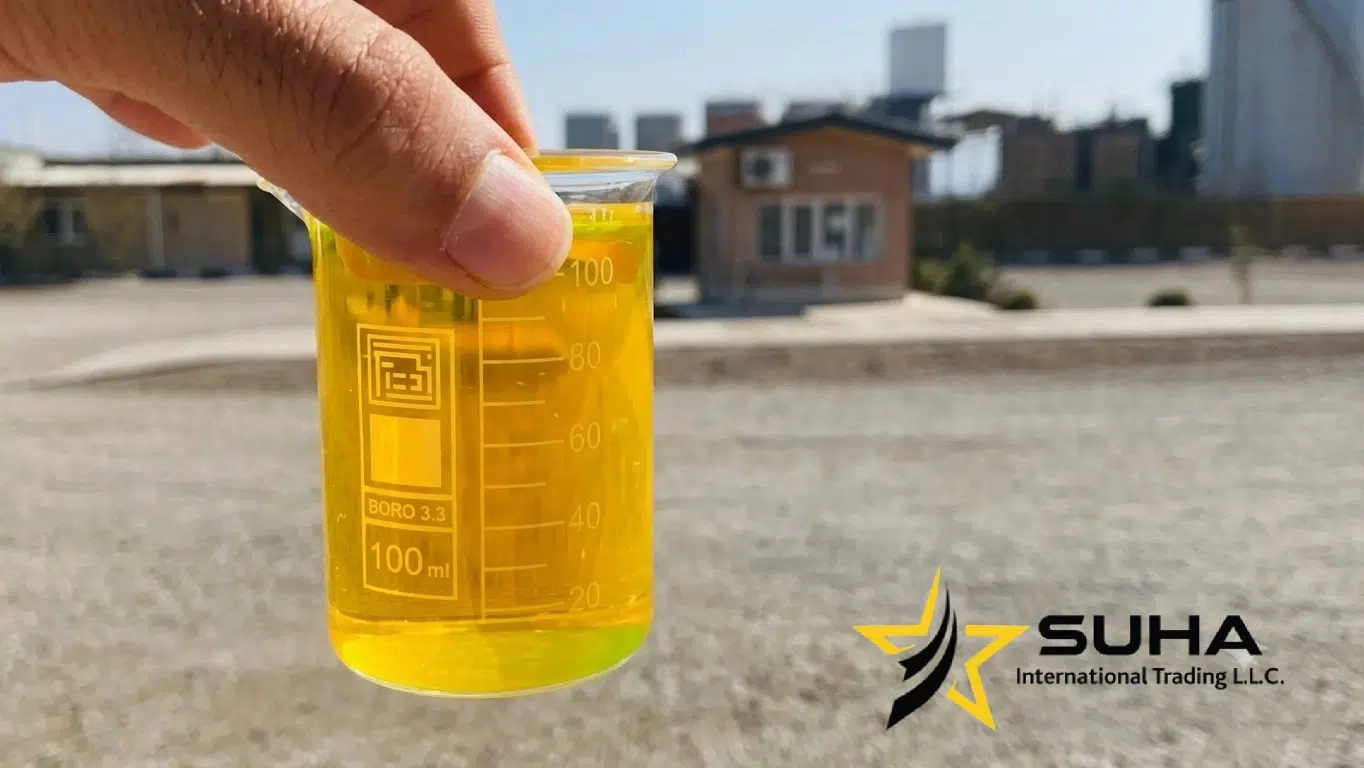
Base Oil SN500 Supplier — Group I Solvent Neutral 500, Shipped from Turkey & the UAE
Virgin Group I paraffinic base stock — 108 cSt at 40 °C, 10.9 cSt at 100 °C, flash point 245 °C — the heavy anchor in heavy-duty diesel engine oils, marine lubricants, gear oils and greases. Shipped in 180 kg drums, flexitanks and ISO tanks from Mersin and Jebel Ali (CAS 64742-54-7, HS 2710.19) with a batch Certificate of Analysis, downloadable TDS, and a formal FOB or CIF offer inside 24 hours.
In short — Base Oil SN500 is a virgin API Group I solvent-neutral paraffinic base oil. Typical measured values are 108 cSt at 40 °C and 10.9 cSt at 100 °C (specification minimum 10.8), viscosity index 88 (min 87), flash point 245 °C (min 235), pour point −4 °C (max −3), Noack 3.5 wt % (max 5) and sulfur 1.2 wt %. It is the standard heavy component in HDDO, marine and gear oil blends, normally cut with a lighter grade such as SN150 to reach a target SAE viscosity.
SUHA International supplies it from two origins, Turkey and the UAE, with a batch Certificate of Analysis, a downloadable specification sheet, a 14 MT minimum order (one 20-ft container of 80 drums), drum / flexitank / ISO tank packing, and a formal FOB or CIF price within 24 hours to more than 40 export markets.
What Is Base Oil SN500?
Base Oil SN500 is a heavy paraffinic mineral base stock produced by solvent refining. The letters SN stand for Solvent Neutral — the oil is refined with a solvent to strip out aromatics, sulfur and nitrogen compounds, then dewaxed and hydro-finished. The number is the part most buyers misread: 500 is an approximate viscosity in Saybolt Universal Seconds at 100 °F, not centistokes. Converted to the modern unit, our SN500 measures 108 cSt at 40 °C.
Why blenders buy the heavy grade
A finished lubricant is rarely a single base stock. Blenders hold a light grade and a heavy grade and mix toward the SAE target. SN500 is the heavy anchor: it supplies film thickness, load-carrying capacity and high-temperature body that light grades cannot. Its high flash point (minimum 235 °C, typically 245 °C) also keeps the finished blend inside safe classification limits for storage and marine carriage.
Group I remains dominant in this role for three reasons. It has higher aromatic content and therefore better additive solvency and seal swell than Group II or III — which matters in marine and older engine formulations. It is significantly cheaper per ton. And it is the only group that naturally yields bright stock, the very heavy residual grade used alongside SN500 in gear oils and greases.
Identity and trade data
| Identifier | Value |
|---|---|
| Chemical name | Distillates (petroleum), solvent-dewaxed heavy paraffinic |
| CAS number | 64742-54-7 |
| EC / EINECS number | 265-157-1 |
| HS code | 2710.19 |
| API group | Group I (solvent refined) — sulfur 1.2 wt %, VI 88 |
| Common synonyms | SN500, Solvent Neutral 500, Base Oil 500, SN-500, Virgin Base Oil SN500 |
| Appearance | Clear & bright, free of visible water and sediment (ASTM D-1500 colour 1.8) |
| IMDG / ADR classification | Not classified as dangerous goods (flash point 245 °C — combustible, not flammable) |
Supply context, 2026. Group I capacity in Europe has been shrinking for a decade as refiners close solvent plants or convert to Group II, while demand for heavy grades in marine, gear oil and grease applications has not fallen at the same rate. The practical effect for buyers is longer lead times on European-origin SN500 and a shift of Group I sourcing toward Turkey, the Gulf, Russia and Asia. Buyers increasingly contract dual-origin to avoid single-corridor exposure.
For independent market pricing and capacity data see ICIS, Argus Media and Lubes'n'Greases. Loading and lead-time figures on this page are our own operational data.
Base Oil SN500 Technical Specification
The table below is our published specification for virgin Base Oil SN500, with both the contractual limit and the typical measured result. Every consignment ships with a Certificate of Analysis carrying the actual values for that batch — not a copy of this sheet. Where your formulation has a limit tighter than shown here, tell us before we source: batches can be screened against it.
| Property | Unit | Test method | Specification | Typical result |
|---|---|---|---|---|
| Appearance | — | Visual | Clear & bright | Clear & bright |
| Colour | — | ASTM D-1500 | Max 2 | 1.8 |
| Density @ 15 °C | kg/m³ | ASTM D-4052 | — | 893 |
| Kinematic viscosity @ 40 °C | mm²/s (cSt) | ASTM D-445 | — | 108 |
| Kinematic viscosity @ 100 °C | mm²/s (cSt) | ASTM D-445 | Min 10.8 | 10.9 |
| Viscosity index | — | ASTM D-2270 | Min 87 | 88 |
| Flash point | °C | ASTM D-92 | Min 235 | 245 |
| Pour point | °C | ASTM D-97 | Max −3 | −4 |
| Noack volatility @ 250 °C | wt % | ASTM D-5800 | Max 5 | 3.5 |
| Sulfur | wt % | ASTM D-4951 | — | 1.2 |
How to read this specification as a buyer
The two right-hand columns do different jobs and buyers routinely confuse them. Specification is the contractual limit — the number a rejection claim is measured against. Typical result is what recent batches actually measured. A batch at 10.8 cSt at 100 °C is fully on specification even though the typical figure is 10.9. Write your purchase contract against the specification column, and use the typical column only to predict blending behaviour.
What matters most in each line
- Viscosity at 100 °C (min 10.8 cSt) — the controlling parameter for blending. This is the number your Refutas or ASTM D7152 calculation uses, not the 40 °C figure. It is written as a minimum because a heavy anchor stock failing low is what breaks an SAE target.
- Viscosity at 40 °C (typ. 108 cSt) — reported for reference and ISO VG comparison. Note it is a typical value, not a contractual limit, so do not build a rejection clause on it.
- Flash point (min 235 °C, typ. 245 °C) — well above the 200 °C threshold that matters for marine carriage and warehouse classification. A comfortable margin here is a genuine commercial advantage in tender scoring.
- Pour point (max −3 °C) — this is a virgin heavy paraffinic stock, so the pour point sits close to zero. Finished oils for cold climates require a pour point depressant; do not assume the base stock alone will perform below freezing.
- Noack at 250 °C (max 5 wt %, typ. 3.5) — low volatility for a Group I heavy grade, meaning less oil consumption and less thickening in service. Many SN500 offers do not report Noack at all.
- Sulfur (typ. 1.2 wt %) — above 0.03 %, which is precisely what places this oil in API Group I. It is a classification marker, not a defect, but it does rule the product out of low-SAPS finished specifications.
- Colour (max 2, typ. 1.8) — a housekeeping check. Material arriving darker than its COA usually indicates thermal abuse or tank contamination in transit rather than a production fault.
- Density (893 kg/m³) — use this for volume-to-weight conversion. One metric ton occupies roughly 1,120 litres at 15 °C, which is how you verify a flexitank or ISO tank fill against the invoiced weight.
Virgin, not re-refined
This specification covers virgin base oil produced from crude fractions, not re-refined material recovered from used oil. Re-refined base oil is a legitimate product with a real market, but it is a different commodity at a different price, and it behaves differently in additive response and oxidation life. If an offer you are comparing is materially cheaper per ton, establish which of the two it is before comparing anything else. Trace metals by ICP, total acid number and colour will normally separate them in a laboratory.
Values on this page supersede earlier published figures. This specification was reviewed against the producer's current data sheet in July 2026. Where an older PDF, catalogue or third-party listing shows different flash point, pour point or viscosity index values for our SN500, the table above and the downloadable TDS are the current reference.
Group I vs Group II vs Group III
The API 1509 classification sorts base oils by saturates content, sulfur and viscosity index. It is the first thing a formulator checks and the first thing a customs or quality dispute turns on, so it is worth being precise about where SN500 sits.
| Group | Saturates | Sulfur | VI | Process | Typical use |
|---|---|---|---|---|---|
| Group I (SN500 — sulfur 1.2 %, VI 88) | < 90 % | > 0.03 % | 80–120 | Solvent refining | HDDO, marine, gear oils, greases, process oils |
| Group II | ≥ 90 % | ≤ 0.03 % | 80–120 | Hydrocracking | Modern passenger-car and API CK-4 engine oils |
| Group III | ≥ 90 % | ≤ 0.03 % | > 120 | Severe hydrocracking / wax isomerisation | Low-viscosity synthetic-grade 0W/5W oils |
| Group IV | Polyalphaolefin (PAO) | Chemical synthesis | Full synthetics, extreme temperature | ||
| Group V | All others — esters, naphthenics, PAG, alkylated naphthalenes | Various | Compressor oils, transformer oils, specialty | ||
When Group I is the right answer — and when it is not
Choose Group I SN500 for marine trunk-piston and system oils, heavy-duty diesel oils in older specification tiers, industrial and automotive gear oils, greases, metalworking fluids and rubber process oils. Its aromatic content gives better additive solubility and elastomer compatibility than hydroprocessed stocks, and the cost per ton is materially lower.
Do not specify Group I where the finished oil must meet modern low-SAPS or fuel-economy engine specifications, where very low volatility is required, or where oxidation life at high temperature is the governing constraint — those call for Group II or III. If you are unsure which side of that line your formulation falls on, send us the target specification and we will say so plainly rather than sell you the wrong grade.
SN500 vs SN100, SN150 and SN350
Important correction to a widespread error. The number in SN100, SN150, SN350 and SN500 is not viscosity in centistokes at 40 °C. It is an approximate viscosity in Saybolt Universal Seconds at 100 °F, a legacy US unit. Many supplier pages reproduce the number as if it were cSt, which produces the impossible result that SN350 appears thicker than SN500. The table below gives the correct cSt values.
| Grade | KV @ 40 °C (cSt) | KV @ 100 °C (cSt) | Flash point (°C) | Typical role in a blend |
|---|---|---|---|---|
| SN100 | 18–22 | 3.8–4.2 | 190–210 | Light diluent, hydraulic and textile oils, transformer-adjacent process oils |
| SN150 | 28–32 | 5.0–5.5 | 200–220 | Most common light component in engine oil blends |
| SN350 | 60–72 | 8.0–9.0 | 215–230 | Mid grade, industrial oils, single-stock SAE 20/30 bases |
| SN500 (our grade) | 108 | 10.9 (min 10.8) | 245 (min 235) | Heavy anchor — HDDO, marine, gear oils, greases |
| Bright stock (BS150) | 440–520 | 28–32 | > 280 | Very heavy residual, gear oils, greases, cylinder oils |
Read down the middle column and the logic of a blending house becomes obvious. At 108 cSt our SN500 is roughly three to four times heavier than SN150 at 40 °C and about a quarter the weight of bright stock. A plant carrying SN150, SN500 and bright stock can reach almost any commercial viscosity target by ratio alone, which is why those three are the most traded Group I grades in the world.
Blending SN500 to a Target Viscosity
The most frequent technical question we get is what ratio of SN500 to SN150 produces a given SAE grade. The honest answer starts with a warning: viscosity does not blend linearly in centistokes. Mixing equal parts of a 30 cSt and a 100 cSt oil does not give 65 cSt.
Use a blending index, not an average
The standard method is ASTM D7152, or the older Refutas calculation. Convert each component's viscosity to a viscosity blending index, average the indices weighted by mass fraction, then convert the result back to viscosity. The Refutas index is:
VBI = 14.534 × ln( ln( ν + 0.8 ) ) + 10.975
where ν is kinematic viscosity in cSt at the reference temperature. Blend the indices by mass, then invert the equation. Run it on the 100 °C viscosity, because that is where SAE grades are defined and where SN500 carries its contractual minimum of 10.8 cSt. Free calculators exist, but any blending plant should hold this in a validated spreadsheet rather than trusting a web tool.
Indicative starting ratios
| Target | Approx. KV @ 100 °C | Indicative SN500 | Indicative SN150 |
|---|---|---|---|
| SAE 20 base | 6.9–9.3 cSt | ~35–45 % | ~55–65 % |
| SAE 30 base | 9.3–12.5 cSt | ~70–85 % | ~15–30 % |
| SAE 40 base | 12.5–16.3 cSt | ~85–95 % + bright stock | — |
| SAE 50 base | 16.3–21.9 cSt | SN500 + 15–25 % bright stock | — |
These ratios are indicative only. Additive packages, viscosity index improvers and pour point depressants all shift the finished viscosity, and every batch of base oil sits at a different point inside its specification band. Treat the table as a starting point for a laboratory blend trial, never as a production recipe. We will supply pre-shipment samples of the actual batch so your lab can calibrate against real material.
Where SN500 Is Used
SN500 is almost never the finished product. It is the heavy fraction of a blend, chosen for film strength and thermal body. These are the outlets that absorb most of the world's SN500 production.
Heavy-duty diesel engine oils
The largest single outlet. SN500 provides the high-temperature film that protects rings, liners and bearings in trucks, buses, construction plant and agricultural machinery, typically blended with SN150 to hit an SAE 15W-40 or monograde target.
Marine lubricants
Used in trunk-piston engine oils, system oils and stern tube lubricants. Group I's aromatic content gives the additive solvency and detergency response that marine formulations depend on, particularly where fuel-derived contamination is high.
Industrial & automotive gear oils
Blended with bright stock to reach ISO VG 220–680 and SAE 80W-90 or 85W-140 targets, supporting the load-carrying capacity and EP additive response that enclosed gear drives require.
Greases
Serves as the base fluid in lithium, lithium-complex and calcium greases. Viscosity at 40 °C in the SN500 range suits the bulk of general-purpose and chassis grease production.
Metalworking & process oils
Neat cutting oils, drawing and stamping compounds, quenching oils, and rubber and PVC process oils where a heavy, thermally stable, low-volatility carrier fluid is required.
Hydraulic & circulating oils
Used as the heavy component in higher ISO VG hydraulic and bearing circulating oils, and in turbine-adjacent industrial fluids where Group I performance is acceptable to the specification.
Where SN500 should not be used
Being explicit about this saves buyers money and saves us returns. SN500 is not suitable for transformer or dielectric oils — those require roughly 8–12 cSt at 40 °C plus controlled dielectric strength and gassing behaviour under IEC 60296, and use naphthenic or specially hydrotreated light stocks; at 108 cSt this grade is an order of magnitude too viscous. It is not a white or food-grade oil and carries no NSF H1 or USP certification. It is not suitable for low-SAPS or fuel-economy engine specifications requiring Group II or III, and it is not a refrigeration or aviation fluid.
How Group I SN500 Is Produced
The solvent refining route has been essentially unchanged for decades. Understanding it explains why Group I properties look the way they do — and why batch-to-batch variation exists even from a single refinery.
- 1
Vacuum distillation
Atmospheric residue is redistilled under vacuum to cut the heavy lubricating fraction that becomes SN500 feedstock. The cut point set here fixes the viscosity band and the flash point.
- 2
Solvent extraction
Furfural or NMP selectively dissolves aromatics, sulfur and nitrogen compounds and they are drawn off as extract. This raises the viscosity index to the 87–88 range and improves oxidation stability. Extract severity is the main lever on final VI, and it is why sulfur remains at 1.2 wt % — Group I is refined, not hydrocracked.
- 3
Solvent dewaxing
The raffinate is chilled with an MEK/toluene solvent mix, wax crystallises and is filtered off, bringing the pour point to its specification maximum of −3 °C. The recovered wax is sold on as slack wax and refined into paraffin wax.
- 4
Hydro-finishing
A mild hydrogen treatment saturates residual unsaturates and polar compounds, improving colour, odour and storage stability. This is finishing, not hydrocracking — the oil stays Group I.
- 5
Batch testing and release
Each batch is tested to ASTM D-445, D-2270, D-92, D-97, D-1500, D-4052, D-5800 and D-4951. The Certificate of Analysis records actual measured values and the batch number, and travels with the shipment.
Packaging, MOQ and Incoterms
Packaging choice is a cost decision, not a preference. Drums cost more per ton but suit smaller blenders and inland destinations without bulk discharge. Flexitanks are the cheapest route for a full container but require a discharge facility at the other end.
| Format | Net weight | Per 20-ft container | Best suited to | Relative cost / MT |
|---|---|---|---|---|
| New steel drum | 180 kg | 80 drums = 14.4 MT | Blenders under 20 MT, inland delivery, no bulk discharge | Highest |
| Flexitank | 20–24 MT | 1 flexitank per container | Full-container buyers with pump discharge | Lowest |
| ISO tank | 20–25 MT | 1 tank per slot | Repeat lane traffic, returnable equipment | Low on repeat lanes |
| IBC / tote | 1,000 L (~880 kg) | 20 IBCs = ~17.6 MT | Buyers needing intermediate volumes | Medium-high |
Minimum order quantity
The minimum order quantity (MOQ) is 14 MT — one 20-ft container of 80 drums. Flexitank and ISO tank shipments start at 20 MT because that is the minimum practical fill for those formats. Mixed containers are possible above 14 MT total, so a blender can take SN500 alongside SN150 or SN350 in a single shipment rather than holding three separate orders.
Incoterms offered
What Drives the Price — and How Long It Takes
We do not publish a fixed price per ton, and any supplier who does is either quoting stale numbers or quoting a bait figure. Group I base oil is a crude derivative that reprices continuously. What we can do is be transparent about what moves the number, so your procurement team can sanity-check any offer — ours included.
Price drivers, in rough order of weight
- Crude benchmark. Brent or Dubai sets the floor. Base oil follows with a lag of days to weeks.
- Regional Group I availability. European plant closures have tightened heavy grades structurally; a single refinery turnaround can move the regional number several percent.
- Freight and equipment. Container availability and route congestion can be a larger swing factor than the oil itself on long-haul CIF business.
- Packaging. Drums add materially per ton over flexitank; new versus reconditioned drums is a further step.
- Volume and contract shape. A twelve-month offtake prices differently from a single spot container.
- Incoterm and payment terms. CIF carries freight and insurance; L/C at sight carries bank cost; both sit inside the unit price.
Because these move daily, our quotations are valid for three to seven days depending on market volatility. A quote held open for a month is not a favour — it is priced with a risk margin you end up paying.
Indicative lead times
| Stage / destination | Indicative time |
|---|---|
| Order confirmation to loading | 7–12 days |
| Gulf & East Africa | 5–12 days transit |
| West Africa & South Asia | 12–20 days transit |
| Northern Europe & Mediterranean | 15–25 days transit |
| South America | 25–35 days transit |
| Document set to buyer | Within 3 working days of B/L |
Transit times are carrier schedule estimates and exclude port congestion, customs holds and inland haulage. They are indicative, not contractual — the firm schedule appears on your quotation.
How to Verify SN500 Before You Pay
Base oil is an easy product to adulterate and a hard one to judge by eye. If you are buying from a new SN500 supplier — us included — these are the checks worth running. A supplier who resists any of them is telling you something.
Warning signs in an offer
A price far below the regional market usually means re-refined, off-spec or blended material. A refusal to provide a batch COA before payment, no fixed loading port, pressure to pay 100 % in advance to a personal account, and specification tables that contradict themselves — such as listing SN350 as heavier than SN500 — are all reasons to slow down and verify.
Export Markets and Destination Requirements
As a dual-origin Base Oil SN500 supplier we load from Mersin in Türkiye and Jebel Ali in the UAE, serving more than 40 markets. Which origin is cheaper depends entirely on your discharge port — the table below is the routing logic we apply when quoting, plus the pre-shipment conformity documents each region actually requires. Getting that paperwork wrong is the most common cause of demurrage on a first shipment.
Primary destination regions
| Region | Key destination ports | Preferred origin | Transit | Conformity document required |
|---|---|---|---|---|
| GCC & Middle East | Dammam, Jeddah, Doha, Kuwait, Sohar, Umm Qasr, Bandar Abbas | Jebel Ali (UAE) | 3–10 days | SASO / SABER COC for Saudi Arabia; ESMA for UAE domestic |
| East Africa | Mombasa, Dar es Salaam, Djibouti, Berbera, Port Sudan | Jebel Ali (UAE) | 7–14 days | PVoC (Kenya, Tanzania), COC via appointed inspection body |
| West Africa | Lagos/Apapa, Tema, Abidjan, Dakar, Douala, Conakry | Mersin or Jebel Ali | 18–28 days | SONCAP (Nigeria), CoC (Ghana), Form M & PAAR for Nigerian clearance |
| North Africa | Alexandria, Damietta, Casablanca, Tunis, Misrata, Algiers | Mersin (Türkiye) | 4–10 days | Certificate of Conformity (Egypt, GOEIC registration), legalised COO |
| South & Central Asia | Karachi, Nhava Sheva, Mundra, Chittagong, Colombo, Bandar Abbas | Jebel Ali (UAE) | 5–14 days | PSI where applicable; BIS not required for base oil |
| Southeast & East Asia | Port Klang, Singapore, Jakarta, Ho Chi Minh, Manila | Jebel Ali (UAE) | 12–20 days | Standard COO and COA; import licence in some markets |
| Europe & Mediterranean | Rotterdam, Antwerp, Hamburg, Constanta, Piraeus, Valencia | Mersin (Türkiye) | 7–20 days | REACH registration status confirmation, EUR.1 / A.TR for preferential duty |
| Black Sea & Caucasus | Poti, Batumi, Constanta, Odesa, Novorossiysk | Mersin (Türkiye) | 3–7 days | A.TR movement certificate, legalised COO |
| South America | Santos, Callao, Guayaquil, Cartagena, Buenos Aires | Mersin (Türkiye) | 25–35 days | Legalised COO, consular invoice in some markets, MSDS in Spanish/Portuguese |
Conformity requirements change with national regulation. The list above reflects our current export practice and is provided for planning; confirm the applicable regime with your customs broker before the letter of credit is opened. We prepare the document set once the discharge port is confirmed.
Choosing the origin that costs you less
Two loading corridors are only an advantage if the right one is selected. As a rule of thumb: for Europe, the Black Sea, North Africa and South America, Mersin is normally shorter and cheaper, and Turkish origin carries preferential duty into the EU under A.TR. For the GCC, East Africa, South Asia and Southeast Asia, Jebel Ali wins on both freight and transit. Buyers in West Africa should ask for both — the difference there is driven by carrier schedules that month rather than distance, and it can be substantial.
What changes by market
- Packaging preference. West and East African buyers overwhelmingly take drums, because inland discharge infrastructure is limited. GCC, European and Southeast Asian blenders take flexitanks or ISO tanks and pay materially less per ton.
- Payment norms. L/C at sight is standard for African and South Asian first shipments. Established GCC and European accounts more often work on T/T or D/P with agreed credit terms.
- Inspection. Nigerian, Kenyan and Egyptian shipments almost always require third-party pre-shipment inspection as a regulatory condition, not merely a buyer preference. Budget for it from the start.
- Seasonality. Demand for heavy grades rises ahead of monsoon and harvest cycles in South Asia and East Africa. Booking two to three weeks earlier in those windows avoids paying spot freight.
- Drum specification. Some markets require new drums only; others accept reconditioned. The price gap is real, so state your requirement in the enquiry rather than after the quote.
Not on this list? These are the lanes we run most often, not a limit. If your discharge port is elsewhere, send it with your enquiry and we will quote the routing and confirm which conformity regime applies before you commit to anything.
Contract Terms Worth Negotiating
Most disputes in base oil trading come from clauses nobody read until something went wrong. If you are moving from spot containers to an annual offtake, these are the points that decide who carries the risk. We would rather you raise them at the quotation stage than discover them at discharge.
Quantity tolerance
Bulk shipments never load to an exact figure. A ±5 % tolerance at seller's option is standard for flexitank and ISO tank cargo; drummed cargo is exact because it is counted. Make sure the invoice basis matches the tolerance: if the contract says 20 MT ±5 % and 20.8 MT loads, you pay for 20.8. Fix whether weight is determined at load port or discharge port, and by whose scale.
Which specification governs
State explicitly that the specification column of the TDS is contractual and the typical column is indicative. Without that sentence, a buyer can claim against a typical value and a seller can hide behind a wide limit. For SN500 the parameters worth naming individually are viscosity at 100 °C (min 10.8 cSt), flash point (min 235 °C), viscosity index (min 87) and colour (max 2) — those four catch almost everything that can go wrong.
Sampling and retention
Agree that samples are drawn at loading in the presence of both parties or an appointed inspector, sealed, and split three ways: one to the buyer, one to the seller, one retained sealed for at least 90 days. A quality claim without a jointly sealed retention sample is very difficult to win, and it is the single clause buyers most often omit. Name the arbitration laboratory in the contract too — after a dispute starts, agreeing on one is much harder.
Claim window and remedy
A typical window is 15 to 30 days from discharge, which is realistic for laboratory turnaround but short enough to prevent a claim after the material has been blended and sold. Define the remedy in advance: price adjustment, replacement, or return at whose cost. "To be agreed" is not a remedy clause.
Price mechanism on term contracts
For anything longer than a quarter, a fixed price is a bet both sides usually regret. The workable structures are a monthly reset against a published index, a formula linked to the crude benchmark with an agreed differential, or a fixed price with a defined trigger — for example, either party may reopen if the benchmark moves more than a set percentage. Whichever you choose, write down the publication and the pricing date, not just the intention.
Practical loading detail buyers forget
- Flexitank discharge. You need a pump and a heated bay in cold months. SN500 at −4 °C pour point will not gravity-discharge in a Northern European winter. Confirm your facility can handle it before choosing flexitank over drums.
- Drum condition. Specify new or reconditioned in the enquiry. Also specify whether you need lids with removable bungs — some blending plants cannot handle tight-head drums.
- Container liner temperature. On long South American or Northern European routes, ask about a thermal liner. It is inexpensive relative to a load that will not pump out.
- Marking and labelling. Batch number, net weight, production date and your own SKU can be printed on drum labels at loading if you request it at order stage, not after.
- Partial shipment and transhipment. If the L/C prohibits both and the carrier tranships anyway, documents are rejected. Check the routing before the credit is issued.
A note on how we quote. Our offer states the unit price, the incoterm and named port, the validity window, the quantity tolerance, the packaging, the payment terms, the loading window and the document set. If any of those is missing from a competing offer, it is not a comparable quotation — it is an indication. Ask for the same eight items from everyone you are comparing.
What We Actually Commit To
Large-volume buyers are not short of price lists. What is scarce in a Base Oil SN500 supplier is batch consistency across a contract year, one who absorbs logistics complexity, and one who says no when a grade is wrong for the application. That is the basis we work on.
Badges above denote the test methods and document formats used for this product. Certification held by the producing refinery is stated on the mill documents supplied with each shipment.
What buyers say
"We moved to dual-origin supply after a port disruption cost us three weeks of blending. Two loading corridors under one contract solved the problem we actually had."
"The batch COA matched our own lab test on viscosity and TAN within tolerance. That has not been our experience with every supplier in this market."
Customer references are anonymised at the buyers' request. Contactable trade references are available on request during contract negotiation.
Handling, Storage and Shelf Life
SN500 is not classified as dangerous goods for transport and is a low-hazard material in normal industrial use. The practical risks are contamination and water ingress rather than acute toxicity.
Storage
Cool, dry, shaded, under cover. Keep containers sealed and store drums on their sides or with lids below the rim so rainwater cannot pool over the bungs. Segregate from oxidising agents. Ideal range 5–35 °C.
Handling
Nitrile gloves, safety glasses, adequate ventilation. Avoid prolonged and repeated skin contact — this is the main occupational exposure route for mineral oils. Wash after handling; do not use solvents on skin.
Shelf life
Five years from manufacture in sealed original packaging. Retest viscosity, colour and appearance beyond that. Age alone rarely spoils the oil — water ingress does.
Fire & spill
Flash point 245 °C typical, minimum 235 °C; combustible, not flammable. Extinguish with foam, dry chemical or CO₂ — never a water jet. Contain spills with inert absorbent, prevent entry to drains and watercourses, dispose via licensed waste oil contractor.
The SDS governs. The GHS-format Safety Data Sheet supplied with every shipment is the authoritative document for classification, exposure limits, first aid and disposal in your jurisdiction. The summary above is orientation, not a substitute. Cross-reference chemical and toxicological data at PubChem and ECHA.
Speak directly with
our export desk
All base oil enquiries answered within 24 business hours, usually sooner. For urgent supply or tender deadlines, WhatsApp is the fastest channel.
Include this for the fastest quote
Base Oil SN500 — Technical and Supply FAQ
What is Base Oil SN500?
A virgin API Group I solvent-neutral paraffinic base oil. Typical measured values are 108 cSt at 40 °C and 10.9 cSt at 100 °C against a specification minimum of 10.8, viscosity index 88 (min 87), flash point 245 °C (min 235), pour point −4 °C (max −3), Noack 3.5 wt % (max 5) and sulfur 1.2 wt %. It is produced by solvent extraction, solvent dewaxing and hydro-finishing, and used as the heavy base stock in HDDO, marine lubricants, gear oils and greases.
Do the numbers in SN100, SN150, SN350 and SN500 mean viscosity in cSt?
No — and this is the most common error in the market. The number is an approximate viscosity in Saybolt Universal Seconds at 100 °F, not centistokes at 40 °C. In cSt at 40 °C: SN100 is about 18–22, SN150 about 28–32, SN350 about 60–72, and our SN500 measures 108. Any table listing SN350 as 350 cSt and SN500 as 105 cSt is mixing two different units and producing an impossible result.
What is the difference between SN150 and SN500?
SN150 is a light grade at roughly 28–32 cSt at 40 °C, used in general-purpose lubricants, hydraulic fluids and passenger-car engine oils. SN500 is roughly three to four times heavier at 108 cSt, used where film strength matters: heavy-duty diesel oils, marine lubricants, gear oils and greases. Blenders normally hold both and mix toward the SAE target.
Is SN500 a Group I or Group II base oil?
Group I. Under API 1509, Group I means saturates below 90 % or sulfur above 0.03 %, with a viscosity index of 80–120. Our SN500 measures 1.2 wt % sulfur and VI 88, placing it squarely in Group I. Group II exceeds 90 % saturates with sulfur at or below 0.03 %; Group III adds a VI above 120. Group I is not an inferior product — its higher aromatic content gives better additive solvency and seal compatibility, which is exactly why marine and heavy-duty formulations still specify it.
What is the flash point of Base Oil SN500?
The specification is a minimum of 235 °C by ASTM D-92, with a typical measured result of 245 °C. That margin sits comfortably above the 200 °C threshold governing marine carriage and warehouse classification, so the material is combustible rather than flammable. It is a classification limit, not a service temperature.
What is the viscosity index of Base Oil SN500?
The specification is a minimum of 87 by ASTM D-2270, with a typical measured result of 88 — normal for a solvent-refined Group I paraffinic stock. A VI materially above 120 would indicate a hydroprocessed Group III oil, not SN500.
What is the pour point of Base Oil SN500?
The specification is a maximum of −3 °C by ASTM D-97, with a typical measured result of −4 °C. This is a heavy virgin paraffinic stock, so the pour point sits close to zero. Finished oils destined for cold climates require a pour point depressant — do not assume the base stock alone will flow below freezing.
Can Base Oil SN500 be used as transformer oil?
No. Transformer oils require roughly 8–12 cSt at 40 °C plus tightly controlled dielectric strength and gassing behaviour under IEC 60296. SN500 at 108 cSt is around ten times too viscous and is not manufactured to electrical specifications. Naphthenic or specially hydrotreated light stocks are used instead. Some supplier pages list transformer oil among SN500 applications; that is incorrect.
How do I blend SN500 and SN150 to a target viscosity?
Not by averaging — viscosity does not blend linearly in cSt. Use the ASTM D7152 method or a Refutas calculation: convert each component viscosity to a blending index, average the indices by mass fraction, then convert back. Run it on the 100 °C viscosity, where SAE grades are defined and where SN500 carries its contractual minimum of 10.8 cSt. As a rough starting point an SAE 30 base is often reached near 70–85 % SN500 with 15–30 % SN150 before additives, confirmed by laboratory blend trial on the actual batch.
What are the main applications of Base Oil SN500?
Heavy-duty diesel engine oils, marine trunk-piston and system oils, industrial and automotive gear oils, lithium and calcium greases, metalworking and quenching oils, and rubber and PVC process oils. It is rarely used alone — it is the heavy component of a blend.
How is Base Oil SN500 packaged for export?
Steel drums of 180 kg net, with 80 drums loading into a 20-ft container for 14.4 MT; flexitanks at 20–24 MT per container; ISO tanks at 20–25 MT; and 1,000 L IBCs for intermediate volumes. Flexitank gives the lowest cost per ton but requires pump discharge at destination.
What is the minimum order quantity for SN500?
14 MT, equal to one 20-ft container of 80 drums. Flexitank and ISO tank orders start at 20 MT because that is the minimum practical fill. Mixed containers combining SN500 with SN150 or SN350 are possible above 14 MT total.
What is the shelf life of Base Oil SN500?
Five years from the manufacturing date in sealed original packaging stored cool, dry and shaded. Beyond that, retest viscosity, colour and appearance before blending. In practice water ingress, not age, is what puts material off specification on arrival.
What determines the price of Base Oil SN500?
Crude benchmark first, then regional Group I availability, freight and container costs, packaging choice, order volume, incoterm and payment terms. Because the feedstock reprices continuously, our quotations carry a validity window of three to seven days. Treat any long-held fixed price with suspicion — it either carries a risk margin or will be revised at loading.
What is the lead time for a Base Oil SN500 order?
Typically 7–12 days from confirmed order to loading, then transit of 5–12 days to Gulf and East African ports, 12–20 days to West Africa and South Asia, 15–25 days to Northern Europe and 25–35 days to South America. Documents follow within three working days of the bill of lading.
What documents are supplied with each shipment?
A batch-specific Certificate of Analysis with actual tested values, a GHS-format Safety Data Sheet, the Technical Data Sheet, commercial invoice and packing list, bill of lading, certificate of origin, and where required a third-party inspection certificate from SGS, Bureau Veritas or Intertek. Destination-specific documents — legalised certificate of origin, SONCAP for Nigeria, PVoC for Kenya and Tanzania, COC for Saudi Arabia, or a Certificate of Conformity for Egypt — are prepared before loading once you confirm the discharge port.
How can I verify SN500 quality before payment?
Request a one-litre pre-shipment sample for your own laboratory, check the batch COA against the TDS limits, and appoint an independent inspector to draw and seal samples at the loading port. An L/C at sight can be made conditional on presentation of that inspection certificate — the strongest protection available to a first-time buyer. Keep a sealed retention sample from the delivered consignment.
Which countries do you export Base Oil SN500 to?
More than 40 markets from two loading corridors. From Jebel Ali (UAE): the GCC and Middle East — Saudi Arabia, Qatar, Kuwait, Oman, Iraq — plus East Africa (Kenya, Tanzania, Djibouti, Sudan) and South and Southeast Asia (Pakistan, India, Bangladesh, Sri Lanka, Malaysia, Indonesia, Vietnam). From Mersin (Türkiye): North Africa (Egypt, Morocco, Tunisia, Libya), Europe and the Mediterranean, the Black Sea and Caucasus (Georgia, Romania, Ukraine) and South America (Brazil, Peru, Ecuador, Colombia). West African destinations — Nigeria, Ghana, Ivory Coast, Senegal — are quoted from whichever origin is cheaper that month.
Which conformity certificates are needed to import SN500?
It depends on the destination. Nigeria requires SONCAP with Form M and PAAR; Kenya and Tanzania require PVoC; Saudi Arabia requires a SASO / SABER certificate of conformity; Egypt requires a certificate of conformity with GOEIC registration; EU imports need REACH registration status confirmation and benefit from an A.TR or EUR.1 certificate for preferential duty on Turkish origin. We prepare the applicable set before loading once you confirm the discharge port.
Where can I download the Base Oil SN500 specification sheet?
The full TDS is a free PDF download from the technical specification section of this page — no registration. It lists appearance, colour, density, kinematic viscosity at 40 and 100 °C, viscosity index, flash point, pour point, Noack volatility and sulfur, each with its ASTM method, the contractual specification limit and the typical measured result. A batch-specific Certificate of Analysis is issued separately with every shipment.
What quantity tolerance applies to bulk SN500 shipments?
±5 % at seller's option is standard for flexitank and ISO tank cargo, because bulk liquid never loads to an exact figure. Drummed cargo is exact because drums are counted. The invoice follows the loaded weight within that tolerance, so a 20 MT order may invoice at up to 21 MT. The contract should also fix whether weight is determined at load port or discharge port, and by whose scale.
Why source SN500 from a supplier with both Turkish and UAE origin?
Two independent loading corridors, Mersin and Jebel Ali. Port congestion, a refinery turnaround or a regional restriction affecting one route does not halt the contract. It also lets the shorter freight leg be chosen per destination, and gives two refinery sources for holding specification consistency across an annual offtake.