Sodium Hydroxide in Cosmetics: Complete Safety Guide, Uses & What Your Skin Products Really Contain (2026)
- Sodium Hydroxide in Cosmetics: Overview
- What Is Sodium Hydroxide?
- 6 Main Uses of Sodium Hydroxide in Cosmetics and Beauty Products
- Is Sodium Hydroxide Safe in Cosmetics and Skincare?
- Benefits of Sodium Hydroxide in Cosmetics industry
- Potential Risks and Protection Measures
- How to Read Cosmetic Labels
- Professional vs. Consumer Product Concentrations
- Common Myths vs. Facts About Sodium Hydroxide in Cosmetics
- The Bottom Line
You pick up a moisturizer, flip it over, and there it is on the ingredient list: sodium hydroxide. The same compound is used in drain cleaners and industrial degreasers. Naturally, that raises a question — why is it in your face cream, and should you be worried?
The short answer is no. But understanding why requires a closer look at what sodium hydroxide in cosmetics actually does, what concentration limits regulators enforce, and what the science says about skin safety. This guide covers everything — from chemistry and formulation to EU and FDA regulations — so you can make genuinely informed decisions about the products you use every day.
What Is Sodium Hydroxide in Cosmetics? (And Why Chemists Love It)
Sodium hydroxide — chemical formula NaOH, commonly known as lye or caustic soda — is a white, odorless alkaline solid with a pH of 14 in its pure form. In the beauty and personal care industry, it functions primarily as a pH adjuster, saponification agent, and emulsion stabilizer.
When cosmetic chemists talk about sodium hydroxide in cosmetics, they’re rarely talking about a free, active compound sitting in your moisturizer. In a finished skin care product, sodium hydroxide is rarely present as free sodium hydroxide at meaningful levels — it reacts with the acids or fats in the formula, neutralizing itself in the process. What reaches your skin is the buffered, pH-adjusted product, not raw lye.
This is the fundamental point most consumers miss. The ingredient that enters the manufacturing process is not the same ingredient that ends up on your skin.
INCI and Label Names to Know
When scanning ingredient lists, you may encounter sodium hydroxide under the following names:
- Sodium Hydroxide (standard INCI name)
- Caustic Soda
- Lye
- Soda Lye
- Sodium Hydrate (technical/industrial datasheets)
⚠️ Common Mislabeling Alert: Some outdated sources incorrectly list “Ascorbyl palmitate” as an alternate name for sodium hydroxide. This is factually wrong. Ascorbyl palmitate is an entirely different ingredient — a fat-soluble vitamin C ester — and has no chemical relationship to NaOH whatsoever.
Quick Chemistry: Why pH Matters in Skincare
Your skin’s surface maintains a naturally acidic pH of roughly 4.5–5.5, known as the acid mantle. This protective layer regulates moisture, defends against bacteria, and supports the skin barrier. When a cosmetic product has a pH that’s too far outside this range — either too acidic or too alkaline — it can compromise the barrier, cause irritation, or simply become ineffective.
This is where sodium hydroxide in cosmetics earns its keep: tiny, precisely measured amounts raise the pH of acidic formulas just enough to bring them into the safe zone for skin contact.
7 Key Uses of Sodium Hydroxide in Cosmetics and Beauty Products
1. pH Adjustment in Serums, Moisturizers, and Toners
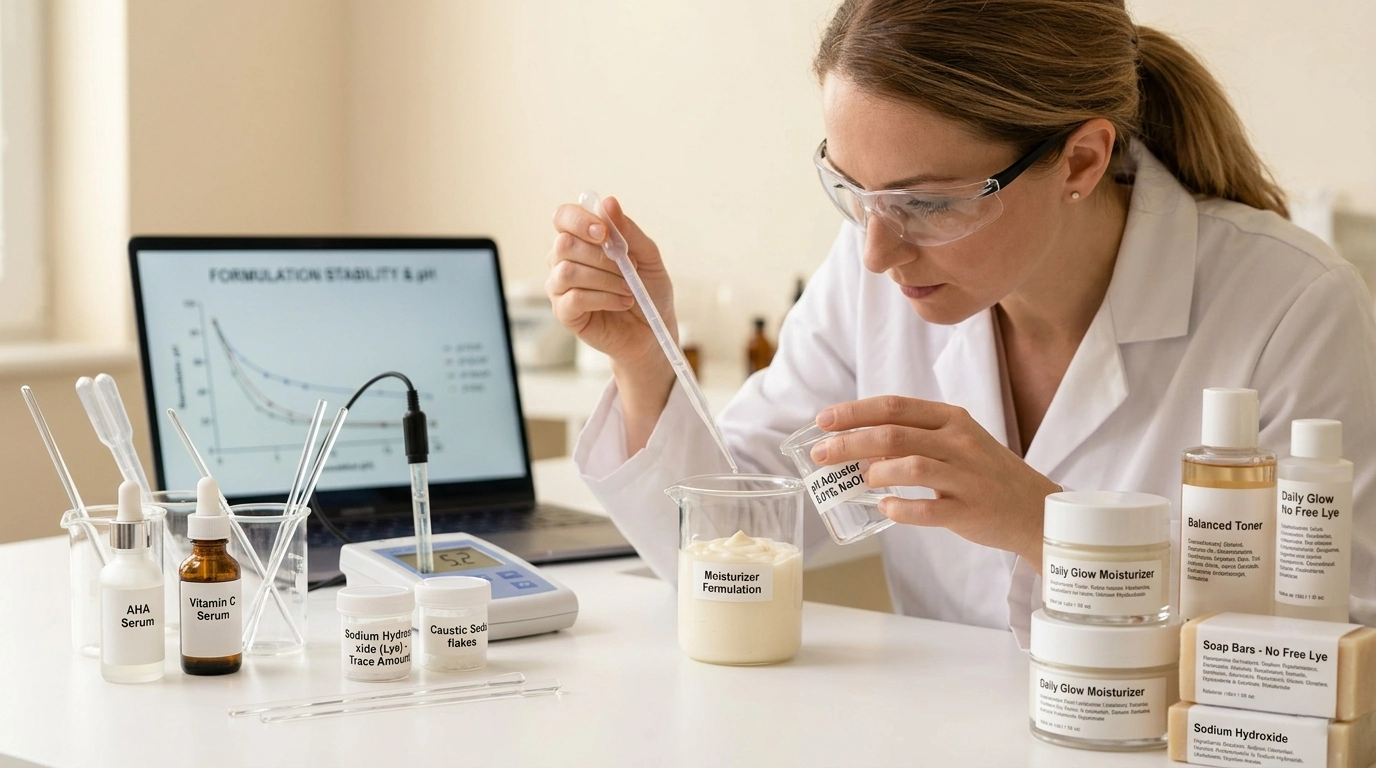
This is the most widespread use of sodium hydroxide in cosmetics by far, and also the safest. Active ingredients like glycolic acid (AHA), salicylic acid (BHA), vitamin C (ascorbic acid), and retinoids must be formulated at very specific pH levels to remain both effective and tolerable on skin. Too acidic and the formula burns; too alkaline and the actives stop working.
At concentrations of 0.01–0.1%, sodium hydroxide neutralizes excess acidity in these formulations without leaving any meaningful residual lye. As a buffering agent, sodium hydroxide neutralizes excess acids in a formula, keeping products within a stable skin-safe pH range.
Products where you’ll commonly find it: Vitamin C serums, AHA/BHA exfoliants, hyaluronic acid serums, retinol creams, pH-balanced toners.
2. Saponification — Transforming Oils into Soap
Soap cannot be made without an alkali. For bar soap, that alkali has always been sodium hydroxide. During the saponification reaction, NaOH reacts with triglycerides (fats and oils) at a molecular level, producing fatty acid salts — what we call soap — and glycerin as a natural byproduct.
During this chemical reaction, the sodium hydroxide is fully consumed. In a properly formulated and cured soap, no free lye remains — what’s left are fatty acid salts (the actual soap) and naturally occurring glycerin.
This is also why sodium hydroxide doesn’t appear on finished bar soap labels in most markets. INCI regulations require listing only the final ingredients in a product, and since lye undergoes complete chemical transformation, it is legally — and accurately — absent from the label. What you’ll see instead is “saponified coconut oil,” “saponified olive oil,” or similar.
Fun historical note: Sodium hydroxide has been reacted with fats to form soap for millennia. The chemistry is ancient; the regulation is modern.
3. Chemical Exfoliation in Professional and At-Home Peels
In professional-grade chemical peels, sodium hydroxide (1–5%) is used sparingly to adjust formulations or create alkaline peels that exfoliate dead skin, targeting concerns like hyperpigmentation or acne scars. These are strictly controlled due to their potency.
At these concentrations, sodium hydroxide acts as a keratolytic agent — it breaks the intercellular bonds that hold dead skin cells together, revealing fresher skin beneath. The advantage over physical scrubs is that it produces no micro-tears and can be precisely controlled.
Important: Professional-grade peels in this concentration range must only be applied by trained aestheticians or dermatologists.
4. Hair Relaxers and Straightening Treatments
One of the more potent applications of sodium hydroxide in cosmetics is in lye-based hair relaxers. These formulas work by breaking the disulfide bonds in the hair’s keratin protein structure, allowing tightly coiled hair to be mechanically straightened and reset in a looser pattern.
Hair straighteners for general consumer use are capped at 2%, though professional-use products can go up to 4.5%. The high alkalinity (typically pH 12–13) is what makes these treatments effective — and also what makes them potentially damaging if overused or left on too long.
For this reason, lye relaxers have seen a significant decline in consumer popularity over the past decade, with many users switching to “no-lye” alternatives (which use calcium hydroxide or guanidine-based systems instead).
5. Cuticle Softeners and Nail Care Products
Nail cuticle solvents are limited to 5% sodium hydroxide under EU regulations. Applied for a brief period and rinsed thoroughly, these products dissolve the protein bonds in excess cuticle tissue — producing cleaner, more precise manicure results without cutting, which carries the risk of infection.
Because these are rinse-off products used on a small area for a short time, the safety profile is well-established when used as directed.
6. Emulsification and Cream Stability
Oil and water don’t naturally mix. Cosmetic emulsions — moisturizers, lotions, foundations, sunscreens — require precise pH management to maintain stability. As an emulsifier, sodium hydroxide helps maintain the viscosity and structure of emulsions. It also contributes to a pH environment that slows microbial growth, naturally extending product shelf life without requiring additional preservatives.
7. Denaturant in Alcohol-Based Products
Sodium hydroxide alters ethanol’s taste and chemical character so it no longer qualifies as drinkable alcohol, helping meet regulatory requirements for “Alcohol Denat.” in cosmetic formulations. This use is less visible to consumers but legally significant — many countries require that ethanol used in cosmetics be denatured to prevent consumption.
Is Sodium Hydroxide in Cosmetics Safe? The Full Science-Backed Answer
This is the question that drives most people to this article — and it deserves a thorough answer.
The Cosmetic Ingredient Review Expert Panel, an independent body that evaluates ingredient safety for the cosmetics industry, concluded that sodium hydroxide is safe in current cosmetic practices when products are formulated to be nonirritating. For hair straighteners and depilatories, where concentrations run higher, the panel added the recommendation that users minimize skin contact.
For typical skincare products, the concentration is so low — often 0.01% or less — that it keeps the potent ingredient from causing chemical burns, a possible side effect of high concentrations of sodium hydroxide.
The key principle here is dose-response: the hazard a substance poses is inseparable from the amount you’re exposed to. This applies to water, vitamin A, caffeine, and sodium hydroxide equally.
Concentration Safety Chart
| Product Type | Typical NaOH Concentration | Risk Level |
|---|---|---|
| Daily moisturizer/serum (pH adjustment) | 0.01–0.1% | Negligible |
| Gentle cleanser/face wash | 0.05–0.5% | Very low |
| At-home chemical exfoliants | 1–2% | Low (follow directions) |
| Professional chemical peels | 3–5% | Moderate (professional use only) |
| Cuticle removers | Up to 5% | Low (rinse-off, short contact) |
| Consumer hair relaxers | Up to 2% | Moderate (minimize scalp contact) |
| Professional hair relaxers | Up to 4.5% | High (trained application only) |
| Soap making | 10–30% | Neutralized completely in the final product |
Sodium Hydroxide Regulations: What the FDA and EU Actually Say
EU Cosmetics Regulation (Annex III)
The European Union has some of the strictest cosmetics ingredient regulations in the world. Sodium hydroxide is listed in Annex III of Regulation (EC) No. 1223/2009 — the list of substances that may only be used under specific conditions.
The uses of Sodium Hydroxide may not exceed 5% in nail cuticle solvents; 2% for general use, and 4.5% in professional use of hair straighteners; must have a pH below 12.7 when used as a pH adjuster in depilatories; and must have a pH below 11 in other uses.
These aren’t vague guidelines — they’re hard legal limits enforced across all 27 EU member states. Products exceeding these thresholds cannot be legally marketed in the EU.
US FDA Position
The FDA classifies sodium hydroxide as GRAS (Generally Recognized As Safe) for indirect food contact and cosmetic use. American manufacturers must comply with Good Manufacturing Practices (GMP) — formal standards governing ingredient sourcing, processing, neutralization, and labeling accuracy.
Unlike the EU’s prescriptive limits, the FDA framework is more principle-based, relying on GMP compliance and the manufacturer’s obligation to ensure product safety. The practical outcome is similar: sodium hydroxide in cosmetics sold in the US is tightly controlled at the formulation level.
Professional vs. Consumer Product Limits
| Product Type | Consumer Grade | Professional Grade |
|---|---|---|
| Hair Relaxers | Up to 2% | Up to 4.5% (EU) |
| Chemical Peels | 1–2% | 3–5% |
| Cuticle Removers | Up to 5% | 5–10% (nail salons) |
| pH Adjusters | 0.01–0.1% | Same |
Professional formulas are not inherently more dangerous — they’re designed for application by trained practitioners who understand how to control exposure time, protect surrounding tissue, and neutralize the treatment properly.
Skin Benefits: What Sodium Hydroxide in Cosmetics Actually Does for Your Skin
It’s easy to frame sodium hydroxide purely as a “necessary evil” in formulation — a chemical needed to make the pH math work. But the downstream benefits are real and meaningful:
Preserves the acid mantle. By ensuring products land in the pH 4.5–6.5 range, sodium hydroxide helps formulas work with the skin’s natural protective barrier rather than stripping it. A cleanser with a pH of 9–10 (common in old-school bar soaps) can disrupt this barrier significantly; a properly buffered formula does not.
Makes active ingredients more effective. Vitamin C (L-ascorbic acid) works optimally at pH 2.5–3.5. Retinoids and AHAs have their own sweet spots. Without precise pH adjustment — often achieved with sodium hydroxide — these actives either degrade, lose efficacy, or cause unnecessary irritation. The ingredient enables the performance of everything around it.
Extends shelf life naturally. Maintaining optimal pH slows oxidation of sensitive ingredients and inhibits bacterial and fungal growth, reducing the need for added preservatives. This is increasingly valued in clean-label and minimal-ingredient formulations.
Enables natural soap. For consumers seeking simple, short ingredient lists, cold-process or hot-process soaps made via saponification represent exactly that. The result is a product with no synthetic detergents — just oils, water, and the transformation chemistry of sodium hydroxide.
Potential Risks of Sodium Hydroxide in Cosmetics (And Who Should Be Cautious)
In finished cosmetics at regulated concentrations, sodium hydroxide is low-risk for most people. That said:
While the chemical is considered safe as an ingredient in skin care, it may still produce an unexpected reaction in sensitive skin. Some symptoms of an unsafe reaction include hives, flaky skin, inflammation, redness, and irritation. It is recommended to perform a patch test before using any new skin care product.
Groups who should exercise extra caution:
- Sensitive or reactive skin: Even well-formulated products can trigger a response in highly sensitive individuals. Always patch test.
- Users of hair relaxers: This is the highest-concentration consumer application. Overuse, scalp abrasions, or leaving the product on beyond the indicated time significantly increases irritation risk.
- People with eczema or compromised skin barriers: A disrupted barrier is more susceptible to alkaline irritants. Consult a dermatologist before using high-pH products.
- DIY soap makers: Working with raw lye (10–30% NaOH solutions) requires full protective gear — gloves, goggles, long sleeves — and proper ventilation. The raw ingredient carries a genuine hazard that the finished product does not.
Practical Safety Tips
- Always patch test: Apply a small amount to the inner forearm, wait 24 hours before full use
- Follow timing instructions: Especially critical for cuticle removers and hair relaxers
- Rinse thoroughly: Never let high-concentration products sit beyond the directed contact time
- Avoid broken or actively irritated skin: Compromised barriers absorb more, react more
- If in doubt, see a dermatologist: Particularly before using professional-strength treatments at home
5 Persistent Myths About Sodium Hydroxide in Cosmetics — Fact-Checked
Myth #1: “Any product with lye on the label will burn my skin.” Fact: Concentration and formulation determine safety, not the ingredient name alone. At 0.05% in a serum, sodium hydroxide is less irritating than the citric acid used in most vitamin C products. The dose makes the poison — and in cosmetics, the dose is carefully controlled.
Myth #2: “Sodium hydroxide is a synthetic industrial chemical with no place in natural beauty.” Fact: NaOH is an inorganic compound that occurs naturally and is approved for use in USDA Certified Organic soap production. The USDA’s National Organic Program explicitly permits it because it disappears entirely during saponification, leaving no synthetic residue in the final product.
Myth #3: “If my soap doesn’t list lye, the brand is hiding something.” Fact: This is a misunderstanding of INCI labeling rules. Regulations require listing final ingredients — the chemical species present in the finished product. Since saponification fully consumes sodium hydroxide and converts it into soap (fatty acid salts) and glycerin, the original lye is no longer chemically present. Listing it would actually be inaccurate.
Myth #4: “Sodium hydroxide in cosmetics is the same thing as drain cleaner.” Fact: Drain cleaners use sodium hydroxide at concentrations of 30–50% or higher, with no buffering or neutralization. Cosmetic applications use it at 0.01–5% in carefully controlled, neutralized formulations. Comparing the two is like saying water and a hurricane are the same thing because they’re both made of water.
Myth #5: “No-lye relaxers are always safer than lye relaxers.” Fact: No-lye relaxers substitute calcium hydroxide and guanidine for sodium hydroxide, but they operate at similarly high pH levels (12–13). They tend to be less scalp-irritating but can cause more hair dryness over time. Neither system is categorically “safer” — both require careful application. The choice depends on your hair type and scalp sensitivity.
How to Read a Cosmetic Label: Spotting Sodium Hydroxide and Knowing What It Means
Ingredient lists in most markets are written in descending order of concentration — the first ingredient is the most abundant, the last is the least. Here’s what sodium hydroxide’s position on that list tells you:
Near the end of a leave-on product (moisturizer, serum, eye cream): Normal. This is the pH-adjustment use. Concentration is minimal, typically 0.01–0.1%. Nothing to be concerned about.
Near the end of a rinse-off product (cleanser, shampoo): Normal. Again, pH adjustment — and the product is washed away quickly.
Near the beginning of any leave-on product: This would be unusual and worth questioning. A high concentration of sodium hydroxide in a leave-on formula would suggest the final product has an unusually high pH, which could be irritating. This is a legitimate red flag.
Not listed on bar soap: Expected and correct. The NaOH has been fully consumed. You’ll see “saponified [oil name]” instead — this is the chemically accurate way to label the finished soap.
In a hair relaxer, mid-to-top of the list: Normal for that product category. This is an intentionally high-pH, high-activity formula.
Frequently Asked Questions About Sodium Hydroxide in Cosmetics
Q: Is sodium hydroxide in cosmetics bad for sensitive skin? A: For most sensitive skin types, trace amounts used for pH adjustment (0.01–0.1%) pose no meaningful risk. Sensitive skin can often use products adjusted with sodium hydroxide, provided the overall formula is gentle and pH-balanced. Patch testing is recommended if you are highly reactive.
Q: Does sodium hydroxide in soap damage skin? A: No. In a properly formulated and fully cured bar soap, no free lye remains — what’s left are fatty acid salts (the actual soap) and naturally occurring glycerin. The finished soap contains none of the raw caustic compound.
Q: Why do some shampoos and conditioners contain sodium hydroxide? A: For the same reason serums do: to correct the pH of the final formula. Hair and scalp products need to stay within a pH range that’s compatible with both the hair shaft structure and scalp skin. Sodium hydroxide brings acidic formulas up to that range.
Q: Is lye in cosmetics the same as lye used in food? A: Chemical,y yes — sodium hydroxide (NaOH) is the same compound. In food production, it’s used to cure olives, make pretzels brown and crispy, and process certain Asian noodles. In both food and cosmetics, it’s used in regulated amounts that render the final product safe for consumption or skin contact, respectively.
Q: Can I use skincare with sodium hydroxide while pregnant? A: Standard cosmetics containing trace sodium hydroxide for pH adjustment are not a known concern in pregnancy. However, consult your OB-GYN or dermatologist before using high-concentration treatments like chemical peels or hair relaxers during pregnancy, as a general precaution, regardless of specific ingredients.
The Bottom Line: Should You Avoid Sodium Hydroxide in Cosmetics?
No — and here’s the direct case for why.
The function of sodium hydroxide in cosmetics is largely invisible to the consumer, but its effects are everywhere: in the serum that doesn’t sting, the cleanser that doesn’t strip, the bar soap that lathers without irritating, the hair relaxer that works without burning the scalp when used correctly. It makes the products you already trust work as well as they do.
The sodium hydroxide benefits make it a must-have in cosmetics: a small amount delivers big results, from saponification to pH balancing; it’s used across soaps, creams, and peels; in soaps, it’s fully consumed during saponification, leaving no residual lye; and it ensures consistent pH and texture, extending product shelf life.
The EU’s Annex III restrictions and the FDA’s GRAS classification aren’t rubber stamps — they reflect decades of safety data, formulation science, and regulatory review. Understanding those frameworks is what allows consumers to shop with confidence rather than fear.
Sodium hydroxide in cosmetics isn’t a loophole or a compromise. It’s a precisely controlled, well-studied, and genuinely essential part of how modern beauty products are made to be safe, stable, and effective.
About the Supplier: Your Trusted Sodium Hydroxide Exporter
Looking for a reliable sodium hydroxide supplier or caustic soda exporter for industrial, cosmetic, or soap-making applications? We are a professional sodium hydroxide (NaOH) exporter and distributor serving clients across the Middle East, Europe, Asia, and beyond — with operational bases in Dubai (UAE) and Ankara (Turkey).
Whether you need caustic soda for cosmetic formulation, saponification, pH adjustment, hair relaxers, chemical peels, or industrial-grade processing, we supply high-purity sodium hydroxide that meets international regulatory standards — including EU Annex III and FDA GMP requirements.
Why Work With Us?
- ✅ Minimum Order Quantity: 25 metric tons
- ✅ Bulk supply of lye / caustic soda/sodium hydrate for cosmetic and industrial use
- ✅ Certified NaOH exporter with global shipping capability
- ✅ Available in flake, pearl, and liquid forms
- ✅ Consistent purity grades suitable for cosmetics, soap manufacturing, and chemical processing
- ✅ Competitive pricing with reliable logistics from UAE & Turkey hubs
Contact Us
📱 Phone / WhatsApp: +971 50 720 9246
📧 Email: info@causticsodaco.com
📍 UAE Office: Business Bay, Dubai, United Arab Emirates
📍 Turkey Office: Gölbaşı, Ankara, Turkey
Minimum order: 25 metric tons. For bulk pricing, shipping quotes, and product specifications, reach out via WhatsApp or email — our team responds within 24 hours.