
Ethylene Dichloride Supplier From Turkey and UAE (Dubai) – Global Source for High-Purity EDC
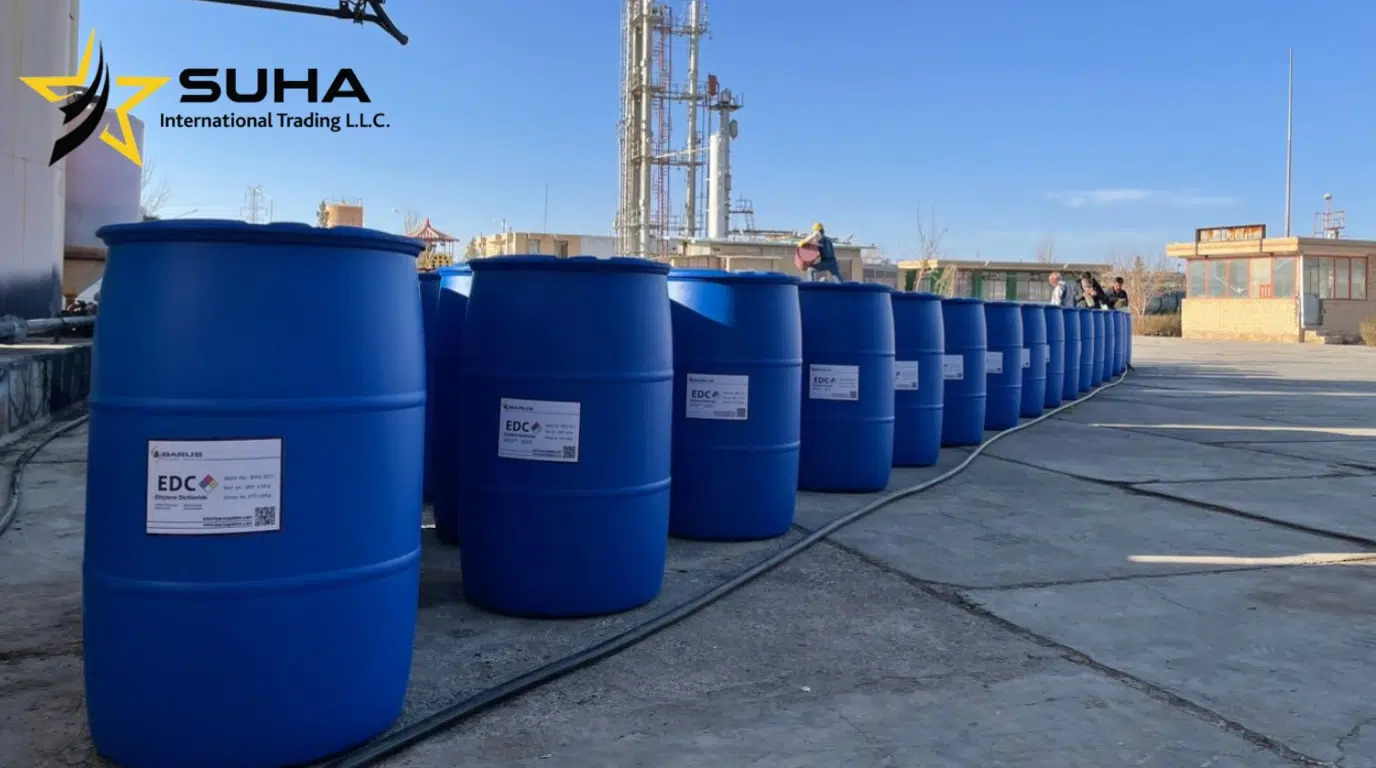
Ethylene Dichloride Supplier & Bulk EDC Exporter – Global 1,2-Dichloroethane
SUHA International Trading supplies ethylene dichloride (EDC) to VCM and PVC producers, chemical processors and industrial distributors — 99.5% minimum purity as standard, in ISO tank containers, chemical parcel lots and UN-approved drums. Every consignment ships with a batch Certificate of Analysis, a GHS Safety Data Sheet and the UN 1184 Class 3 dangerous-goods file your forwarder and customs broker need, under HS 2903.15 and CAS 107-06-2.
In short — we are an ethylene dichloride supplier and exporter serving industrial buyers of EDC (1,2-dichloroethane): CAS 107-06-2, formula C2H4Cl2, HS 2903.15, classified UN 1184, Class 3 flammable liquid, Packing Group II. Standard trade quality is 99.5% minimum, supplied in ISO tanks of roughly 20–26 MT, in parcel lots, or in UN-approved 200-litre drums for trial volumes. Minimum bulk order is one ISO tank.
Two points decide whether an EDC purchase runs smoothly. First, EDC is a dangerous good and a carcinogen-classified substance, so the discharge terminal, the carrier and the destination import file all have to be confirmed before a delivery date is promised. Second, the impurity table matters more than the purity headline — water, acidity and iron decide how the material behaves in a cracker or a reactor. We prepare the specification and the export file around both.
Who Buys Ethylene Dichloride, and Why It Is Traded
Ethylene dichloride is one of the largest-volume organic chemicals in world trade, and almost all of it exists for a single reason: it is the intermediate step between chlorine and PVC. Ethylene and chlorine make EDC, EDC is cracked to vinyl chloride monomer, and VCM is polymerised into PVC. Roughly 95% of global EDC production is consumed inside that chain, which means EDC demand is not really its own market — it is PVC demand, one step upstream.
That structure explains why the material is traded internationally at all. Most large PVC complexes are balanced: they make their own EDC from their own chlorine. The merchant market exists at the edges of that balance — VCM plants whose chlorine supply is short, PVC producers whose EDC unit is in turnaround, new capacity that has come online ahead of its upstream units, and chemical processors who need EDC as a starting material but have no chlor-alkali operation of their own. Those buyers are not buying a commodity casually; they are covering a gap that stops a plant if it is not covered.
The practical consequence for procurement is that reliability is worth more than a small price advantage — which is the first thing to look for in an EDC supplier. A cracker that runs out of feedstock costs far more per day than the spread between two offers, and a cargo refused at a terminal because the dangerous-goods paperwork was wrong is the same loss in a different form. That is the frame this page is written in: what an industrial buyer needs to specify, verify and document in order to receive EDC on the date it was promised.
Typical EDC Buyers We Quote
What We Contribute to an EDC Purchase
As an ethylene dichloride supplier we are an exporter rather than the producing plant, and we say so plainly. What a buyer gets from working with us is not a molecule that differs from anyone else's — it is specification control against your actual process requirement, dangerous-goods equipment and routing that the discharge terminal will accept, a document file assembled before the vessel sails rather than chased after arrival, and a straight answer when your requirement is better served somewhere else.
What Is Ethylene Dichloride? Definition, CAS & Identifiers
Ethylene dichloride — systematically 1,2-dichloroethane, and abbreviated EDC in the trade — is a chlorinated hydrocarbon with the formula C2H4Cl2. It is a clear, colourless, dense liquid with a sweet chloroform-like odour, produced industrially by chlorination and oxychlorination of ethylene. It is highly flammable, classified in the EU as a Category 1B carcinogen, and shipped worldwide as a Class 3 dangerous good under UN 1184.
Getting the identifiers right on the commercial invoice, packing list and dangerous goods declaration is the cheapest way to avoid a hold at the port of discharge. The most common paperwork error on this product is confusing it with 1,1-dichloroethane (CAS 75-34-3), a different substance with a different boiling point and a different UN entry, or with ethylene dibromide. A second recurring error is declaring EDC under a general "halogenated hydrocarbons" heading instead of its own six-digit subheading. Customs authorities treat both as classification errors rather than typographical ones.
Trade and Regulatory Identifiers for Ethylene Dichloride
| Attribute | Value | Commercial relevance |
|---|---|---|
| Trade name | Ethylene Dichloride (EDC) | Name used on offers, contracts and invoices |
| IUPAC name | 1,2-Dichloroethane | Name used on the SDS, label and DG declaration |
| Other names | Ethylene chloride, DCE, glycol dichloride | Appear in older buyer specifications |
| CAS number | 107-06-2 | The single identifier every technical team accepts |
| EC / EINECS | 203-458-1 | Required for EU import and REACH files |
| ECHA InfoCard | 100.003.145 | Reference for the EU regulatory position |
| HS code | 2903.15 | Own six-digit subheading; national codes extend it |
| UN number | UN 1184 | Governs packaging, placarding and carrier acceptance |
| Transport class | Class 3 — flammable liquid | IMDG at sea, ADR/RID by road and rail |
| Packing group | II | Determines approved packaging performance level |
| EU classification | Carc. 1B (H350), Flam. Liq. 2 (H225) | Drives REACH position and workplace controls |
| Formula | C2H4Cl2 | Stated on CoA and technical documentation |
| Molecular weight | 98.96 g/mol | Used in yield and stoichiometry calculations |
| Appearance | Clear, colourless liquid | Discolouration on arrival indicates ageing |
← Scroll the table sideways to see all columns →
Physical Properties That Affect Shipment and Storage
| Property | Typical value | Why it matters commercially |
|---|---|---|
| Density at 20 °C | ≈ 1.25 g/cm³ | A tank reaches its payload limit before its volume limit |
| Boiling point | ≈ 83.5 °C | Vapour management during hot-climate transfer |
| Melting point | ≈ -35 °C | No freezing risk on normal export routes |
| Flash point (closed cup) | ≈ 13 °C | Below ambient in most destinations — Class 3, PG II |
| Auto-ignition temperature | ≈ 413 °C | Hot-surface separation in the storage area |
| Explosive limits in air | ≈ 6.2 – 16.0 vol% | Wide range; vapour accumulation must be prevented |
| Water solubility at 20 °C | ≈ 0.87 g/100 mL | Limited but not negligible; spill containment required |
| Vapour density (air = 1) | ≈ 3.4 | Vapour sinks and collects in pits, sumps and bunds |
| Stability | Darkens and turns acidic with air, moisture and light | Sealed systems and stabiliser preserve shelf life |
← Scroll the table sideways to see all columns →
For independent verification of the substance data above, the PubChem record for 1,2-dichloroethane (CID 11) and the ECHA substance infocard are the two references most technical and regulatory teams accept without further discussion. The production route is documented in the 1,2-dichloroethane and vinyl chloride literature.
How Ethylene Dichloride Is Manufactured
Understanding the production route explains most of the commercial behaviour of this product — why EDC prices move with both ethylene and chlorine, why merchant availability tightens when PVC runs hard, and why two shipments with the same stated purity can behave differently in a cracking furnace.
Direct chlorination of ethylene
Ethylene and chlorine react in the liquid phase over an iron(III) chloride catalyst: C2H4 + Cl2 → C2H4Cl2. This route consumes elemental chlorine directly, which ties its economics to chlor-alkali operating rates.
Oxychlorination of ethylene
Ethylene, hydrogen chloride and oxygen react over a supported copper chloride catalyst: C2H4 + 2 HCl + 1/2 O2 → C2H4Cl2 + H2O. Its purpose is to consume the hydrogen chloride released when EDC is cracked, rather than to make EDC from scratch.
The balanced process
Run together, the two routes leave no net HCl to dispose of: 2 C2H4 + Cl2 + 2 HCl + 1/2 O2 → 2 C2H4Cl2 + H2O. This is the configuration of virtually every integrated EDC/VCM complex in the world.
Washing, neutralisation and distillation
Crude EDC is washed, neutralised and distilled to remove water, acidity and chlorinated by-products. Oxychlorination EDC carries a heavier by-product load than direct-chlorination EDC, so purification depth is a genuine difference between sources — and the reason the impurity table is worth more attention than the purity headline.
Cracking to VCM — the downstream step
At the buyer's plant, EDC is thermally cracked at roughly 480-550 °C under pressure: C2H4Cl2 → C2H3Cl + HCl. Conversion per pass is deliberately limited and unconverted EDC is recycled. Impurities that promote coking or corrosion in the furnace shorten run length, which is why feedstock quality is a production-reliability issue rather than a purchasing preference.
EDC Supply Formats and Quality Levels
EDC has no formal international grade system in the way that caustic soda has "flakes 98%" or "pearls 99%". What exists in practice are quality levels defined by the buyer's process and supply formats defined by the buyer's volume and receiving infrastructure. The three combinations below cover almost every enquiry we receive.
VCM-Feedstock EDC — 99.5% minISO tanks or parcel lots
The standard merchant quality: 99.5% minimum purity with controlled water, acidity, iron and chlorinated by-products. Bought by VCM and PVC producers covering a shortfall or a turnaround, usually in multi-tank lots or parcel quantities against a monthly schedule.
Request a quotation →High-Purity EDCIntermediate & speciality synthesis
Where EDC is a starting material rather than a cracker feed, the limits that matter shift to moisture, residue and specific by-products rather than bulk assay. Send your specification sheet and we will confirm against available production before quoting rather than after.
Send your specification →Drummed EDCUN-approved 200-litre steel drums
For qualification runs, second-source approval and smaller industrial consumers. Around 20 MT net in a 20-foot container. Subject to dangerous-goods packaging availability and to the route accepting packaged Class 3 cargo, which is not true of every service.
Ask about drummed supply →Specify the process, not just the percentage. An enquiry that says "EDC 99.5%" can be answered by material that performs very differently in the field. An enquiry that says "EDC for a cracking furnace, our limits are water X ppm, acidity Y ppm, iron Z ppm" gets an offer that either matches or is honestly declined — which is faster and cheaper than discovering the gap after the tank arrives.
Ethylene Dichloride Specification & Impurity Control
The table below sets out the parameters that appear in commercial EDC contracts, with the ranges commonly seen in the market. These values are given for orientation so that a buyer can frame an enquiry realistically. They are not an offer specification. The binding figures are the ones written into the sales contract and confirmed on the batch Certificate of Analysis for the material actually shipped.
| Parameter | Indicative range | What it controls in your process |
|---|---|---|
| EDC purity | 99.5% min (w/w) | Yield per tonne of feed and cracker conversion |
| Appearance | Clear, free of suspended matter | First indicator of ageing or contamination on arrival |
| Colour (Pt-Co) | Water-white | Visual acceptance at discharge |
| Water / moisture | Low ppm maximum | Water plus HCl means corrosion in carbon-steel systems |
| Acidity as HCl | Low ppm maximum | Degradation indicator and corrosion risk in tanks and lines |
| Iron (Fe) | Low ppm maximum | Catalyses decomposition and promotes furnace coking |
| Non-volatile residue | Low ppm maximum | Fouling in reboilers, exchangers and downstream equipment |
| Chlorinated by-products | Defined per contract | Cracking behaviour, by-product formation and product quality |
| Stabiliser / inhibitor | Present or absent, as agreed | Shelf life over long sea transit and storage |
← Scroll the table sideways to see all columns →
Why the Impurity Table Beats the Purity Headline
Two shipments can both be certified at 99.5% and still differ by an order of magnitude in the parameters that actually cause problems. The missing half-percent is not empty space: it is water, acidity, iron and chlorinated by-products, and their proportions depend on the production route and the depth of purification at origin. Water combined with acidity attacks carbon steel; iron catalyses decomposition and accelerates coke formation in a cracking furnace; heavy chlorinated by-products change the by-product slate downstream. A buyer who compares only assay figures is comparing the least informative number on the certificate.
Certificate of Analysis — What to Insist On
Ask for a batch-numbered, dated Certificate of Analysis issued against the material loaded, not a template specification sheet reused across shipments. A usable EDC CoA carries the product name and CAS number, the batch or tank identification, the date of analysis, the test method for each parameter, the result against the agreed limit, and the signature of the issuing laboratory. Agree in the contract, before shipment, which laboratory governs if your incoming analysis differs from the supplier's — an umpire laboratory named in advance turns a potential dispute into a procedure.
- Product identification, CAS number and batch or tank number
- Date of production and date of analysis
- Purity, water, acidity, iron, residue and any contract-specific impurity
- Test method stated next to each result
- Stabiliser content where the contract specifies one
- Issuing laboratory, signature and reference to the sales contract
What Ethylene Dichloride Is Used For
Ethylene dichloride has one dominant application and a set of smaller ones. Around 95% of world production goes to vinyl chloride monomer and from there to PVC; the remainder is split between chlorinated and nitrogen-containing intermediates and a small, shrinking share of solvent and process uses. The commercial point for a buyer is that the dominant use sets the price, while the smaller uses set the specification.
Vinyl Chloride Monomer
The primary use. EDC is cracked to VCM and hydrogen chloride, with the HCl recycled to oxychlorination. Feedstock quality drives furnace run length and coking rate, so specification discipline here is a production-uptime question.
≈ 95% of global EDC demandPVC Value Chain
VCM is polymerised to PVC resin for pipes, cable insulation, window and door profiles, flooring, roofing membranes, packaging, automotive parts and medical disposables. PVC demand is what ultimately moves EDC.
Construction & infrastructure drivenEthyleneamines & Chelating Agents
Reaction with ammonia produces ethylenediamine and higher ethyleneamines, used in chelating agents, lubricant and fuel additives, epoxy curing agents and surfactants. Tighter impurity limits required.
Higher purity specificationVinylidene Chloride (VDC) Monomer
EDC is a precursor to VDC, which is used to produce PVDC – a high-barrier polymer for food packaging, coatings and films. This application requires very low levels of certain by-products.
Speciality packaging gradeChlorinated Solvents (TCE, PCE)
EDC is used to manufacture trichloroethylene and perchloroethylene, which are solvents for degreasing, dry cleaning and chemical extraction. Regulatory restrictions are reducing this outlet in many regions.
Declining but still significantPharmaceutical & Agrochemical Intermediates
EDC serves as a building block for various active ingredients, including certain anaesthetics, pesticides and herbicides. Requires ultra-high purity and tight control of trace impurities.
High-value, low-volumeProcess Solvent (Controlled Use)
Historically used in extraction, degreasing, adhesives and laboratory work. ECHA treats solvent use as minor relative to manufacture of other substances, and carcinogenicity controls mean any such use has to be justified against available substitutes.
Minor and declining shareSecond-Source Qualification
Not an application but a recurring commercial reason to buy: plants qualifying an alternative supplier take drummed or single-tank volumes with a full document set before committing to contract volumes.
Trial quantities availableEDC, VCM and PVC — the Chain in One Line
Ethylene + chlorine → EDC → VCM → PVC. Each arrow is a separate plant, often on the same site and often owned by the same company. When a buyer asks whether to purchase EDC or VCM, the answer usually turns on logistics rather than chemistry: EDC is a liquid that ships in ordinary ISO tanks at ambient temperature, while VCM is a gas that has to move liquefied under pressure or refrigerated, in specialised equipment with far fewer available carriers. For most importers, EDC is the practical form in which this part of the chain can be bought at all.
EDC Packaging, Tonnage & Container Loading
Ethylene dichloride is dense — about 1.25 g/cm³, a quarter heavier than water — so equipment reaches its weight limit before its volume limit. That single fact governs how the product is loaded, how freight is calculated and how much material actually arrives per unit of transport. The cards below show the main packaging formats.
ISO Tank Container
Standard bulk method – 20 to 26 net tonnes per T11 tank.
- ✔ Payload ~20–26 MT
- ✔ Discharge at certified terminal
- ✔ Reusable for annual contracts
- ✖ Requires DG logistics
Parcel Tanker
Chemical tankers for large volumes (from ≈1,000 MT upward).
- ✔ Ideal for long-term contracts
- ✔ Lower freight cost per tonne
- ✖ Requires terminal storage capacity
UN‑Approved Drums
200‑litre steel drums – approx. 250 kg per drum, 20 MT per 20‑ft container.
- ✔ Perfect for trials and qualification
- ✔ Flexibility for small quantities
- ✖ Higher unit cost
Flexitank – Not Permitted
Not approved for Class 3 dangerous liquids.
- ✖ Risk of terminal refusal
- ✖ Non‑compliant with IMDG/ADR
- ✖ Uninsured loss in case of incident
Treat any flexitank offer as a warning sign. Flexitanks are approved for non-hazardous liquids only. An offer to ship EDC — a UN 1184 Class 3 flammable liquid — in a flexitank indicates a counterparty who either does not understand the dangerous-goods rules or intends to declare the cargo incorrectly. Either way, the cargo is at risk of refusal, seizure or an uninsured loss, and the buyer of record carries that exposure at destination.
What Decides the Tonnage in an ISO Tank
Buyers frequently ask why one offer quotes 22 MT per tank and another 26 MT. Three variables explain almost all of it. Tank volume varies between roughly 21,000 and 26,000 litres across the T11 fleet. Filling ratio is limited by the dangerous-goods rules to allow for thermal expansion, so a tank is never filled to its nominal capacity. Permitted payload is set by the tank's maximum gross weight less its tare, and by road weight limits at both ends of the journey. With EDC at 1.25 kg per litre, the payload ceiling arrives quickly, which is why the useful question at offer stage is net tonnes per tank rather than tank size.
Tank Condition and Last Cargo
For a dedicated-quality product, the cleaning certificate and the previous cargo history of the tank matter as much as the CoA. Ask for both before the tank is filled, not after the material fails your incoming test. Where your process is sensitive, specify in the contract that tanks must be dedicated or that a named prior-cargo exclusion list applies, and require the cleaning certificate to travel with the document set.
Routing and Terminal Acceptance
Not every port, service or carrier accepts Class 3 cargo, and those that do may restrict it by service, by transhipment hub or by season. This is the single most common cause of a delayed EDC shipment, and it is entirely avoidable: the discharge terminal's dangerous-goods acceptance and the carrier's booking policy are confirmed before the offer is fixed, not after the contract is signed. Where a preferred port will not take the cargo, we quote the workable alternative and state the difference in the inland leg openly.
Is EDC Dangerous? Classification, Storage & Controls
Yes — and it should be procured on that basis. EDC is highly flammable, with a closed-cup flash point around 13 °C, which is below ambient temperature in most of the markets it ships to. It also carries a harmonised EU classification as a Category 1B carcinogen. This is not a product where a buyer can rely on general chemical-handling practice; it needs closed systems, hazardous-area equipment and a documented exposure-control regime.
| Item | Classification | Practical consequence |
|---|---|---|
| Signal word | Danger | Highest GHS signal level on the label |
| Flammability | Flam. Liq. 2 — H225 | Hazardous-area classification, grounding, bonding, no ignition sources |
| Carcinogenicity (EU CLP) | Carc. 1B — H350 | Exposure minimisation, monitoring, health surveillance obligations |
| Acute toxicity | H302 — harmful if swallowed | Hygiene controls; no eating or drinking in the handling area |
| Irritation | H315, H319, H335 | Skin, eye and respiratory protection under a documented risk assessment |
| IARC evaluation | Group 2B | Possibly carcinogenic to humans; cited in many national frameworks |
| Transport | UN 1184, Class 3, PG II | Approved equipment, placarding, DG declaration, carrier acceptance |
← Scroll the table sideways to see all columns →
Storage Requirements at the Buyer's Site
- Store in closed, grounded systems in a cool, well-ventilated and bunded area, protected from direct sunlight.
- Keep away from ignition sources, hot surfaces, sparks and open flame — the flash point sits below normal ambient temperature.
- Use electrical equipment rated for the applicable hazardous-area classification in the storage and transfer zone.
- Ground and bond all equipment during transfer; static discharge is a realistic ignition source with this product.
- Prevent vapour accumulation. EDC vapour is around 3.4 times heavier than air and collects in pits, sumps, trenches and bunds.
- Monitor confined spaces and test the atmosphere before any entry.
- Segregate from oxidisers, strong bases, active metals such as aluminium powder, and other incompatibles listed in the SDS.
- Provide bunding, spill containment, absorbent material and appropriate fire-fighting media at the storage area.
- Train personnel specifically in flammable and carcinogen-classified liquid handling, and select PPE from a documented risk assessment.
The current supplier Safety Data Sheet always takes precedence over generic handling advice, including everything on this page. Request the SDS at enquiry stage and route it to your EHS, engineering and logistics teams before the cargo is booked, not after it arrives.
EDC Compliance, REACH Position & Export Documents
Obligations for ethylene dichloride depend on where it is made, imported, stored and used, and on the role the buyer plays in the supply chain. No supplier can honestly claim blanket global compliance without naming the framework. The practical questions are which rules apply to your legal entity, and which documents your customs file needs.
European Union — REACH and the Intermediate Exemption
1,2-Dichloroethane sits on the REACH Authorisation List (Annex XIV) because of its carcinogenicity classification, with a latest application date of 22 May 2016 and a sunset date of 22 November 2017. After that date, uses within scope require an authorisation. One exemption matters commercially more than any other: isolated intermediates used under strictly controlled conditions fall outside the scope of the authorisation requirement. That is precisely why EDC continues to move in Europe as VCM feedstock while the same substance is tightly restricted for open uses such as solvents.
The obligation sits with the EU legal entity that imports or uses the substance, not with the foreign exporter, and it differs by role and by intended use. If your destination is in the EU, tell us the intended use and your supply-chain position at enquiry stage. We would rather decline a requirement early than ship into a position the buyer cannot lawfully hold.
Dangerous-Goods Transport
Shipments must comply with the rules for the chosen mode — IMDG at sea, ADR and RID for European road and rail, IATA in the rare cases of air movement — covering approved equipment, marking, labelling, placarding, segregation, documentation and carrier acceptance under UN 1184. The Dangerous Goods Declaration must agree with the invoice, the packing list and the physical cargo; a mismatch between them is treated as a declaration error, not a clerical one.
Destination Requirements Outside the EU
Elsewhere, EDC is typically controlled through national chemical inventories, occupational exposure limits, hazardous-substance import licensing, precursor or controlled-chemical registers, and drinking-water standards. Several markets we serve require an import permit or a pre-shipment approval issued to the importing company. That permit is the buyer's to obtain, and it needs to be in hand before the cargo sails — not while it sits at the terminal accruing demurrage.
Standard Export Document Set
What Determines the Ethylene Dichloride Price
No figure appears on this page, and that is deliberate. Ethylene dichloride is priced per metric ton against two volatile feedstocks and a freight market that moves independently of both. Any number published on a supplier page is stale within days and will mislead your budgeting. We issue firm, dated quotations per shipment with a stated validity period, and we would rather explain the drivers than post a number that expires before you use it.
| Driver | Effect on landed cost | Within your control? |
|---|---|---|
| Ethylene cost | Sets the hydrocarbon half of the cost base; follows naphtha and ethane cracker economics | No — but contract timing is |
| Chlorine availability | Chlorine is a co-product of caustic soda; chlor-alkali operating rates move EDC supply | No |
| PVC and VCM demand | Almost all EDC demand is derived from PVC; construction cycles set the direction | No |
| Specification tightness | High-purity and low-impurity requirements narrow the eligible production | Yes — specify what the process needs |
| Order volume | Multi-tank lots, parcels and annual contracts price below single-tank spot | Yes — consolidate requirements |
| Packaging format | Drummed material carries a substantial premium per tonne over bulk | Yes |
| ISO tank availability | DG tank supply, cleaning and repositioning cost can move the delivered number sharply | Partly — flexible timing helps |
| Discharge port choice | DG acceptance, terminal charges and the inland leg differ significantly between ports | Yes |
| Incoterm | FOB, CFR, CIF and CPT are not comparable numbers | Yes — compare like with like |
| DG surcharges and routing | Class 3 surcharges, transhipment restrictions and congestion fees | Partly — route choice helps |
| Compliance and inspection | Import permits, legalisation and third-party inspection are real line items | Yes — specify them up front |
← Scroll the table sideways to see all columns →
The most common costing error we see is comparing one supplier's FOB number against another's CIF and concluding the first is cheaper. Insist that every offer states the same Incoterm, the same discharge port, the same packaging configuration, the same net tonnage per unit and the same specification — and that inspection, documentation and legalisation costs are named rather than left to surface later. Once offers are genuinely comparable, the spread between serious suppliers is usually narrower than it first appeared, and the decision moves to reliability, where it belongs.
How to Buy Ethylene Dichloride in Bulk
From first enquiry to discharged tank, an ethylene dichloride purchase runs through six stages. The two that buyers most often underestimate are stage four, where dangerous-goods acceptance and import licensing are confirmed, and stage six, where the document set has to be complete and internally consistent before the cargo reaches customs.
Send the enquiry with six data points
Specification or purity requirement, quantity in MT and frequency, packaging format, discharge port plus final delivery address, preferred Incoterm, and shipment window. With these six we can quote; without them any number is a guess.
Receive a dated offer
Stating origin, specification, packaging, net tonnage per tank or container, Incoterm, payment terms, quantity tolerance, validity period and shipment window — with the cost elements identified rather than bundled.
Review the technical file
Specification sheet, a recent Certificate of Analysis and the Safety Data Sheet, checked by your process engineers against the cracker or reactor requirement and by your EHS team against your site controls.
Confirm the compliance route
Your import licence or controlled-chemical registration, the discharge terminal's Class 3 acceptance, and in the EU your REACH position for the intended use. This happens before the contract, not after.
Contract, payment instrument, allocation
Sales contract signed, letter of credit opened or telegraphic transfer remitted, then allocation, batch testing, tank cleaning certification and any nominated third-party inspection.
Shipment, documents and clearance
Tanks filled and sealed under a dangerous-goods booking, scanned document set issued within three to five working days of sailing, originals by courier, and arrival coordinated with your broker and receiving terminal.
Payment and Contract Terms
We work on irrevocable letter of credit at sight through an acceptable bank, or telegraphic transfer — either in full in advance or as a deposit against the balance on presentation of the Bill of Lading copy. Cash against documents and deferred terms are considered for established buyers after credit review. USD is standard and EUR is available. For repeat consumers we prefer an annual framework contract with monthly call-off, which stabilises both allocation and equipment booking and usually prices better than a sequence of spot purchases.
Request an EDC Quotation, CoA or SDS
Send six data points and you will receive a firm, dated offer — FOB, CFR or CIF to your discharge port — with packaging, net tonnage per tank, documentation and inspection costed in.
Speak With Our EDC Supply Desk
We respond to ethylene dichloride enquiries within 24 business hours, usually faster. For an urgent feedstock requirement or a tender deadline, WhatsApp is the quickest channel. You can request the current specification, Certificate of Analysis or Safety Data Sheet at no cost and with no obligation.
💬 WhatsApp — fastest response channel+971 50 720 9246 📧 Email — enquiries and formal quotationsinfo@causticsodaco.comInclude This for the Fastest Quote
FAQ — Ethylene Dichloride Supply
What is ethylene dichloride used for?
Ethylene dichloride is primarily used as feedstock for vinyl chloride monomer (VCM), which is polymerised to PVC. Smaller volumes are used to produce ethyleneamines, chlorinated solvents (TCE, PCE), vinylidene chloride, and as a chemical intermediate in pharmaceuticals and agrochemicals. About 95% of global EDC production goes into the VCM/PVC chain.
What is the price of EDC per ton?
There is no single fixed price. EDC is priced per metric ton based on ethylene and chlorine costs, freight, ISO tank availability, destination, Incoterm and specification. We provide firm, dated quotations per shipment with a validity period rather than publishing a stale number.
Is ethylene dichloride dangerous?
Yes. EDC is highly flammable (flash point ~13°C), classified as UN 1184 Class 3 PG II, and in the EU as a Category 1B carcinogen (H350). IARC lists it in Group 2B. It requires closed systems, hazardous-area equipment, grounding, bonding, vapour control and trained personnel.
What is the difference between EDC and VCM?
EDC (C2H4Cl2) is a liquid shipped in ISO tanks at ambient temperature. VCM (C2H3Cl) is a gas at ambient conditions, produced by cracking EDC at 480-550°C, and must be shipped liquefied under pressure or refrigerated. EDC is the raw material; VCM is the monomer; PVC is the polymer.
Minimum order quantity for EDC?
For bulk supply, one ISO tank (≈20-26 MT) is the practical minimum. Drummed quantities (≈250 kg/drum, 20 MT per container) are available for trial and qualification. Multi-tank or annual contracts with monthly call-off are quoted for continuous consumers.
How is EDC shipped?
Bulk EDC is shipped in ISO tank containers (20-26 MT per tank) or chemical parcel tankers (from ≈1,000 MT). Smaller volumes go in UN-approved 200-litre steel drums. Flexitanks are not permitted because EDC is a Class 3 flammable liquid.
What documents are needed for EDC import?
Commercial Invoice, Packing List, Bill of Lading, Certificate of Origin, batch Certificate of Analysis, GHS Safety Data Sheet, Dangerous Goods Declaration (UN 1184), tank cleaning/last-cargo certificate, and where required, third-party inspection reports (SGS, BV, Intertek) and legalised/apostilled documents.
Is EDC banned in Europe?
EDC is not banned but is on the REACH Authorisation List (Annex XIV) due to its carcinogenicity. Uses within scope require authorisation. However, isolated intermediate use under strictly controlled conditions (e.g., VCM feedstock) is exempt. Importers into the EU must verify their own REACH position.
What is the purity of commercial EDC?
VCM-feedstock grade is typically 99.5% minimum, with tight limits on water, acidity (as HCl), iron and chlorinated by-products. Higher purity is available for speciality uses. The impurity table is more important than the purity headline.
Can EDC be shipped in flexitanks?
No. Flexitanks are approved only for non-hazardous liquids. EDC is UN 1184 Class 3 flammable liquid, so using a flexitank is a dangerous-goods violation and risks refusal, seizure or uninsured loss.