
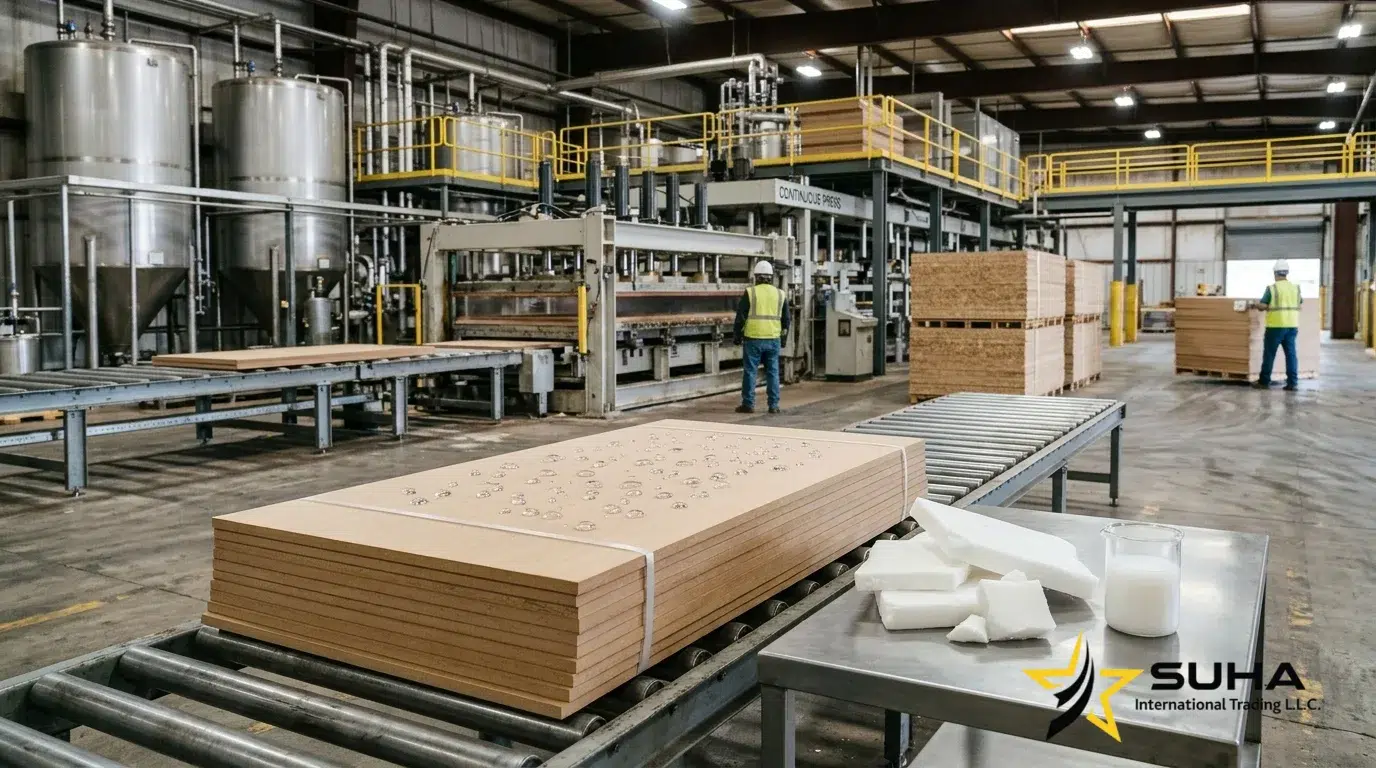
Wood-panel chemicals · Bulk paraffin & slack wax from Türkiye and UAE
Paraffin Wax Emulsion for MDF & Particleboard: Grades, Dosage and Bulk Wax Supply
Paraffin wax emulsion for MDF and particleboard is the sizing agent that makes wood-based panels repel water. Fine wax droplets coat the fibres or chips so liquid water cannot wick into the board, which cuts thickness swelling and water absorption, reduces sanding dust and helps panels meet EN moisture specifications. It is added in small amounts relative to the dry wood. This guide is for MDF and particleboard producers, wax-emulsion manufacturers and chemical distributors. It explains how sizing works, how much to dose, which paraffin wax or slack wax grade to use for the emulsion, and what to check before you buy.
Short answer
Paraffin wax emulsion for MDF and particleboard is a 50–60% solids dispersion of paraffin or slack wax in water, stabilised by emulsifiers. Published studies report paraffin doses of roughly 0.1–1% of the dry wood, and one MDF study found little extra swelling benefit above about 0.25%. Each plant sets its own dose by trial. In MDF the wax is usually added before or at the refiner, or into the blowline. In particleboard it goes into the glue blender with the UF or MUF resin. Waxes richer in long-chain n-paraffins (lower oil content) size more efficiently; slack wax costs less per tonne. We supply the wax, not ready-made emulsion.
Fundamentals
Why MDF and Particleboard Need Paraffin Wax Sizing
Wood fibres and chips are naturally hydrophilic, which is why every board line needs a water-repellent sizing agent. Without a sizing agent, a board soaked in water swells sharply in thickness, absorbs water along its edges, loses strength, and shows raised fibres under paint or laminate. UF resin alone does not stop this. A small amount of well-dispersed paraffin wax emulsion for MDF and particleboard makes the fibre surface hydrophobic and does most of the job at very low cost per cubic metre. That is why paraffin wax for MDF and particleboard remains the standard sizing agent in wood-based panels.
For a panel producer, paraffin sizing delivers four things:
- Lower thickness swelling and water absorption, measured by the 24-hour immersion test in EN 317. This is what decides whether a board meets the EN 312 particleboard classes or the EN 622-5 MDF requirements.
- Moisture-resistant grades. Higher-performance boards for kitchens, bathrooms and humid climates, such as P3 particleboard or moisture-resistant MDF, depend on good wax sizing alongside MUF resin.
- Less dust and better sanding. Wax lubricates the surface, which reduces sanding dust and extends sanding-belt life.
- Smoother processing. A hydrophobic, lubricated fibre surface can help the mat release from press belts and gives a cleaner surface for lamination.
Türkiye has become Europe's leading producer of wood-based panels, and plants across the Middle East, North Africa and Central Asia are expanding. Paraffin and slack wax are a small share of board cost, but a supply interruption stops a line. That is why panel plants value a regional wax source with short lead times.
Process
How Paraffin Wax Emulsion Works in MDF and Particleboard
Paraffin does not seal the board like a coating. Microscopic wax particles deposit on fibre and chip surfaces and lower the surface energy, so liquid water beads up instead of wicking along capillaries. The wax does not stop water vapour, and it does not reduce long-term equilibrium moisture. It slows short-term liquid water uptake, which is exactly what the 24-hour swelling test measures.
| Board | Usual addition point | Form | Notes |
|---|---|---|---|
| MDF | Chips before pre-steaming, at the refiner, or into the blowline | Emulsion or molten wax | Refiner and pre-steaming addition spreads wax over the fibre before the resin goes in at the blowline |
| Particleboard | Glue blender, with UF or MUF resin and hardener | Emulsion (most common) or molten wax spray | Face and core layers can be dosed differently |
| OSB | Strand blender, before or with the resin | Usually molten (slack) wax | High-oil slack wax is widely used |
| Hardboard / HDF | Refiner or blowline | Emulsion | Similar to MDF, with higher density |
Swipe the table sideways to see every column.
Wax and resin compete for the same fibre surface. Wax that coats a fibre where resin should bond reduces internal bond strength, so the dose and the dispersion quality matter as much as the wax grade. Emulsion stability under the shear, heat and acidic pH of a UF system also has to be confirmed, so that the emulsion does not break before it reaches the fibre.
Comparison
Wax Emulsion vs Molten Paraffin: Which Dosing Method?
Panel plants dose paraffin either as a ready water-based emulsion or as molten wax pumped from a heated tank. Many large plants make their own emulsion on site from bulk paraffin or slack wax to cut freight on the water content.
| Criterion | Wax emulsion | Molten paraffin / slack wax |
|---|---|---|
| Handling | Pumped cold; storage at about 5–30 °C | Heated tanks and lines, typically above 60 °C |
| Dispersion on fibre | Very fine particles (around 1–5 µm) spread evenly | Coarser; depends on spray nozzles and refiner mixing |
| Sizing efficiency per kg wax | Higher | Generally lower than a fine emulsion |
| Freight | About 40–50% of what you ship is water | 100% active wax |
| Shelf life | Limited (months); avoid freezing | Long, as a solid wax |
| Fire risk in the plant | Low (water-based) | Hot-wax handling precautions needed |
| Typical users | MDF, particleboard | OSB, some particleboard lines |
Swipe the table sideways to compare.
Making your own emulsion? You need consistent wax: the same melting point and oil content from lot to lot keeps the emulsion stable.
Choose the wax gradeGrade selection
Which Paraffin Wax Is Best for MDF and Particleboard Emulsions?
Research on MDF sizing shows that paraffins richer in long-chain n-alkanes size more efficiently than those with a lot of oil and branched molecules. Lower-oil waxes generally contain a higher share of these straight-chain n-paraffins, which is why refined grades tend to size more efficiently per kilogram. Slack wax costs less per tonne and is the traditional panel wax. When you choose the base wax for a paraffin wax emulsion for MDF, or a wax emulsion for particleboard, these are the main options. For the full range of grades, see our semi refined paraffin wax supply page. The right choice balances cost per tonne against the dose you need:
Semi Refined Paraffin Wax 3–5% / 5–7%
Consistent melting point and lower oil than slack wax give efficient sizing and stable emulsions. A strong choice for MDF and face-layer particleboard.
Semi Refined Paraffin Wax 7–10%
Lower cost than the 3–7% grades, with sizing still good enough for standard (non-moisture-resistant) particleboard and MDF.
Slack Wax 5%, 10% and Heavy 12%
The traditional wood-panel wax. Lowest cost per tonne of the emulsion-grade options, widely used in emulsions and molten dosing.
Light Slack Wax 30%
Very low cost but oily and soft. Better suited to molten dosing in OSB and to budget blends than to high-performance MDF.
Each panel line and emulsifier system responds differently. Run plant trials and compare swelling at equal wax solids before you switch grades.
Related grades: semi refined 5–7%, slack wax 5%, slack wax 10% and heavy slack wax 12%.
Dosage
Paraffin Wax Emulsion Dosage for MDF and Particleboard: What Research Reports
Paraffin wax emulsion for MDF and particleboard is dosed as wax solids on oven-dry wood. A 0.5% dose means 5 kg of wax per tonne of dry fibre or chips, or 10 kg of a 50% solids emulsion. There is no single correct dose. Each plant sets its own by trial, depending on board type, density, resin system, wax grade and the swelling target. Published research gives these reference points:
| Source | Paraffin level studied or reported | Finding |
|---|---|---|
| Roffael et al. (2005), MDF | 0.1–1.0% of dry fibre | No harm to physical-mechanical properties across this range. Above about 0.25%, extra paraffin had little further effect on swelling. Long-chain n-paraffins sized more efficiently. |
| Wood Research (2025), industrial MDF | 1.5 kg/m³ (≈ 0.2% of board weight) | Small changes in swelling and water absorption, but lower internal bond and bending strength at some densities |
| Other literature cited in the same study | 0.5–1% and 1–2% | Ranges used by other researchers, showing how widely practice varies |
Swipe the table sideways to see every column.
The practical lesson: more wax is not automatically better. The swelling benefit tends to level off, and paraffin can reduce internal bond. Most producers find their lowest effective dose through plant trials and hold it there. As a wax supplier we do not set dosing. We supply consistent wax so that the dose you have proven keeps working, lot after lot.
Calculator
Paraffin Wax Demand Calculator for MDF and Particleboard Plants
Estimate how much paraffin or slack wax your panel line uses each year, and how much emulsion that makes. Use it to plan contracts and container schedules.
Annual Wax & Emulsion Estimator
Enter your annual output, board density and the wax dose your plant uses (0.5% is only an example). The estimate assumes oven-dry wood is about 90% of board weight, with the rest resin, wax and moisture.
Container estimate uses about 25 MT of palletised slabs per 40ft container. Final quantities depend on your actual dose, density and yield.
Quality control
Paraffin Wax Emulsion for MDF: Specifications Panel Plants Should Check
Whether you buy a ready paraffin wax emulsion for MDF or make your own from bulk paraffin wax, these are the properties that decide how it performs on the line:
| Property | Typical range | Why it matters |
|---|---|---|
| Solids content | 50–60% | Sets the dose and freight cost; check every lot |
| Particle size | ≈ 1–5 µm | Finer particles spread more evenly over the fibre surface |
| Viscosity @ 20 °C | ≈ 20–400 mPa·s | Pumping and metering accuracy |
| pH | Depends on emulsifier type | Must suit your resin and hardener system |
| Ionic character | Anionic, cationic or non-ionic | Studies show anionic and cationic systems can size equally well; compatibility with the resin decides |
| Stability | No creaming or separation in storage | An unstable emulsion doses unevenly and blocks nozzles |
| Resin compatibility | Stable when mixed with UF or MUF | Test with your own resin, hardener and temperature |
Swipe the table sideways to see every column.
For the wax itself, check melting point (ASTM D87), oil content (ASTM D721) and consistency between lots. A shift in melting point or oil content changes how the emulsion forms and how it sizes the board, even when the solids content looks the same.
Troubleshooting
Wax Sizing Problems in MDF and Particleboard, and How to Fix Them
| Problem | Likely cause | Fix |
|---|---|---|
| High thickness swelling | Dose too low, poor dispersion, emulsion breaking early | Check solids and particle size, move the addition point earlier, increase the dose in small steps |
| Low internal bond | Wax overdose or wax coating bond sites | Reduce wax to the lowest effective dose and improve the resin distribution |
| Emulsion separating in the tank | Old stock, freezing, heat, or contamination | Store at 5–30 °C, stir, use stock first-in first-out, check the shelf life |
| Blocked nozzles or lines | Emulsion breaking with resin or hardener | Test compatibility and change the mixing order or emulsifier type |
| Lot-to-lot swelling variation | Changes in wax melting point or oil content | Specify melting point and oil content on the purchase order and check every COA |
| Poor lamination or paint adhesion | Too much wax at the surface | Lower the face-layer dose and check sanding depth |
Swipe the table sideways to see the fixes.
Procurement
Bulk Paraffin and Slack Wax for Wax Emulsion Makers and Panel Plants
We supply the paraffin and slack wax that emulsion producers and wood-panel plants use to make paraffin wax emulsion for MDF and particleboard. We supply the wax only, not ready-made emulsion, so you control your own emulsion recipe. The same grades are used as molten paraffin wax for particleboard and OSB lines. With offices in Ankara and Dubai, we serve panel plants in Türkiye by road and load containers for the Middle East, North Africa, the Caucasus, Central Asia and Eastern Europe.
Forms and packing
- Semi refined wax in 5 kg slabs, packed in carton boxes or laminated bags
- 40 cartons or 50 laminated bags per pallet
- Slabs can be converted to flakes, granules or pellets in bags for faster melting in emulsion plants
- Slack wax in 200 kg drums or IBC tanks
Loading and terms
- Semi refined slabs: about 17.5–18.5 MT per 20ft and about 25 MT per 40ft palletised
- MOQ: one full container load (1 FCL, 20ft or 40ft)
- FOB Mersin or Jebel Ali, or by truck from Türkiye
- Lot COA (melting point, oil content), MSDS and certificate of origin with every shipment
Resin chemicals from the same supplier
Panel plants can consolidate more than wax with us. We also supply urea for UF resin production, melamine for MUF resin in moisture-resistant boards, and ammonium sulfate, which is widely used as a hardener for UF resins. That means one supplier, one document set and fewer bookings.
Supplier
Paraffin Wax Supplier for MDF and Particleboard, with Offices in Türkiye and Dubai
SUHA International Trading works from two offices: our head office in Business Bay, Dubai, and our Türkiye office in Ankara, close to Türkiye's wood-panel industry. You can meet the team, call in your own time zone, and load from the port or border crossing closest to your plant. More about SUHA International
Dubai Office
Office 2305, Burlington Tower,Business Bay, Dubai, United Arab Emirates Open in Google Maps
Ankara Office
Karşıyaka District, 749 Street, No 30,Gölbaşı, Ankara 06830, Türkiye Open in Google Maps
Meetings at either office are by appointment. WhatsApp is monitored seven days a week, and enquiries are answered within one business day.
Consistent wax, lot after lot
Melting point and oil content are reported on every COA, so your emulsion and your swelling results stay stable.
The full oil-content range
Slack wax at 5–30% oil and semi refined wax at 1–10% oil, so you can trade cost per tonne against dose.
Close to Türkiye's panel industry
Road delivery from Türkiye and container loading at Mersin cut lead times for Turkish, Caucasus and Balkan plants.
Wax plus resin chemicals
Urea, melamine and ammonium sulfate alongside paraffin, on one contract.
Trial-friendly
Samples with a COA for plant trials before you switch grade or supplier.
Contract supply
Monthly container schedules sized from your annual wax demand.
Related products and guides
FAQ
Paraffin Wax Emulsion for MDF & Particleboard: FAQ
What is paraffin wax emulsion used for in MDF and particleboard?
Paraffin wax emulsion is a water-repellent sizing agent. Fine wax particles coat wood fibres and chips so liquid water beads up instead of soaking in, which reduces short-term thickness swelling and water absorption, cuts sanding dust and helps panels meet EN moisture requirements.
How much paraffin wax is used in MDF and particleboard?
There is no single standard dose; each plant sets its own by trial. Published studies report paraffin levels of roughly 0.1–1% of the dry wood, with some literature citing up to 1–2%. One MDF study found little extra swelling benefit above about 0.25% paraffin. A 0.5% dose equals 5 kg of wax per tonne of dry wood.
Does more wax always reduce swelling?
No. Research on MDF found that above about 0.25% paraffin, extra wax had little further effect on swelling, and an industrial study found paraffin can lower internal bond and bending strength at some densities. Most plants look for the lowest dose that meets their swelling target.
What is the best wax for MDF wax emulsion?
Waxes richer in long-chain n-paraffins, meaning lower oil content, size more efficiently per kilogram. Semi refined paraffin wax with 3–7% oil gives efficient sizing and stable emulsions. Slack wax at 5–12% oil is the traditional, lower-cost panel wax. High-oil slack wax suits molten dosing in OSB.
Is slack wax or paraffin wax better for particleboard?
Slack wax costs less per tonne and is widely used. Semi refined paraffin wax has lower oil content and more long-chain n-paraffins, which research links to more efficient sizing. Plant trials at equal wax solids show which gives the lower cost per cubic metre of board.
What is the difference between wax emulsion and molten wax?
A wax emulsion is wax dispersed in water at about 50–60% solids. It is pumped cold and spreads very finely over the fibre. Molten wax is 100% active, so it is cheaper to ship, but it needs heated tanks and lines. MDF and particleboard mostly use emulsions; OSB often uses molten slack wax.
Where is wax emulsion added in MDF production?
In MDF, wax is usually added to the chips before pre-steaming, at the refiner, or into the blowline. Adding it before the resin spreads wax over the fibre first. In particleboard, wax emulsion is mixed in the glue blender with the UF or MUF resin and hardener.
What solids content and particle size should a wax emulsion have?
Wax emulsions for wood panels are typically 50–60% solids, with a particle size of roughly 1–5 µm and a viscosity of about 20–400 mPa·s. The emulsion must stay stable in storage and when mixed with your resin and hardener.
Does wax emulsion make MDF waterproof?
No. Wax sizing slows short-term liquid water uptake, which is what the 24-hour swelling test measures. It does not stop water vapour or make a board waterproof. Moisture-resistant boards also need MUF or PMDI resin.
Which test measures thickness swelling in MDF and particleboard?
Thickness swelling after 24 hours of water immersion is measured according to EN 317. The limits for each board type are set in EN 312 for particleboard and EN 622-5 for MDF.
Do you supply ready-made wax emulsion?
No. We supply the wax only: semi refined paraffin wax and slack wax that emulsion producers and panel plants use to make their own wax emulsion or to dose molten wax.
How is paraffin wax for emulsions packed and shipped?
Slack wax is supplied in 200 kg drums or IBC tanks. Semi refined wax comes in 5 kg slabs in carton boxes or laminated bags, 40 cartons or 50 bags per pallet, and can be converted to flakes, granules or pellets; a 40ft container carries about 25 MT palletised. Loading is at Mersin or Jebel Ali, or by truck from Türkiye.
Where are your offices?
SUHA International Trading has its head office at Office 2305, Burlington Tower, Business Bay, Dubai, UAE, and a Türkiye office at Karşıyaka District, 749 Street, No 30, Gölbaşı, Ankara 06830. Meetings at both offices are by appointment.
Can I get a wax sample for a plant trial?
Yes. We supply samples with a certificate of analysis for plant trials. Contact us on WhatsApp at +971 50 720 9246 or by email at info@causticsodaco.com with your board type and current wax grade.
Request a Quote for Paraffin or Slack Wax for Panel Production
Send us five details and our desk in Ankara or Dubai will reply within one business day with a grade recommendation, a recent COA and a delivered or FOB offer.
- Board type (MDF, PB, OSB)
- Wax grade or oil content, drums or IBC
- Monthly wax tonnage
- Emulsion made in-house or bought
- Plant location or port
References
- Roffael E. et al., "On paraffin sizing of medium density fiberboards (MDF), Part 1", Holz als Roh- und Werkstoff 63 (2005): effect of n-alkane chain length and emulsifier type
- "Influence of paraffin on MDF properties at industrial scale", Wood Research (2025): paraffin, swelling, internal bond and MOR in production boards
- EN 317 (thickness swelling after immersion), EN 312 (particleboard specifications), EN 622-5 (MDF specifications)
- Wood Based Panels International, "Turkey now takes the lead in Europe": Türkiye's position in European wood-based panel production
- Product data: SUHA International paraffin and slack wax specifications. Dosage ranges are typical industry starting points and should be confirmed by plant trials.