
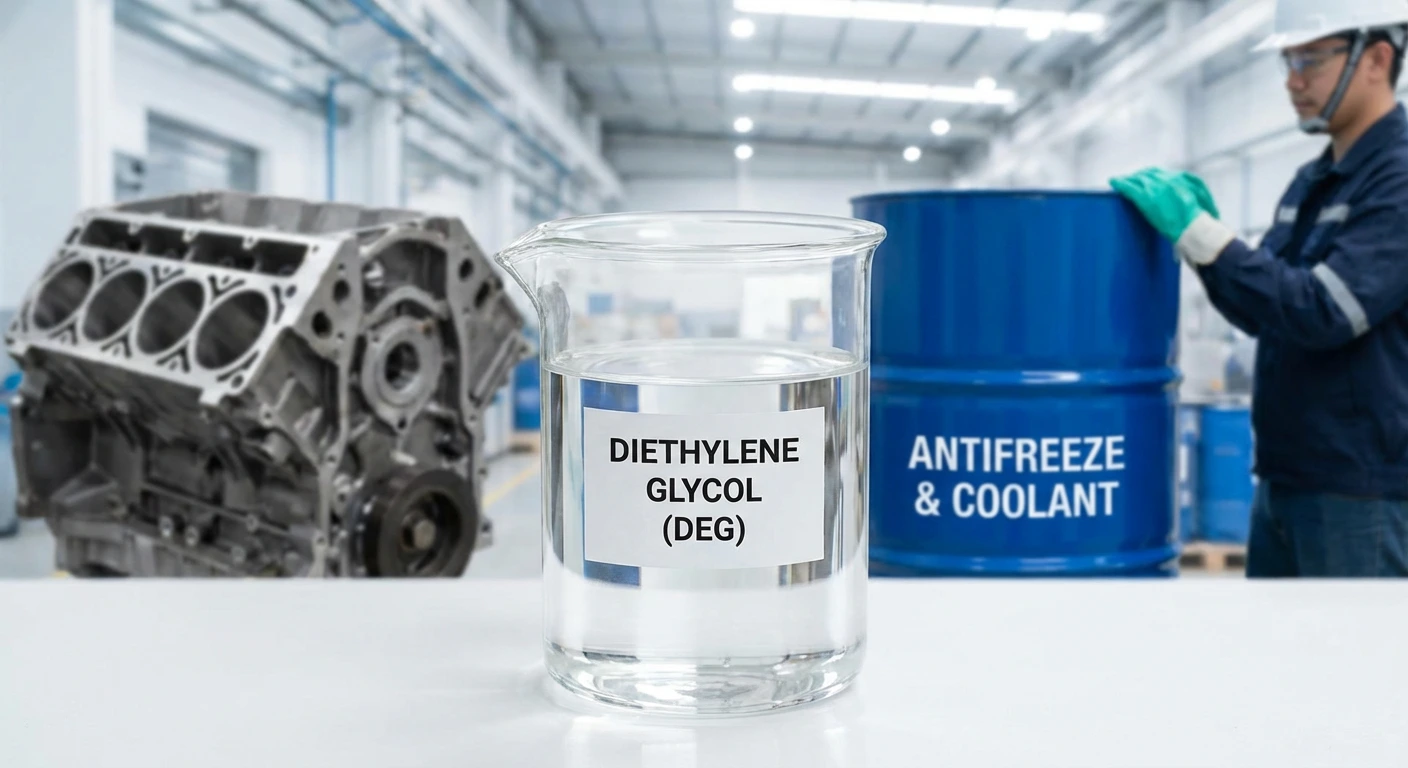
The role of DEG in Antifreeze and Coolant
The performance and longevity of any water-cooled engine—whether automotive, heavy-duty diesel, or industrial—hinges on the quality of its coolant. While often overlooked, the chemical composition of antifreeze is a complex science. Central to this science is the role of Diethylene Glycol in antifreeze. This guide provides a comprehensive technical overview of why DEG is a superior base fluid for creating robust, reliable, and long-lasting engine coolants.
What is Diethylene Glycol and Why is it Essential for Antifreeze?
Diethylene Glycol (DEG) is a high-purity, synthetic organic compound belonging to the glycol family. Chemically, it is a dihydric alcohol with the formula C₄H₁₀O₃. What makes its use as Diethylene Glycol in antifreeze so effective are its distinct physical properties: a high boiling point (245°C), low volatility, and excellent thermal stability.
When mixed with water, DEG functions as a powerful freezing point depressant, preventing the coolant from turning into destructive ice crystals at sub-zero temperatures. Simultaneously, it elevates the boiling point, allowing engines to operate at higher temperatures without the risk of overheating. This dual-action capability is the primary reason Diethylene Glycol in antifreeze is fundamental to protecting engines in all operating conditions.
The Core Functions of Diethylene Glycol in Antifreeze
The application of Diethylene Glycol in antifreeze delivers three critical performance benefits: freeze protection, boil-over prevention, and corrosion inhibition.
Advanced Freezing Point Depression
The primary function of any antifreeze is to prevent the engine coolant from freezing. Water expands by approximately 9% when it turns to ice, an expansion force strong enough to crack an engine block or radiator.
DEG molecules interfere with the hydrogen bonding of water, disrupting the formation of the crystalline lattice structure of ice. This forces the mixture to a much lower temperature before it solidifies.
- 50/50 Mixture: A standard blend of 50% DEG and 50% water provides freeze protection down to approximately -37°C (-35°F).
- 60/40 Mixture: A 60% DEG concentration can offer protection to below -50°C (-58°F) for extreme arctic conditions.
Superior Boiling Point Elevation for High-Stress Engines
Modern engines run hotter than ever due to stricter emissions standards and higher power outputs. An effective coolant must resist boiling under this thermal load. The presence of Diethylene Glycol in antifreeze raises the boiling point of water significantly. This prevents the formation of steam pockets within the engine’s cooling channels, which can lead to localized “hot spots” and catastrophic engine failure.
The Cornerstone of Corrosion and Cavitation Protection
This is where the science behind Diethylene Glycol in antifreeze truly excels. While DEG itself is not a corrosion inhibitor, it serves as the ideal base fluid for sophisticated inhibitor packages. Modern coolants use Organic Acid Technology (OAT) or Hybrid Organic Acid Technology (HOAT) additives that are fully soluble in DEG.
This package performs several vital functions:
- Forms a Protective Barrier: The inhibitors create a thin, inert, and self-healing layer on all metal surfaces, including aluminum, cast iron, steel, copper, and brass.
- Prevents Galvanic Corrosion: It stops the electrochemical reactions that occur when different metals are in contact within the coolant solution.
- Inhibits Cavitation: In heavy-duty diesel engines, the rapid collapse of vapor bubbles (cavitation) can erode cylinder liners. DEG-based coolants with the right additives form a resilient barrier that withstands this destructive force, a critical feature for fleet vehicles and industrial machinery.
Technical Comparison: Diethylene Glycol vs. Other Glycols in Antifreeze
To fully appreciate the benefits of Diethylene Glycol in antifreeze, it’s useful to compare it against other common glycols.
| Glycol Type | Key Advantage | Key Disadvantage | Best Use Case |
|---|---|---|---|
| Diethylene Glycol (DEG) | Highest boiling point & thermal stability. Low volatility reduces evaporation loss. | Higher viscosity at very low temperatures. | High-performance and industrial applications where temperature stability is critical. |
| Monoethylene Glycol (MEG) | Excellent heat transfer & cost-effective. Most common automotive antifreeze base. | Lower boiling point than DEG; more volatile. | Standard automotive and light-duty applications. |
| Propylene Glycol (PG) | Low toxicity. Often marketed as “pet-safe” or environmentally friendly antifreeze. | Poorer heat transfer characteristics than DEG/MEG; more expensive. | Applications where low toxicity is the primary concern (e.g., food processing, indoor use). |
The choice to use Diethylene Glycol in antifreeze is often made for heavy-duty, industrial, or high-performance formulations where its superior thermal stability and low volatility justify the formulation cost.
Formulation and Best Practices for Using DEG Antifreeze
Properly formulating and maintaining a coolant with Diethylene Glycol in antifreeze is crucial for maximizing its protective qualities.
- Use Deionized Water: Always mix DEG with deionized or distilled water. Tap water contains minerals (like calcium and magnesium) that can precipitate out, causing scale buildup in radiators and reducing heat transfer efficiency.
- Correct Concentration: A 50/50 ratio is standard for most climates. Over-concentrating (above 70% DEG) is counterproductive, as it will raise the freeze point and significantly reduce the heat transfer capability of the fluid.
- Adhere to Service Intervals: While DEG itself does not degrade, the corrosion inhibitors do get consumed over time. It is essential to flush and replace the coolant at the interval recommended by the manufacturer to ensure continuous protection.
Conclusion: The Unmatched Value of Diethylene Glycol in Antifreeze
In summary, Diethylene Glycol in antifreeze is more than just a simple additive; it is the foundational fluid that enables modern engines to operate reliably under immense thermal stress. Its unique ability to provide robust protection against freezing, boiling, and corrosion makes it an indispensable component for high-quality coolant formulations.
For applications demanding unwavering performance and maximum equipment longevity, a coolant based on Diethylene Glycol is the professional’s choice.
For a reliable, high-purity supply of Diethylene Glycol for your antifreeze formulations, contact our technical experts today. We provide bulk orders, competitive pricing, and formulation support. (Contact Us)
📞 Phone/WhatsApp: +971 50 720 9246
📧 Email: info@causticsodaco.com
🌐 Website: www.causticsodaco.com