
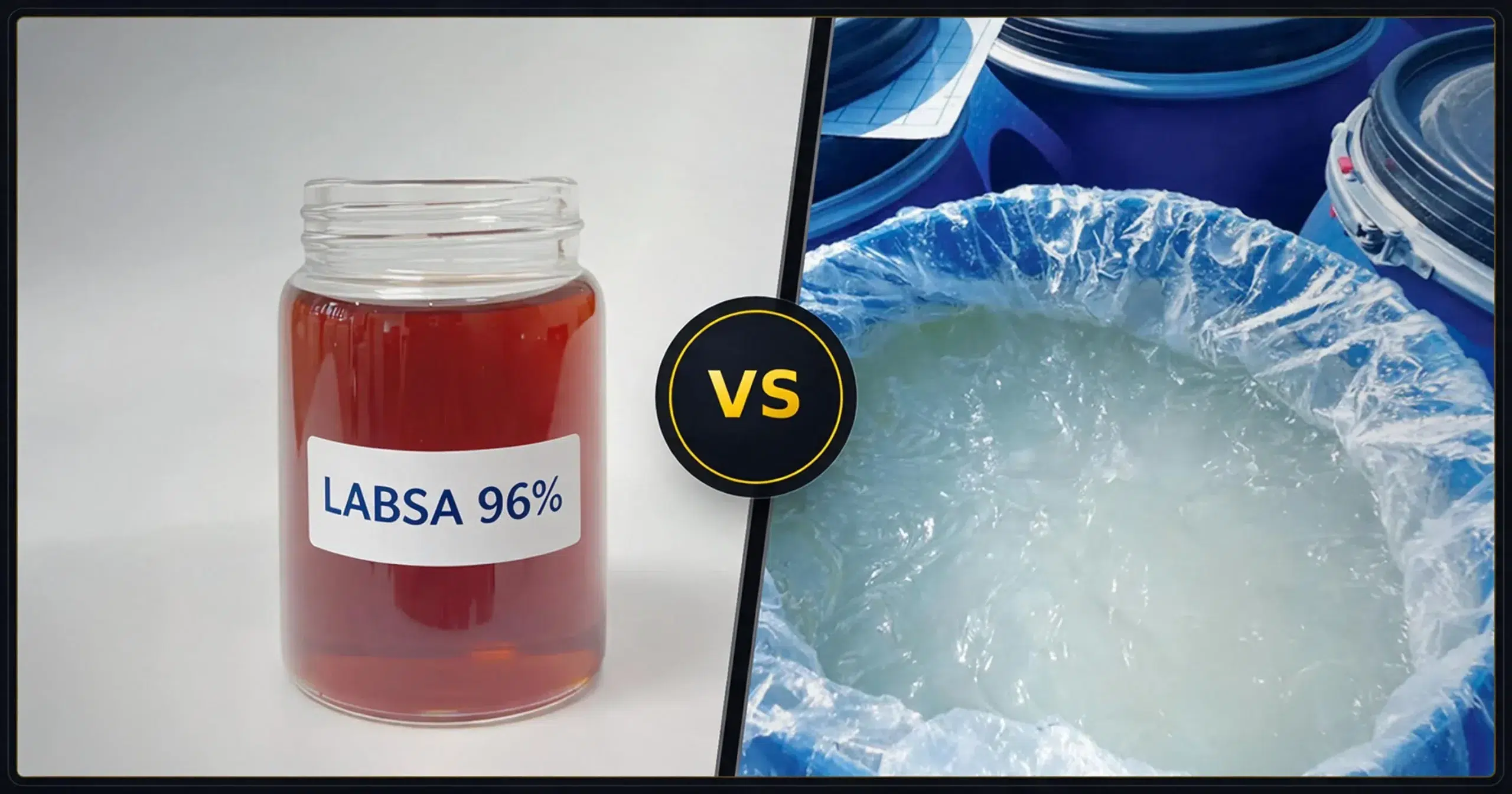
LABSA vs SLES
Which surfactant does your formulation actually need?
LABSA is an acid you neutralise in the plant; SLES arrives ready to use. That one difference decides equipment, safety obligations, batch time and where each product belongs. This guide compares them on chemistry, detergency, foam, mildness and application fit — and sets out exactly what to specify before you send an enquiry.
- LABSA grades
- 96% · 97–98%
- SLES grade
- 70% active paste
- Both are
- Anionic surfactants
- Neutralisation
- LABSA yes · SLES no
- HS codes
- 3402.31 · 3402.39
- Loading
- Türkiye · UAE
- ~133 kgNaOH per MT of LABSA
- 96 vs 70kg active per 100 kg
- UN 2586LABSA is Class 8
- Bothin most liquid products
Which surfactant for your product?
Pick what you are making. The weighting below reflects common commercial practice — how the surfactant load is typically split, not a rule. Regional habits, water hardness and raw material availability all move it.
Indicative weighting only. Establish your own ratio through bench trials against your performance, sensory and cost targets.
LABSA vs SLES: the full comparison
Every property that drives a formulation or sourcing decision. Values described as typical are general commercial ranges — the exact figures on your material depend on manufacturer, grade and batch, so always work from the certificate of analysis with your shipment.
| Property | LABSA 96% | SLES 70% |
|---|---|---|
| Full name | Linear alkylbenzene sulfonic acid | Sodium lauryl ether sulfate (sodium laureth sulfate) |
| Also traded as | Acid slurry, DBSA, LAS acid | SLES 70, AES, Texapon N70 type |
| Chemical type | Sulfonic acid — the free acid, not a salt | Sodium salt of an ethoxylated alkyl sulfate |
| Surfactant class | Anionic, after neutralisation to LAS | Anionic, supplied ready-neutralised |
| Commercial concentration | 96% active; premium 97–98%; a 90% grade is traded in some markets | 70% active paste; 25–28% liquid grades for local supply |
| Physical form | Light brown viscous liquid | Pale to white highly viscous paste |
| pH character | Strongly acidic, corrosive — UN 2586, Class 8, PG III | Near-neutral, typically pH 7.0–9.5 at 5% solution |
| Foaming | Moderate–good Dense but less persistent; suppressed by builders and soil | High Copious, creamy, stable; boosted further by betaines |
| Detergency | High Excellent on oily and particulate soil in built systems | Good Effective but generally less efficient per unit on heavy soil |
| Wetting | Strong wetting and soil penetration in alkaline systems | Good wetting with a softer profile; holds up in cold water |
| Mildness | Low Heavy-duty profile; not used in personal care | Higher Standard personal care surfactant; improves with EO level and co-surfactants |
| Hard water tolerance | More sensitive to calcium and magnesium; needs builders or sequestrants | Generally more tolerant, thanks to the ethoxylate chain |
| Neutralisation | Required — caustic soda or another alkali before use | Not required — already neutralised |
| Common applications | Laundry powder and liquid, dishwash, hard-surface and industrial cleaners | Shampoo, body wash, hand wash, dishwash, liquid detergent, industrial cleaning |
| Formulation role | Primary surfactant — the cleaning backbone | Primary in personal care; foam, viscosity and mildness modifier elsewhere |
| Processing requirement | Acid-resistant handling, neutralisation vessel, cooling, pH control, alkali supply | Dilution and mixing only; care through the gel phase and in cold weather |
| Key COA parameters | Active matter, free sulfuric acid, non-sulfonated matter, colour (Klett), average molecular weight | Active matter, sodium sulfate, pH, colour (Hazen), 1,4-dioxane, EO number |
| Storage & handling | Corrosive; acid-resistant tanks or HDPE drums; viscosity rises sharply when cold | Non-corrosive; protect from freezing and prolonged heat; viscosity temperature-dependent |
| HS classification | HS 3402.31 — linear alkylbenzene sulphonic acids and their salts | Generally HS 3402.39 under HS 2022 — confirm with your broker |
← Swipe the table sideways to see both columns.
What LABSA and SLES actually are
LABSA — linear alkylbenzene sulfonic acid
CAS 27176-87-0 · HS 3402.31 · UN 2586
LABSA is the acidic intermediate that becomes the world's most widely used detergent surfactant once neutralised. It is produced by sulfonating linear alkylbenzene (LAB) with sulfur trioxide or oleum. The WHO environmental health criteria monograph describes the route plainly: the parent alkylbenzenes are reacted with sulfuric acid or sulfur trioxide to give the corresponding sulfonic acid, which is then neutralised to the desired salt.[1]
Commercial LABSA 96% is a light brown viscous liquid with a sharp odour. Premium 97–98% grades carry lower free oil and better colour; a 90% grade circulates in parts of South Asia and Africa and should never be compared like-for-like against a 96% quotation.
Why neutralisation defines it
LABSA in the drum is not yet a surfactant. It is a strong acid carrying residual free sulfuric acid from sulfonation, commonly specified at a maximum around 1.8%. Adding it directly to a batch simply acidifies it. Neutralising with caustic soda flakes, liquid caustic or soda ash converts it to sodium linear alkylbenzene sulfonate — LAS — which is the actual surfactant.
Where it goes
- Laundry powder — neutralised into the crutcher slurry, then spray-dried
- Liquid laundry — neutralised, then blended with builders and hydrotropes
- Dishwashing liquid — the grease-removal part of the surfactant system
- Hard-surface and industrial cleaners — floor care, degreasers, vehicle wash, institutional concentrates
- Technical auxiliaries — emulsifier and wetting agent, including agrochemical formulations
More on the manufacturing side in our note on LABSA in detergent manufacturing. If you are still separating the feedstock from the surfactant, read the difference between LABSA and LAB before issuing an enquiry — quoting the wrong one is a common and expensive error for new importers.
SLES — sodium lauryl ether sulfate
CAS 68585-34-2 · HS 3402.39 (HS 2022) · not a DG
SLES is a ready-neutralised anionic surfactant valued for high stable foam, easy thickening and relative mildness. It is made by ethoxylating a fatty alcohol — usually lauryl alcohol of palm kernel or coconut origin, or a synthetic equivalent — then sulfating and neutralising the result. The number of ethylene oxide units, the EO number, is a defining commercial variable: 2 EO is the most widely traded, with 1 EO and 3 EO serving specific viscosity and mildness targets.
SLES 70% is the standard traded form — a pale, extremely viscous paste in drums, IBCs, flexibags or ISO tanks. Unlike LABSA it needs no chemical conversion: it is diluted into water and formulated directly.
Why formulators reach for it
- Foam — copious, creamy, persistent, and it survives soil and sebum better than most alternatives
- Viscosity control — thickens readily and predictably with sodium chloride
- Mildness — the ethoxylate chain moderates interaction with skin proteins relative to unethoxylated sodium lauryl sulfate (SLS)
- Hard water — better calcium and magnesium tolerance than LAS alone
- Simplicity — no acid handling, no neutralisation vessel, no Class 8 paperwork
Where it goes
Shampoos, body washes, hand washes and facial cleansers; dishwashing liquids; premium liquid laundry detergents; car wash and foaming industrial cleaners; plus textile processing, construction chemicals and agrochemical formulation.
Its environmental profile is well characterised: alcohol ether sulfates are readily biodegradable both aerobically and anaerobically, generally within several days, with removal of 98 to 100% measured in municipal activated sludge treatment plants.[2]
One handling caution buyers underestimate
SLES 70% paste passes through a stiff gel phase as it is diluted. Adding water too fast, or paste to insufficient water, can produce an unmixable mass that takes hours to recover. In cold weather the paste itself becomes very hard to pump or scoop out of drums.
Both are routine to manage — but they belong in your commissioning plan and your winter logistics planning, not discovered on the production floor. Ask your supplier for their dilution guidance in writing before the first batch.
The structural differences that explain everything else
LABSA has an aromatic ring and a sulfonic acid group; SLES has a straight alkyl chain, a short ethoxylate bridge and a sulfate ester group. Those three distinctions account for nearly every performance difference on this page.
LABSA structure
- A linear alkyl chain, commercially C10–C14, averaging around C11.8 in detergent grades[1]
- An aromatic benzene ring attached at various internal positions along that chain
- A sulfonic acid group (–SO₃H) bonded to the ring through a carbon–sulfur bond
- Supplied as the free acid; becomes a surfactant only as the sodium salt
SLES structure
- A straight fatty alkyl chain, predominantly C12–C14, with no aromatic ring
- A short polyethylene glycol bridge of typically 1–3 ethylene oxide units
- A sulfate ester group (–OSO₃⁻) bonded through an oxygen atom
- Supplied as the sodium salt, ready to formulate
Why the carbon–sulfur bond matters
LABSA's sulfonic acid group is joined to the ring by a carbon–sulfur bond, which is chemically robust. SLES's sulfate group is joined through an oxygen atom in an ester linkage, which is more susceptible to acid-catalysed hydrolysis. So LAS tolerates a wide pH range including strongly alkaline built systems, while SLES is best kept out of persistently acidic conditions — and it is exactly why un-neutralised LABSA must never meet a batch that already contains SLES.
Why the ethoxylate bridge matters
The short ethylene oxide chain does three things at once. It raises water solubility and lowers the temperature at which the surfactant stays dissolved, so SLES performs in cold water. It shields the charged head group, reducing the tendency to form insoluble calcium salts in hard water. And it moderates interaction with skin proteins, which is the structural basis of its comparative mildness. LAS has no equivalent feature — a more aggressive, more hardness-sensitive, more solubility-limited molecule, which is precisely what makes it such an effective heavy-duty cleaner in a properly built formulation.
The relationships in one line each
LABSA → sulfonation of LAB → sulfonic acid → + alkali → LAS → detergency → laundry, hard-surface, industrial SLES → ethoxylation + sulfation of fatty alcohol → sodium salt → foam, mildness, viscosity → personal care, dishwash, premium liquidsHow they behave, property by property
Surfactant claims are only meaningful inside a stated formulation. What follows are general tendencies at typical use levels — a well-built SLES system can out-clean a poorly built LAS system, and the reverse is equally true.
Detergency
Neutralised LABSA leads. LAS is described in the WHO monograph as the most widely used surfactant in detergent and cleaning products, in both liquid and powder preparations and for household and industrial use[1] — a position earned on soil-removal efficiency across an enormous range of formulations. Its detergency depends heavily on the supporting system: builders, alkalinity and sequestrants are what let it work at full efficiency in real wash water.
Foaming
SLES leads on every practical measure — volume, density, creaminess and stability over time. LAS foams adequately but collapses faster, particularly against oily soil and in hard water. In machine-wash laundry that is an advantage, since excess foam is a defect. In hand dishwashing, hand wash and shampoo, foam is the consumer's proxy for cleaning power and SLES is doing work LAS cannot cheaply substitute for.
Grease removal
Neither anionic alone is the whole answer. LAS emulsifies oily soil efficiently, especially with alkalinity support, and is the more efficient route to raw degreasing power. SLES contributes too, but its main job in a dishwash or degreaser is holding foam and performance as soil load rises. Serious grease formulations add a non-ionic — an alcohol ethoxylate or amine oxide — because the anionic–non-ionic pair beats either alone.
Mildness
SLES by a wide margin; LAS is not used in personal care. Mildness is concentration-dependent for both. The American Cleaning Institute's review of alcohol ethoxy sulfates notes dilute solutions appear non-irritating to skin, while undiluted concentrates around 35% active were severely irritating in the rabbit assay.[2] So SLES supports a mild finished product at in-use dilution — and concentrated paste still needs proper PPE in the plant.
Hard water
SLES is more tolerant; LAS needs builder support. The LAS–calcium interaction is long established: calcium reduces surfactant solubility, with direct implications for detergency performance.[3] This is a design parameter, not a defect — soda ash, silicate, zeolites, citrates or phosphonates exist precisely to manage it. But if you formulate for a hard-water market with a minimal builder system, it becomes a real constraint and the SLES fraction usually rises.
Wetting
Both wet effectively. LAS shows strong wetting and soil penetration in alkaline systems, which suits floor cleaners, degreasers and pre-treatment. SLES wets well with a softer profile and holds performance better in cold water, which suits ambient-temperature applications and cold-fill liquid products.
Viscosity building
SLES is the practical tool here. SLES systems thicken readily and predictably with sodium chloride, giving a simple, precise route to a target viscosity. LAS systems are harder to thicken and often need hydrotropes to stay clear and stable — which is why even LAS-led liquid detergents usually carry an SLES fraction.
Formulation flexibility
SLES is the more forgiving material: no neutralisation, easy thickening, good cold-water behaviour, good compatibility with betaines and non-ionics, mild enough for skin contact. LABSA is more demanding and more rewarding, because the detergency advantage is real and repeats on every batch. Which trade-off wins depends on whether your plant already neutralises.
LABSA vs SLES by product type
Where each surfactant typically fits. "Typical preference" reflects common commercial practice, not a rule.
| Application | LABSA | SLES | Typical preference | Main reason |
|---|---|---|---|---|
| Laundry powder | High | Limited | LABSA | High detergency and controlled foam; SLES paste is awkward in dry processing |
| Liquid laundry detergent | High | Supporting | LABSA-led blend | LAS carries the cleaning load; SLES adds solubility, viscosity and cold-water stability |
| Hand dishwashing liquid | Good | High | Blend, SLES-weighted | Persistent foam and hand mildness are the purchase drivers; LAS carries the grease removal |
| Industrial & institutional cleaners | High | Situational | LABSA | Concentrate strength dominates; alkaline systems suit LAS |
| Degreasers | High | Minor | LABSA + non-ionic | Emulsification of oily soil under alkalinity; non-ionics work alongside |
| Household hard-surface cleaners | High | Supporting | LABSA-led | Cleaning per unit of active; SLES where foam or low-streak feel is wanted |
| Shampoo | Not used | High | SLES | Mildness, foam quality and sensory profile; LAS is unsuitable for hair and scalp |
| Body wash & shower gel | Not used | High | SLES | Skin contact requires a personal care surfactant system |
| Liquid hand wash | Not used | High | SLES | Repeated skin contact, foam expectation, easy thickening |
| Car wash & foaming cleaners | Good | High | Blend | Visible foam is the performance signal; LAS supports the cleaning load |
| Textile & technical auxiliaries | Situational | Situational | Process-specific | Wetting, emulsification and compatibility requirements vary widely by process |
← Swipe the table sideways to see every column.
Need LABSA 96% or SLES 70% in bulk?
Prices are not published — every enquiry is quoted individually. Send the grade, monthly volume, packaging preference and destination port by email or WhatsApp and you get specification, batch COA, SDS, packaging and container loading options, MOQ, availability and a firm quotation on your preferred Incoterm, loading from Türkiye and the UAE.
How to get a price for LABSA 96% or SLES 70%
No prices are published on this page. Both products are traded commodities whose levels move with feedstock, energy, freight and regional supply, and a figure written today would be wrong within weeks and misleading in any market other than the one it was quoted for. Every enquiry is answered individually — by email or on WhatsApp.
Ask for a price directly
Send the six lines above and you will have a quotation for LABSA 96%, SLES 70% or both. Buyers sourcing the two surfactants for one formulation can consolidate the enquiry into a single shipment.
Laundry, liquid detergent, dishwash and personal care
LABSA vs SLES for laundry detergent
LABSA is the standard primary surfactant in both powder and liquid laundry, with SLES supporting or absent. Four reasons hold across markets.
Detergency per unit of active. Laundry is the highest-volume detergent category almost everywhere, and LAS removes oily and particulate soil per unit of active matter in a way no comparable anionic matches inside a built system.
Foam profile. Machine washing needs controlled foam. Excess foam cushions mechanical action, over-suds front-loaders and triggers extra rinses. LAS's collapsible foam is an advantage — one of the few places SLES's greatest strength is a liability.
Builder compatibility. Laundry formulations are built systems: soda ash, silicate, zeolites, sulfate, enzymes, brighteners. LAS is robust across that alkaline environment, and the builder system simultaneously solves LAS's hardness sensitivity. The two design problems cancel out.
Powder vs liquid. In powder, LABSA is neutralised into the crutcher slurry before spray drying and the LAS integrates into the granule; SLES 70% paste does not suit that process. In liquid laundry a modest SLES fraction is common — solubility, viscosity and a better sensory profile for premium positioning.
LABSA vs SLES for liquid detergent
Most commercial liquid detergents use both — neutralised LABSA carrying the cleaning load, SLES contributing foam, viscosity and stability. If you are deciding between LABSA or SLES for liquid detergent, the honest answer is a ratio question, not a choice.
Foam. Liquids for hand washing and semi-automatic machines are expected to foam visibly. An all-LAS liquid can under-deliver against consumer expectation, particularly in hard water.
Viscosity and appearance. SLES thickens predictably with salt, hitting a target viscosity without additional polymers. LAS systems are harder to thicken and often need hydrotropes to stay clear. Products in transparent bottles are judged on clarity, and the SLES fraction usually helps.
Cold stability. Liquids shipped or stored cold must stay homogeneous. The ethoxylate chain improves low-temperature solubility, reducing cloud and separation in the bottle.
Where the ratio is settled. The typical architecture is a majority LAS system with an SLES fraction sized to hit the foam, viscosity and stability targets — then trimmed back as far as those targets allow. That trimming exercise, run on the bench, is what actually fixes the formulation.
LABSA vs SLES for dishwashing liquid
Hand dishwashing is the clearest case for a deliberate blend, weighted more toward SLES than a laundry product.
Foam is the product promise. Consumers judge a dishwashing liquid by whether the foam survives the sink load. Foam that collapses halfway through reads as a weak product regardless of how clean the plates are.
Grease removal must be real. Foam without degreasing gets returned. Neutralised LABSA emulsifies oily soil more efficiently than SLES, which is why it stays in the formulation even in premium products.
Hand feel matters. Prolonged skin contact in warm water. A high-LAS, low-SLES system is harsher on hands, and in competitive markets that becomes a purchase driver — a genuine formulation constraint, not marketing.
The standard answer: LAS + SLES + an amphoteric such as cocamidopropyl betaine, sometimes with an amine oxide or alkanolamide. The betaine lifts foam and mildness together, which lets you carry more LAS without a sensory penalty. Adjusting that three-way balance is the main lever for tuning foam, mildness and cleaning together.
LABSA vs SLES for shampoo and personal care
SLES is a standard personal care surfactant. LABSA is not, and should not be treated as an option here. This is the one comparison on this page that is close to categorical.
Both are anionic, and that shared classification is the source of a persistent misunderstanding among new buyers. But personal care and industrial detergent formulation are different disciplines. Sodium LAS interacts harshly with skin and hair keratin, has an unsuitable sensory profile, and holds no established position in modern shampoo, body wash or facial cleanser practice. No commercial advantage is worth a product that fails on the attribute customers are actually buying.
SLES is the workhorse of the category, typically combined with cocamidopropyl betaine or another amphoteric, a non-ionic such as an alkyl polyglucoside, and conditioning and pearlising agents. The betaine boosts foam and improves system mildness together — which is why almost no commercial shampoo runs SLES alone.
1,4-dioxane: a procurement issue before it is a formulation issue
1,4-dioxane is a trace by-product of the ethoxylation step, present in all ether sulfates. It is classified by IARC as Group 2B, possibly carcinogenic to humans,[4] and several jurisdictions now regulate it in finished products. New York State sets a maximum of 1 ppm in household cleansing and personal care products and 10 ppm in cosmetics, with the waiver period expired at the end of 2025.[5]
The arithmetic matters. A raw material specified at a 50 ppm maximum, used at 15% w/w in a finished shampoo, contributes up to roughly 7.5 ppm — well above a 1 ppm finished-product limit. If you sell into a regulated market you need a low-dioxane or stripped grade and a supplier who will state the measured figure on the COA, not just the specification ceiling. Ask at enquiry stage, not after the first container has cleared.
Can LABSA and SLES be used together?
Yes — and in most liquid cleaning products they are. Both are anionic, so they are chemically compatible. But the LABSA must be fully neutralised first.
Why blending works
- Complementary strengths — LAS supplies detergency and soil removal; SLES supplies foam, foam stability, viscosity response and better skin feel
- Performance balance — keep the detergency of LAS while buying back the sensory and foam performance a pure LAS system lacks
- Hardness resilience — the SLES fraction partially offsets LAS's hardness sensitivity, useful where builder levels are constrained
- Synergy with amphoterics — adding betaine to an anionic blend typically lifts both foam and mildness beyond what either anionic reaches alone
The processing rule that matters
Neutralise the LABSA to its target pH first, verify it, and only then introduce the SLES and the remaining ingredients.
Adding un-neutralised LABSA to a batch that already contains SLES drops the pH sharply and risks hydrolysing the ether sulfate — degrading the surfactant you just paid a premium for. Neutralisation is also exothermic, so the batch needs cooling and controlled addition regardless of what else is in the vessel.
No blend ratios are published here on purpose. Workable ratios depend on your water hardness, builder system, target viscosity, pH, preservative system, packaging and finished specification. Any number quoted without those inputs would be misleading. Establish yours through bench trials against your own performance and cost targets.
What to check before you buy either one
Specifications vary by manufacturer and grade for both products. These are the parameters to verify on the batch COA and fix in the contract — not target values. Do not accept any published figure, including ours, as a substitute for your own supplier's documentation.
Buying LABSA in bulk
13 checks before the contract
- Anionic active matter — which grade you are actually buying: 96%, 97–98%, or a 90% grade in some markets
- Free sulfuric acid — drives extra alkali consumption and adds sodium sulfate to your finished product
- Non-sulfonated matter (free oil) — unreacted LAB; high levels cut effective actives and cause odour and cloudiness
- Water content — affects both actives and storage stability
- Colour in Klett units — matters for clear liquid products and any specified finished appearance
- Average molecular weight — sets your caustic soda consumption per ton. Frequently omitted; ask for it explicitly
- Packaging and net weight — 200 kg HDPE drums, 1,000 L IBCs or ISO tank; confirm net weight rather than assuming
- Container loading — drums are volume-limited, not weight-limited, so a 20ft loads far less than its payload rating suggests
- Batch consistency — ask for the actives spread across recent production, not just the specification range
- COA and SDS — per batch, before shipment, not on arrival
- Dangerous goods documentation — UN 2586, Class 8, PG III; confirm packing and marking meet destination requirements
- Origin, production date, shelf life — typically ~12 months sealed; check you are not offered aged stock
- Cold-weather discharge — viscosity rises sharply at low temperature; plan winter arrivals
Buying SLES in bulk
13 checks before the contract
- Active matter — commonly around 70% for paste grades; confirm the tolerance band
- Ethoxylation level (EO number) — 1, 2 or 3 EO behave differently on viscosity, mildness and cloud point. Never assume 2 EO
- Sodium sulfate — inorganic salt affecting clarity, viscosity response and effective actives
- Unsulfated matter — unreacted alcohol; drives odour and cloudiness
- pH in 5% solution — out-of-range material risks hydrolysis in storage
- Colour (Hazen / APHA) — critical for clear and pearlised personal care products
- 1,4-dioxane — request the measured figure, not just the specification maximum, for regulated markets
- Viscosity and gel-phase behaviour — ask for the supplier's dilution guidance; it determines your mixing procedure
- Packaging — 200 kg drums, ~1,000 kg IBCs, flexibags or ISO tanks. Match to batch size and discharge capability
- COA and SDS — per batch; SLES is not a DG like LABSA, but the SDS is still required
- Origin, production date, shelf life — ether sulfates degrade slowly; buy fresh and rotate stock
- Temperature in transit and storage — protect from freezing and prolonged heat; both damage handling properties
- Preservation — confirm the preservative system; SLES solutions support microbial growth on dilution
Container and logistics considerations for both
Both are typically traded in full container loads. Drummed cargo fills the cubic capacity of a 20ft before it reaches the weight limit, so drum shipments carry less tonnage than buyers new to the trade expect — an important point when comparing a quoted MOQ against a container's payload rating. IBCs improve tonnage per container and cut handling labour but need a suitable discharge setup. Flexibags and ISO tanks give the best payload per container for SLES at volume, but require tank discharge capability and attention to demurrage and tank return terms.
Whichever Incoterm you work on — EXW, FOB, CFR, CIF or DAP — confirm before contracting who arranges and pays for inland transport, loading, documentation and destination handling, and confirm the document set: commercial invoice, packing list, bill of lading, certificate of origin, COA, SDS and any dangerous goods declaration required for the LABSA.
Technical suitability is not commercial suitability
A surfactant can be the technically correct choice and still be the wrong purchase. This is where experienced procurement separates itself from formulation-led decision making.
A trial may show a LAS-led system cleans as well as, or better than, an SLES-led one. That result can still be overridden by:
- Capability — no neutralisation equipment, and no capital budget to build it for one product line
- Regulation — a destination market with finished-product limits or ingredient restrictions that reshape the specification
- Supply continuity — one product available reliably at your origin, the other on allocation or long lead times
- Freight and origin — a nearer origin landing faster, with less working capital tied up in transit than a distant one
- MOQ against batch size — a full container of a secondary surfactant that takes fourteen months to consume ties up cash and risks shelf-life loss
- Customer specification — a private-label brief that names the surfactant system, leaving no substitution freedom
- Safety and insurance — Class 8 storage obligations a particular site cannot economically meet
Run the technical evaluation and the commercial evaluation as two separate exercises, then reconcile them. Deciding on chemistry alone produces formulations that cannot be sourced; deciding on commercial terms alone produces products that fail in the market.
How manufacturers actually structure the surfactant system
What changes between these is the equipment you need, the safety obligations you carry, and how much freedom you have to move the formulation later.
LABSA-led
- Highest active matter delivered per ton supplied
- Needs neutralisation vessel, cooling and pH control
- Carries Class 8 storage and PPE obligations
- Caustic soda becomes a second sourcing line
Blended
- The architecture behind most commercial liquid products
- Ratio is the lever for tuning foam and viscosity
- Betaine addition lets you carry more LAS
- Still requires neutralisation capability
SLES-led
- Mandatory for shampoo, body wash and hand wash
- Lower active matter delivered per ton supplied
- No caustic soda sourcing or alkali handling
- Suits toll manufacturers and small-batch plants
How to choose a reliable LABSA or SLES supplier
For commodity surfactants, supplier selection comes down to consistency and documentation. A supplier who delivers variable active matter creates far more damage through reformulation, off-spec batches and customer complaints than any apparent advantage elsewhere.
SUHA International Trading L.L.C., trading as Causticsodaco, supplies LABSA 96% and 97–98% and SLES 70% alongside a wider range of chemical raw materials to detergent manufacturers, distributors and traders internationally, loading from Türkiye and the UAE, with batch COA and SDS supplied for every shipment.
Buyers sourcing both surfactants for the same formulation can consolidate the enquiry, and the related inputs — caustic soda flakes for neutralisation, soda ash light and sulfuric acid — come from the same source.
- LABSA CAS
- 27176-87-0
- SLES CAS
- 68585-34-2
- HS codes
- 3402.31 · 3402.39
- LABSA DG
- UN 2586 · Class 8 · PG III
- Packing
- Drums · IBC · ISO tank
- Loading
- Mersin · Jebel Ali
- Payment
- T/T · L/C · D/P
- Documents
- COA · SDS · CO · B/L
- Inspection
- SGS / BV on request
LABSA vs SLES — FAQ
LABSA vs SLES: which one should you choose?
Choose LABSA when detergency leads the decision, and SLES when foam, mildness or process simplicity lead it — and expect most real formulations to need both.
LABSA is generally advantageous
In laundry powder and liquid, hard-surface cleaners, degreasers and industrial and institutional concentrates: applications where detergency per unit of active is the deciding factor, where the formulation is built with alkali and sequestrants, and where the plant already has neutralisation capability and an alkali supply.
SLES is generally advantageous
In shampoos, body washes, hand washes and other skin-contact products, and wherever foam quality, salt thickening, clarity or cold-water stability carry the product: where the sensory result is the product, or where the plant has no acid handling and no reason to build it.
Both are used together in most dishwashing liquids and premium liquid detergents, where LAS carries the cleaning and SLES buys back the foam and skin feel a pure LAS system lacks. Getting that ratio right against your own water hardness, builder system and finished specification is a bench exercise, not a number to copy from an article.
And whichever way the technical evaluation lands, the procurement specification decides whether it holds up in production. Active matter, free acid, EO number, 1,4-dioxane, colour, packaging, container loading, lead time and batch-to-batch consistency are the parameters that turn a good formulation into a product you can make repeatably and ship on schedule. Fix them in the contract, verify them on the COA, and treat any supplier unwilling to commit to them as a supply risk rather than a bargain.
Send the specification. Get a firm offer back.
Grade, tonnage, packaging, destination port and Incoterm — that is all it takes. A quotation comes back with the technical data sheet and the certificate-of-analysis format attached, normally within 24 hours on working days, for LABSA 96%, SLES 70% or both together.
References
- World Health Organization / IPCS, Environmental Health Criteria 169: Linear Alkylbenzene Sulfonates and Related Compounds, 1996. inchem.org
- American Cleaning Institute, Environmental and Human Safety of Major Surfactants: Alcohol Ethoxy Sulfates. cleaninginstitute.org (PDF)
- K. L. Matheson et al., "Interactions between linear alkylbenzene sulfonates and water hardness ions. I. Effect of calcium ion on surfactant solubility and implications for detergency performance", Journal of the American Oil Chemists' Society, 1985. doi.org/10.1007/BF02545966
- International Agency for Research on Cancer, List of Classifications — 1,4-dioxane, Group 2B. monographs.iarc.who.int
- New York State Department of Environmental Conservation, 1,4-Dioxane Limits for Household Cleansing, Personal Care, and Cosmetic Products. dec.ny.gov
- OECD SIDS / American Cleaning Institute, Linear Alkylbenzene Sulfonate (LAS) — SIDS Initial Assessment Report. cleaninginstitute.org (PDF)
- European Union, Regulation (EC) No 648/2004 on detergents — surfactant biodegradability requirements. eur-lex.europa.eu
Technical values on this page are general commercial ranges provided for orientation. Specifications for LABSA and SLES vary by manufacturer, grade and batch. Always verify against the certificate of analysis and safety data sheet supplied with your own material, and validate any formulation change through your own bench and pilot trials before production. Nothing on this page constitutes a specification, a warranty or a formulation recommendation for a specific product. Content reviewed .