Supplier Of Linear Alkyl Benzene Sulphonic Acid (LABSA) From Turkey And Dubai – UAE
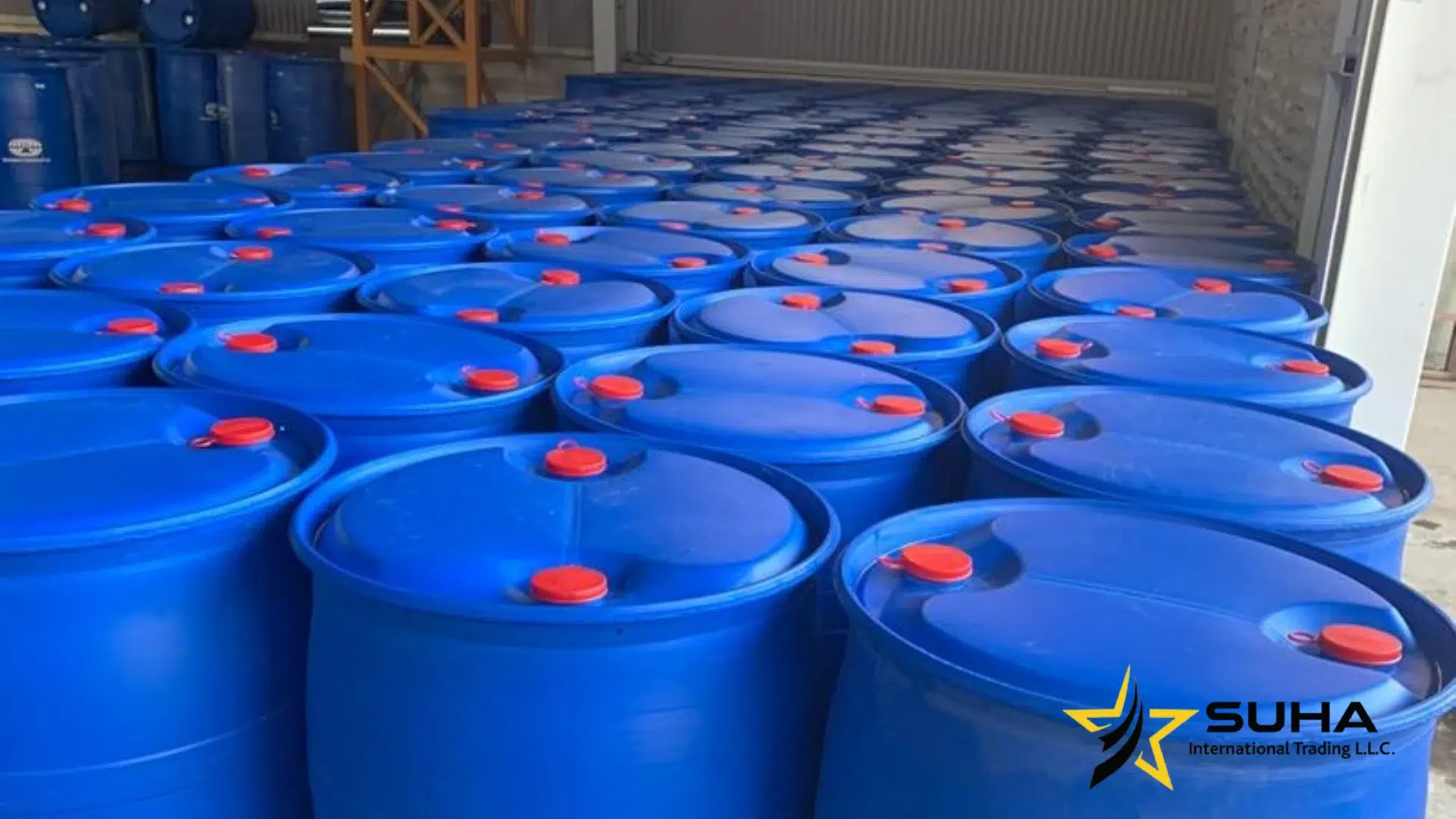
LABSA — Acid Slurry 96% & 97–98% Export Supply at a Glance
SUHA International supplies LABSA (linear alkyl benzene sulphonic acid) at 96% and 97–98% anionic active matter, exported from Mersin (Türkiye) and Jebel Ali (UAE) in 200 kg HDPE drums, 1,000 L IBC totes or ISO tanks. The minimum order is one 20ft container — about 16 MT in drums — and every consignment ships with a batch certificate of analysis, a GHS safety data sheet and the IMDG documentation that UN 2586 Class 8 sea freight requires.
LABSA, acid slurry and DBSA are the same product under three names — the anionic surfactant behind almost every laundry powder, dishwash liquid and industrial degreaser on the market. This page is written for the three people who actually buy it: the formulator who checks active matter and free oil, the importer who checks HS code and landed cost per active tonne, and the trader who needs documents that clear customs the first time.
Maintained by the export desk of SUHA International Trading L.L.C. · Dubai, UAE & Ankara, Türkiye · Last reviewed .
- Product
- LABSA / acid slurry, 96% & 97–98%
- CAS number
- 27176-87-0 · 68584-22-5
- HS code (HS 2022)
- 3402.31
- UN / class
- UN 2586 · IMDG Class 8 · PG III
- Active matter
- 96% min · 97–98% premium
- Free sulphuric acid
- ≤ 1.8%, per batch
- Appearance
- Light brown viscous liquid
- Packing
- 200 kg drum · 1,000 L IBC · ISO tank
- MOQ
- 1×20ft — ≈ 16 MT in drums
- Loading ports
- Mersin (TR) · Jebel Ali (AE)
- Incoterms
- FOB · CFR · CIF · CPT
- Payment
- T/T · L/C at sight · D/P
- Quote turnaround
- Under 24 hours
- Shelf life
- ≈ 12 months, sealed
What Is LABSA (Linear Alkyl Benzene Sulphonic Acid)?
LABSA is the anionic surfactant made by sulphonating linear alkyl benzene (LAB) with sulphur trioxide or oleum. It is a light brown viscous liquid, sold on its anionic active matter — conventionally 96% — and neutralised with caustic soda or soda ash to linear alkylbenzene sulphonate (LAS), the primary cleaning agent in most laundry powders, dishwashing liquids and industrial detergents.
Commercially it is not a single molecule. LABSA is a homologue blend built on a C10–C13 linear alkyl chain, which is why an average molecular weight is quoted rather than a single formula weight. The batch we supply carries an average molecular weight of 322 g/mol; the representative dodecyl homologue, C18H30O3S, has a formula weight of 326.5 g/mol, and commercial material generally falls between 318 and 326 g/mol depending on the LAB feedstock cut. That number is not trivia — it is what your formulation team uses to calculate caustic soda consumption.
Because the alkyl chain is linear rather than branched, LABSA and the LAS made from it are readily biodegradable under OECD test methods. That is precisely why branched alkylbenzene sulphonate was phased out of detergent manufacture worldwide in favour of LAB-based LABSA.
LABSA, acid slurry, DBSA — the same product under different names
Procurement teams, customs brokers and formulators order this material under different names. If your specification sheet, letter of credit or import declaration uses any term below, it describes the LABSA we supply. Matching the name on your documents to the name on ours prevents delays at the bank and at customs.
| Name used | Where you will see it |
|---|---|
| Acid Slurry | The dominant trade name in India, Pakistan, Bangladesh and across East and West Africa — usually written “Acid Slurry LABSA 96%”. |
| DBSA · Dodecylbenzene Sulphonic Acid | Technical documents, SDS and chemical registries. CAS 27176-87-0. |
| LAS acid · Sulphonic acid | Detergent plants, referring to the acid form before neutralisation to LAS. |
| Linear alkylbenzene sulfonic acid | American spelling, used in US and Asian specifications and most databases. |
| ABSA · Alkyl Benzene Sulphonic Acid | Older specifications and some Middle East tenders. |
| Benzenesulfonic acid, C10-16-alkyl derivatives | REACH and regulatory filings. CAS 68584-22-5 — the blend registration covering the commercial product. |
← Swipe the table sideways to see every column.
Both CAS numbers are correct and serve different purposes: 27176-87-0 identifies the representative dodecylbenzene sulphonic acid molecule, while 68584-22-5 covers the C10–C16 alkyl-derivative blend that commercial LABSA actually is. Quote the second on REACH and regulatory paperwork.
LABSA 96% Specification & Certificate of Analysis
Every consignment ships with a batch-specific certificate of analysis. The table below is a real COA from a recent LABSA 96% production batch, reproduced in full — the same document you receive, with the same parameters, limits and method references. The PDF is downloadable above and again at the end of this section.
| Parameter | Unit | Result | Min | Max | Test method |
|---|---|---|---|---|---|
| Form | — | Viscous liquid | — | — | Visual |
| Colour | — | Light brown | — | — | Visual |
| Anionic active matter | % | 96.11 | 96 | — | QTM003 — two-phase titration |
| Non-sulphonated matter (free oil) | % | 1.71 | 0 | 2.0 | QTM051 — solvent extraction |
| Free sulphuric acid | % | 1.77 | 0 | 1.8 | QTM161 — potentiometric titration |
| Acidity | mg KOH/g | 185.12 | 178 | 190 | QTM021 — acid–base titration |
| Average molecular weight | g/mol | 322 | 322 | 322 | Calculated from active matter and acidity |
| Water content | % | 0.40 | 0 | 1.0 | QTM054 — Karl Fischer |
| Colour, 10% solution | Klett | 35 | 0 | 40 | QIN030 — Klett colorimetry |
← Swipe the table sideways to see every column.
QTM and QIN are the producer’s in-house method codes; the working equivalent is named beside each one so your own QC laboratory can reproduce the result — two-phase titration (ISO 2271 / ASTM D3049 family) for active matter, solvent extraction for non-sulphonated matter, potentiometric titration for free sulphuric acid, and Karl Fischer (ASTM E203) for water. Third-party verification by SGS or Intertek at the load port is available on request and is arranged before shipment, not after.
Two numbers on this COA decide what happens in your reactor
Acidity 185.12 mg KOH/g is total acidity. It covers the sulphonic acid and the 1.77% free sulphuric acid, which is why it is higher than the roughly 167 mg KOH/g you would calculate from active matter alone. Size your caustic soda charge on the total figure, or you will under-dose the batch.
Free sulphuric acid 1.77% sits just inside the 1.8% ceiling. That ceiling is not cosmetic. It is what keeps the material inside UN 2586 — arylsulphonic acids with not more than 5% free sulphuric acid, Packing Group III — rather than the more restrictive UN 2584, and it governs corrosivity toward mild steel in your storage system.
Physical properties for tank, pump and stowage planning
These are industry-typical values for LABSA 96% rather than guaranteed contract specifications. They are published because importers need them to plan discharge and stowage, and most supplier pages omit them.
| Property | Typical value | Why it matters to you |
|---|---|---|
| Density at 20 °C | ≈ 1.05 g/cm³ | Converts volume to weight. 1,000 litres is about 1,050 kg — the basis of every loading figure on this page. |
| Viscosity at 20 °C | High — see note | LABSA is markedly viscous at ambient temperature. Positive-displacement pumps are required; centrifugal pumps struggle. |
| Viscosity at 40 °C | Substantially lower | Gentle warming to 35–45 °C is the standard way to speed discharge from ISO tanks and IBC totes. |
| pH, 1% aqueous solution | 2 – 3 | Strongly acidic. Determines material selection for lines, gaskets and storage. |
| Solubility in water | Complete | Disperses readily in aqueous systems during neutralisation. |
| Shelf life, sealed | ≈ 12 months | Stored out of sunlight in sealed original packing. Colour may darken slowly without loss of active matter. |
CONFIRM: insert your own measured viscosity band in mPa·s at 20 °C and 40 °C. Publishing a real number here is a genuine differentiator — almost no competitor does.
LABSA Grades — 90%, 96% and 97–98% Compared
LABSA 96% — standard export grade
Minimum 96% anionic active matter. The workhorse for laundry powder, detergent bars, dishwash paste and industrial degreasers, where cost per unit of active matter decides the formulation. This is the grade covered by the batch COA above.
Typical buyers: detergent powder plants, soap manufacturers, industrial cleaning blenders.
LABSA 97–98% — premium high-active grade
Higher active matter, lower free oil and lower Klett colour, for concentrated liquid detergents where clarity matters and for neutralisation into high-purity LAS pastes.
Typical buyers: liquid detergent producers, personal-care precursor manufacturers, exporters of concentrated formulations.
Why we supply 96% and 98% rather than LABSA 90
LABSA 90 is widely traded in South Asia and parts of Africa, and buyers regularly ask why it is not on our list. The answer is freight economics rather than chemistry.
| Grade | Active matter | What the balance is | Practical effect for an importer |
|---|---|---|---|
| LABSA 90 (acid slurry 90) | ≈ 90% | Higher water and unreacted oil content | You pay ocean freight, duty and insurance on roughly 10% water. On a full container that usually cancels the lower unit price. |
| LABSA 96 (our standard) | 96% min | ≤ 2% free oil, ≤ 1.8% free sulphuric acid, ≤ 1% water | The international export standard. Best balance of active matter per freight tonne and formulation stability. |
| LABSA 97–98 (premium) | 97–98% | Lower free oil, lower Klett colour | Highest active matter per tonne shipped; preferred where the finished product must stay clear. |
If a tender specifically requires 90% material we can quote it on a project basis, but for containerised export over any meaningful distance we recommend 96% and will show you the delivered-cost comparison per tonne of active matter before you decide.
Applications of LABSA (Acid Slurry) by Industry
What LABSA does in each process, and the complementary chemicals from our range that sit alongside it on the same production floor.
Household detergents
Neutralised to LAS with caustic soda flakes, LABSA is the primary active in laundry powder, detergent bars, dishwashing liquid and multi-purpose cleaners — the single largest end use worldwide.
Industrial cleaning
Heavy-duty degreasers, metal cleaning and vehicle-wash formulations, where high wetting power at low cost is what the specification is really buying.
Agrochemical emulsifiers
Calcium salts of LABSA are standard emulsifiers in emulsifiable concentrate (EC) pesticide formulations.
Textile & leather
Wetting, scouring and dyeing auxiliaries, and degreasing agents in leather processing. Frequently bought alongside SLES and sodium sulfide.
Oilfield chemicals
Demulsifiers, acidising surfactants and corrosion-inhibitor intermediates.
Construction & coatings
Emulsion-polymerisation surfactant, concrete admixture component and pigment dispersant.
Neutralising LABSA to LAS — Caustic Soda Requirement
Almost nobody uses LABSA in the acid form. It is neutralised with caustic soda — occasionally soda ash or an amine — to sodium linear alkylbenzene sulphonate, LAS. Buyers regularly ask how much caustic to order alongside the LABSA, so the calculation is set out here in full.
Two separate acid loads have to be neutralised, and forgetting the second one is the most common dosing error on the floor:
- The sulphonic acid. One mole of NaOH (40.0 g/mol) per mole of LABSA. At an average molecular weight of 322 g/mol, one tonne of 96.11% active material contains about 2.985 kmol and needs about 119 kg of NaOH on a 100% basis.
- The free sulphuric acid. Two moles of NaOH per mole of H₂SO₄. At 1.77% free acid, one tonne of LABSA carries 17.7 kg of H₂SO₄ and needs a further 14 kg of NaOH.
Together, roughly 133 kg of NaOH on a 100% basis per tonne of LABSA 96%, before any excess. Plants typically add 1–3% over the stoichiometric figure to land the finished paste at pH 7.5–8.5, and control on pH rather than on the calculated dose.
NaOH (100% basis) ≈ [ (MT × AM% ÷ 322) × 40 ] + [ (MT × H₂SO₄% ÷ 98.08) × 2 × 40 ]
Caustic soda requirement calculator
Enter your order quantity and the figures from your own COA. The calculator applies the stoichiometry above and converts to the caustic soda product form you intend to buy.
Calculated on an average molecular weight of 322 g/mol. Neutralisation is strongly exothermic — control the addition rate and cooling, and confirm the final dose against pH in your own plant trial. This calculator sizes a purchase order; it does not replace a process design.
We supply the caustic soda side of this calculation as well — flakes, pearls and liquid — so the LABSA and the caustic charge can move on one contract and, where routing allows, one shipment.
What Drives the LABSA Price — and How to Compare Acid Slurry Offers
LABSA is quoted in US dollars per metric ton against a written specification, normally FOB the loading port or CFR/CIF your discharge port. It is a feedstock-linked commodity with no published index, and a headline per-ton number is the least useful figure on an offer sheet. Compare on the two calculations below instead.
Compare cost per tonne of active matter, not per tonne of product
Offers arrive in different units, and comparing them wrongly is the most common costing mistake. USD per kg × 1,000 = USD per MT, so a quotation of USD 0.95/kg is USD 950/MT. Then divide by the active fraction:
Cost per MT of active LABSA = (price per MT) ÷ (active matter ÷ 100)
USD 950/MT at 96% is USD 990 per tonne of active matter. USD 900/MT at 90% is USD 1,000 per tonne of active matter. The apparently cheaper grade is the dearer one — before freight is even counted.
Then compare landed cost, not FOB
Ocean freight, marine insurance, terminal handling, duty and inland delivery are charged per container, not per tonne — so they fall as a per-tonne cost when the container is fully loaded and rise sharply on part loads. Class 8 dangerous-goods surcharges vary by carrier and lane. Ask for the FOB and the CFR side by side to your own port; the gap between them is what decides your real cost.
The variables that move a LABSA quotation
CONFIRM: this page deliberately carries no LABSA price band, because none has been verified for publication. If you want an indicative USD/MT range shown here — the way the caustic soda flakes price page does it — send the figures and it can be added, with schema offers to match.
LABSA Packing and Container Loadout — Drum, IBC, ISO Tank
All LABSA shipments move under the IMDG Code as UN 2586, Class 8. The figures below are calculated on a density of 1.05 g/cm³ with standard pallet plans, and they are the same figures used on our proforma invoices — build your landed-cost model from them.
| Packing | Net per unit | Units per 20ft | Net per 20ft | Notes |
|---|---|---|---|---|
| HDPE drum | 200 kg | 80 drums (20 pallets × 4) | 16.0 MT | The standard export configuration and our MOQ. Drums are volume-limited rather than weight-limited, so a 40ft adds little tonnage — drums normally ship in 20ft. |
| IBC tote | 1,000 L ≈ 1,050 kg | 10 IBC totes | ≈ 10.5 MT | Single tier, floor loaded. A 40ft takes 20–21 totes, roughly 21–22 MT. The practical choice when you have a pump but no bulk tank. |
| ISO tank | Bulk | 1 tank | 22 – 24 MT | Lowest cost per tonne. Requires a receiving tank, a positive-displacement pump and a cleaning certificate for the previous cargo, which we supply. |
← Swipe the table sideways to see every column.
CONFIRM: drum tare weight and pallet plan behind these figures. If your discharge port restricts container gross weight, say so at the enquiry stage and the loading plan is adjusted before the booking, not after.
Which packing should you choose?
LABSA HS Code 3402.31, UN 2586 and Dangerous Goods
LABSA is classified under HS 3402.31 — “linear alkylbenzene sulphonic acids and their salts” — the dedicated subheading created in the HS 2022 revision. It ships as UN 2586, alkylsulphonic acids liquid, Class 8, Packing Group III, valid because free sulphuric acid is held below 5%.
Important — the code changed in 2022
Before the HS 2022 revision, LABSA was declared under the general anionic-surfactant subheading 3402.11. That code no longer exists in the current nomenclature, and many supplier websites and older proforma invoices still quote it. If your broker declares 3402.11 today the entry will be rejected. Use 3402.31 and confirm the full national 8- to 10-digit extension with your customs broker at destination, because the last digits differ by country.
| Item | Value |
|---|---|
| HS code (HS 2022) | 3402.31 — linear alkylbenzene sulphonic acids and their salts |
| Superseded code | 3402.11 — pre-2022 nomenclature, no longer valid |
| CAS numbers | 27176-87-0 (representative molecule) · 68584-22-5 (C10-16 alkyl derivatives) |
| UN number | UN 2586 — alkylsulphonic acids, liquid, with not more than 5% free sulphuric acid |
| Hazard class | Class 8 — corrosive |
| Packing group | PG III |
| Frameworks | IMDG for sea freight, ADR/RID for European inland carriage, GHS-compliant SDS supplied in English |
Marine pollutant status, EmS codes and segregation requirements are stated on the Dangerous Goods Declaration issued for your specific shipment, together with the container packing certificate. Rely on the document that travels with the cargo, not on a website.
Export Documents With Every LABSA Shipment
Complete, correct paperwork is what separates a container that clears in two days from one that sits in demurrage.
Issued for every consignment
- Commercial invoice and packing list
- Batch-specific certificate of analysis
- Safety data sheet, GHS format, in English
- Certificate of origin, attested by the chamber of commerce
- Bill of lading, consigned on your instructions
- Dangerous goods declaration and container packing certificate
Arranged on request, before shipment
- SGS or Intertek inspection at the load port — quantity and quality
- A.TR movement certificate for Türkiye-origin cargo under the EU–Türkiye customs union
- EUR.1 where a preferential agreement applies to your destination
- Preferential origin documentation for UAE-origin cargo under CEPA agreements
- Legalised invoice or certificate of origin where embassy attestation is required
- Insurance certificate on CIF terms
Choose the origin deliberately
We load from both Mersin and Jebel Ali, and the right origin is often a customs question rather than a freight question. Türkiye origin can carry A.TR or EUR.1 into markets with a European or Turkish trade agreement; UAE origin can carry preferential documentation into CEPA partner markets. Tell us your destination country at the enquiry stage and we will tell you which origin lands cheaper after duty — not just which is cheaper on FOB.
CONFIRM: ISO 9001 and similar certification badges are deliberately not shown. Add back only the ones you hold a current certificate for, and name the certifying body — unverifiable badges are an E-E-A-T liability, not an asset.
LABSA Lead Time, Order Process and Payment Terms
Enquiry and quotation
Send grade, quantity, packing, destination port and required Incoterm. You receive a firm offer with a stated validity period, plus the TDS and COA format so your technical team can approve in parallel with your finance team.
under 24 hoursProforma invoice
Issued on your confirmation, showing full banking details, the packing plan and the shipment window.
same dayPayment or L/C establishment
T/T advance, or an irrevocable L/C at sight established in our favour and advised through our bank. Send the draft L/C wording for review before it is issued.
buyer-dependentProduction or stock allocation
Stock positions are allocated immediately; production slots are scheduled against the sulphonation run.
5–12 working daysInspection and loading
COA issued, third-party inspection carried out if instructed, container stuffed and sealed.
2–4 working daysDocuments released
Draft documents sent for your approval before originals are couriered or presented to the bank.
2–3 working daysIndicative working-day ranges for containerised orders from cleared payment. Vessel schedules from Mersin and Jebel Ali, dangerous-goods booking availability and the destination lane all affect the sailing date; the shipment window on your proforma invoice is the binding figure.
Payment terms
| Term | How it works | Typically used by |
|---|---|---|
| T/T advance | Telegraphic transfer against the proforma invoice, in full or as an agreed advance with the balance against shipping documents. | First orders, single containers, buyers who want the fastest booking. |
| L/C at sight | Irrevocable letter of credit established in our favour through an acceptable bank, payable at sight against compliant documents. | Larger volumes, repeat contracts, buyers whose central bank requires an L/C for foreign exchange. |
| D/P — documents against payment | Documents released by the collecting bank against payment. | Established relationships and specific corridors, agreed case by case. |
A single unworkable L/C clause — an unrealistic latest shipment date, a document we cannot legally issue, or a port name that does not match the booking — is the most common cause of a delayed shipment, and it takes five minutes to catch in draft.
How to Read a LABSA Certificate of Analysis
A certificate of analysis is only useful if you know which lines can hurt you. Five checks take about a minute and catch most of what goes wrong with imported acid slurry.
Match the batch number to the drums
The lot number on the certificate must appear on the drums or totes inside the container. A certificate with no traceable batch reference is a specification sheet, not a batch result — and it proves nothing about what you received.
Read active matter against your contract minimum
“96%” on an offer and “96% minimum” in a contract are different commitments. Check where the assay sits in the band and recalculate your cost per tonne of active matter from the measured number, not the nominal grade.
Check free sulphuric acid against the 1.8% ceiling
It governs both the dangerous-goods classification and corrosivity in your storage system. A result above the ceiling is not a rounding question — it changes the UN number.
Treat free oil as a formulation risk, not a rounding line
Non-sulphonated matter above 2% shows up as haze and instability in finished liquid detergent, long after the container has been discharged and paid for.
Use acidity and molecular weight together
Total acidity and average molecular weight are what size your caustic soda charge. If either is missing from a certificate you are handed, ask for it before you dose the first batch.
If the cargo does not match the certificate
- Retained samples. A sealed sample from each production batch is retained for the shelf life of the material and is the reference for any dispute.
- Pre-shipment inspection. Appoint SGS, Intertek or another recognised inspector at the load port at your cost, or ask us to arrange it. Sampling takes place before the container is sealed.
- Claims. Notify us in writing with your analysis report and photographs and hold the material pending joint inspection. Results are assessed against the retained sample and, where they diverge, referred to an independent laboratory whose finding both parties accept.
Safe Handling and Storage of LABSA (DBSA)
LABSA is a Class 8 corrosive. Handling is straightforward provided the material selection and temperature control are right. A full SDS ships with every order and precedes it on request; the summary below is orientation, not a substitute for the SDS or your own site risk assessment.
Personal protection
Chemical-resistant gloves, splash goggles or a face shield, acid-resistant apron or suit, and closed footwear. Emergency eyewash and safety shower within immediate reach of the transfer point.
Storage and materials
Sealed original packing or a lined tank, away from direct sunlight and heat, in a bunded and ventilated area. Suitable materials: HDPE, PP, PTFE-lined and rubber-lined steel, and certain stainless grades. Carbon steel is not suitable in the presence of free sulphuric acid.
First aid on contact
Flush skin or eyes with running water for at least 15 minutes and seek medical attention. If inhaled, move to fresh air. Do not induce vomiting if swallowed — rinse the mouth and obtain medical help immediately. Follow the SDS supplied with your shipment.
Incompatibilities
Strong alkalis — the reaction is strongly exothermic and is the neutralisation reaction itself — strong oxidising agents, and reactive metals including aluminium, zinc and mild steel, which are attacked with hydrogen evolution. LABSA chemical and safety data (PubChem).
Cold-weather discharge — the question most supplier pages skip
LABSA thickens considerably as temperature drops. In winter conditions in Eastern Europe, Central Asia or highland Africa, a tank or IBC that discharged easily in summer can become extremely slow to pump. The remedy is gentle, even warming to roughly 35–45 °C using a heating jacket, hot-water heating pad or a heated store — never a direct flame, an unregulated immersion heater, or localised overheating, which darkens the product and can degrade it.
Plan warming time into your discharge window: bringing a full ISO tank up to temperature takes hours, not minutes. If you are importing into a cold-season market, say so at the enquiry stage and we will specify packing and any heating arrangement accordingly.
Export Markets We Ship LABSA To
Loading from Mersin in Türkiye and Jebel Ali in the UAE gives practical, well-served routing across four regions, with the option to choose the origin that clears customs most economically at your destination.
Africa
East, West and Southern Africa — detergent manufacturers and chemical distributors serving the fastest-growing household-care markets in the world. Acid slurry is the name used on most enquiries from this region.
Middle East
GCC and Levant, served directly from Jebel Ali with short transit times and frequent sailings.
South & Central Asia
Subcontinental and landlocked Central Asian markets, where LABSA is usually specified as acid slurry and where cold-season discharge planning matters.
Southeast Asia
Established detergent manufacturing bases requiring consistent, certificate-backed supply.
If your country is not listed, ask anyway. Routing and documentation are usually solvable, and we will tell you honestly if a lane does not work rather than quoting something we cannot ship.
Ready to source LABSA in container volume?
Send grade, tonnage, destination port, packing and preferred Incoterm. You get a formal FOB or CIF offer within one business day, with the technical data sheet and the certificate of analysis attached.
Speak to the LABSA export desk
Enquiries are answered within one working day, usually faster. For urgent requirements or tender deadlines, WhatsApp is the quickest channel.
💬 WhatsApp — fastest response+971 50 720 9246 ✉ Email — formal RFQ and documentsinfo@causticsodaco.comInclude these eight lines and your LABSA quote arrives same day
- Grade: LABSA 96% or 97–98%, or the specification you currently buy
- Active matter: the minimum your formulation requires
- Quantity: tonnage per shipment and per year, spot or contract
- Destination: discharge port and country
- Incoterm: FOB, CFR, CIF or CPT
- Packing: 200 kg drums, 1,000 L IBC totes or ISO tank
- Application: powder, liquid detergent, degreaser, agrochemical or textile
- Payment: T/T, L/C at sight or D/P — and any inspection requirement
FAQ — LABSA Supplier & Acid Slurry Exporter
What is the HS code for LABSA?
LABSA is classified under HS 3402.31, the dedicated subheading for linear alkylbenzene sulphonic acids and their salts introduced in the HS 2022 revision. Before 2022 it was declared under 3402.11, which is no longer valid. Confirm the full national 8 to 10 digit extension with your customs broker, as the final digits differ by country.
What is the UN number and dangerous goods class of LABSA?
LABSA ships as UN 2586, alkylsulphonic acids liquid, Class 8 corrosive, Packing Group III. This classification applies because free sulphuric acid is kept below 5 percent, and our specification caps it at 1.8 percent. A Dangerous Goods Declaration and container packing certificate accompany every shipment.
How is the LABSA price calculated, and can you share a rate?
LABSA price moves with linear alkyl benzene and sulphuric acid feedstock costs, so we quote on the day rather than publishing a fixed rate. Your quotation is built from grade, quantity, packing, Incoterm and destination lane, and carries a stated validity period. Send those five details and you will have a firm offer within one business day.
What is the minimum order quantity for LABSA?
The standard MOQ is one full container load: approximately 16 MT as 80 HDPE drums of 200 kg in a 20ft, about 10.5 MT as 10 IBC totes in a 20ft, or 22 to 24 MT in an ISO tank. Trial quantities in drums or IBC totes can be arranged for new buyers in selected markets.
What is the active matter content of your LABSA?
Our standard export grade is guaranteed at minimum 96 percent anionic active matter, and the batch certificate published on this page shows 96.11 percent. A 97 to 98 percent premium grade is available for concentrated liquid formulations. Every shipment carries a batch specific Certificate of Analysis with the measured result.
What is the difference between LABSA 96% and LABSA 97-98%?
The 97 to 98 percent grade carries more active matter, lower non-sulphonated free oil and lower Klett colour, which suits concentrated liquid detergents where clarity matters and high purity LAS pastes. The 96 percent grade is the standard choice for laundry powder, soap and industrial degreasers, where cost per unit of active matter governs the formulation.
Do you supply LABSA 90?
Our export grades are 96 percent and 97 to 98 percent. LABSA 90 carries roughly ten percent more water and unreacted oil, which you then pay ocean freight, duty and insurance on, so for containerised export the apparent saving usually disappears on landed cost. We can quote 90 percent on a project basis and will show you the delivered cost comparison per tonne of active matter first.
Is LABSA the same as acid slurry or DBSA?
Yes. Acid slurry is the common trade name across South Asia and Africa, DBSA or dodecylbenzene sulphonic acid is the technical name used in safety and registry documents, and LAS acid is how detergent plants often refer to it. All describe the same product. Use CAS 68584-22-5 on regulatory filings, as it covers the commercial C10 to C16 alkyl derivative blend.
How much caustic soda is needed to neutralise LABSA?
Roughly 133 kg of sodium hydroxide on a 100 percent basis per tonne of LABSA 96 percent. About 119 kg is for the sulphonic acid itself at an average molecular weight of 322 g/mol, plus about 14 kg for the 1.77 percent free sulphuric acid, which is the part most people forget. Plants typically add 1 to 3 percent over stoichiometric and control on a finished pH of 7.5 to 8.5.
Is LABSA biodegradable?
Yes. Because the alkyl chain is linear rather than branched, LABSA and the LAS produced from it are readily biodegradable under OECD test methods. This is precisely why branched alkylbenzene sulphonate was phased out of detergent manufacture worldwide in favour of LAB based LABSA.
What packaging and container loading do you offer for LABSA?
HDPE drums of 200 kg net, 80 drums to a 20ft for 16 MT; IBC totes of 1,000 litres holding about 1,050 kg, 10 to a 20ft for about 10.5 MT; and ISO tanks carrying 22 to 24 MT. Loading figures are calculated on a density of 1.05 g/cm3 and are confirmed on your proforma invoice.
How should LABSA be stored and handled safely?
Store in sealed original packing or a lined tank, out of direct sunlight, in a bunded and ventilated area. Use HDPE, PP, PTFE lined or rubber lined steel, and avoid carbon steel, aluminium and zinc. Keep away from strong alkalis and oxidisers. Operators need chemical resistant gloves, splash goggles and an acid resistant apron, with eyewash and a safety shower at the transfer point. Sealed material is typically stable for about 12 months.
How do you discharge LABSA in cold weather?
LABSA thickens as temperature falls and can become very slow to pump in winter. Warm it gently and evenly to about 35 to 45 degrees Celsius with a heating jacket, hot water pad or heated store, never with a direct flame or localised heating, which darkens the product. Allow hours rather than minutes for a full ISO tank to reach temperature, and use a positive displacement pump.
What is the lead time for a LABSA order?
Quotation within 24 hours and a proforma invoice the same day you confirm. From cleared payment, allow approximately 5 to 12 working days for stock allocation or a production slot, 2 to 4 working days for inspection and loading, and 2 to 3 working days for document release. The shipment window stated on your proforma invoice is the binding figure.
What payment terms do you accept for LABSA?
T/T advance against the proforma invoice, irrevocable L/C at sight through an acceptable bank, and documents against payment on agreed corridors. Send us the draft L/C wording before it is issued, because an unworkable clause is the most common cause of a delayed shipment and takes minutes to correct in draft.
Are you a LABSA manufacturer or a supplier?
We are an export supplier with dual sourcing, loading from Mersin in Türkiye and Jebel Ali in the UAE. That structure lets us choose the origin that clears customs most economically at your destination and gives continuity if one route is disrupted. Production is carried out by our partner plants, and every batch reaches you with its own Certificate of Analysis.
What documents come with each LABSA shipment?
Commercial invoice, packing list, batch Certificate of Analysis, GHS Safety Data Sheet in English, Certificate of Origin attested by the chamber of commerce, bill of lading, and the Dangerous Goods Declaration with container packing certificate. On request we add SGS or Intertek inspection, A.TR or EUR.1 movement certificates for Türkiye origin cargo, preferential origin documents for UAE origin cargo, legalisation and insurance certificates.
What happens if the cargo does not match the Certificate of Analysis?
A sealed retained sample from each production batch is held as the reference. Notify us in writing with your analysis report and photographs and hold the material pending joint inspection. Results are assessed against the retained sample and, where they diverge, referred to an independent laboratory whose finding both parties accept. You may also appoint a third party inspector at the load port before the container is sealed.
Related products and references
External references