
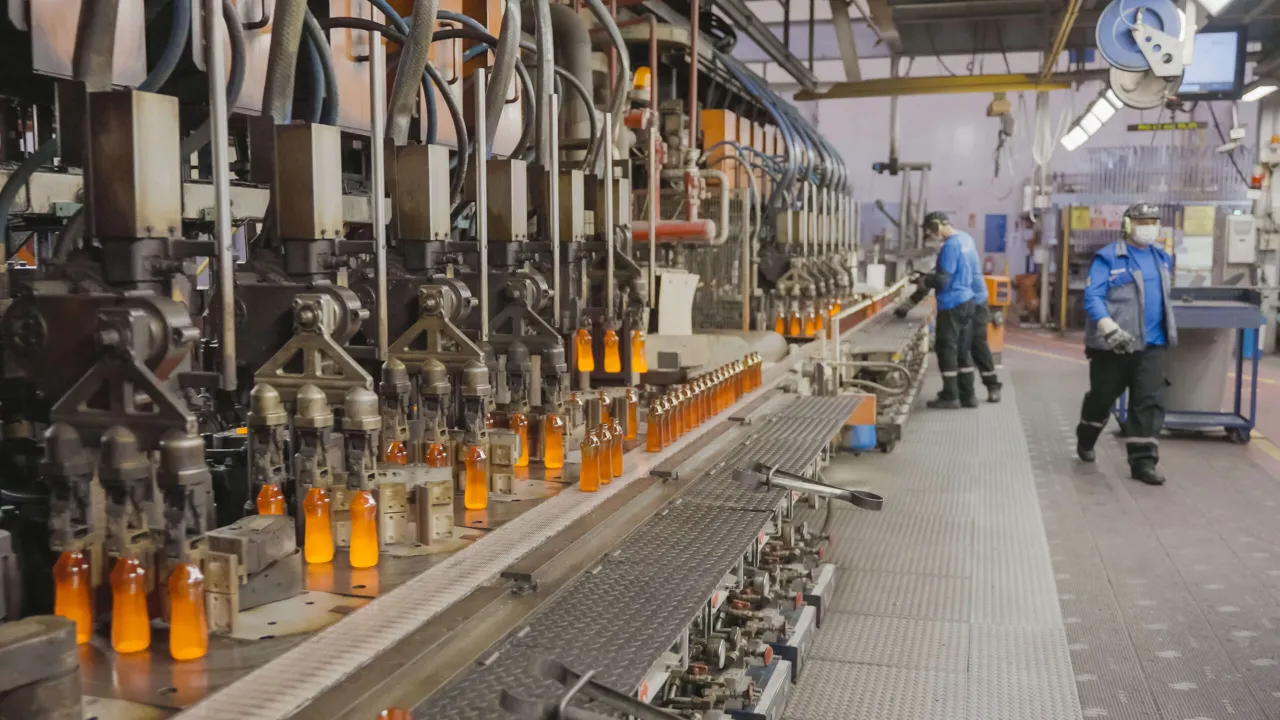
Soda Ash for Glass Manufacturing — Dense Na₂CO₃ Supplier for Flat, Container & Solar Glass
SUHA International is a specialist supplier of soda ash for glass manufacturing, delivering dense sodium carbonate (Na₂CO₃ ≥99.2%) to flat glass, container glass, solar glass and fiberglass producers worldwide. Every shipment includes a per-lot COA, MSDS, and full export documentation — FOB Jebel Ali (UAE) or Mersin (Turkey), with a confirmed CIF or FOB quote in 24 hours.
Purity: Na₂CO₃ ≥99.2% · Fe ≤35 ppm · Moisture ≤0.5%
Batch share: 12–18% of glass batch by weight
Packing: 25/50 kg PP/PE bags · 1,000–1,250 kg FIBC · Bulk vessel
Loading ports: Jebel Ali (Dubai, UAE) · Mersin (Turkey)
Incoterms: FOB · CFR · CIF | MOQ: 1 × 20' FCL (~25–26 MT)
Send your grade, monthly volume, destination port and required incoterm. Our team replies within 24 hours with a firm FOB or CIF price, spec sheet and shipment schedule.
WhatsApp — Get Quote Now ✉ info@causticsodaco.comYour Soda Ash Supplier for Glass Manufacturing — What Every Glass Plant Needs
Glass furnaces run continuously. A single batch inconsistency — from particle size variation, moisture caking, or iron contamination — translates directly into furnace defects, rejects, and downtime. Here is what glass manufacturers receive from us on every order.
Glass-Grade Specification
Na₂CO₃ ≥99.2%, Fe ≤35 ppm, moisture ≤0.5%, insolubles ≤0.03%, NaCl ≤0.5%. Lot-by-lot COA with retained samples. Premium low-iron grades (Fe ≤10 ppm) for solar and ultra-clear glass on request.
Right Packing for Your Plant
25/50 kg laminated PP/PE bags for bagged plants, 1,000–1,250 kg FIBC for batch house automation, and bulk vessel supply for large flat glass producers with pneumatic conveying. All moisture-sealed.
Dubai & Turkey Loading
FOB Jebel Ali (UAE) for the Gulf, South Asia, and East Africa. FOB Mersin (Turkey) for the Mediterranean, West Africa, and Europe. Short transit times keep your safety stock requirements low.
Complete Documentation
COA, MSDS, Certificate of Origin, B/L, Commercial Invoice, and Packing List on every shipment. SGS / BV inspection available. No DG paperwork — soda ash is non-hazardous, simplifying customs clearance.
Essential Definitions for Glass Manufacturing Procurement
Clear definitions of the technical terms used throughout this page and in soda ash supply contracts.
- Dense Soda Ash (Glass Grade)
- Sodium carbonate (Na₂CO₃) with bulk density 0.9–1.1 g/cm³ and median particle size 300–500 microns. It is the exclusive soda ash grade used in industrial glass furnaces for flat glass, container glass, solar glass, and fiberglass production. Its coarse granule size matches silica sand, preventing batch segregation. CAS: 497-19-8 · HS Code: 2836.20.00.
- Light Soda Ash
- Sodium carbonate (Na₂CO₃) with bulk density 0.5–0.6 g/cm³ and particle size approximately 100 microns. Chemically identical to dense grade but physically incompatible with glass furnace batch systems — it generates dust, segregates from silica sand, and causes feeding problems in automated batch houses. Not used in glass manufacturing.
- Flux (in glass batch context)
- A material added to a glass batch that lowers the melting point of silica. Soda ash (Na₂CO₃) is the primary flux in soda-lime glass. It reacts with SiO₂ at 700°C–900°C to form sodium silicates, reducing the effective melting point from approximately 1,710°C (pure silica) to 1,200–1,500°C, cutting furnace fuel consumption by 15–20%.
- Cullet
- Recycled broken glass added to the glass batch in place of some virgin raw materials. Every 10% increase in cullet ratio reduces soda ash consumption by approximately 5–6% per tonne of glass produced, while also lowering furnace energy requirements. Cullet purity — particularly the absence of ceramic contamination — is critical to batch chemistry stability.
- COA — Certificate of Analysis
- A per-lot document issued by the supplier confirming the actual tested values for all specification parameters (Na₂CO₃ purity, moisture, insolubles, iron, NaCl, bulk density). A valid glass-grade COA must include all seven parameters, not just headline purity. SUHA International provides a COA with retained samples on every shipment.
- FIBC — Flexible Intermediate Bulk Container (Jumbo Bag)
- A large woven polypropylene bag rated at 1,000–1,250 kg, used to supply dense soda ash to glass plants with automated batch house FIBC discharge stations. FIBC format eliminates the labor of handling individual 25 or 50 kg bags and integrates directly with belt or screw conveyor batch weighing systems.
Why Dense Soda Ash is the Essential Raw Material in Every Glass Furnace
The reaction is fundamental to every glass batch: Na₂CO₃ + SiO₂ → Na₂SiO₃ + CO₂. Sodium carbonate decomposes above 700°C, releasing CO₂ and introducing sodium oxide (Na₂O) into the melt. This Na₂O content is what modifies glass viscosity, thermal expansion coefficient, and chemical durability — the properties that determine whether the final product meets dimensional, optical, and mechanical tolerances.
For glass plant procurement teams, the operational implication is clear: soda ash is not interchangeable between suppliers without technical evaluation. Particle size distribution, bulk density, moisture content, iron levels, and NaCl are not cosmetic specifications — each one directly affects batch homogeneity, melt rate, defect frequency, and furnace energy consumption.
Dense vs. Light Soda Ash — Why Glass Plants Always Use Dense Grade
Both grades are chemically identical (Na₂CO₃ ≥99.2%), but the physical differences are operationally decisive for glass furnace applications.
Summary: Dense soda ash (0.9–1.1 g/cm³, 300–500 micron particles) is the only grade suitable for industrial glass furnaces. Light soda ash (0.5–0.6 g/cm³, ~100 micron) is used in detergents and chemicals — not glass. The table below compares all nine critical parameters.
| Parameter | Dense Soda Ash Glass Standard | Light Soda Ash |
|---|---|---|
| Physical form | Coarse white granules | Fine white powder |
| Bulk density | 0.9 – 1.1 g/cm³ | 0.5 – 0.6 g/cm³ |
| Median particle size | 300 – 500 microns | ~100 microns |
| Match to silica sand particle size | ✓ Good match — prevents batch segregation | ✗ Too fine — segregation risk |
| Dust generation | Minimal — virtually dust-free | High — requires dust extraction systems |
| Silo & feeder behavior | Free-flowing, consistent feed rate | Risk of bridging, arching, caking |
| Moisture uptake in storage | Lower — larger particles, less surface area | Higher — prone to caking in humidity |
| Container loadability (20' FCL) | up to 26 MT | 16 – 17.2 MT |
| Glass industry use | Flat glass, container glass, solar glass, fiberglass, automotive glass | Not used in industrial glass furnaces |
| Primary use outside glass | Metallurgy, ceramics | Detergents, chemicals, water treatment, textiles |
Dense soda ash holds the majority of global grade-type demand in 2026, with glass manufacturing accounting for the largest share of that volume. Full product pages: Soda Ash Dense · Soda Ash Light
Dense Soda Ash COA Specifications for Glass Manufacturing
Standard parameters for glass-grade dense sodium carbonate. A per-lot Certificate of Analysis confirming all parameters below accompanies every shipment.
Summary: Glass-grade dense soda ash requires seven parameters to be within specification simultaneously. The critical limits are Na₂CO₃ ≥99.2%, moisture ≤0.5%, insolubles ≤0.03%, iron (Fe) ≤35 ppm, and NaCl ≤0.5%. Each parameter has a direct operational consequence in the glass furnace.
| Parameter | Glass-Grade Dense | Unit | Why It Matters for Glass |
|---|---|---|---|
| Na₂CO₃ Content | ≥ 99.2 | % | Controls Na₂O delivery to the melt; low purity means under-dosing alkali or over-loading batch weight |
| Moisture (Loss on Heating) | ≤ 0.50 | % | Excess moisture causes caking in silos, feeder stoppages, and mass balance errors across the batch |
| Water Insolubles | ≤ 0.03 | % | Undissolved particles appear as seeds, stones or cords in finished glass — direct quality rejects |
| Iron (as Fe) | ≤ 0.0035 (35 ppm) | % | Iron causes yellow-green discoloration in clear glass; critical for solar glass transmittance and color-neutral flat glass |
| Sodium Chloride (NaCl) | ≤ 0.50 | % | Chlorine in the melt accelerates crown and superstructure corrosion, increasing furnace maintenance costs |
| Bulk Density | 0.90 – 1.10 | g/cm³ | Consistent bulk density ensures accurate gravimetric dosing and predictable batch weight per feeder cycle |
| Appearance | White granular solid | — | Uniform granule size reduces particle segregation during conveying from silo to batch mixer |
CAS 497-19-8 · EINECS 207-838-8 · HS Code 2836.20.00 · Molar mass 105.99 g/mol · Formula Na₂CO₃
Premium low-iron grades (Fe ≤10 ppm) for ultra-clear flat glass and high-transmittance solar glass are available on request.
Contact our technical team for premium-grade specifications and COA samples.
Glass Manufacturing Applications — Soda Ash Requirements by Segment
As a soda ash supplier for glass manufacturing, we serve all major glass product categories. Each segment has distinct batch composition requirements and soda ash consumption rates.
Summary: Soda ash constitutes 10–18% of a glass batch by weight depending on glass type. Solar glass and flat glass require the highest soda ash fraction (14–16%) and the strictest iron control. Container glass runs on 12–14%, and specialty glass as low as 5–12%.
| Glass Segment | Soda Ash in Batch (wt%) | Key Spec Concern | Daily Consumption (mid-size plant) |
|---|---|---|---|
| Flat / Float Glass Windows, facades, automotive windshields |
14 – 16% | Consistent bulk density; low iron for architectural clear glass | 50 – 120 MT/day |
| Container Glass Bottles, jars, pharmaceutical vials |
12 – 14% | Particle size uniformity; low NaCl; compatible with high cullet ratios | 30 – 55 MT/day |
| Solar Glass PV panel cover glass, ultra-clear float |
14 – 16% | Ultra-low iron (≤10 ppm preferred); high transmittance batch purity | 60 – 150 MT/day |
| Fiberglass Insulation wool, composite reinforcement |
10 – 15% | Consistent alkali delivery; compatibility with boron-modified batches | 20 – 60 MT/day |
| Automotive Glass Laminated, tempered, acoustic glass |
13 – 15% | Tight viscosity control; consistent Na₂O for optical homogeneity | 20 – 80 MT/day |
| Specialty / Lab Glass Borosilicate, optical, display glass |
5 – 12% | High purity; modified alkali ratio with potassium or boron co-fluxes | 5 – 20 MT/day |
How Soda Ash Behaves Stage by Stage in the Glass Furnace
Understanding the process helps procurement teams ask the right technical questions when evaluating a soda ash supplier for glass manufacturing — and helps technical teams troubleshoot batch quality issues.
-
01Batch house mixing (ambient temperature)
Dense soda ash is weighed gravimetrically and blended with silica sand (60–70%), limestone, dolomite, cullet, and minor additives. Consistent bulk density (0.9–1.1 g/cm³) is essential for accurate dosing. Particle size matched to silica (300–500 μm) prevents segregation during pneumatic conveying or belt transfer to the furnace doghouse.
-
02Batch charging and early melt zone (700°C – 900°C)
Na₂CO₃ begins decomposing above 700°C. CO₂ is released as gas — this must escape the batch without trapping and causing blisters. Low-moisture soda ash (≤0.5%) reduces secondary steam generation, and consistent particle size ensures even CO₂ release across the batch blanket. Uneven decomposition creates batch segregation zones and thermal striations.
-
03Melting and fusion zone (1,200°C – 1,550°C)
Sodium silicates form and dissolve residual silica grains. High-purity soda ash (insolubles ≤0.03%) prevents undissolved particles from surviving into the working end. Iron contamination above 35 ppm causes visible discoloration in clear glass. NaCl above 0.5% introduces chlorine that attacks refractory, particularly the crown and superstructure.
-
04Refining zone and fining (1,450°C – 1,600°C)
Residual gas bubbles are removed. Glass viscosity at forming temperature is controlled primarily by the Na₂O content delivered by soda ash. Consistent alkali delivery from lot to lot is what keeps viscosity — and therefore forming behavior — predictable across production shifts and seasonal temperature changes.
-
05Forming, annealing, and quality control
Na₂O in the glass network determines thermal expansion coefficient, chemical durability, and mechanical strength. Soda ash quality directly affects final product dimensional tolerances, breakage rate, and compliance with standards such as EN 572 (flat glass) or ISO 12775 (container glass). Consistent raw material is the foundation of consistent product.
SUHA International vs. Direct Producer Purchase — What Glass Plants Should Know
Many glass plant procurement managers compare buying through a dedicated export trading company versus purchasing directly from a soda ash producer. The differences are operational, not just commercial.
Sourcing Through SUHA International (Export Trading Specialist)
Advantages
- Two loading origins (Dubai + Turkey) — origin flexibility protects against single-source disruption
- Smaller MOQ (1 FCL trial) without producer minimum commitments
- Faster quote turnaround — 24 hours vs. multi-week producer RFQ processes
- Consolidated documentation support and customs guidance per destination
- Origin switching between UAE and Turkey based on freight rates and lead times
- SGS / Bureau Veritas pre-shipment inspection arranged by the supplier
Considerations
- Not the plant of manufacture — glass plants must verify the supply chain origin
- Annual spot price benchmarking against producer indices is advisable
- For very large volumes (+30,000 MT/yr), direct producer contracts may offer different structures
Dense Soda Ash Packaging Options for Glass Plants
We match packaging format to your batch house configuration — from bagged plants to fully automated FIBC systems and bulk silo-fed facilities.
Summary: Dense soda ash is available in four formats: 25 kg bags, 50 kg bags, 1,000–1,250 kg FIBC jumbo bags, and bulk vessel shipments. A standard 20-foot container holds up to 26 MT of dense grade. Bulk vessels start at 3,000 MT.
| Packaging Format | Specification | 20' FCL | 40' FCL | Best For |
|---|---|---|---|---|
| 25 kg PP/PE bags | Laminated, moisture-sealed, palletized on 1.1×1.1 m pallets | ~24 MT | ~25 MT | Small to mid-size glass plants, manual or semi-automated batch weighing |
| 50 kg PP/PE bags | Laminated, moisture-sealed, palletized | ~25 MT | ~25.5 MT | Mid-size plants with forklift batch houses; reduces bag-handling labor vs. 25 kg |
| 1,000–1,250 kg FIBC (Jumbo Bags) | Coated inner liner, moisture-sealed; discharge spout or bottom outlet | ~24–26 MT | ~26 MT | Automated batch houses with FIBC discharge stations and belt / screw conveyors |
| Bulk vessel shipment | Break-bulk or bulk carrier; direct pneumatic discharge at plant silo | 3,000 – 30,000 MT per shipment | Large flat glass and solar glass facilities with bulk silo infrastructure; lowest cost per tonne | |
📦 Packaging Standards
- Inner liner: PE inner bag, heat-sealed to prevent moisture ingress and CO₂ carbonation
- Outer bag: woven PP — UV-resistant for outdoor temporary storage
- Palletization: stretch-wrapped on heat-treated (ISPM 15) export pallets on request
- FIBC discharge: bottom spout or full-open bottom; UN-rated available
- Private label: custom labeling for distributors available
⚠️ Moisture Control in Transit
- Caking risk: soda ash is mildly hygroscopic — unsealed bags absorb moisture and cake within days in humid climates
- Container moisture: desiccant bags in every container; vent-sealed for long voyages to tropical ports
- Receiving check: measure bulk density on arrival — a drop of >0.05 g/cm³ from COA value indicates moisture uptake
- Storage: sealed, palletized, off the floor in a dry ventilated warehouse — never outdoors without cover
Buying Dense Soda Ash — Everything a Glass Plant Procurement Team Needs
MOQ, incoterms, loading ports, lead times, documentation, and how to structure a supply contract that protects production continuity.
📋 Order & Supply Terms
- Trial MOQ: 1 × 20' FCL (~25–26 MT dense) to verify spec and quality before scaling
- Regular supply: 1–3 FCL/month for mid-size plants; full vessel lots for large producers
- Incoterms: FOB, CFR, or CIF — your choice of loading port
- Loading ports: Jebel Ali (Dubai, UAE) and Mersin (Turkey)
- Lead time: 7–15 days from order confirmation to loading; subject to stock position
- Inspection: SGS or Bureau Veritas pre-shipment inspection available on request
- Payment: L/C at sight, TT in advance, or TT against B/L copy — per negotiation
📑 Documentation Per Shipment
- COA — per-lot Certificate of Analysis, all parameters tested
- MSDS / SDS — non-hazardous; no UN number, no IMDG class
- Certificate of Origin — UAE or Turkey origin, as required for import duty purposes
- Bill of Lading — full set (3/3 originals) or express B/L
- Commercial Invoice & Packing List — itemized per container
- SGS / BV report — if third-party inspection requested before loading
- Fumigation / legalization — support provided where destination requires
Destinations We Ship Dense Soda Ash to for Glass Manufacturing
Regular shipments of dense soda ash to glass manufacturers across:
Middle East & Gulf: Jebel AliShuaiba (Kuwait)DammamSohar ·
South Asia: Nhava Sheva (India)Chittagong (Bangladesh)ColomboKarachi ·
Southeast Asia: Ho Chi Minh CityJakartaBangkok ·
East Africa: MombasaDar es Salaam ·
West Africa: LagosTema ·
Mediterranean: AlexandriaMersin
How to Evaluate a Soda Ash Supplier for Glass Manufacturing — Procurement Checklist
Glass plant procurement teams should look beyond unit price when qualifying a soda ash supplier. The variables that directly affect total production cost and furnace reliability include:
Summary: Eight criteria matter when evaluating a soda ash supplier for a glass plant. Specification match, lot-to-lot consistency, and packaging integrity have the most direct impact on furnace production and product quality.
| Evaluation Criterion | What to Verify | SUHA International |
|---|---|---|
| Specification match | Full COA with Na₂CO₃ %, moisture, insolubles, Fe, NaCl — not just purity headline | ✓ Full 7-parameter COA per lot, retained samples |
| Lot-to-lot consistency | Request COAs from 3–5 consecutive shipments; specification variance matters more than a single peak purity figure | ✓ Historical multi-lot COA data available on request |
| Particle size distribution | 300–500 micron median; ask for sieve analysis data, not just grade name | ✓ Dense grade with silica-matched particle size |
| Packaging integrity | Moisture-sealed inner liner; no caking on arrival; bulk density vs. COA within 0.05 g/cm³ | ✓ PE inner liner, heat-sealed; desiccant bags in containers |
| Documentation completeness | COA, MSDS, Certificate of Origin, B/L, Invoice, Packing List — missing any creates customs delays | ✓ Full documentation set with every shipment |
| Lead time reliability | Can supplier commit to a loading window and meet it consistently? Ask for track record. | ✓ 7–15 days from order to loading at FOB port |
| Supply continuity | Single origin suppliers carry more disruption risk; ask about backup origin options | ✓ Two loading origins: Dubai (UAE) and Turkey |
| Technical support | Can supplier advise on grade selection, assist with batch formulation issues, or provide rapid response to a quality claim? | ✓ Technical team available for consultation |
Cullet Ratios, Carbon Reporting, and Soda Ash Consumption Planning
Summary: Increasing cullet ratio reduces soda ash consumption proportionally. Every 10% more cullet saves 5–6% of soda ash per tonne of glass produced. At 50% cullet, annual soda ash volumes drop by roughly 25–30% vs. a virgin batch.
| Cullet Ratio in Batch | Soda Ash Reduction vs. Virgin Batch | Energy Saving (approx.) | Supply Planning Implication |
|---|---|---|---|
| 10% cullet | ~5–6% less soda ash per tonne of glass | ~2.5% lower fuel per tonne | Minor impact — plan annual volumes on virgin batch basis |
| 30% cullet | ~15–18% less soda ash per tonne of glass | ~7–8% lower fuel per tonne | Meaningful reduction — adjust quarterly soda ash purchase schedule |
| 50% cullet | ~25–30% less soda ash per tonne of glass | ~12–14% lower fuel per tonne | Significant — cullet quality management becomes critical; ceramic contamination causes defects |
| 70% cullet | ~35–40% less soda ash per tonne of glass | ~18–20% lower fuel per tonne | Bulk contract volume must be planned in close coordination with cullet stream consistency |
Carbon reporting and CBAM: Glass manufacturers supplying to European markets increasingly need Scope 3 carbon data for their raw materials. We provide carbon intensity documentation for our soda ash supply — including production route (natural trona vs. synthetic Solvay process) and estimated CO₂ per tonne — on request. Trona-based soda ash generates approximately 37% less CO₂ per tonne than synthetic Solvay-process material.
Long-term supply contracts: For glass plants with stable production schedules, we offer annual supply agreements with fixed monthly delivery volumes, price adjustment mechanisms tied to published market indices, and agreed-upon specification windows. This eliminates spot-market exposure and ensures uninterrupted furnace supply — contact our team to structure a supply agreement for your plant.
Soda Ash for Glass Manufacturing — Buyer FAQ
The most common procurement and technical questions from glass plant buyers and batch house engineers.
This applies to flat glass, container glass, solar glass, fiberglass, and automotive glass. Its particle size closely matches silica sand, preventing batch segregation during mixing and conveying. Light soda ash (bulk density 0.5–0.6 g/cm³, approximately 100 microns) is not used in industrial glass furnaces — it generates excessive dust, segregates from silica, and performs poorly in automated batch house feeding systems.
Flat glass and solar glass batches average 14–16%; container glass runs 12–14%. These figures decrease proportionally as cullet ratio increases — every 10% increase in cullet in the batch reduces soda ash requirements by approximately 5–6% per tonne of glass produced.
A mid-size flat glass line at comparable output consumes a similar range. High-capacity float glass facilities — 600–900 tonnes of glass per day — can require 100–150 MT of soda ash per day. Annual supply contracts for a single glass plant commonly range from 5,000 to 30,000 MT depending on furnace size, glass type, and cullet ratio.
For solar glass and ultra-clear flat glass, iron control is tighter — typically ≤10 ppm Fe₂O₃ — to meet high solar transmittance requirements. Contact our technical team for premium-grade specifications and COA samples.
The chemical reaction is: Na₂CO₃ + SiO₂ → Na₂SiO₃ + CO₂. Sodium carbonate breaks down the silica network and introduces sodium oxide (Na₂O) into the glass matrix. This is one of the largest operating cost levers available to glass plant management — and it depends entirely on consistent, on-spec soda ash supply.
All formats are moisture-sealed. A 20-foot container holds up to 26 MT of dense grade. Bulk vessel shipments start at 3,000 MT for plants with silo infrastructure and pneumatic conveying. Custom labeling for distributors is available.
Third-party pre-shipment inspection by SGS or Bureau Veritas is available on request. Soda ash is non-hazardous — no UN number, no IMDG class — making customs clearance straightforward compared to caustic soda or acids.
Our two-origin logistics network means glass plants in most regions have access to competitive freight rates and short transit times. Covered destinations include India, Bangladesh, Pakistan, Sri Lanka, Vietnam, Indonesia, Thailand, Malaysia, Kenya, Tanzania, Nigeria, Ghana, and Egypt.
This allows glass plants to run a batch trial and qualify the material before committing to a regular supply program. Long-term supply contracts typically start at 1–3 FCL per month for mid-size plants, scaling to full vessel lots (3,000–10,000 MT) for large flat glass and solar glass producers.
A plant operating at 50% cullet consumes roughly 25–30% less soda ash versus a virgin batch, while also lowering furnace energy cost and CO₂ emissions. However, cullet quality management is critical — ceramic contamination in the cullet stream disrupts melt chemistry and significantly increases defect rates. We can help calculate adjusted annual soda ash volumes as your cullet strategy evolves.
Get Your Dense Soda Ash Supply Quote — Glass Manufacturing
Our export team replies within 24 hours with a firm FOB or CIF quotation, sample COA, and shipping schedule for your plant.
B2B enquiries only. We reply within 24 hours with a firm FOB or CIF quote, COA sample, and shipment schedule. Phone / WhatsApp: +971 50 720 9246 · Email: info@causticsodaco.com
Explore Related Supply Pages
Source Dense Soda Ash from a Trusted Soda Ash Supplier for Glass Manufacturing
Send your glass type, monthly volume, destination port and packaging requirement. Our export team replies within 24 hours with a firm FOB or CIF quote, sample COA and shipping schedule.