
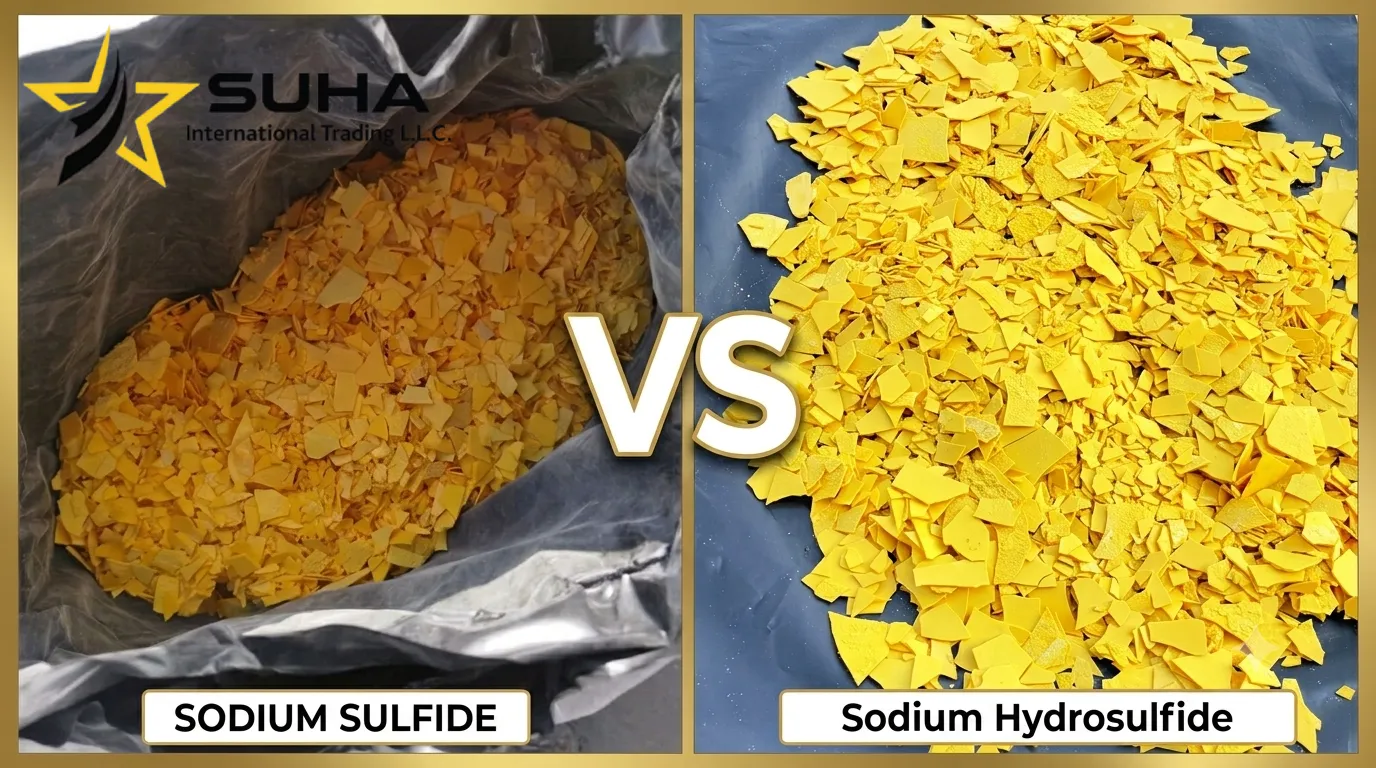
Sodium Sulfide vs Sodium Hydrosulfide (NaHS): Differences, Uses & How to Choose
A supplier-grade technical comparison of Na₂S and NaHS — covering formula, pH behaviour, reactivity, industrial uses, dosing, cost and safety — so you specify the right sulfide the first time.
Few procurement mistakes in the sulfide chemical trade are as common, or as costly, as ordering the wrong salt. The sodium sulfide vs sodium hydrosulfide decision looks trivial on paper — the two compounds differ by a single hydrogen atom — yet that one atom changes alkalinity, reactivity and process behaviour enough to ruin a flotation circuit, stain a batch of leather, or trigger an uncontrolled release of toxic hydrogen sulfide (H₂S). Both salts serve the same core industries (leather, mining, pulp, textiles and wastewater treatment), which is exactly why they get confused.
This guide replaces the vague, machine-translated content that dominates search results with hard numbers and process logic. As a bulk sodium sulfide supplier shipping Na₂S from Dubai and Turkey, our aim is to help you understand the real trade-offs between these two sulfides — and match the product to your specific pH window and application.
Sodium Sulfide vs Sodium Hydrosulfide: The Short Answer
Both are inorganic sulfide salts derived from hydrogen sulfide. Sodium sulfide (Na₂S) carries two sodium ions and a full sulfide ion (S²⁻); it is the stronger base and the classic heavy-duty reagent for leather dehairing, Kraft pulping and the sulfidization of oxide minerals. Sodium hydrosulfide (NaHS) carries one sodium ion and a hydrosulfide ion (HS⁻); it is milder, easier to pH-control, and preferred where precise dosing and lower alkalinity matter — molybdenum flotation, wastewater metal precipitation and grain-safe unhairing. The clean way to remember the relationship: dissolve Na₂S in water and it hydrolyses into NaHS + NaOH. NaHS is, in effect, “half-way” between caustic-heavy Na₂S and pure H₂S.
The Chemical Difference: Na₂S vs NaHS at the Ion Level
The entire comparison begins with one structural fact. Both compounds are salts of the weak acid hydrogen sulfide, but each carries sulfur in a different ionic form:
- Sodium sulfide, Na₂S — two sodium ions (Na⁺) plus one fully deprotonated sulfide ion (S²⁻). That missing second proton is why Na₂S solutions are strongly alkaline: the S²⁻ ion pulls hydrogen from water and releases hydroxide (OH⁻).
- Sodium hydrosulfide, NaHS — one sodium ion (Na⁺) plus one hydrosulfide (bisulfide) ion (HS⁻). Because it retains a hydrogen, NaHS is a 1:1 electrolyte, more soluble in organic solvents, and considerably less basic. A commercial NaHS solution sits at pH 11.5–12.5, and its HS⁻ ion releases far fewer hydroxide ions than S²⁻.
The insight most competitor pages miss is what happens in the beaker. When Na₂S dissolves, it does not remain as S²⁻ — it hydrolyses and dissociates into HS⁻ and OH⁻, effectively yielding NaHS plus caustic soda. Because NaHS does not hydrolyse this way, it does not drive the pH up. This single behavioural difference explains most of the practical choices between the two products across every downstream industry.
Key reactions to remember
- Na₂S + H₂O → NaHS + NaOH (Na₂S raises pH; NaHS does not)
- H₂S + NaOH → NaHS + H₂O (how NaHS is commercially made — absorbing H₂S into caustic soda)
- Na₂S + H₂S → 2 NaHS
- Na₂S / NaHS + acid → H₂S↑ (toxic gas — never combine sulfides with acids)
Commercially, both ship as coloured flakes (yellow to red, driven by iron content). But NaHS is also traded as a liquid solution — typically 20–45% strength, weighing roughly 9–11 lb/gal — a ready-to-meter form in which Na₂S is rarely supplied. That difference in physical form carries real consequences for dosing, freight and dust exposure, covered further below.
Na₂S vs NaHS — Full Comparison Table
| Property | Sodium Sulfide (Na₂S) | Sodium Hydrosulfide (NaHS) |
|---|---|---|
| Chemical formula | Na₂S (often Na₂S·9H₂O) | NaHS (often NaHS·xH₂O) |
| CAS number | 1313-82-2 | 16721-80-5 |
| Active sulfur ion | Sulfide, S²⁻ (more sulfur per kg) | Hydrosulfide, HS⁻ |
| Typical commercial grade | 60–62% flakes (yellow / red) | 70–72% flakes or 20–45% solution |
| Alkalinity / pH behaviour | Strong base — hydrolyses, drives pH up | Milder — does not hydrolyse; pH ≈ 11.5–12.5 |
| Solubility | Highly soluble in water | Highly water-soluble; also more soluble in organic solvents |
| Physical forms supplied | Solid flakes / lumps only | Solid flakes and liquid solution |
| Best-fit strength | Heavy-duty, high-alkalinity duty | Precision, grain-safe, low-pH duty |
| Leather role | Primary dehairing / unhairing agent (fast) | Gentler, slower unhairing; grain protection |
| Mining role | Sulfidizing oxide Pb / Zn / Cu ores | Cu depression in Cu–Mo separation; E_h control |
| Transport / hazard class | Class 8 corrosive (UN 1849); H₂S with acid | Class 8 corrosive, toxic (UN 2922 solution); H₂S with acid |
Figures are typical industrial ranges. Always confirm against the batch Certificate of Analysis (COA) and Safety Data Sheet (SDS) supplied with your order.
Leather & Tanning: Which Sulfide for Dehairing?
The leather industry is the largest single consumer of both chemicals, and the beam house is where the choice between Na₂S and NaHS has the most visible impact on product quality. In unhairing and liming, sulfide ions cleave the disulfide bonds in keratin, dissolving hair at the follicle and opening up the hide’s fibre structure.
Na₂S is the classic workhorse. Its high alkalinity attacks keratin aggressively and swells the hide fast — thorough hair removal in a short cycle. The trade-off is that this same strength can overshoot, causing grain damage or dark staining, particularly when iron content is high. This is precisely why tannery-grade sodium sulfide must be low-iron; our specification guarantees ≤10 ppm Fe to keep finished leather clean and stain-free.
NaHS is increasingly used as a partner, not a substitute. A well-documented property here is that NaHS acts more slowly than Na₂S as a depilatory. Combined with its milder alkalinity, that makes it valuable for grain protection: many modern tanneries now run a mixed Na₂S/NaHS system where NaHS supplies reducing power at a gentler pH, cutting lime consumption and lowering the sulfide load in effluent — an increasingly important factor as tannery wastewater regulations tighten.
Field dosing reference: A widely cited UNIDO leather-processing guideline places typical hair-save unhairing at roughly 1.5–3% Na₂S flake on raw-hide weight (≈3.7–7.4 kg S²⁻ per tonne of raw hide). Note the purity gap when substituting: Na₂S flake is usually 60–62% while NaHS flake is often ~95%, so you must recalculate on an active-sulfide basis rather than swapping kilogram-for-kilogram.
Bottom line for tanneries: Na₂S for maximum unhairing power at the lowest cost per kg of sulfur; blend in NaHS when grain protection, effluent reduction and tighter pH control justify it.
Mining & Mineral Flotation: A Genuine Role Difference
Flotation is where the distinction between the two salts is most technical — and where buying the wrong reagent can wreck a circuit’s metallurgy.
Na₂S — the sulfidizer. Operators use sodium sulfide to “sulfidize” the surface of oxidized lead, copper and zinc minerals, laying down a fresh sulfide-style coating so that xanthate collectors can attach. It is the standard reagent for reprocessing weathered or oxide ores ahead of collector addition, and it also precipitates dissolved copper ions as Cu₂S (a “sequestration” effect). It is frequently paired with soda ash for pH control.
NaHS — the precision depressant. Its flotation edge is controlling pulp potential (E_h) without a sharp pH rise, because HS⁻ does not hydrolyse the way S²⁻ does. In copper–molybdenum separation, NaHS depresses copper sulfides so a cleaner molybdenite concentrate floats — and because it keeps the pulp less alkaline, it avoids over-activating unwanted gangue. There’s a further technical reason plants prefer it: excess Na₂S strips dissolved oxygen from the pulp, and dissolved oxygen is needed for sulfhydryl collectors to adsorb — so overdosing Na₂S can actually reduce flotation efficiency, a problem NaHS sidesteps.
The most sophisticated circuits use both together. In one documented Cu/Zn reprocessing operation on weathered ore (Les Mines Selbaie), engineers dosed NaHS to the primary SAG/ball mills at pH 9 and Na₂S to the cleaner regrind at pH 5.5 — a roughly 70/30 split — to virtually restore normal-ore metallurgy. The takeaway: in mining, the reagent choice is dictated by the exact mineral you’re targeting and your potential/pH window, not by “sulfide content” alone.
Wastewater Treatment & Heavy-Metal Removal
Both salts precipitate dissolved heavy metals — copper, nickel, zinc, lead, mercury, cadmium and chromium — as highly insoluble metal sulfides. Because metal sulfides are far less soluble than the hydroxides produced by lime treatment, sulfide precipitation is the preferred route for meeting stringent discharge limits, and demand is rising as water-pollution regulation tightens worldwide.
In this application, NaHS is frequently the reagent of choice for two practical reasons rooted in its lower alkalinity:
- Lower neutralisation cost: it doesn’t push pH as high as sodium sulfide, so less acid is required to bring treated water back into range downstream.
- Dosing precision: tighter control of sulfide-ion concentration reduces the risk of residual sulfide in the treated stream — itself a discharge violation.
That said, sodium sulfide remains fully effective and is often chosen when it is already on site for another process, or when its lower cost per unit of sulfur outweighs the extra neutralisation. The correct answer is process-specific — the recurring theme whenever you weigh these two reagents against each other.
Pulp, Paper & Textile Dyeing
Kraft pulp & paper: Na₂S is combined with caustic soda (NaOH) to form “white liquor,” the cooking solution that dissolves lignin while preserving cellulose fibres and producing high-strength pulp. NaHS plays a support role here: mills inject it to restore sulfidity during reduction-furnace outages, when their own on-site Na₂S generation drops — a top-up function rather than the primary cook chemical.
Textile sulfur dyeing: both act as a reducing agent, converting insoluble sulfur dyes into their soluble, substantive leuco form so the dye penetrates cotton and blended fabrics. Dye chemistry gives a useful dosing detail: Na₂S alone is an effective reducer, whereas an equivalent NaHS system typically needs added alkali (about 10 g/L Na₂CO₃ or 5 g/L NaOH) to match performance. A word of caution — over-powerful reducers such as sodium hydrosulphite (dithionite) can over-reduce the dye and harm its affinity for cellulose, a reminder that “stronger” is not automatically “better.”
Cost, Dosing & Handling Economics
Never settle the Na₂S vs NaHS question on headline price per tonne. Compare on delivered cost per kilogram of active sulfide, then add the downstream costs each product creates:
- Sulfur density: Na₂S delivers more sulfide ion per kg than NaHS at comparable grade, so it usually wins on raw reagent economics.
- Neutralisation cost: the higher alkalinity of sodium sulfide can mean more acid downstream — a hidden cost that often tilts the maths toward NaHS in pH-sensitive processes.
- Form & logistics: NaHS liquid removes dissolving steps and dust exposure but ships a lot of water; solid flakes of either product are cheaper to freight per unit of active sulfur — a real factor when importing to Africa, South Asia or South America.
- Storage losses: both oxidise on air exposure (to sulfite and thiosulfate), eroding active content — sealed packaging and correct storage protect the value you paid for.
Safety: The Shared H₂S Hazard
On safety, the two products are near-identical and demand equal respect. Both are Class 8 corrosives, and both release toxic, flammable hydrogen sulfide (H₂S) gas on contact with acids. A critical, often-overlooked threshold: for NaHS solutions, H₂S evolution rises sharply once pH drops below 10.2 — which happens on contact with acidic materials or even simple dilution with water. H₂S is detectable by its rotten-egg odour at low concentrations but becomes undetectable at high concentrations due to olfactory fatigue, and it is heavier than air, pooling in low-lying areas.
Non-negotiable handling rules for both Na₂S and NaHS:
- Never store or mix with acids or oxidising agents — segregate strictly in transit and storage.
- Wear chemical-resistant gloves, splash goggles and protective clothing; use SCBA or supplied-air respirators near open tanks or confined spaces.
- Keep containers tightly sealed; store cool, dry and well-ventilated, away from sunlight and moisture.
- Always work from the batch-specific SDS shipped with your order.
Neither product is meaningfully “safer” in a chemical sense — both require the same H₂S discipline. NaHS’s milder alkalinity can be gentler on materials and skin, but the gas hazard is effectively identical.
Decision Guide: Which Sulfide Should You Buy?
| If your priority is… | Choose | Why |
|---|---|---|
| Maximum unhairing power, lowest cost per kg of sulfur | Na₂S | Higher alkalinity + more S²⁻ per kg |
| Grain protection & lower tannery effluent load | NaHS (or Na₂S/NaHS blend) | Milder pH, slower action, less lime, less residual sulfide |
| Sulfidizing oxide Pb / Zn / Cu ores before collection | Na₂S | Standard surface-sulfidization reagent |
| Copper depression in Cu–Mo flotation, E_h control | NaHS | Precise potential control without pH spike or O₂ stripping |
| Wastewater metal precipitation with tight pH limits | NaHS | Lower neutralisation cost, dosing precision |
| Kraft white-liquor cooking | Na₂S | Primary sulfidity source alongside NaOH |
| No dissolving step / continuous liquid metering | NaHS solution | Ships as 20–45% liquid, ready to dose |
Order Bulk Sodium Sulfide — or Ask Our Team
Still weighing the sodium sulfide vs sodium hydrosulfide decision for your process? Tell us your industry, target application and destination port. Our export team will recommend the right grade — Na₂S 60% low-iron yellow flakes or the appropriate NaHS form — and send a formal FOB / CIF quotation within 24 hours. Request a quote, or message us on WhatsApp (+971 50 720 9246). See full specifications on our sodium sulfide product page.
Frequently Asked Questions
Is sodium hydrosulfide the same as sodium sulfide?
No. Sodium sulfide (Na₂S) contains a full sulfide ion (S²⁻) and two sodium ions, while sodium hydrosulfide (NaHS) contains a hydrosulfide ion (HS⁻) and one sodium ion. Na₂S is the stronger base; when dissolved in water it hydrolyses to form NaHS and sodium hydroxide (NaOH). They serve overlapping industries but behave differently in reactions.
Which is stronger, Na₂S or NaHS?
Na₂S is the stronger base and carries more active sulfur per kilogram, making it the more aggressive reagent for high-alkalinity jobs like leather dehairing and Kraft pulping. NaHS is milder because its HS⁻ ion releases fewer hydroxide ions, which is an advantage when you need sulfide reactivity without a sharp pH rise.
What is the chemical formula of sodium sulfide and sodium hydrosulfide?
Sodium sulfide is Na₂S (CAS 1313-82-2), commonly supplied as the hydrate Na₂S·9H₂O. Sodium hydrosulfide is NaHS (CAS 16721-80-5). The difference is one hydrogen atom and one sodium atom: Na₂S has a sulfide ion (S²⁻); NaHS has a hydrosulfide ion (HS⁻).
Which is better for leather dehairing, sodium sulfide or sodium hydrosulfide?
Na₂S is the primary, most powerful unhairing agent thanks to its high alkalinity and faster action. NaHS is gentler and slower, and is increasingly blended with Na₂S to protect the grain surface, cut lime use, and lower the sulfide load in tannery effluent. Many modern tanneries run a Na₂S/NaHS blend rather than choosing one exclusively.
Why is NaHS preferred over sodium sulfide in flotation and wastewater?
Because NaHS does not hydrolyse, it controls pulp potential (E_h) and sulfide concentration without raising pH. In copper–molybdenum flotation it depresses copper without over-activating gangue or stripping the dissolved oxygen that collectors need. In wastewater it precipitates heavy metals while keeping downstream acid and neutralisation costs lower than sodium sulfide.
Can I substitute NaHS for Na₂S kilogram-for-kilogram?
No. Their active-sulfide content and grades differ (Na₂S flake is usually 60–62%; NaHS flake is often ~95%, with NaHS also sold as a 20–45% solution), and their alkalinity differs. Always recalculate the dose on an active-sulfide basis and re-check your process pH window before switching.
Are sodium sulfide and sodium hydrosulfide equally hazardous?
Effectively yes. Both are Class 8 corrosives and both release toxic hydrogen sulfide (H₂S) gas on contact with acids, so both require identical segregation, PPE and ventilation controls. For NaHS solutions, H₂S release increases sharply below pH 10.2. NaHS’s milder alkalinity can be gentler on materials, but the gas hazard is the same.
Do you supply both sodium sulfide and sodium hydrosulfide?
We supply bulk sodium sulfide (Na₂S 60% low-iron yellow flakes, ≤10 ppm Fe) FOB Dubai and Turkey, with full COA/SDS documentation. For NaHS requirements, contact our export team so we can match the correct grade and form to your application.
Related Products & Guides
- Sodium Sulfide (Na₂S) 60% — Product Page & Specifications
- Caustic Soda Flakes 98% (NaOH)
- Soda Ash (Sodium Carbonate)
- Sodium Hypochlorite
- Request a Bulk Quote
Authoritative External References
- PubChem — Sodium Sulfide (Na₂S): properties & safety data
- PubChem — Sodium Hydrosulfide (NaHS)
- PubChem — Hydrogen Sulfide (H₂S) hazard information
Disclaimer: This article provides general technical information for procurement and process reference only. Always follow your batch-specific SDS/COA and applicable local regulations. Dosing figures are illustrative industry ranges, not process recommendations.