- Supplier of Standard Malaysian Rubber (SMR) – SMR 10, SMR 20, CV50, CV60
- Standard Malaysian Rubber (SMR): A Comprehensive Overview
- Physical and Chemical Properties of SMR
- Advanced Production Process
- Grades of Standard Malaysian Rubber (SMR)
- Key Applications and Industry Uses
- Handling, Storage, and Transportation Protocols
- Packing and Logistics Specifications
- Your Trusted Source for Premium Rubber Solutions
- Specification of Natural Rubber
SMR Supplier for Bulk Standard Malaysian Rubber
Content reviewed: 5 October 2026 · SUHA International Trading L.L.C., Dubai & Ankara
SUHA International Trading is an SMR supplier serving tyre makers, rubber compounders, distributors and traders worldwide. We supply Standard Malaysian Rubber in all main grades – SMR 20, SMR 10, SMR GP, SMR 5, SMR L, SMR CV50 and SMR CV60 – in 33.33 kg or 35 kg bales, quoted FOB, CFR or CIF, with a minimum order of one full container load (1 × 20ft FCL) and a lot-wise quality certificate against the Malaysian Rubber Board (MRB) specification.
Standard Malaysian Rubber (SMR) is the benchmark grade of technically specified natural rubber (TSR). Every bale is graded by laboratory tests – dirt, ash, nitrogen, volatile matter, plasticity and Mooney viscosity – rather than by eye, which is why purchasing teams in tyre, automotive and industrial rubber plants specify it by grade code. As a Standard Malaysian Rubber supplier working from Dubai and Ankara, we connect buyers with SMR-scheme production in Malaysia and handle the commercial side: grade selection, contract, documents and shipment to your port.
- ProductNatural rubber (TSR)
- OriginMalaysia
- HS code4001.22
- CAS No.9006-04-6
- Bale weight33.33 / 35 kg
- MOQ1 × 20ft FCL
What Is Standard Malaysian Rubber (SMR)?
Standard Malaysian Rubber is natural rubber (cis-1,4-polyisoprene) produced from the latex of the Hevea brasiliensis tree and graded under the SMR scheme, which Malaysia introduced in 1965 as the world's first technically specified rubber scheme. The scheme is administered by the Malaysian Rubber Board (MRB), which sets the grade limits, approves the producing factories and governs the testing that every lot must pass before it is released for export.
Before TSR, natural rubber was traded as visually graded sheets such as Ribbed Smoked Sheet (RSS). Technical grading changed that: a buyer ordering SMR 20 or SMR CV60 knows the maximum dirt and ash, the minimum plasticity retention and – for CV grades – the Mooney viscosity window before the cargo leaves the factory. Other producing countries later adopted the same model, so SMR sits alongside Indonesia's SIR, Thailand's STR and Vietnam's SVR in the wider TSR family; grade numbers such as 10 and 20 broadly line up across these systems, while the exact limits are set by each national scheme.
SMR is shipped as compressed rubber blocks (bales) wrapped in polyethylene film. Natural rubber is not classified as dangerous goods for transport, so it moves in ordinary dry containers.
Physical and Chemical Properties of SMR
The technical specifications set by the Malaysian Rubber Board are what make Standard Malaysian Rubber predictable in the mixer. The key properties are summarised below; grade-by-grade limits follow in the full specification table.
| Property | Specification |
|---|---|
| Appearance | Pale to dark brown solid blocks |
| Mooney Viscosity (ML 1+4, 100°C) | 65–105 |
| Dirt Content | ≤0.02% |
| Ash Content | ≤1.0% |
| Specific Gravity | Approximately 0.93 |
| Elastic Recovery | Excellent |
Dirt and Mooney values differ by grade – always order against the grade limits in the specification table below.
What the test parameters mean for your process
- Dirt content – insoluble particles retained on a 45 µm (325 mesh) sieve. Lower dirt means fewer weak points and better fatigue life in dynamic parts.
- Ash content – mineral residue after burning; high ash points to contamination or added fillers.
- Nitrogen content – an indicator of proteins left from the latex; it affects cure rate and water absorption.
- Volatile matter – mainly residual moisture; high values cause porosity during curing.
- Wallace plasticity (Po) – initial plasticity of the raw rubber.
- Plasticity Retention Index (PRI) – resistance to oxidation when heated; a higher PRI means the rubber breaks down less during mixing and ageing.
- Mooney viscosity (ML 1+4, 100°C) – the stiffness of the rubber; it controls mixing energy, extrusion and moulding flow.
SMR Grades We Supply
The SMR grading system gives each grade a defined technical profile, so you can match price and cleanliness to the job. As a full-range Standard Malaysian Rubber supplier, we quote every grade below; these are the ones most of our buyers order:
| Grade | Description and Primary Use Case |
|---|---|
| SMR 10 | Medium-grade rubber for tires, conveyor belts, and molded products |
| SMR 20 | Most widely used industrial grade for tires and mechanical rubber goods |
| SMR GP | General-purpose grade for footwear, mats, and hoses |
| SMR CV50 | Constant-viscosity grade for high-quality molded and extrusion products |
| SMR CV60 | Higher viscosity for engineering and automotive components |
SMR 20 and SMR 10 – the tyre grades
SMR 20SMR 10
SMR 20 is the volume grade of the natural rubber trade and the default for truck, bus and passenger tyre compounds, conveyor belts and mechanical goods. SMR 10 carries half the dirt limit of SMR 20 (0.08% vs 0.16%) and a higher PRI, so it is chosen where cleanliness and ageing resistance matter more.
SMR CV50 and SMR CV60 – constant viscosity
CV50CV60
Ordinary natural rubber stiffens in storage ("storage hardening"). CV grades are stabilised with a small dose of hydroxylamine salt at the latex stage, so the Mooney stays at 50 ± 5 or 60 ± 5 for months. That removes or shortens premastication and gives repeatable batches for moulded and extruded automotive parts.
SMR 10CV and SMR 20CV – viscosity-controlled block grades
10CV20CV
The same cleanliness limits as SMR 10 and SMR 20 with a controlled Mooney window (60 or 65, +7/−5). A good fit for tyre and technical-goods plants that want steadier mixing without paying for CV50/CV60.
SMR L, SMR 5 and SMR GP
SMR LSMR 5SMR GP
SMR L is a light-coloured, very clean latex grade (Lovibond colour controlled) for pale and brightly coloured products. SMR 5 is a clean sheet-based grade. SMR GP is a general-purpose, viscosity-stabilised blend (65 +7/−5) widely used in footwear, mats and hoses where cost efficiency comes first.
Full SMR Specification – Grade Limits
This is the specification of natural rubber we supply against. Swipe sideways on mobile to see every grade; the parameter column stays fixed. The same table is available as a downloadable PDF for your QA file.
| Parameter | Unit | SMR CV50 | SMR CV60 | SMR L | SMR 5 | SMR GP | SMR 10 | SMR 10CV | SMR 20 | SMR 20CV |
|---|---|---|---|---|---|---|---|---|---|---|
| Dirt (max) | %wt | 0.02 | 0.02 | 0.02 | 0.05 | 0.08 | 0.08 | 0.08 | 0.16 | 0.16 |
| Ash (max) | %wt | 0.50 | 0.50 | 0.50 | 0.60 | 0.75 | 0.75 | 0.75 | 1.00 | 1.00 |
| Nitrogen (max) | %wt | 0.60 | 0.60 | 0.60 | 0.60 | 0.60 | 0.60 | 0.60 | 0.60 | 0.60 |
| Volatile Matter (max) | %wt | 0.80 | 0.80 | 0.50 | 0.80 | 0.80 | 0.80 | 0.80 | 0.80 | 0.80 |
| Po (min) | NA | NA | 35 | 30 | NA | 30 | NA | 30 | NA | |
| PRI Index (min) | 60 | 60 | 60 | 60 | 50 | 50 | 50 | 40 | 40 | |
| Lovibond Color: individual value (max) | NA | NA | 6.0 | NA | NA | NA | NA | NA | NA | |
| Lovibond Color: range (max) | NA | NA | 2.0 | NA | NA | NA | NA | NA | NA | |
| Mooney Viscosity (ML, 1+4, 100ºC) | 50 +/- 5 | 60 +/- 5 | NA | NA | 65 +7/-5 | NA | 60 +7/-5 | NA | 65 +7/-5 |
NA = not specified for that grade. Each shipment is released with a test certificate showing the actual lot results.
Specification of Natural Rubber – SMR grades (PDF)
All 9 grades · CV50 to SMR 20CV · dirt, ash, nitrogen, VM, Po, PRI, colour, Mooney
Which SMR Grade Do You Need?
Pick your end product to see the grades buyers in that segment usually specify. Your compound designer has the final word – we can send samples for trials before a full container order.
I am making:
Usual grades: SMR 20, SMR 10, SMR 20CV
SMR 20 gives the best cost per tonne for treads, sidewalls and carcass compounds; SMR 10 or 20CV is chosen when cleaner rubber or steadier mixing is needed.
SMR compared with other natural and synthetic rubbers
| Material | Origin / basis | How it is graded | When buyers choose it |
|---|---|---|---|
| SMR (Standard Malaysian Rubber) | Malaysia, MRB scheme | Laboratory tests per lot | Consistent TSR with a full grade range including CV and L grades |
| SIR / STR / SVR | Indonesia / Thailand / Vietnam | Laboratory tests under each national scheme | Equivalent TSR 10/20 where the approved-source list allows another origin |
| RSS (Ribbed Smoked Sheet) | Sheet rubber, mainly Thailand | Visual grading (RSS 1–5) | High-strength compounds where visual grading is acceptable |
| SBR (synthetic) | Petrochemical, from styrene and butadiene | Producer grade specification | Blended with natural rubber for abrasion and wet grip; lower green strength than NR |
How Standard Malaysian Rubber Is Produced
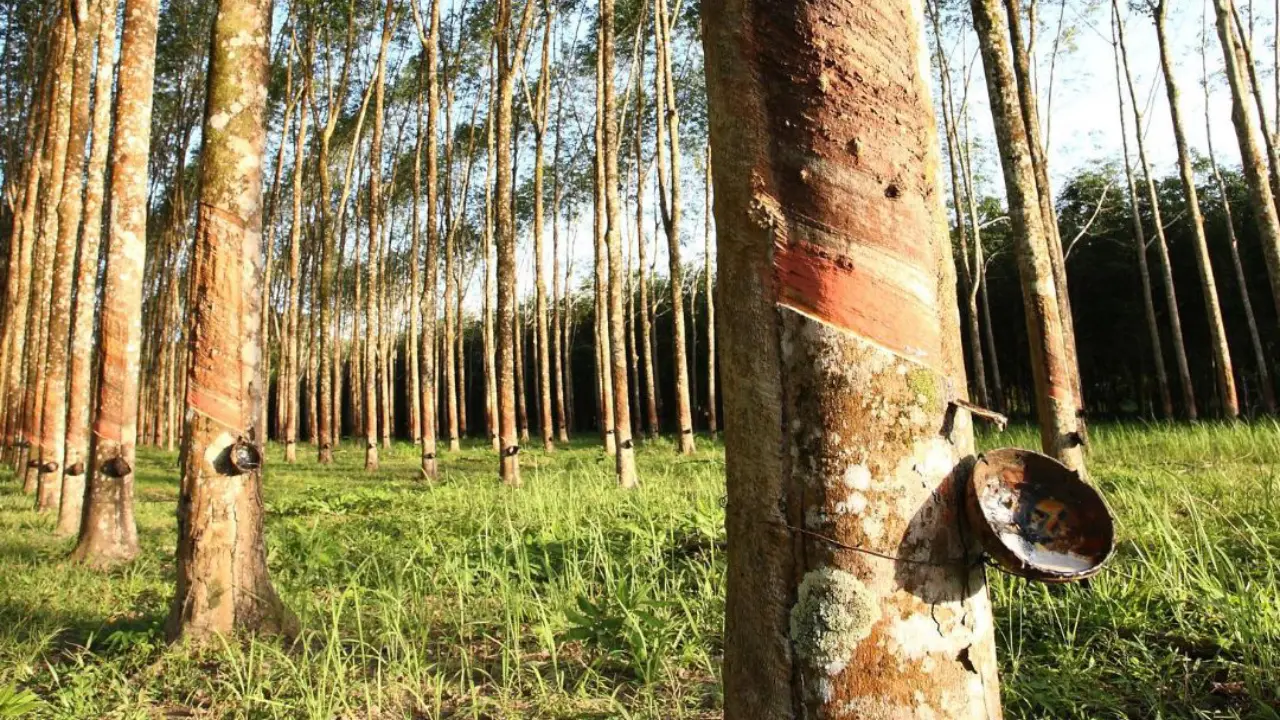
SMR production follows a controlled, standardised method so that every bale of a grade behaves the same way. Field-latex grades (CV, L) start from fresh latex; block grades such as SMR 10 and SMR 20 are made mainly from field coagulum such as cup lumps.
- Collection. Fresh latex is tapped from Hevea brasiliensis trees; for CV grades a viscosity stabiliser is added at this stage, for SMR L a colour-protecting agent.
- Coagulation. The latex is coagulated with formic acid (block grades use naturally coagulated field material).
- Size reduction and washing. The coagulum is washed, shredded and crumbed to remove dirt and contaminants.
- Drying. Crumbs are dried under controlled temperature and time to protect the rubber's PRI.
- Testing. Samples from each lot are tested for dirt, ash, nitrogen, volatile matter, plasticity, PRI and viscosity.
- Baling and labelling. The rubber is pressed into uniform bales, wrapped in polyethylene film, palletised and marked with grade and lot for full traceability.
Key Applications and Industry Uses
Most of the world's natural rubber goes into tyres, but SMR's range of grades reaches far beyond the tyre plant.
Tire and Tube Manufacturing
Natural rubber gives tyres elasticity, tensile strength, low heat build-up and tear resistance. SMR is used in tread, sidewall, carcass and inner-tube compounds, especially in truck and bus tyres where heat build-up is critical. SMR 20SMR 10
Automotive Components
Engine mounts, bushings, gaskets, seals, hoses and anti-vibration parts need rubber that withstands repeated stress and moulds precisely. Constant-viscosity grades keep batch-to-batch flow consistent. SMR CV60SMR CV50
Industrial Belts, Hoses, and Mechanical Goods
Conveyor belts, transmission belts, industrial hoses and rubber rollers rely on SMR's strength, flexibility and wear resistance in mining, cement, manufacturing and agriculture. SMR 10SMR 20SMR GP
Footwear and Consumer Products
Shoe soles, mats, gloves and moulded household items need a balance of softness, grip and durability; lighter grades are used where colour matters. SMR GPSMR L
Adhesives, Sealants, and Coatings
The natural tack and cohesive strength of SMR suit pressure-sensitive adhesives, contact cements and waterproof sealants. Lower-viscosity CV50 dissolves and processes more easily. SMR CV50SMR L
Medical and Pharmaceutical Applications
Clean, light-coloured grades are used by makers of medical and laboratory rubber goods. Final suitability depends on the manufacturer's own compound and regulatory validation – we supply the grade and lot certificates. SMR LSMR CV
Packing, Container Loading and Logistics
SMR bales follow the MRB standard block size of roughly 670 × 330 × 170 mm. Each bale is wrapped in polyethylene film and stacked on pallets for safe handling and efficient global transport.
| Specification | Details |
|---|---|
| Bale Weight | 33.33 kg or 35 kg |
| 20-ft Container Loading | Approximately 19–20 metric tons |
| 40-ft Container Loading | Approximately 26–28 metric tons |
With 36 bales per pallet, a pallet holds about 1.20 MT (33.33 kg bales) or 1.26 MT (35 kg bales). Use the estimator to plan bale and pallet counts for your order:
Estimate only. Final bale, pallet and container counts are confirmed on the packing list for each contract.
Why Buyers Choose Us as Their Standard Malaysian Rubber Supplier
Choosing an SMR supplier is less about the grade name – which is standard – and more about lot consistency, paperwork and delivery. This is how we work with importers:
Who we supply
- Tyre and retread plants
- Automotive and technical rubber goods makers
- Footwear, belting and hose producers
- Distributors and importers
- Traders and re-exporters (back-to-back contracts)
Commercial terms
- MOQ: one full container load (1 × 20ft FCL)
- Incoterms: FOB, CFR or CIF
- Load port: Malaysian origin port, named on your quotation
- Mixed grades per container on request
- Samples available for compound trials
Shipping documents
- Commercial invoice and packing list
- Bill of lading
- Certificate of origin
- Lot test certificate against MRB limits
- Phytosanitary or fumigation papers where the destination requires them
EU buyers: EUDR due diligence
Natural rubber is a covered commodity under the EU Deforestation Regulation (EUDR). Its obligations apply from 30 December 2026 for large and medium operators and from 30 June 2027 for micro and small operators. If you place SMR on the EU market, tell us at enquiry stage so the geolocation and traceability data your due-diligence statement needs can be arranged with the shipment.
What to include in your RFQ
- Grade (for example SMR 20, SMR 10, SMR CV60) and any Mooney window
- Quantity in MT and number of containers
- Bale weight: 33.33 kg or 35 kg
- Destination port and Incoterm
- Required shipment month
- Documents and inspection required (for example third-party inspection)
- End use, so we can confirm the grade fits
- Preferred payment terms
SMR Price: What Moves It
Standard Malaysian Rubber is priced off a live market, so quotations are valid for a short period. The main drivers are:
- Benchmark prices – the Malaysian Rubber Board publishes daily SMR prices, and SGX SICOM TSR20 futures are the most-watched international reference for block rubber.
- Grade premium – CV, L and SMR 5 grades sell at a premium over SMR 20 because of the extra latex processing and tighter limits.
- Supply season – tapping slows during the wintering (leaf-fall) season in Southeast Asia and during heavy monsoon rain.
- Currency – movements of the Malaysian ringgit against the US dollar.
- Freight and terms – ocean freight, Incoterm and order size.
For a firm price, send your grade, quantity and destination and we will reply with a dated quotation.
Handling, Storage, and Transportation
To keep Standard Malaysian Rubber in specification from the factory to your mixer, follow these practices:
- Handling: Use clean gloves and equipment to prevent contamination or physical damage to the bales; keep the PE wrap intact until use.
- Storage: Store in a cool, dry, well-ventilated area, shielded from direct sunlight, heat sources, copper/manganese contamination and oxidising agents. Use stock first in, first out.
- Cold weather: Natural rubber can crystallise and turn hard in cold storage. This is reversible – warm the bales in a hot room before mixing.
- Storage hardening: Grades without viscosity control slowly stiffen over months; CV grades are designed to avoid this.
- Transportation: Protect bales from moisture and secure pallets so loads cannot shift in transit.
SMR Supplier FAQ
What is Standard Malaysian Rubber (SMR)?
Standard Malaysian Rubber (SMR) is technically specified natural rubber produced in Malaysia from Hevea brasiliensis latex and graded by laboratory tests under the SMR scheme of the Malaysian Rubber Board. Grades such as SMR 20, SMR 10 and SMR CV60 have fixed limits for dirt, ash, nitrogen, volatile matter, PRI and, for CV grades, Mooney viscosity.
How do I choose a reliable SMR supplier?
A reliable SMR supplier ships rubber from MRB-scheme factories, provides a lot test certificate for every shipment, states the bale weight and container loading clearly, offers samples for compound trials and can supply the documents your customs and, for the EU, your EUDR due diligence require.
What is the difference between SMR 10 and SMR 20?
SMR 10 is cleaner than SMR 20: its maximum dirt is 0.08% against 0.16%, maximum ash 0.75% against 1.00%, and its minimum PRI is 50 against 40. SMR 20 is the lower-cost volume grade for tyres and mechanical goods; SMR 10 is chosen where cleaner rubber and better ageing resistance are needed.
What does CV mean in SMR CV50 and SMR CV60?
CV stands for constant (controlled) viscosity. A small amount of hydroxylamine salt is added at the latex stage to stop storage hardening, so the Mooney viscosity stays at 50 ± 5 for CV50 or 60 ± 5 for CV60. This gives consistent processing and reduces or removes premastication.
Which SMR grade is used for tyres?
SMR 20 is the most widely used grade in tyre compounds, followed by SMR 10. Plants that want steadier mixing often specify SMR 20CV or SMR 10CV.
What is the HS code for SMR natural rubber?
Standard Malaysian Rubber is classified under HS code 4001.22, technically specified natural rubber (TSNR). Its CAS number is 9006-04-6.
How is SMR packed and how much fits in a container?
SMR is packed in bales of 33.33 kg or 35 kg wrapped in polyethylene film and stacked on pallets. A 20ft container carries approximately 19–20 metric tons and a 40ft container approximately 26–28 metric tons.
What is the minimum order quantity for SMR?
Our minimum order is one full container load (1 × 20ft FCL), which is approximately 19–20 metric tons of SMR. Mixed grades in one container can be arranged on request.
What is the price of SMR 20?
SMR 20 is priced off live market benchmarks such as the Malaysian Rubber Board daily prices and SGX SICOM TSR20 futures, plus grade premium, freight and Incoterm. Prices change daily, so send your grade, quantity and destination for a dated quotation.
Is SMR the same as SIR, STR or SVR?
They belong to the same family of technically specified rubber, graded by lab tests, but each is produced under its own national scheme: SIR in Indonesia, STR in Thailand and SVR in Vietnam. Grades with the same number are broadly comparable, but the exact limits differ, so check whether your approved-source list allows another origin.
How should SMR bales be stored?
Store SMR bales in a cool, dry, ventilated warehouse away from sunlight, heat and oxidising agents, keep the polyethylene wrap intact and use stock first in, first out. Bales that crystallise in cold weather can be restored by warming them in a hot room before mixing.
Does the EUDR apply to natural rubber imports?
Yes. Rubber is one of the commodities covered by the EU Deforestation Regulation. Obligations apply from 30 December 2026 for large and medium operators and from 30 June 2027 for micro and small operators, and importers need traceability data, including geolocation of the plots of production, for their due-diligence statement.
Request an SMR Quotation
Tell us the grade, quantity, bale weight and destination port. As your SMR supplier – and a Standard Malaysian Rubber supplier that handles contract, documents and shipment in one place – we will reply with a dated quotation, the specification sheet and sample options for your compound trials.
Email: info@causticsodaco.com