- What is caustic soda used for in mining?
- Caustic soda supplier for mining and mineral processing
- 7 uses of caustic soda in mining and mineral processing
- Caustic soda for alumina refining: the Bayer process
- Caustic soda in gold mining: why cyanide leaching needs it
- Caustic soda vs lime in mining: which alkali where?
- How much caustic soda does each mining process use?
- Neutralising acid mine drainage with caustic soda
- Flakes, pearls or 50% liquid: which caustic soda should a mine buy?
- Mining-grade caustic soda specification for your RFQ
- Shipping caustic soda to mining regions
- Safe handling of caustic soda on mine sites
- Caustic soda in mining: FAQ
- Related products and guides
- Buy caustic soda for your mine
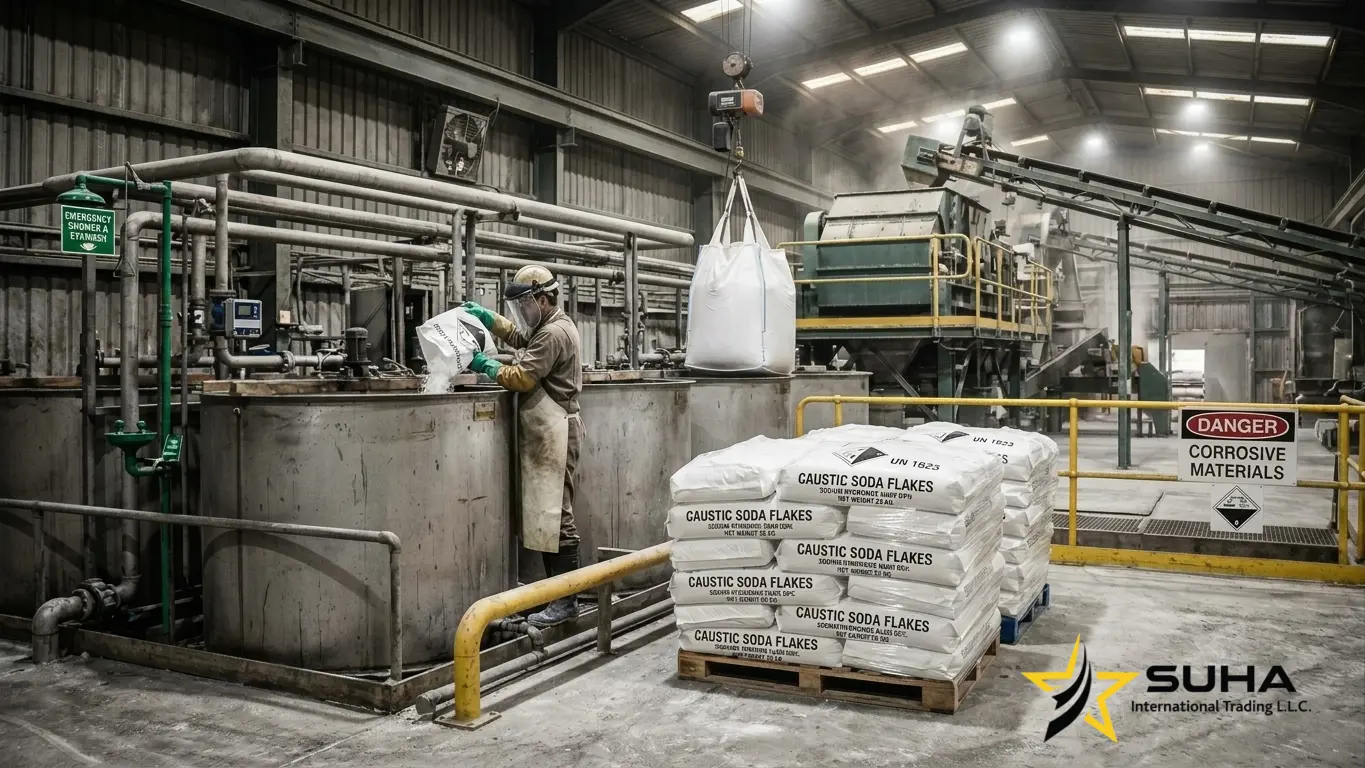
What is caustic soda used for in mining?
Caustic soda (sodium hydroxide, NaOH, CAS 1310-73-2) is the strong alkali that mining runs on. It dissolves alumina out of bauxite in the Bayer process, holds gold cyanide leach circuits at pH 10.5–11.5 so cyanide does not escape as HCN gas, sets flotation pulp pH, precipitates uranium as yellowcake, regenerates ion-exchange resins, neutralises acid mine drainage and conditions drilling muds.
SUHA International Trading supplies mining-grade caustic soda (flakes, pearls and 50% liquid) by the container from Jebel Ali and Mersin to mines and refineries in Africa, Latin America, the Middle East and Central Asia. Mines rarely sit next to a chlor-alkali plant, so most of this caustic travels by sea as solid caustic soda flakes or pearls, or as 50% liquid caustic soda. This guide covers where NaOH is used, how much each process consumes, NaOH versus lime, the grade to specify, how to ship it to mining regions and how to handle it on site.
- Main uses
- 7 processes
- Cyanide leach pH
- 10.5–11.5
- Bayer make-up
- ≈ 40–150 kg/t alumina
- Solid grades
- Flakes 98–99% · Pearls 99%
- Liquid grade
- 48–50% NaOH
- Transport
- UN 1823 / 1824 · Class 8
Caustic soda supplier for mining and mineral processing
We supply caustic soda to mining companies, mine contractors and reagent distributors as a container-load export: flakes 98–99%, pearls 99% and liquid 48–50%, shipped FOB Jebel Ali or Mersin, or CFR/CIF to the port that serves your mine, with a certificate of analysis for every lot.
Grades for every circuit
Flakes for inland dissolving, pearls for gold-room elution and auto-dosing, 50% liquid for alumina refineries and coastal plants.
Packed for mine logistics
25 kg laminated bags or 1,000 kg jumbo bags, palletised on request, IMDG Class 8 marked. About 20–25 t of solid caustic per 20 ft container.
Paperwork mines ask for
Lot COA, SDS, certificate of origin, B/L and packing list; SGS or Bureau Veritas inspection before loading; support with Class 8 import permits.
Two loading origins
Jebel Ali (UAE) for East and Southern Africa and Central Asia; Mersin (Türkiye) for West Africa, the Mediterranean and Latin America.
Spot or contract
Single containers for trials, or scheduled monthly shipments on a fixed specification for operating mines and reagent distributors.
Quote in 24 hours
Send grade, tonnage, port and Incoterm and get a firm offer with loading window. Lead time is typically 7–15 days to loading, subject to stock.
7 uses of caustic soda in mining and mineral processing
Alumina refining is by far the largest mining use of NaOH, followed by precious-metal leaching, flotation and water treatment. Each card links to a deeper guide where one exists.
Bayer process: alumina from bauxite
Hot caustic liquor dissolves gibbsite and boehmite as sodium aluminate, leaving red mud behind. Soda lost every cycle must be replaced continuously.
How caustic works in the Bayer processGold and silver cyanidation
CIL, CIP and heap-leach circuits run at pH 10.5–11.5 so cyanide stays as CN⁻. NaOH also makes up the hot caustic–cyanide elution solution in the gold room.
Protective alkalinity explainedFlotation pH control
Copper, lead and zinc concentrators trim pulp pH with NaOH so collectors and depressants act selectively, often alongside soda ash and sodium sulfide for oxide ores.
Sodium sulfide for flotationUranium and rare earths
NaOH precipitates sodium diuranate (yellowcake) from carbonate-leach solutions and regenerates anion-exchange resins. Hot concentrated NaOH cracks monazite in rare-earth plants.
Typical consumption by processAcid mine drainage
Raising the pH of acidic, metal-laden mine water precipitates iron, copper, zinc, nickel and manganese as hydroxides before discharge.
Metal removal pH tableMetal refining and processing
Caustic is used for alkaline cleaning, pickling neutralisation and electrolyte pH control in base-metal refineries and smelter effluent plants.
Caustic soda in metal processingDrilling fluids
Exploration and dewatering rigs add NaOH to bentonite muds to hold pH around 9.5–10.5, limit corrosion and help clay yield.
Soda ash in drilling fluidsCaustic soda for alumina refining: the Bayer process
In the Bayer process, hot caustic soda liquor dissolves the aluminium minerals in bauxite as sodium aluminate; the impurities settle out as red mud and pure aluminium hydroxide is then crystallised back out of the cooled liquor. Digestion runs at about 140–150 °C for gibbsitic bauxite and up to 240–280 °C for boehmitic and diasporic ores. Calcining the hydroxide at around 1,000 °C gives smelter-grade alumina.
The liquor is recycled, but every pass loses soda. Reactive silica in the bauxite combines with sodium and aluminium to form desilication product, some soda leaves with the red mud, and some is lost in washing. Refineries therefore buy caustic continuously, typically about 40–150 kg NaOH per tonne of alumina, and more on high-silica bauxite. For a procurement team this is a contract item, not a spot purchase.
Most of the world's caustic is made by chlor-alkali electrolysis of brine; see how caustic soda is made and why supply and price track chlorine demand on the caustic soda price page.
Caustic soda in gold mining: why cyanide leaching needs it
Cyanide only stays in solution as the CN⁻ ion when the water is alkaline. Hydrogen cyanide has a pKa of about 9.2, so as the pH drops toward neutral more of the cyanide turns into HCN, which is toxic, volatile and lost to the leach. Holding the circuit at pH 10.5–11.5 keeps workers safe and keeps cyanide working on the gold.
| pH | HCN share | What it means |
|---|---|---|
| pH 8 | ≈ 94% | Unsafe; most cyanide is gas-forming HCN |
| pH 9.2 | ≈ 50% | Half the cyanide is HCN |
| pH 10 | ≈ 14% | Still significant losses |
| pH 10.5 | ≈ 5% | Lower limit of normal operation |
| pH 11 | ≈ 1.6% | Typical target |
| pH 11.5 | ≈ 0.5% | Upper end; more alkali cost |
Lime usually supplies the bulk alkalinity because it is cheap. NaOH is added for fast pH trim, because it dissolves completely and does not scale screens and pipes, and as the alkali in the gold room: elution circuits pre-soak or strip loaded carbon with a hot 1–3% NaOH and cyanide solution at roughly 95–130 °C.
Caustic soda keeps cyanide stable but does not destroy it. Cyanide in tailings is destroyed by oxidation, for example with hydrogen peroxide, with NaOH or lime holding the pH the process needs.
Caustic soda vs lime in mining: which alkali where?
Most mines use both. The table shows why caustic soda earns its place next to the cheaper lime.
| Factor | Caustic soda | Lime |
|---|---|---|
| Dissolution | Complete and fast | Slow, slurry with grit |
| pH control | Precise, quick response | Lagging, overshoot common |
| Scaling | None from the reagent | Calcium scale on pipes, screens and carbon |
| Sludge from AMD treatment | Less volume | More, gypsum-rich |
| Cost per unit alkalinity | Higher | Lower |
| Best use | pH trim, elution, reagent make-up, low-flow or remote water plants | Bulk leach alkalinity, high-flow neutralisation |
How much caustic soda does each mining process use?
Indicative ranges for planning a supply contract. Actual dosing depends on ore mineralogy, water chemistry and circuit design and should be confirmed by metallurgical test work.
| Process | Role of NaOH | Typical use | Usual form |
|---|---|---|---|
| Bayer alumina | Digestion make-up | ≈ 40–150 kg/t alumina | 50% liquid or dissolved flakes |
| Gold CIL / CIP | Protective alkalinity (with lime) | Set by pH target and ore acidity | Flakes or pearls, dissolved on site |
| Carbon elution | Hot 1–3% NaOH strip or pre-soak | Set by bed volumes per strip | Pearls or flakes |
| Base-metal flotation | Pulp pH modifier | ≈ 0.1–1 kg/t ore | Flakes or liquid |
| Uranium | Yellowcake precipitation, resin regeneration | Set by uranium tenor of solution | 50% liquid |
| Acid mine drainage | Neutralisation, metal precipitation | By titration of the water | 20–50% solution |
| Drilling mud | pH 9.5–10.5 control | ≈ 0.5–3 kg/m³ mud | Flakes or pearls |
Neutralising acid mine drainage with caustic soda
Caustic soda treats acid mine drainage by raising pH until dissolved metals drop out as hydroxides, which are then settled or filtered. Each metal has its own removal window, so the target pH is set by the worst metal in the water. The same approach is used in general industrial plants; see caustic soda for water treatment.
| Metal | Typical removal pH | Watch-out |
|---|---|---|
| Iron (Fe³⁺) | ≈ 4–5 | Oxidise Fe²⁺ first or it needs pH 8.5+ |
| Aluminium | ≈ 5.5–7 | Redissolves above about pH 8.5 |
| Copper | ≈ 8–9 | Complexing agents raise the pH needed |
| Zinc | ≈ 8.5–9.5 | Redissolves at high pH |
| Nickel | ≈ 9.5–10.5 | Often sets the final pH |
| Manganese | ≈ 9.5–10.5 | Aeration helps; may need oxidant |
Indicative values only. Set the dose by jar tests on the actual mine water and recheck after any change in pit or dump drainage.
Flakes, pearls or 50% liquid: which caustic soda should a mine buy?
The further the mine is from a deep-water port, the stronger the case for solid caustic soda. Liquid caustic is about half water, so long inland hauls pay freight on water, and 50% solution starts to crystallise at about 12 °C. Solid NaOH ships dry and keeps for 24 months or more in sealed bags. Compare forms in caustic soda flakes vs liquid and types and grades of caustic soda.
| Factor | Flakes 98–99% | Pearls 99% | Liquid 48–50% |
|---|---|---|---|
| Freight to inland sites | Efficient | Efficient | Costly (half water) |
| Handling on site | Manual or hopper dissolving | Free-flowing, best for auto-dosing | Pump and dose |
| Storage | 24+ months sealed, dry | 24+ months sealed, dry | Closed tanks kept above ≈ 15 °C |
| Packing | 25 kg bags · 1 t jumbo | 25 kg bags · 1 t jumbo | IBC, ISO tank, flexitank |
| Best for | Remote and inland mines | Gold rooms, automated dosing | Coastal refineries, alumina plants |
A 20 ft container carries about 20–25 t of solid caustic soda in bags, which keeps freight quotes and customs valuation predictable on annual contracts. Jumbo bags cut handling time where forklifts are available; 25 kg bags suit manual sites.
Mining-grade caustic soda specification for your RFQ
Mining circuits tolerate more impurity than food or pharma uses, but chloride and carbonate still cost money: chloride drives pitting in carbon-steel tanks and launders, and carbonate is alkalinity you paid for as NaOH but do not get. The limits below match the grades we ship.
| Parameter | Flakes / pearls | Liquid 48–50% |
|---|---|---|
| NaOH | ≥ 98% flakes · ≥ 99% pearls | ≥ 48% |
| Na₂CO₃ | ≤ 0.8% | ≤ 0.5% |
| NaCl | ≤ 0.1% | ≤ 0.03% |
| Iron (Fe) | ≤ 50 ppm | ≤ 10 ppm |
| HS code | 2815.11 | 2815.12 |
| UN number | UN 1823, Class 8, PG II | UN 1824, Class 8 |
| Documents | COA per lot, SDS, CO, B/L, packing list | COA per lot, SDS, CO, B/L, packing list |
Insist on a batch-specific certificate of analysis, not a "typical analysis" sheet; a sample caustic soda pearls COA shows what to expect. To test a delivery at the mine, see how to check caustic soda quality.
Shipping caustic soda to mining regions
We load caustic soda FOB at Jebel Ali (UAE), usually for East and Southern Africa, and at Mersin (Türkiye), usually for West Africa and the Americas. These are the ports mining buyers most often name:
| Mining region | Main mining | Usual port | Country guide |
|---|---|---|---|
| Copperbelt (Zambia, DRC) | Copper, cobalt | Dar es Salaam, Walvis Bay | Zambia |
| Tanzania | Gold | Dar es Salaam | Tanzania |
| Namibia | Uranium, gold, zinc | Walvis Bay | Namibia |
| South Africa | Gold, PGMs, base metals | Durban, Richards Bay | South Africa |
| Ghana | Gold, bauxite | Tema, Takoradi | Ghana |
| Kenya and Uganda | Gold | Mombasa | Kenya · Uganda |
| Peru | Copper, gold | Callao, Matarani | Peru |
| Chile | Copper, lithium | Antofagasta, San Antonio | Chile |
Landed CIF levels by destination are published on caustic soda price by country.
Safe handling of caustic soda on mine sites
Caustic soda is corrosive (GHS H314, H290) and dissolving solid NaOH releases a lot of heat; a strong solution can pass 90 °C during make-up.
- Wear full PPE. Chemical goggles and face shield, alkali-resistant gauntlets, apron or coverall and rubber boots; an eyewash and safety shower within 10 seconds of the make-up area.
- Caustic into water, never water onto caustic. Add solids slowly to cool water with the agitator running, in a vented tank rated for the temperature.
- Use the right materials. Carbon steel, stainless steel or HDPE; never aluminium, zinc or galvanised fittings, which react and release hydrogen.
- Store sealed, dry and off the floor. Keep bags on pallets away from acids; open bags absorb moisture and CO₂ and cake.
Full procedures: how to store caustic soda safely and the caustic soda SDS (PDF). Hazard data: PubChem, sodium hydroxide.
Caustic soda in mining: FAQ
What is caustic soda used for in mining?
Caustic soda (sodium hydroxide, NaOH) is used in mining as an alkaline leaching agent and pH regulator. It dissolves alumina from bauxite in the Bayer process, holds gold cyanide leach circuits at pH 10.5–11.5 so cyanide stays in solution instead of escaping as HCN gas, adjusts flotation pulp pH, precipitates uranium and regenerates ion-exchange resins, neutralises acid mine drainage and conditions drilling muds.
Why is caustic soda used in gold cyanidation?
Cyanide is only stable as the CN⁻ ion in alkaline water. At pH 9.2 about half of it is present as hydrogen cyanide (HCN), which is toxic and volatile; at pH 10.5 that share falls to about 5% and at pH 11 to under 2%. NaOH, often together with lime, raises and holds this protective alkalinity and is the standard alkali in the hot caustic–cyanide solution used to strip gold from loaded carbon.
Should a mine use caustic soda or lime?
Most mines use both. Lime is the cheaper bulk alkali, but it dissolves slowly, scales pipes and screens and makes more sludge. Caustic soda dissolves completely, gives fast and precise pH control and leaves no grit, so it is used for pH trim, carbon elution, reagent make-up and where lime quality is poor or scaling is a problem.
How much caustic soda does the Bayer process use?
Bayer alumina refineries typically replace about 40–150 kg of NaOH (100% basis) per tonne of alumina to make up soda losses to desilication product, red mud and washing. Bauxite with high reactive silica sits at the top of the range or above it, because every kilogram of reactive silica locks up soda in desilication product.
Which form of caustic soda is best for a remote mine site?
Remote and inland mines usually buy solid caustic soda: flakes at 98–99% or pearls at 99% NaOH in 25 kg bags or 1,000 kg jumbo bags. Solid NaOH ships without water weight and keeps for 24 months or more in sealed bags. Coastal plants with heated tank farms often buy 48–50% liquid caustic soda for direct pumping.
What specification of caustic soda should a mining RFQ state?
For solid caustic soda specify NaOH ≥ 98% for flakes or ≥ 99% for pearls, Na₂CO₃ ≤ 0.8%, NaCl ≤ 0.1% and iron ≤ 50 ppm. For 48–50% liquid specify Na₂CO₃ ≤ 0.5%, NaCl ≤ 0.03% and iron ≤ 10 ppm. Ask for a certificate of analysis for every lot, an SDS, and IMDG Class 8 packing under UN 1823 (solid) or UN 1824 (solution).
What grades of caustic soda do you supply for mining?
We supply caustic soda flakes at 98–99% NaOH, pearls at 99% NaOH in 25 kg bags or 1,000 kg jumbo bags, and liquid caustic soda at 48–50% in ISO tanks or IBCs. Industrial grade is standard for mining; every lot ships with a certificate of analysis, and SGS or Bureau Veritas inspection is available before loading.
Can caustic soda destroy cyanide in tailings?
No. Caustic soda keeps cyanide stable; it does not destroy it. Cyanide in tailings is destroyed by oxidation, for example with hydrogen peroxide or the SO₂/air process, and caustic soda or lime is used alongside to hold the pH those processes need.
At what pH does caustic soda remove metals from acid mine drainage?
Typical removal pH values are about 4–5 for ferric iron, 8–9 for copper, 8.5–9.5 for zinc and 9.5–10.5 for nickel and manganese. Aluminium and zinc are amphoteric and redissolve if the pH is pushed too high, so the dose should be set by jar tests on the actual mine water.
What is the HS code and UN number of caustic soda?
Solid caustic soda (flakes and pearls) is HS 2815.11 and liquid caustic soda is HS 2815.12. Solid NaOH ships as UN 1823 and solution as UN 1824, both Class 8 corrosive. The CAS number is 1310-73-2.
How do mines buy caustic soda in bulk from SUHA International?
SUHA International Trading ships caustic soda flakes, pearls and 50% liquid by the container from Jebel Ali (UAE) and Mersin (Türkiye) on FOB, CFR or CIF terms, with a certificate of analysis for every lot and optional SGS or Bureau Veritas inspection. Send grade, tonnage and destination port for a quotation within 24 hours.
Related products and guides
Buy caustic soda for your mine
Send grade (flakes, pearls or liquid), tonnage per shipment and per year, destination port and Incoterm. You get a firm FOB, CFR or CIF offer within 24 hours, with a COA for every lot and optional SGS or Bureau Veritas inspection.