How a US–Iran Conflict Could Reshape the Global Chemical Market
How a US–Iran Conflict Could Reshape the Global Chemical Market
A scenario analysis for chemical importers, exporters, and procurement teams: what a Strait of Hormuz disruption would mean for caustic soda, methanol, urea, glycols, polyolefins, and the shipping lanes that move them — plus a practical risk-management framework for buyers and sellers.
In short — roughly a fifth of global seaborne oil, plus a meaningful share of global methanol, urea, and polyolefin capacity, moves through or near the Strait of Hormuz. A US–Iran conflict does not need to close the strait outright to move global chemical prices — mining, insurance withdrawal, or simple risk-avoidance by shipowners is often enough. This report is scenario analysis, not a forecast of an actual event, built to help global chemical market buyers, exporters, and traders map the risk product by product and region by region.
Why This Scenario Matters to Chemical Buyers & Sellers
Chemical markets are globally interconnected in a way few other industrial sectors are. A caustic soda plant in Louisiana, a methanol producer in the Gulf, a PVC compounder in Turkey, and a detergent formulator in West Africa are all links in the same supply chain, priced off the same energy curve, and often moved on the same handful of shipping lanes. Iran sits at a genuine chokepoint of that system — this guide walks through the pressure points systematically and applies them to more than twenty individual chemical products and eleven downstream industries.
Current State of the Global Chemical Market
Coming into this period, the global chemical market has already absorbed several years of overlapping stress: post-pandemic demand normalization, high European gas costs, Chinese capacity expansion pressuring commodity margins, and repeated Red Sea shipping disruptions. A second chokepoint shock in Hormuz would compound, not replace, that existing pressure.
| Indicator | Baseline (Stable) | Historical Crisis Precedent |
|---|---|---|
| Brent crude oil | Range-bound | +15% to +40% within days |
| Gulf tanker war-risk insurance | Low, standard | Multiples of baseline, sometimes 10x |
| Container freight, Asia–Europe | Standard | +50% to +100% during diversions |
| Regional methanol/urea spot | Stable | +10% to +30%, plant-dependent |
| LNG / gas spot (Europe, Asia) | Seasonal | Sharp spikes if Qatari transit affected |
Table 1 — Illustrative indicators based on comparable historical precedent, not a forecast.
📊 Iran's Position: Iran holds the world's second-largest gas reserves and remains a discounted exporter of methanol and urea to Asian buyers. In a conflict scenario, Iranian-origin volumes would likely exit the market almost immediately, tightening the discounted segment relied on by price-sensitive buyers — but Iran's bigger relevance to this scenario is geographic, not volumetric.
Source: scenario analysis based on documented Iranian petrochemical export patterns.
Why the Strait of Hormuz Matters
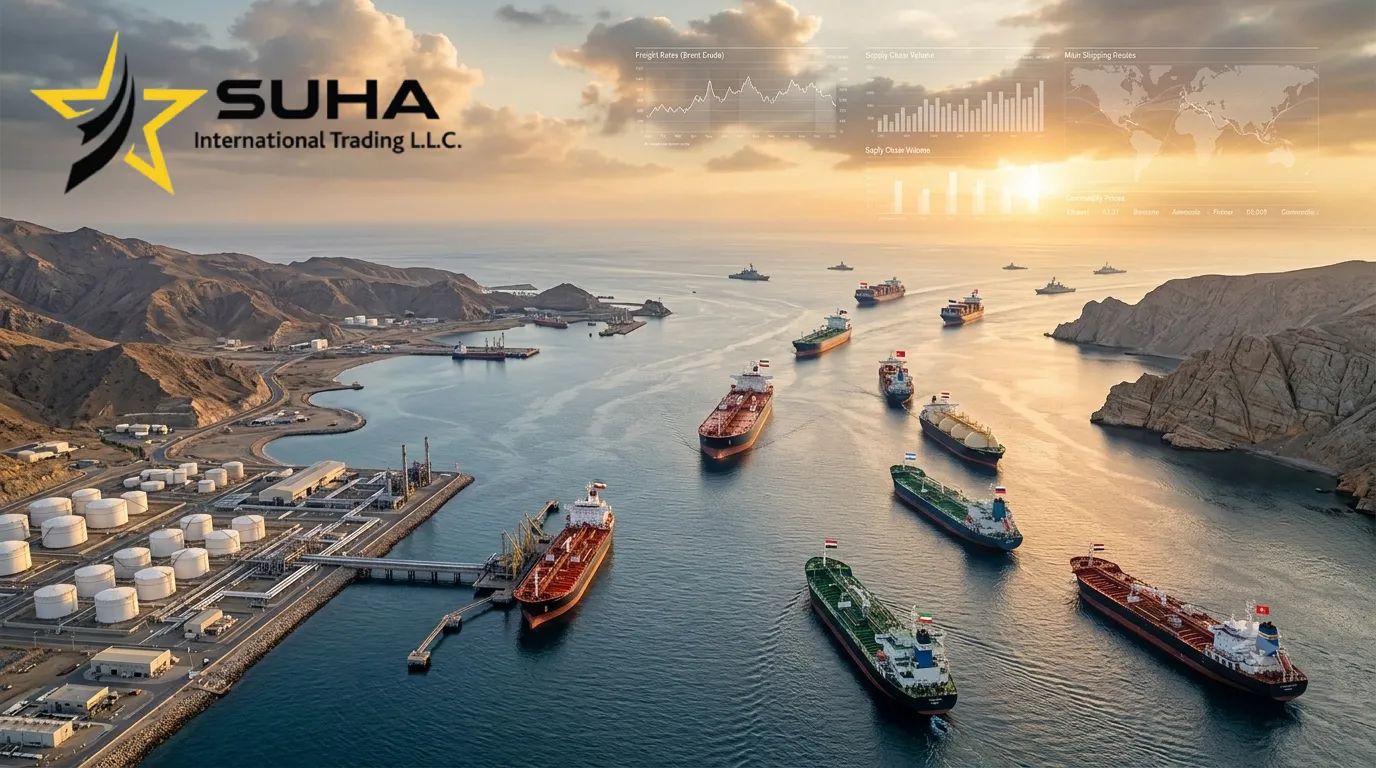
The Strait of Hormuz — about 21 miles wide at its narrowest, with shipping lanes only two miles across — is the export route for the large majority of Saudi, UAE, Qatari, Kuwaiti, and Iraqi oil and gas exports. Iran does not need to close it fully to disrupt it: historical precedent (2019 tanker attacks, periodic seizure incidents) shows isolated attacks or mine-laying are often enough to trigger insurance withdrawal and voluntary rerouting — which has nearly the same practical effect as closure for commercial planning.
| Shipping Route | Risk Level |
|---|---|
| Strait of Hormuz (Gulf–Indian Ocean) | Very High |
| Bab-el-Mandeb / Red Sea | High (compounding, already disrupted) |
| Suez Canal | Moderate (indirect, via Red Sea diversion) |
| Turkish Straits (Bosphorus/Dardanelles) | Low–Moderate (spillover only) |
| Trans-Pacific (China–US West Coast) | Low (indirect, freight market tightening) |
| Trans-Atlantic (US Gulf–Europe) | Low (indirect, via energy price effects) |
Table 4 — Shipping route risk levels under the conflict scenario.
Impact on Energy Prices, Feedstock & Production
Energy is the connective tissue between a Hormuz disruption and the global chemical market. Expect a two-phase pattern: an initial sharp spike in crude and gas prices driven by risk premium, followed by partial retracement if physical supply isn't actually interrupted — with a new, higher floor if it is.
Energy Prices
Naphtha-based producers (Asia, Europe) see feedstock costs rise with crude; gas-based producers (US Gulf Coast, Middle East) face independent LNG/pipeline gas volatility.
Feedstock Availability
GCC producers using intra-region pipeline NGLs face less physical risk than importers bringing feedstock from outside the Gulf via long-haul tanker routes.
Chemical Manufacturing
Turkish and UAE chlor-alkali plants likely stay operational but face higher input costs and export insurance friction — multi-origin buyers are structurally better positioned.
Petrochemical Production
Saudi/UAE polyethylene producers face longer transit and higher logistics costs even without direct plant damage, since exports route through or near the strait.
💡 Expert Note: Energy-intensive chlor-alkali and glycol production — including caustic soda, MEG, and methanol — shows cost pressure faster than downstream polymer converters, since electricity and gas are a larger share of direct production cost.
Impact on Shipping Costs & Supply Chains
Freight Rates
The 2024 Red Sea disruption forced most Asia–Europe container traffic around the Cape of Good Hope, more than doubling rates on some lanes during peak periods. A Hormuz disruption offers no alternative sea route out of the Gulf, so carriers would likely reduce port calls rather than reroute — compounding, not replacing, existing Red Sea pressure.
Marine Insurance
War-risk premiums for Gulf transits rose by roughly an order of magnitude for short periods during the 2019 tanker incidents. Expect a similar or larger spike here, with some underwriters potentially pausing new Gulf-transit coverage entirely for a period.
Bulk & Container Shipping
Bulk carriers moving sulfur, urea, and soda ash face the same insurance pressure as tankers, with less flexible delivery windows. Container lines carrying drummed LABSA or bagged soda ash see tightened slots and higher rates across multiple lanes simultaneously.
| Shipping Cost Category | Pre-Conflict | Peak Crisis (Illustrative) | Post-Resolution |
|---|---|---|---|
| Container freight, Gulf–Europe | Baseline | +60% to +120% | Normalizes over 2–4 months |
| War-risk marine insurance | Baseline | 5x–10x | Elevated for months after |
| Bulk charter rates, Gulf-origin | Baseline | +30% to +70% | Normalizes faster than container |
| Average transit delay | Standard | +7 to +20 days | Residual delays for weeks |
The supply chain disruption is best understood as a liquidity problem as much as a physical one: chemical volumes that could physically move often won't, because sellers can't get affordable insurance and traders pull back until the situation clarifies. This typically precedes actual physical shortage by days or weeks.
Regional Analysis & Country Opportunities
| Region | Expected Demand / Sourcing Change |
|---|---|
| Middle East (GCC) | Export volumes constrained; UAE gains as a regional trading hub |
| Turkey | Increased buyer interest as a non-Hormuz alternative source |
| China | Diversifies toward Russian, Malaysian, non-Gulf methanol and urea |
| India | High cost/availability exposure; seeks alternative NGL/naphtha sources |
| Europe | Gas price pressure intensifies; chlor-alkali and glycol costs rise |
| Africa | Higher landed costs; longer lead times from Gulf/Turkey lanes |
| North America | Indirect exposure via global price benchmarks |
| South America | Cost pressure on agriculture- and mining-linked imports |
Table 6 — Regional demand and sourcing impact.
Country Opportunities
| Country | Opportunity | Export Risk |
|---|---|---|
| Turkey | Gains as non-Hormuz alternative for caustic soda, polymers, glycols | Low–Moderate |
| United States | Gulf Coast producers gain export share as Gulf-origin supply tightens | Low |
| Russia | Alternative methanol/urea supplier to China | Moderate |
| Malaysia/Indonesia | Alternative Asian petrochemical supply | Low |
| Egypt | Alternative urea/ammonia supplier via Mediterranean routes | Moderate |
| Trinidad & Tobago | Alternative methanol supplier to Asia/US | Low |
How Each Product Is Exposed to This Scenario
Exposure varies sharply by product, driven by two factors: how much of global production sits inside the Gulf, and how energy/feedstock-intensive the production process is.
Caustic Soda
Electricity-intensive chlor-alkali production. Moderate cost pressure; multi-origin buyers of flakes and liquid are best positioned.
Soda Ash
Geographically diversified production (US, Turkey, China) limits direct exposure; mild energy-driven increase expected.
Sodium Bicarbonate
Follows soda ash pricing with a muted trajectory; food-grade demand is relatively price-inelastic.
LABSA
Feedstock (LAB) tied to regional naphtha/benzene pricing — moderate to significant cost increase expected for detergent manufacturers.
SLES
Produced from fatty alcohols rather than direct Gulf feedstock — more insulated, though general freight/energy inflation still applies.
Sulfur
Gulf refinery byproduct. Reduced throughput tightens global supply, hitting sulfuric acid-dependent industries directly.
Sulfuric Acid
The highest-volume industrial chemical globally — cost flows directly from sulfur availability, hitting mining economies hard.
Methanol
One of the most exposed products — Iran's discounted China-bound volumes plus broad regional gas-feedstock concentration. Expect the sharpest relative price move.
MEG
Significant Gulf production for polyester/PET. Feedstock and logistics pressure both apply — textile and packaging costs rise within weeks.
DEG
Co-product of MEG production; tracks MEG pricing closely given shared production economics.
TEG
Dual exposure: a chemical product under general pressure, and a critical input to the natural gas dehydration industry itself under strain.
HDPE
Heavily produced in Saudi Arabia/UAE for export — among the more directly exposed polymers via Hormuz-adjacent shipping lanes.
LDPE
Similar Gulf-production exposure to HDPE; packaging film manufacturers likely pass costs through fastest given thin margins.
LLDPE
Shares the same Gulf-production exposure profile as HDPE and LDPE — monitor all three polyethylene grades as one risk category.
PVC Resin
Chlor-alkali linked on the chlorine side; construction-sector demand typically absorbs cost increases more slowly than fast-moving packaging.
Paraffin Wax
Refining byproduct with diversified production — moderate cost pressure tied to broader crude movement rather than direct Hormuz exposure.
PE Wax
Tracks general polyethylene feedstock costs, given its linkage to the broader polyolefin value chain.
Petroleum Jelly
Lower-volume, higher-margin specialty product — modest cost pass-through expected even under sustained pressure.
Base Oil
Heavily refined in and around the Gulf; exposed to the same refinery throughput and shipping disruption risk affecting sulfur.
Bitumen
Heavy refining byproduct with significant Gulf production; Asian and African buyers most exposed to export disruption.
Hydrogen Peroxide
Less directly Gulf-exposed in production, but still energy-intensive — general cost inflation passes through to pulp, paper, and water treatment buyers.
| Product | Feedstock | Conflict Risk | Expected Price Impact |
|---|---|---|---|
| Caustic Soda | Salt, electricity | Moderate | Moderate, energy-driven |
| Soda Ash | Trona/synthetic, energy | Low–Moderate | Mild increase |
| Sodium Bicarbonate | Soda ash | Low–Moderate | Mild increase |
| LABSA | LAB, benzene | Moderate–High | Moderate–significant |
| SLES | Fatty alcohols | Low–Moderate | Mild increase |
| Sulfur | Refinery byproduct | High | Significant increase |
| Sulfuric Acid | Sulfur | High | Significant increase |
| Methanol | Natural gas | Very High | Sharp increase |
| MEG / DEG / TEG | Naphtha/ethylene, gas | High | Significant increase |
| HDPE / LDPE / LLDPE | Ethylene | High | Significant increase |
| PVC Resin | Chlorine, ethylene | Moderate–High | Moderate–significant |
| Paraffin Wax | Crude refining | Moderate | Mild–moderate |
| PE Wax | Ethylene | Moderate–High | Moderate increase |
| Petroleum Jelly | Crude refining | Low–Moderate | Mild increase |
| Base Oil | Crude refining | High | Significant increase |
| Bitumen | Crude refining | High | Significant, regional |
| Hydrogen Peroxide | Energy-intensive process | Low–Moderate | Mild increase |
| Urea | Natural gas | Very High | Sharp increase |
Industry Impact Across Eleven Sectors
Buyer & Exporter Risk Management
For Buyers
For Exporters
Future Outlook & Key Takeaways
History (2019 Hormuz incidents, 2024 Red Sea crisis) suggests even a serious conflict scenario is more likely to produce a sharp, weeks-to-months disruption than a permanent restructuring of the global chemical market. Freight rates, insurance premiums, and spot prices would likely normalize over two to six months after de-escalation — though greater buyer interest in Turkish and US Gulf Coast supply could persist well beyond the immediate crisis.
Key Takeaways: The Strait of Hormuz — not Iran's own production volume — is the central variable. Methanol, urea, and MEG/DEG/TEG carry the highest exposure. Freight and insurance costs typically arrive faster than actual physical shortage. Turkey and US Gulf Coast producers are the clearest relative beneficiaries. Buyer preparation meaningfully reduces exposure versus reactive crisis-time sourcing.
Conclusion: A US–Iran conflict scenario would not need to close the Strait of Hormuz outright to reshape the global chemical market — elevated risk alone is often enough to trigger the insurance withdrawal, freight tightening, and buyer diversification that drive real price and availability effects. The right response is the one that has worked in every comparable episode of the last decade: diversify origin ahead of time, build modest buffers on the most exposed products, and treat non-Hormuz-transit suppliers in Turkey and the UAE as a genuine hedge.
Editorial note on methodology: this is scenario analysis for procurement and trade planning purposes. Historical precedents cited (2019 Strait of Hormuz tanker incidents, 2024 Red Sea shipping crisis, prior Iran sanctions episodes) are documented events used to inform plausible ranges of impact. Specific percentages, timelines, and outcomes presented for a hypothetical future conflict are illustrative scenario modeling, not predictions or guarantees.
Need a Diversified, Non-Hormuz-Dependent Supply Partner?
SUHA International supplies caustic soda, LABSA, methanol, glycols, polyolefins, waxes, and related petrochemicals from Turkey and the UAE — dual-origin sourcing built for exactly this kind of regional risk. Share your product, volume, and destination for a formal quote.
Speak Directly With
Our Export Team
We respond to trade and supply inquiries within 24 business hours — usually faster. For urgent sourcing questions related to regional risk, WhatsApp is the fastest channel.
Include This for a Fast Response
FAQ — US–Iran Conflict & the Chemical Market
How would a US–Iran conflict affect the global chemical market?
Primarily through disruption to the Strait of Hormuz, higher energy prices, and rising freight and marine insurance costs. Methanol, urea, MEG, and polyolefins would see the sharpest price movement; chlor-alkali and detergent inputs would see moderate, energy-driven increases. Risk-driven freight/insurance pullback typically arrives before actual physical shortage.
Would caustic soda prices rise in a US–Iran conflict?
Likely moderate upward pressure, driven mainly by higher regional electricity costs rather than direct feedstock shortage. Turkish and UAE producers would likely remain operational but face higher input costs. Multi-origin buyers see more stable pricing than single-source buyers.
Why does the Strait of Hormuz matter so much to the chemical industry?
It is the primary export route for Gulf oil, gas, and petrochemical trade, including Qatari LNG and regional methanol/urea. Even a partial disruption can trigger insurance withdrawal and rerouting that functions like a closure for commercial planning, regardless of whether physical transit is actually blocked.
Which chemicals are most exposed to a US–Iran conflict scenario?
Methanol and urea top the list, followed by MEG, DEG, TEG, and the major polyethylene grades. Sulfur and sulfuric acid are also high-exposure. Sodium bicarbonate, soda ash, and petroleum jelly are comparatively insulated given more diversified production.
How would freight rates be affected by a US–Iran conflict?
Rates on Gulf-linked lanes would likely rise sharply, compounding pressure already created by the Red Sea disruption. Unlike Red Sea rerouting, there's no alternative sea route out of the Gulf, so carriers would likely cut call frequency instead — shrinking capacity and pushing rates up 50–100%+ in acute phases.
Will marine insurance become unavailable for Gulf shipments?
Full unavailability is unlikely, but scarcity and sharply elevated premiums are near-certain. War-risk premiums rose by roughly an order of magnitude for short windows during the 2019 tanker incidents before gradually moderating.
How should chemical buyers prepare for this kind of geopolitical risk?
Diversify supplier origin before a crisis, build modest safety stock on the most exposed products, pre-negotiate freight and insurance terms, and review force majeure clauses in existing Gulf-origin contracts ahead of time.
Would Turkey benefit from a US–Iran conflict, in chemical trade terms?
Turkey is one of the clearer relative beneficiaries, given regional production with land access to Europe that doesn't depend on Hormuz. It wouldn't be fully insulated — regional energy and freight pressure still applies — but its risk profile is materially lower than Gulf-adjacent producers.
How would urea and fertilizer markets be affected?
Urea is one of the highest-exposure products, given Iran's discounted export role and the region's gas-based production base. Egypt, Russia, and non-Gulf GCC producers would likely see increased demand, though global prices overall would probably rise.
Would this conflict scenario affect plastics and packaging prices?
Yes — HDPE, LDPE, and LLDPE are significantly produced in Saudi Arabia and the UAE for export. Packaging manufacturers, operating on thin margins, would likely be among the first to pass raw material cost increases through to customers.
How long would chemical price disruptions typically last?
Based on 2019 and 2024 precedent, the most acute disruption concentrates in the first several weeks, with gradual normalization over two to six months following de-escalation. Some diversification shifts can persist well beyond the crisis itself.
Which industries would be hit hardest by rising chemical costs?
The detergent industry (LABSA, SLES, caustic soda together), agriculture (urea), and mining (sulfuric acid, caustic soda) would see the most significant impact. Packaging and plastics processing, given thin margins, pass costs through fastest.
Would US chemical producers benefit from a US–Iran conflict?
US Gulf Coast producers, largely fed by domestic shale gas rather than Hormuz-transit-dependent supply, would likely see a relative competitive advantage as Gulf-origin exports become costlier and less certain — though they'd still face global benchmark and freight pressure.
How would this scenario affect chemical buyers in Africa and South America?
Buyers dependent on imported caustic soda, sulfuric acid, and fertilizer from the Middle East and Turkey would face higher landed costs and longer lead times, without the domestic alternatives available to North America or parts of Asia.
What is the difference between risk-driven and supply-driven chemical price increases?
Risk-driven increases occur when insurers and shippers withdraw from a region due to perceived danger, even if movement remains technically possible — this happens within days. Supply-driven increases require actual production or shipping loss, which usually takes longer to materialize.
Would methanol prices be more volatile than other chemicals in this scenario?
Likely yes — combining concentrated Gulf gas-feedstock production with the specific exposure created by Iran's role as a discounted supplier to China creates a compounding effect specific to methanol relative to less concentrated products.
Should chemical distributors increase inventory ahead of potential conflict escalation?
Moderate, targeted increases on the highest-exposure products (methanol, urea, MEG, major polyolefins) are reasonable for distributors with adequate storage and working capital — broad-based stockpiling carries its own working-capital and price-normalization risks.
How does this scenario compare to the 2024 Red Sea shipping crisis?
The Red Sea crisis forced Asia–Europe container traffic around the Cape of Good Hope with no alternative route available. A Hormuz disruption is structurally similar in offering no alternative sea route — but potentially more severe for chemicals specifically, given how much methanol, urea, and polyolefin capacity sits directly in the affected region.
What role does Qatar's LNG play in this scenario?
Qatar has essentially no alternative export route for its LNG outside Hormuz, making it one of the most exposed non-combatant producers. Since LNG underpins much of the region's ammonia, urea, and methanol economics, disruption ripples well beyond the energy sector itself.
What should procurement teams do right now, before any conflict actually occurs?
Map which current suppliers and routes pass near Hormuz, qualify at least one non-Gulf-transit alternative supplier, review contracts for force majeure and price-adjustment clauses, and set a pre-agreed framework for when to build safety stock versus wait.