
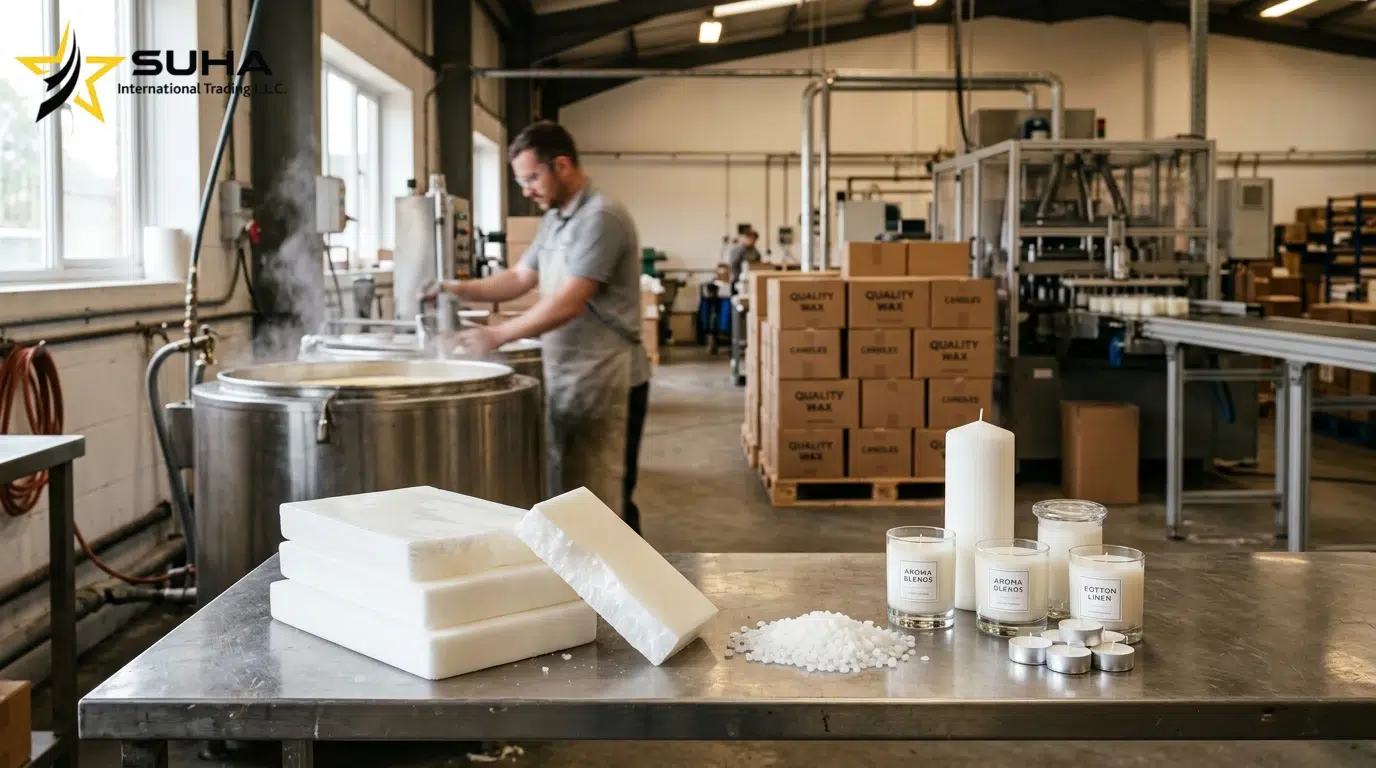
Candle raw materials · Bulk supply from Türkiye & Dubai
Paraffin Wax for Candles: Grade, Melting Point and Supply Guide for Candle Manufacturers
Paraffin wax for candles is a petroleum-derived wax, de-oiled to a low oil content and supplied at a set melting point, that forms the body of a candle and feeds its flame. It is the most widely used candle wax in the world: it holds fragrance strongly, burns bright, releases cleanly from moulds and covers every format from soft jar wax to hard taper wax. This guide is written for candle factories, wax distributors and importers who buy in containers, not kilograms. It shows which paraffin wax grade fits each candle, what melting point and oil content to specify, and how to order bulk paraffin wax for candles with the right documents.
Short answer
The best paraffin wax for candles depends on the candle you make. Use fully refined paraffin wax (oil ≤ 0.5%) for scented container candles, tealights and premium pillars. It is white, odourless and holds fragrance without sweating. Use semi refined paraffin wax with 1–2% oil for pillars, tapers and unscented candles, where cost per candle matters more. As a guide, choose a melting point of about 48–54 °C for jar candles, 54–58 °C for tealights and votives, 56–62 °C for pillars and 60–64 °C for tapers and hot-climate markets.
- Why paraffin wax for candle making
- Best paraffin wax grade for candles
- Melting point by candle type
- Fully vs semi refined for candles
- Oil content, sweating and soot
- Candle wax additives
- Making candles with paraffin wax
- Candle problems and fixes
- Paraffin vs soy wax
- Candle wax specification sheet
- Bulk supply and order planner
- HS code and export documents
- Our offices in Türkiye and Dubai
- FAQ
Why it is used
Why Paraffin Wax Is the Most Used Wax for Candle Making
Paraffin wax is a blend of straight-chain saturated hydrocarbons, mainly C20 to C40. It is separated from lubricating-oil distillates during crude oil refining and then de-oiled. Long, uniform carbon chains give a candle exactly what it needs: a solid that stays rigid on the shelf, melts sharply into a thin liquid, climbs the wick and burns as a steady, bright flame.
For a candle manufacturer, the case for paraffin wax for candle making comes down to five practical points:
- Scent throw. Paraffin releases fragrance strongly both cold, in the jar, and hot, when lit. That is why most scented candle brands still use paraffin or paraffin blends.
- Colour and finish. Fully refined wax is bright white and translucent, so dyes come out true and the surface is smooth and glossy.
- One chemistry, every format. Grades run from soft container wax to hard taper wax, so one supplier can cover a whole candle range.
- Mould release. Paraffin shrinks as it sets, so pillars and votives release cleanly from metal and polycarbonate moulds.
- Cost and availability. Paraffin is made at refinery scale, ships as non-dangerous cargo and costs much less per tonne than soy, coconut or beeswax.
The trade-offs are just as clear. Paraffin is petroleum-based, so brands selling on a "natural" claim blend it or switch to plant waxes. An oversized wick or too much fragrance makes any candle smoke. That is a formulation problem, not a wax problem, and the sections below show how to avoid it.
Grade board
Best Paraffin Wax for Candles: Grades by Oil Content
Candle grade paraffin wax is bought on two numbers: oil content, the liquid oil left in the wax after refining, and melting point. Oil content controls whiteness, odour, hardness and how much fragrance the wax can carry before it sweats. Melting point controls the candle format. Here is how our grades match candle production:
Fully Refined Paraffin Wax for Candles
Bright white, odourless, hard and translucent. This is the reference base for scented, container and premium candles, because it adds no odour and burns the cleanest.
Semi Refined Paraffin Wax 1–2% for Candles
Translucent white with a very light odour. Supplied in light (MP 58–60 °C) and heavy (MP 62–64 °C) grades. It balances finish and cost for volume pillar and taper lines.
Semi Refined Paraffin Wax 3–5% for Candles
Softer, with the light grade slightly off-white. Chosen where price per candle leads: household, church and emergency candles, usually hardened with stearic acid.
Semi Refined 5–7% and 7–10% Wax
Soft, yellowish and oily to the touch. It is not a candle wax on its own. It is used in small shares in budget blends, fire starters and industrial applications.
| Property | Test method | Fully refined | Semi refined 1–2% | Semi refined 3–5% |
|---|---|---|---|---|
| Oil content | ASTM D721 | ≤ 0.5% | 1–2% max | 4.1–4.5% (lab results) |
| Melting point | ASTM D87 | Per grade ordered | 58–60 / 62–64 °C | 60 / 62 °C |
| Congealing point | ASTM D938 | Per COA | 58–60 / 60–62 °C | Per COA |
| Flash point | ASTM D92 / D93 | Per COA | 250 °C min | 250 °C |
| Appearance | ASTM D6045 / D1500 | Bright white, translucent | Translucent white | White (heavy) · light yellowish (light) |
| Odour | Sensory | Odourless | Very light | Light |
| Best candle fit | — | Scented container, tealight, premium pillar | Pillar, taper, unscented, volume export | Household, church, emergency |
Swipe the table sideways to see every grade.
3–5% figures are from our own laboratory analyses: light grade oil 4.50%, MP 60 °C; heavy grade oil 4.10%, MP 62 °C; SG 0.83. Write the melting point and oil content you need on the purchase order.
Need today's FOB level for fully refined or semi refined candle wax?
See the paraffin wax price pageCandle Wax Grade Finder
Choose the candle you make, your market climate and whether it is scented. The finder gives the paraffin wax grade, melting point, starting fragrance load and additives most factories begin trials with.
Specification
Paraffin Wax Melting Point for Candles: Which Grade for Which Candle
Melting point is the most important number on any candle wax specification. If the wax is too soft for the format, it slumps, bends or sweats in a warm shop. If it is too hard, it tunnels in the jar, cracks as it cools or needs a bigger wick. Most candle manufacturers start from these ranges and then fine-tune with burn tests:
Paraffin Wax for Container Candles
A soft, low-melt fully refined wax gives a full melt pool to the glass, strong hot throw and good adhesion with fewer wet spots. Container candles carry the highest fragrance loads in the industry.
Paraffin Wax for Tealights
The cup holds the shape, so purity matters more than hardness. Fully refined pellets dose fastest on automatic tealight presses.
Paraffin Wax for Votive Candles
The wax must release from the mould yet liquefy fully inside its holder. Use fully refined wax, or semi refined 1–2% light grade with a little stearic acid.
Paraffin Wax for Pillar Candles
Free-standing, so it needs enough hardness to keep a wall around the melt pool. Use fully refined or semi refined 1–2% with about 5% stearic acid.
Paraffin Wax for Taper Candles
Tall and thin, so rigidity and drip resistance lead. Use semi refined 1–2% heavy grade or fully refined high-melt wax with stearic acid and a little PE wax.
Paraffin Wax for Church Candles
Long burns at high volume. Semi refined 1–2% or 3–5% hardened with stearic acid keeps cost per candle low.
Paraffin Wax for Household Candles
Plain white utility and emergency candles. Semi refined 3–5% with 5–10% stearic acid is the usual low-cost recipe.
Paraffin Wax for Outdoor Candles
Tins and buckets that sit in sun and heat before use. A heavy grade plus a UV inhibitor keeps them presentable.
Hot-climate rule: for Middle East, African and South Asian markets, raise the melting point of any free-standing candle by about 2–4 °C. Shops and warehouses there often pass 35 °C, and a pillar made at 56 °C can lean on the shelf before it sells. Our heavy 62–64 °C grade suits these markets.
| Candle type | Melting point | Recommended grade | Typical fragrance load | Common additive |
|---|---|---|---|---|
| Container / jar | 48–54 °C | Fully refined | 6–10% | Microcrystalline 1–3% |
| Tealight | 54–58 °C | Fully refined | 0–6% | Optional stearic 2–3% |
| Votive | 54–58 °C | Fully refined / SR 1–2% light | 5–6% | Stearic 3–5% |
| Pillar | 56–62 °C | Fully refined / SR 1–2% | 3–6% | Stearic ~5% |
| Taper / dinner | 60–64 °C | SR 1–2% heavy | 0–3% | Stearic 5–10%, PE wax 0.5–2% |
| Church / religious | 58–64 °C | SR 1–2% or 3–5% | Unscented | Stearic 5–10% |
| Household / emergency | 56–60 °C | SR 3–5% | Unscented | Stearic 5–10% |
| Outdoor / garden | 60–64 °C | SR 1–2% heavy | 3–6% (citronella) | Stearic ~5%, UV inhibitor |
Swipe the table sideways to see every column.
Ranges are typical industry starting points, not limits. Your wick, fragrance and moulds set the final values.
Comparison
Fully Refined vs Semi Refined Paraffin Wax for Candles
Both grades come from the same refinery stream. The difference is how far de-oiling and finishing go. Fully refined paraffin wax is sweated or solvent de-oiled to 0.5% oil or less, then hydrofinished or clay-treated to remove colour bodies and odour. Semi refined paraffin wax stops earlier, so it keeps more oil and a light odour, and it costs less per tonne.
Choose fully refined paraffin wax for candles when…
- The candle is scented and sold on scent throw
- You need a bright white base for true dye colours
- You make container candles, tealights or premium pillars
- Retail buyers test your candles for soot and odour
- You export to EU or Gulf retail chains
Choose semi refined paraffin wax for candles when…
- The candle is unscented or lightly scented
- Cost per candle is the main buying criterion
- You make pillars, tapers, church or household candles
- You add stearic acid anyway for hardness and opacity
- You sell into price-led wholesale markets
Many candle factories run both: fully refined wax for the scented range and semi refined 1–2% for plain white volume lines. Blending is also common. A pillar base of semi refined wax, lifted with a share of fully refined wax, gains whiteness without paying the fully refined price on every kilogram.
Quality driver
Oil Content in Candle Wax: How It Affects Sweating, Soot and Scent Throw
Oil content is what separates a good candle wax from a cheap one. A little oil softens the wax slightly and helps fragrance blend in. Too much, and liquid migrates to the surface. Fragrance oil adds to that liquid phase, which is why scented container candles need the lowest-oil base you can get.
| Effect on the candle | Low oil (≤ 0.5%) | Medium oil (1–2%) | High oil (3–5% and above) |
|---|---|---|---|
| Whiteness | Bright white | White / translucent | Off-white to yellowish |
| Hardness | Hard, brittle | Firm | Softer, flexible |
| Sweating (oil on surface) | Very low risk | Low risk | Higher risk, worse in heat |
| Fragrance capacity | Highest | Good | Reduced, as oil and fragrance compete |
| Odour of its own | None | Very light | Noticeable |
| Soot tendency | Lowest | Low | Higher |
| Mottling (crystal pattern) | Needs additive or fragrance | Possible | Appears naturally |
Swipe the table sideways to compare.
If you buy wax above 5% oil, you are buying a blending component, not a candle wax. Those grades, and slack wax, belong in fire starters, board sizing and industrial uses rather than in a candle you put your brand on.
Formulation
Candle Wax Additives to Blend with Paraffin Wax
Few commercial candles are 100% paraffin. Small additions tune hardness, opacity, gloss and fragrance retention. These are the additives most factories combine with paraffin wax for candles. All three wax additives can travel in the same container as your paraffin.
Stearic acid
The classic paraffin partner. About 5% is the usual start for pillars and up to about 10% for tapers. It whitens, adds opacity and hardness, and improves mould release. Keep it at 2–3% or below for a mottled finish. Stearic acid supply
Microcrystalline wax
A few percent makes paraffin less brittle, improves glass adhesion in jars and cuts cracks and air pockets in pillars. It also helps softer blends hold fragrance. Microcrystalline wax
Polyethylene wax
Small additions, often 0.5–2%, raise hardness, drip resistance and gloss for tapers and hot-climate pillars. PE wax raises melt viscosity, so re-check the wick. PE wax grades
Polymer additives
Dosed well under 1%, polymer candle additives improve fragrance binding and reduce mottling and frosting in fully refined blends.
Dyes and UV inhibitors
Use oil-soluble candle dyes only. Add a UV absorber to coloured candles sold under bright shop lighting or in windows.
Fragrance oil
Paraffin container blends typically carry 6–10% fragrance by weight, and pillars about 3–6%. The real ceiling comes from your wax blend and your fragrance supplier's IFRA data.
Production
How to Make Candles with Paraffin Wax: Production Steps and Temperatures
The process is the same in a ten-person workshop and a fully automated line. Only the equipment changes. These steps assume bulk paraffin wax for candle making, supplied in slabs or pellets:
- Incoming check. Compare melting point and oil content on the lot COA with your specification. Keep a sealed retained sample from every lot.
- Melt. Melt in a jacketed tank or melter about 10–15 °C above the wax melting point. Avoid holding the wax above roughly 90 °C for long, because it yellows.
- Add additives. Stir in stearic acid, microcrystalline wax or PE wax until fully dissolved, then add dye.
- Add fragrance. Add it at the temperature your fragrance supplier specifies, usually between 65 and 85 °C. Stir gently for two to three minutes so it binds evenly.
- Pour or mould. Container candles are typically poured at about 60–70 °C into pre-warmed glass. Pillars and votives go into moulds hotter, at about 75–85 °C. Tapers are dipped or machine-moulded.
- Cool slowly and top up. Fast cooling causes cracks, sinkholes and frosting. Pillars usually need a second pour a few degrees warmer to fill the centre sink.
- Cure and burn-test. Cure scented candles for at least 24–48 hours, often several days, before burn testing. Check melt pool, flame height, soot and burn time against the wick.
Temperatures are typical industry ranges. Your wax blend, fragrance and equipment set the exact values.
Troubleshooting
Paraffin Candle Problems: Sweating, Soot, Tunnelling and How to Fix Them
| Problem | Likely cause | Fix through the wax |
|---|---|---|
| Sweating / oily surface | High-oil wax, fragrance overload, heat | Move to fully refined or 1–2% oil wax, reduce fragrance, add microcrystalline wax |
| Black smoke / soot | Oversized wick, too much fragrance, high-oil wax | Size the wick down and use fully refined wax for scented lines |
| Pillars bending in shops | Melting point too low for the climate | Use a heavy 62–64 °C grade and add stearic acid or PE wax |
| Tunnelling in jars | Wax too hard for the jar, wick too small | Use a lower-melt container wax and re-wick |
| Weak hot throw | Wax too hard, or fragrance added too cold | Lower the melting point and add fragrance in the right temperature window |
| Cracks and air pockets | Fast cooling, brittle wax | Cool slowly and add 1–3% microcrystalline wax |
| Yellowing | Overheating, UV, semi refined base | Shorten time at heat, add a UV inhibitor, move to fully refined wax |
| Poor mould release | Low-shrink blend | Add stearic acid and pour slightly hotter |
| Wet spots on glass | Wax pulling away from cold glass | Pre-warm jars, use a softer container wax, cool evenly |
Swipe the table sideways to see the fixes.
Comparison
Paraffin Wax vs Soy Wax for Candles
Buyers often ask whether to switch from paraffin to a natural wax. Most large producers keep paraffin as their core range for performance and cost, and add soy or coconut lines for the natural-claim segment.
| Criterion | Paraffin wax | Soy wax | Beeswax | Paraffin–soy blend |
|---|---|---|---|---|
| Scent throw | Strongest, hot and cold | Moderate | Low, with its own honey note | Strong |
| Formats | All: container, pillar, taper, tealight | Mainly container | Pillar, taper | Container, some pillars |
| Finish | Bright white, glossy | Creamy, frosting common | Yellow to golden | White, less frosting than soy |
| Melting range | Wide, soft to hard | Narrow, soft (~48–52 °C) | High (~62–65 °C) | Medium |
| Container-scale supply | Refinery scale, year-round | Agricultural, seasonal prices | Limited | Depends on soy supply |
| Relative cost per tonne | Lowest | Higher | Much higher | In between |
| "Natural" claim | No | Yes | Yes | Partial |
Swipe the table sideways to compare all waxes.
Purchasing
Candle Wax Specification Sheet: What to Put on Your Purchase Order
"Paraffin wax 58–60" alone is not a specification. Two lots sold under that name can behave differently in your jars. Put these parameters on the purchase order and ask for every one of them on the lot COA:
| Parameter | Test method | Why it matters for candles | What to ask for |
|---|---|---|---|
| Melting point | ASTM D87 | Sets the candle format and the hot-climate behaviour | A range no wider than 2 °C, e.g. 58–60 °C |
| Congealing point | ASTM D938 | Predicts how the wax sets in moulds and jars | Stated on the COA |
| Oil content | ASTM D721 | Drives sweating, soot, odour and fragrance capacity | ≤ 0.5% for scented candles, ≤ 2% for pillars |
| Needle penetration at 25 °C | ASTM D1321 | Measures hardness. A lower number means a harder wax for pillars and tapers | A maximum value stated on the COA |
| Colour (Saybolt) | ASTM D156 | Whiteness of the base and how true dyes come out | A high Saybolt number for fully refined grades |
| Odour | ASTM D1833 | Wax odour competes with your fragrance | The lowest rating for scented lines |
| Form and packing | — | Melting speed and labour on your line | Slabs, flakes or pellets, plus carton or bag type |
Swipe the table sideways to see every parameter.
Candle safety standards your finished candles may need
If you export finished candles, the wax should support these product standards. In Europe, EN 15493 covers candle fire safety, EN 15494 covers safety labelling and EN 15426 covers sooting behaviour. In the United States, ASTM F2417 covers fire safety and ASTM F2058 covers safety labelling. A clean, low-oil fully refined base makes the sooting test far easier to pass.
Procurement
Bulk Paraffin Wax for Candles: Forms, Packing and Container Loading
For a candle factory, the wax decision does not stop at the grade. Physical form, packing and container load decide how fast the wax melts, how much handling it needs and what each delivered tonne really costs. We supply wholesale paraffin wax for candle making in these forms:
Forms
- Slabs: 5 kg slabs, the standard for candle plants with bulk melters
- Flakes, granules or pellets: slabs converted on request for faster melting and automatic dosing on tealight and votive presses. These ship in bags
Packing and loading
- Slabs in 25 kg multi-layer cartons, or in laminated bags
- 40 cartons or 50 laminated bags per pallet
- 20ft container: about 17.5–18.5 MT
- 40ft container: about 25 MT palletised
- By sea from Mersin (Türkiye) or Jebel Ali (UAE), or overland by truck from Türkiye
Candle Wax Order Planner
Enter your order tonnage and the wax weight of one candle. The planner shows cartons, pallets and containers, and roughly how many candles that paraffin will make before additives and fragrance.
Compliance
Candle Wax HS Code, COA and Export Documents
A specification sheet is a promise. The certificate of analysis for your lot is the proof. Before you release payment on any shipment of paraffin wax for candles, check these points:
| Item | What to check |
|---|---|
| Certificate of Analysis (COA) | Melting point, oil content, congealing point, colour and odour for the actual lot, not a generic TDS |
| MSDS / SDS | Required by most customs authorities and by your own workplace safety rules |
| CAS / EC | CAS 8002-74-2 · EC 232-315-6 |
| HS code | 2712.20 for paraffin wax under 0.75% oil (fully refined). 2712.90 for semi refined grades above that. Finished candles fall under 3406 |
| Dangerous goods | Not classified as dangerous goods. No UN number, so it ships as general cargo |
| Shipping set | Commercial invoice, packing list, bill of lading or CMR for road, and certificate of origin |
A wrong HS code on the proforma is one of the most common causes of customs holds for candle wax. Make sure the code matches the oil content of the grade you actually bought. If you are changing supplier or grade, ask for a pre-shipment sample and burn ten candles with your own wick and fragrance before you approve the container.
Standards and references used in this guide
- ASTM D87 (melting point), ASTM D938 (congealing point), ASTM D721 (oil content), ASTM D1321 (needle penetration), ASTM D156 (Saybolt colour), ASTM D1833 (odour), ASTM D92/D93 (flash point)
- EN 15493 (candle fire safety), EN 15494 (candle safety labels), EN 15426 (candle sooting behaviour)
- ASTM F2417 (fire safety for candles), ASTM F2058 (candle safety labelling)
- Harmonized System headings 2712 (petroleum waxes) and 3406 (candles)
- Grade data: SUHA International product specifications and laboratory analyses. Industry ranges are typical starting points and should be confirmed by burn testing.
Supplier
Paraffin Wax Supplier for Candle Manufacturers, with Offices in Türkiye and Dubai
SUHA International Trading supplies candle wax to candle factories, wax distributors and importers from two offices: our head office in Business Bay, Dubai, and our Türkiye office in Ankara. You can meet us, call us in your time zone, and load from the port closest to your market. More about our company
Dubai Office
Office 2305, Burlington Tower,Business Bay, Dubai, United Arab Emirates Open in Google Maps
Ankara Office
Karşıyaka District, 749 Street, No 30,Gölbaşı, Ankara 06830, Türkiye Open in Google Maps
Meetings at either office are by appointment. WhatsApp is monitored seven days a week, and enquiries are answered within 24 business hours.
Every candle grade, one source
Fully refined wax plus semi refined 1–2%, 3–5%, 5–7% and 7–10%, in light and heavy melting points. That covers a full candle range on one contract.
Two loading hubs
FOB Mersin for Europe, the Black Sea, North Africa and the Mediterranean. FOB Jebel Ali for the Gulf, East Africa and South Asia. Trucks from Türkiye for overland markets.
Lot-level COA
Each shipment travels with its own certificate of analysis, MSDS and certificate of origin, with the HS code matched to the grade.
Additives in the same container
Consolidate stearic acid, microcrystalline wax and PE wax with your paraffin. You get one booking and one document set.
Slabs or pellets
Standard 5 kg slabs, or flakes, granules and pellets for automatic candle lines.
Container-load MOQ
The minimum order is one FCL, 20ft or 40ft, which makes trial orders realistic for growing candle brands.
Explore related candle wax products
FAQ
Paraffin Wax for Candles: Frequently Asked Questions
Is paraffin wax good for candles?
Yes. Paraffin wax is the most widely used candle wax because it gives the strongest scent throw, a bright white finish, clean mould release and a wide melting point range at the lowest cost per tonne. Fully refined paraffin wax with a correctly sized wick burns with a steady, bright flame.
What is the best paraffin wax for candles?
For scented container candles and tealights, fully refined paraffin wax with 0.5% oil or less is best. For pillars, tapers and unscented candles, semi refined paraffin wax with 1–2% oil gives a good finish at lower cost. Household and church candles often use 3–5% oil wax hardened with stearic acid.
What melting point paraffin wax is best for candles?
As a starting guide, use about 48–54 °C wax for container candles, 54–58 °C for tealights and votives, 56–62 °C for pillars, and 60–64 °C for tapers and outdoor candles. For free-standing candles sold in hot markets such as the Middle East and Africa, go about 2–4 °C higher.
What is the difference between fully refined and semi refined paraffin wax for candles?
Fully refined paraffin wax has 0.5% oil or less and is bright white, odourless and hard, so it suits scented and premium candles. Semi refined paraffin wax keeps more oil, from 1–2% up to about 10%, has a light odour and costs less, so it is used for pillar, taper, church and household candles.
Is 58-60 paraffin wax good for candles?
Yes. Paraffin wax 58-60 is one of the most traded candle grades. It suits pillars and votives in temperate markets, and it can be used for container candles when blended with a softer wax. For pillars sold in hot climates, a heavy 62–64 °C grade holds its shape better.
Which paraffin wax is best for container candles?
Container candles work best with a soft, fully refined paraffin wax of about 48–54 °C melting point. The low oil content lets the wax carry 6–10% fragrance without sweating, and the low melt gives a full melt pool to the edge of the jar.
How much fragrance oil can paraffin wax hold?
Paraffin container blends typically carry 6–10% fragrance oil by weight, and pillars about 3–6%. The exact maximum depends on the wax blend, its oil content and the fragrance supplier's limits, so burn-test before scaling up. Lower-oil wax holds more fragrance without sweating.
Why does my paraffin candle sweat?
Sweating, or oil on the surface, happens when liquid oil and fragrance migrate out of the solid wax. The usual causes are high-oil wax, too much fragrance or storage in heat. Switching to fully refined or 1–2% oil wax, cutting the fragrance load, or adding a little microcrystalline wax usually fixes it.
Should I add stearic acid to paraffin wax for candles?
Stearic acid is the most common paraffin additive for pillars and tapers. About 5% whitens the candle, adds hardness and opacity and improves mould release, and tapers may use up to about 10%. Keep stearic acid at 2–3% or below if you want a mottled finish.
Paraffin wax or soy wax: which is better for candles?
Paraffin wax gives stronger scent throw, works in every candle format and costs less per tonne. Soy wax is chosen for a natural marketing claim, mainly in container candles. Many candle manufacturers keep paraffin as their core range and add soy or paraffin–soy blends for the natural segment.
What is the HS code for paraffin wax for candles?
Paraffin wax with less than 0.75% oil, which covers fully refined grades, is classified under HS 2712.20. Semi refined paraffin wax with higher oil content falls under HS 2712.90. Finished candles are classified under HS 3406.
How many candles can one tonne of paraffin wax make?
Divide 1,000,000 grams by the wax weight of one candle. One tonne makes about 5,000 candles of 200 g, or about 83,000 tealights of 12 g, before additives and fragrance. Allow 1–3% for process losses.
What is the minimum order for bulk paraffin wax for candles?
Our minimum order is one full container load (1 FCL), either 20ft or 40ft. A 20ft container carries about 17.5–18.5 MT and a 40ft container about 25 MT palletised, loaded at Mersin or Jebel Ali, or by truck from Türkiye.
How is bulk paraffin wax for candles packed?
It is supplied as 5 kg slabs in 25 kg multi-layer cartons or laminated bags, with 40 cartons or 50 bags per pallet. Slabs can also be converted to flakes, granules or pellets for automatic candle lines, and these ship in bags.
Is paraffin wax dangerous goods for shipping?
No. Paraffin wax is not classified as dangerous goods and has no UN number, so it ships as general cargo by sea or road. Each shipment still carries an MSDS, a certificate of analysis, a certificate of origin and the standard commercial documents.
Where are your offices?
SUHA International Trading has its head office at Office 2305, Burlington Tower, Business Bay, Dubai, UAE, and a Türkiye office at Karşıyaka District, 749 Street, No 30, Gölbaşı, Ankara 06830. Meetings at both offices are by appointment.
Can I get a sample of paraffin wax for candles before ordering?
Yes. Ask for a pre-shipment sample with its certificate of analysis, then burn-test it with your own wick and fragrance before approving the container. Contact us on WhatsApp at +971 50 720 9246 or by email at info@causticsodaco.com.
Request a Quote for Paraffin Wax for Candles
Send us five details and our wax desk in Dubai or Ankara will reply with the matching grade, the lot COA and a FOB Mersin or Jebel Ali offer.
- Candle type (jar, pillar, taper…)
- Grade or melting point
- Slabs or pellets
- Monthly tonnage
- Destination port or city