
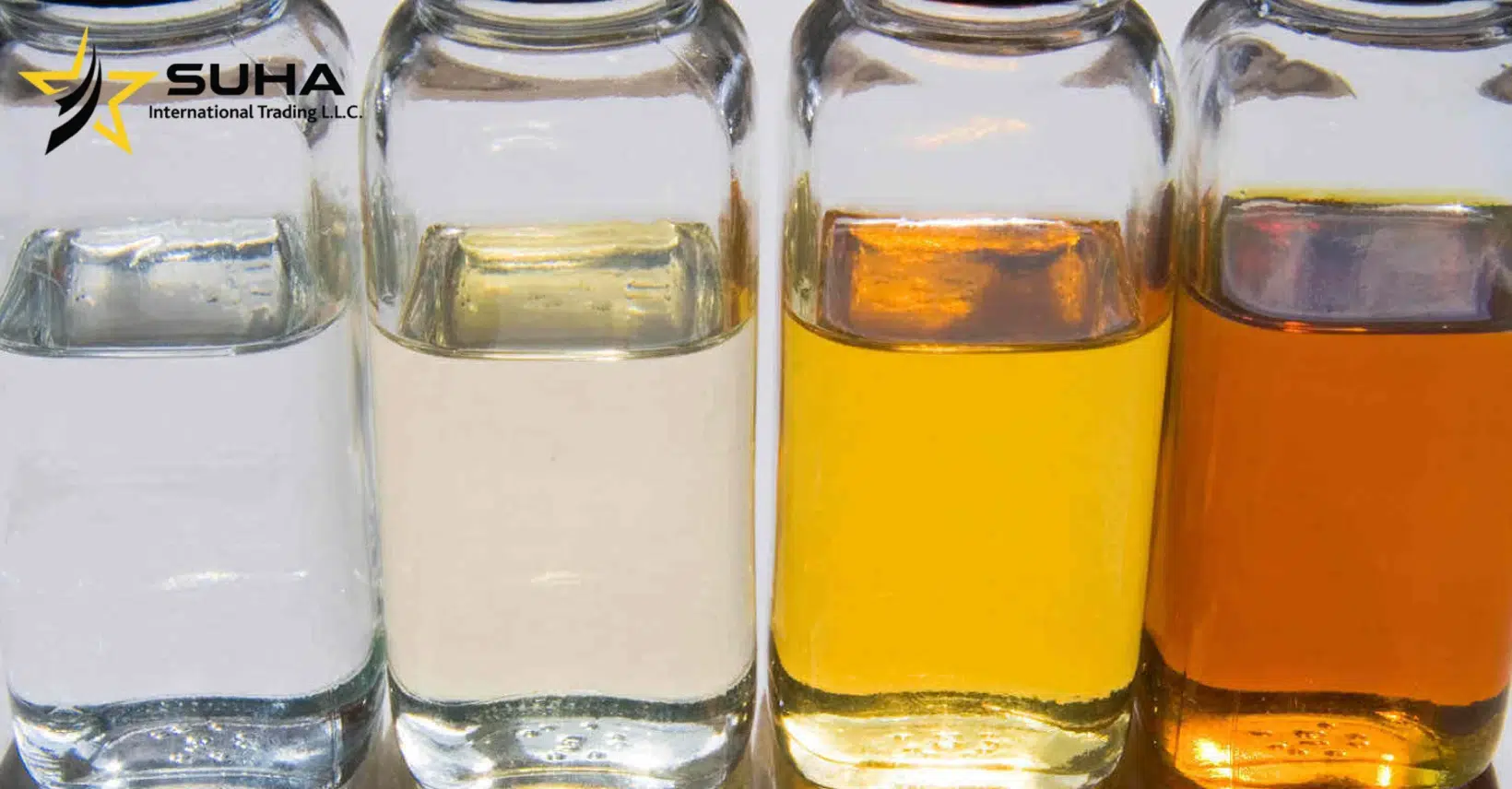
Lubricant raw materials · Bulk supply from Türkiye & Dubai
Base Oil for Lubricants: Grade, Viscosity and Supply Guide for Lubricant Blenders
Base oil for lubricants is the refined petroleum stock that makes up most of every finished lubricant, typically 70–99% of the formula. Additives are blended into it to make engine oil, hydraulic oil, gear oil, grease and metalworking fluids. Its viscosity, viscosity index, volatility and purity set the limits of what the final product can do. This guide is for lubricant blending plants, oil distributors and importers who buy base oil by the container or flexitank. It explains which Group I base oil grade fits each lubricant, how to blend grades to an exact ISO VG, and what to check on the COA before you pay.
Short answer
The right base oil for lubricants depends on the product and the viscosity you need. Light Group I SN150 (about 19–24 cSt at 40 °C) is used for low-viscosity hydraulic oils, spindle and metalworking oils, and as the light part of engine oil blends. Medium SN350 (about 67–70 cSt) suits ISO VG 68 hydraulic and compressor oils. Heavy SN500 (about 108 cSt) carries heavy-duty diesel engine oils, gear oils and greases. Blending SN150 with SN500 covers every grade from ISO VG 32 to VG 100. Turbine oils and low-SAPS engine oils need Group II or III stocks.
- What base oil does in a lubricant
- Group I vs II vs III base oil
- SN150, SN350 and SN500 grades
- Base oil by lubricant type
- Base oil blending calculator
- Specifications to check
- Virgin vs recycled base oil
- Lubricant blending steps
- Blending problems and fixes
- Packaging and order planner
- HS code and documents
- Our offices in Türkiye and Dubai
- FAQ
Fundamentals
What Base Oil Does in a Lubricant
Every lubricant is a base oil plus an additive package. Base stocks make up roughly 90–99% of finished industrial lubricants such as hydraulic, gear and compressor oils. In automotive engine and transmission oils, where additive packages and viscosity modifiers are heavier, they make up about 70–90%. Because the lubricant base oil, or base stock, is most of the volume, it decides most of the performance and most of the cost of the finished product.
In a finished lubricant, the base oil has five jobs:
- Carry the load. Its viscosity builds the oil film that separates moving metal surfaces.
- Stay usable across temperatures. Its viscosity index (VI) decides how much the oil thins when hot and thickens when cold.
- Resist ageing. Saturates and sulfur content drive oxidation stability, sludge and acid formation over the service life.
- Hold the additives. Group I oils have good solvency, so anti-wear, detergent and EP additives dissolve and stay in solution.
- Carry heat away. Flash point and volatility set the safe operating temperature and how much oil is lost to evaporation.
Additives can improve a good base oil, but they cannot rescue a poor one. That is why serious lube oil blending plants specify their lubricant base oil as carefully as their additives.
Classification
Base Oil Groups for Lubricants: Group I vs Group II vs Group III
The American Petroleum Institute sorts lubricant base oils into five groups by saturates content, sulfur and viscosity index. The group tells a blender what the stock can do and which specifications it can meet.
| Group | Saturates | Sulfur | Viscosity index | How it is made | Typical lubricant use |
|---|---|---|---|---|---|
| Group I | < 90% | > 0.03% | 80–120 | Solvent extraction and dewaxing | Industrial oils, gear oils, greases, heavy-duty diesel and monograde engine oils, metalworking fluids |
| Group II | ≥ 90% | ≤ 0.03% | 80–120 | Hydrocracking | Modern engine oils, turbine and long-life hydraulic oils |
| Group III | ≥ 90% | ≤ 0.03% | ≥ 120 | Severe hydrocracking and isomerisation | Low-viscosity and "synthetic" passenger car engine oils |
| Group IV | Polyalphaolefins (PAO) | Chemical synthesis | Full synthetic and extreme-temperature lubricants | ||
| Group V | All others: esters, PAG, naphthenics | Various | Specialty, food-grade, biodegradable fluids | ||
Swipe the table sideways to see every column.
Why Group I still matters: Group I base oil has the best natural solvency for additives and seal swell. It comes in heavy grades that hydrocracked stocks cannot easily match, and it costs the least per tonne. That makes it the working base oil for industrial lubricants, greases, gear oils and heavy-duty diesel engine oils across Africa, the Middle East, South Asia and Eastern Europe. Group II and III are the right choice when a specification demands low sulfur, high VI or very low volatility.
Grade board
Best Base Oil for Lubricants: SN150, SN350 and SN500 Grades
"SN" stands for solvent neutral, a solvent-refined, neutral (non-acidic) Group I paraffinic stock. The number is the approximate viscosity in Saybolt Universal Seconds at 100 °F. A higher number means a thicker oil. The three grades we supply cover the full viscosity range most lubricant blenders need:
Base Oil SN150 for Lubricants
KV40 19–24 cSt, KV100 4.5–5.0 cSt, VI 100–110, flash point 170–180 °C. The light end of the blend: low-viscosity hydraulic oils, spindle oils, metalworking fluids and engine oil cuts.
Base Oil SN350 for Lubricants
KV40 67–70 cSt, KV100 7.5–9.0 cSt, VI 90–100, flash point 220–230 °C. It hits ISO VG 68 almost on its own, which suits hydraulic, compressor and circulating oils.
Base Oil SN500 for Lubricants
KV40 about 108 cSt, KV100 10.8 cSt min, VI 87 min, flash point 235 °C min, Noack 5% max. The backbone of heavy-duty diesel engine oils, gear oils and greases.
| Property | Test method | SN150 | SN350 | SN500 |
|---|---|---|---|---|
| Kinematic viscosity @ 40 °C (cSt) | ASTM D445 | 19–24 | 67–70 | ~108 (typical) |
| Kinematic viscosity @ 100 °C (cSt) | ASTM D445 | 4.5–5.0 | 7.5–9.0 | 10.8 min |
| Viscosity index | ASTM D2270 | 100–110 | 90–100 | 87 min |
| Flash point COC (°C) | ASTM D92 | 170–180 | 220–230 | 235 min |
| Pour point (°C) | ASTM D97 | 0 max | 0 max | −3 max |
| Colour | ASTM D1500 | 1.0–1.5 | 2.0–2.5 | 2.0 max |
| Total acid number (mg KOH/g) | ASTM D664 | 0.03 max | 0.03 max | Per COA |
| Noack volatility (wt %) | ASTM D5800 | Per COA | Per COA | 5 max |
| Density @ 15 °C | ASTM D1298 / D4052 | 0.868–0.874 kg/L | 0.880–0.882 kg/L | ~893 kg/m³ |
Swipe the table sideways to compare all grades.
Values are from our published virgin-grade TDS for each grade. Recycled grades target the same viscosity bands; their batch data is supplied on the COA.
Base Oil Selector for Lubricant Blenders
Choose the lubricant you make. The selector shows the base oil grades blenders usually start from, the typical base oil share of the finished product, and the main specification to watch.
Application
Choosing Base Oil for Lubricant Blending by Product
Each finished lubricant asks something different of its base oil. These are the Group I starting points most blending plants use. Your additive supplier's approval list and the target specification decide the final formula.
Base Oil for Hydraulic Oil
The largest industrial lubricant by volume. About 98–99% base oil plus a zinc or ashless anti-wear package, often around 1%. Watch VI, pour point and demulsibility.
Base Oil for Diesel Engine Oil
Heavy-duty diesel oils for trucks, buses and generators are still widely blended on Group I. Base oil is around 75–85% of the formula, with a DI package and viscosity modifier. Watch Noack and VI.
Base Oil for Monograde Engine Oil
Simple, high-volume oils for older engines and hot markets. Mostly SN500, trimmed with SN150 for SAE 30 and with heavier stock for SAE 50.
Base Oil for Gear Oil
Gear oils need thick, film-strong stocks. SN500 covers ISO VG 100. Higher grades add bright stock. EP additives typically run a few percent.
Base Oil for Compressor Oil
Air compressor oils need low carbon-forming tendency and good oxidation stability. Use clean, low-colour, low-volatility stocks with a high flash point.
Base Oil for Grease
The base oil is the lubricating part of grease, with the thickener holding it in place. Group I solvency suits lithium and calcium soap greases.
Base Oil for Metalworking Fluids
Light SN150 carries cutting, drawing and rust-preventive oils. For soluble oils, it is blended with emulsifiers, and colour and odour matter to machine shops.
Base Oil for Two-Stroke Oil
A blend of light and heavy stocks with a solvent for easy fuel mixing. Ash-free additives keep spark plugs and exhaust ports clean.
Base Oil for Turbine, Transformer and Low-SAPS Oils
Turbine oils and modern low-SAPS engine oils need Group II or III stocks for oxidation life and low sulfur. Transformer oils use dedicated naphthenic or specially treated insulating oils.
| Lubricant | Base oil grades | Base oil share | Viscosity target | Key base oil spec |
|---|---|---|---|---|
| Hydraulic oil | SN150 + SN500, or SN350 | ~98–99% | ISO VG 32 / 46 / 68 | VI, pour point |
| HD diesel engine oil | SN500 + SN150 | ~75–85% | 15W-40 / 20W-50 | Noack, VI |
| Monograde engine oil | SN500 (+ SN150) | ~85–92% | SAE 30 / 40 / 50 | KV100, flash point |
| Gear oil | SN500 + heavier stock | ~94–98% | ISO VG 100–320 | KV40, flash point |
| Compressor oil | SN350 / SN500 | ~98–99% | ISO VG 68 / 100 | Colour, Noack |
| Grease | SN500 (+ heavier) | ~70–95% | NLGI grade | KV40, solvency |
| Metalworking fluid | SN150 | Varies | ISO VG 10–32 | Colour, odour |
| Two-stroke oil | SN150 / SN500 + bright stock | Varies | JASO / API TC | Ash, miscibility |
Swipe the table sideways to see every column.
Shares and grades are typical industry starting points. Final formulas depend on the additive package and the specification you certify against.
Blending tool
Base Oil Blending Calculator: How to Hit an Exact ISO VG
In base oil for lubricant blending, most plants reach a target viscosity by mixing a light and a heavy base oil. Viscosity does not blend in a straight line: 50% SN150 and 50% SN500 does not give the average of the two. The industry uses the Refutas blending equation, which converts each oil's viscosity to a viscosity blending number, mixes those numbers by mass fraction, and converts back. The calculator below applies it to our typical grade viscosities.
Two-Component Base Oil Blend Calculator
Choose a light oil, a heavy oil and your target viscosity at 40 °C. The calculator returns the mass split and the estimated viscosity at 100 °C of the base blend, before additives.
The calculator gives a starting ratio for the base blend only. Viscosity modifiers and additive packages raise the final viscosity, so confirm by lab test (ASTM D445) before you scale up.
Purchasing
Base Oil Specifications That Decide Lubricant Quality
A grade name such as "SN500" is not a specification. Two cargoes sold under the same name can differ enough to push your finished oil out of grade. Put these parameters on the purchase order and check every one on the batch COA:
| Parameter | Test method | Why it matters for lubricants | What to ask for |
|---|---|---|---|
| Kinematic viscosity @ 40 / 100 °C | ASTM D445 | Sets the ISO VG or SAE grade of the finished oil | A narrow min–max band per grade |
| Viscosity index | ASTM D2270 | How much the oil thins with heat. Key for multigrades and hydraulics | A stated minimum |
| Flash point | ASTM D92 | Safe operating temperature, and an early sign of light-end contamination | A stated minimum |
| Pour point | ASTM D97 | Cold-flow limit; you may need a pour point depressant | A stated maximum |
| Noack volatility | ASTM D5800 | Oil lost to evaporation in engines. A limit in many engine oil specs | A stated maximum for engine oil stocks |
| Colour | ASTM D1500 | Refining quality and customer perception of the finished product | A maximum colour number |
| Total acid number | ASTM D664 / D974 | Residual acidity that speeds corrosion and ageing | Close to zero for virgin stock |
| Water content | ASTM D6304 / D95 | Water causes haze, additive drop-out and rust | Clear and bright, low ppm |
| Sulfur and saturates | ASTM D4951 / D2007 | Define the API group and oxidation behaviour | Stated on the COA |
Swipe the table sideways to see every parameter.
Comparison
Virgin vs Recycled Base Oil for Lubricants
We supply both virgin and recycled (re-refined) Group I base oils. Virgin base oil is refined from fresh crude vacuum distillate by solvent extraction, dewaxing and hydrofinishing. Recycled base oil is made from collected used lubricating oil that is distilled and purified back to a base stock. Both target the same viscosity bands, but they suit different jobs.
Choose virgin base oil for lubricants when…
- You blend engine oils certified to API or OEM specifications
- Colour, odour and batch consistency matter to your customers
- You need a full TDS with tight min–max limits
- Your product carries a premium brand promise
Choose recycled base oil for lubricants when…
- You make general industrial oils, greases or price-led products
- Cost per litre is the main buying criterion
- A slightly darker colour is acceptable
- You approve each batch on its own COA
Recycled colour typically runs from light to pale yellow and varies with the feedstock, so we supply recycled batch data on the COA rather than a fixed datasheet. Blend a trial batch with your additive package before you commit a full contract.
Production
How Lubricant Blending Works: From Base Oil to Finished Product
- Receive and test. Sample every drum batch, flexitank or ISO tank on arrival. Check viscosity, flash point, water and appearance against the COA before discharging to storage.
- Store separately. Keep each grade in its own dedicated, dry tank. Cross-contamination between SN150 and SN500 is the most common cause of off-grade blends.
- Calculate the recipe. Work out the light and heavy base oil split for the target viscosity (see the calculator above), then add the additive package and any viscosity modifier at the supplier's treat rate.
- Charge and heat. Charge the base oils first, then heat gently, typically to around 50–65 °C, so the additives dissolve evenly. Avoid overheating, which ages the oil.
- Add additives and mix. Add the DI or AW package and other additives in the order the supplier specifies. Mix with paddle, pulse-air or in-line blending until the blend is uniform.
- Test the finished batch. Check KV40 and KV100, VI, flash point, pour point and appearance, plus any performance tests your specification needs.
- Filter and fill. Filter, then fill into drums, pails, IBCs or bulk, and retain a sample of every batch.
Temperatures and order of addition are typical. Follow your additive supplier's blending guide.
Troubleshooting
Lubricant Blending Problems and How Base Oil Choice Fixes Them
| Problem | Likely base oil cause | Fix |
|---|---|---|
| Finished oil below ISO VG | Light grade at the low end of its band, or the wrong blend ratio | Re-calculate the blend from actual COA viscosities and add heavy stock |
| Haze or cloudiness | Water in the base oil, or wax at low temperature | Check water content, dry the tanks, add a pour point depressant |
| Additive drop-out or sediment | Poor solvency or contamination | Use a Group I stock with good solvency; check tank cleanliness |
| Low flash point | Light-end contamination, or too much light stock | Test incoming oil for flash point and reject off-spec batches |
| Dark colour | Recycled stock, heat damage or contamination | Use virgin base oil for colour-critical products and avoid overheating |
| High oil consumption in engines | High Noack volatility | Specify a Noack maximum, or move to heavier or Group II stock |
| Poor cold start | High pour point or low VI | Add a pour point depressant and use a higher-VI light stock |
| Foaming | Contamination or air entrainment | Clean the lines and check the antifoam treat rate |
Swipe the table sideways to see the fixes.
Procurement
Bulk Base Oil for Lubricants: Packaging, Loading and Order Planner
For a blending plant, packaging decides handling cost, storage needs and how fast you can discharge. We ship lubricant base oil in four formats:
| Packaging | Net per unit | Per 20ft container | Best for |
|---|---|---|---|
| New steel drums | 180 kg | 80 drums · 14.4 MT | Smaller blenders, mixed grades, markets without bulk tanks |
| IBC totes | ≈ 880–1,000 kg | 18–20 IBCs | Mid-size plants, easy forklift handling |
| Flexitank | 20–24 MT | 1 flexitank | Lowest cost per tonne into a bulk tank |
| ISO tank | 20–25 MT | 1 tank | Repeat bulk deliveries, cleanest transfer |
Swipe the table sideways to see every column.
We load FOB Mersin (Türkiye) and FOB Jebel Ali (UAE), with EXW, CFR, CIF and DAP terms available. Overland markets can be served by truck from Türkiye. Payment is by T/T, L/C at sight or D/P.
Base Oil Order Planner
Enter the tonnage you need and choose a packaging format. The planner shows the number of units and containers.
Compliance
Base Oil HS Code, COA and Export Documents
| Item | What to check |
|---|---|
| Certificate of Analysis (COA) | Viscosity at 40 and 100 °C, VI, flash point, pour point, colour, TAN and water for the actual batch, not a generic TDS |
| Technical Data Sheet (TDS) | The min–max limits the batch must meet. Compare it with the COA line by line |
| MSDS / SDS | Required for customs, storage permits and workplace safety |
| CAS / EC | CAS 64742-54-7 · EC 265-157-1 |
| HS code | 2710.19 for lubricating base oils (petroleum oils, other than light oils). Confirm the code for re-refined grades with your customs broker |
| Shipping set | Commercial invoice, packing list, bill of lading or CMR for road, and certificate of origin |
Ask for a pre-shipment sample when you change supplier or grade. Blend a lab batch with your own additive package and check the finished viscosity before you approve the cargo.
Standards and references used in this guide
- API 1509, Appendix E: base oil group definitions (saturates, sulfur, viscosity index)
- ASTM D445 (kinematic viscosity), D2270 (viscosity index), D92 (flash point), D97 (pour point), D5800 (Noack volatility), D1500 (colour), D664 (acid number), D4052 / D1298 (density)
- ISO 3448: ISO viscosity grades for industrial lubricants · SAE J300: engine oil viscosity grades
- ASTM D7152: calculating the viscosity of a blend of petroleum products (blending-number method used in the calculator)
- Harmonized System heading 2710 (petroleum oils)
- Grade data: SUHA International published TDS for SN150, SN350 and SN500. Industry ranges are typical starting points.
Supplier
Base Oil Supplier for Lubricant Manufacturers, with Offices in Türkiye and Dubai
SUHA International Trading supplies Group I base oil for lubricants to blending plants, lubricant brands and oil distributors from two offices: our head office in Business Bay, Dubai, and our Türkiye office in Ankara. You can meet us, call us in your time zone, and load from the port closest to your market. More about our company
Dubai Office
Office 2305, Burlington Tower,Business Bay, Dubai, United Arab Emirates Open in Google Maps
Ankara Office
Karşıyaka District, 749 Street, No 30,Gölbaşı, Ankara 06830, Türkiye Open in Google Maps
Meetings at either office are by appointment. WhatsApp is monitored seven days a week, and enquiries are answered within 24 business hours.
Three grades, one contract
SN150, SN350 and SN500 cover every blend from ISO VG 32 to VG 100 and the main SAE engine oil grades.
Virgin and recycled
Choose virgin base oil for certified engine oils, and recycled for price-led industrial lines, from the same supplier.
Two loading hubs
FOB Mersin for Europe, the Black Sea, North Africa and the Mediterranean. FOB Jebel Ali for the Gulf, East Africa and South Asia.
Batch-level COA
Every cargo ships with its own certificate of analysis, TDS, MSDS and certificate of origin.
Four packaging formats
Drums, IBCs, flexitanks and ISO tanks, so the format matches your storage and discharge set-up.
Container-load MOQ
The minimum is one FCL: 14.4 MT in drums, or 20 MT in a flexitank or ISO tank.
Explore our base oil grades
FAQ
Base Oil for Lubricants: Frequently Asked Questions
What is base oil for lubricants?
Base oil for lubricants is the refined petroleum or synthetic stock that makes up most of a finished lubricant, typically 70–99% of the formula. Additives are blended into it to make engine oil, hydraulic oil, gear oil, grease and metalworking fluids. Its viscosity, viscosity index and purity set the performance limits of the final product.
Which base oil is best for lubricants?
It depends on the product. Group I SN150 suits low-viscosity hydraulic and metalworking oils, SN350 suits ISO VG 68 hydraulic and compressor oils, and SN500 suits heavy-duty diesel engine oils, gear oils and greases. Turbine oils and low-SAPS passenger car engine oils need Group II or Group III base oil.
How much base oil is in a lubricant?
Base oil makes up roughly 90–99% of industrial lubricants such as hydraulic, gear and compressor oils. In automotive engine and transmission oils, where additive packages and viscosity modifiers are heavier, it makes up about 70–90%.
What does SN mean in base oil SN150 and SN500?
SN stands for solvent neutral: a solvent-refined, neutral (non-acidic) Group I paraffinic base oil. The number is the approximate viscosity in Saybolt Universal Seconds at 100 °F, so SN500 is a much thicker oil than SN150.
What is the difference between Group I, Group II and Group III base oil?
Under API 1509, Group I base oil has less than 90% saturates and/or more than 0.03% sulfur, with a viscosity index of 80–120. Group II has at least 90% saturates, no more than 0.03% sulfur and a VI of 80–120. Group III meets the same saturates and sulfur limits but has a VI of 120 or higher.
Which base oil is used for engine oil?
Heavy-duty diesel and monograde engine oils are widely blended on Group I SN500, with SN150 as the light component, plus a DI package and viscosity modifier. Modern low-viscosity and low-SAPS passenger car engine oils use Group II or Group III base oils.
Which base oil is used for hydraulic oil?
Hydraulic oils are usually blended from SN150 and SN500 to hit ISO VG 32, 46 or 68, or made with SN350 alone for ISO VG 68. Base oil is about 98–99% of the formula, with an anti-wear additive package of around 1%.
How do you blend SN150 and SN500 to get ISO VG 46?
Viscosities are blended with a blending-number method such as the Refutas equation, not a simple average. With typical grades of about 21.5 cSt (SN150) and 108 cSt (SN500) at 40 °C, roughly 48% SN150 and 52% SN500 by mass gives about 46 cSt. Always confirm the ratio with the actual COA viscosities and a lab test.
Can you mix different base oil grades?
Yes. Mixing light and heavy grades of the same group, such as SN150 with SN500, is the standard way to reach a target viscosity. Mixing groups is also common but changes VI, volatility and additive solubility, so test the finished blend.
Is recycled base oil good for lubricants?
Recycled, or re-refined, base oil works well for general industrial oils, greases and price-led lubricants when each batch is approved on its COA. For engine oils certified to API or OEM specifications, or where colour and consistency matter, virgin base oil is the safer choice.
What is viscosity index in base oil?
Viscosity index (VI, ASTM D2270) measures how much an oil's viscosity changes with temperature. A higher VI means the oil thins less when hot and thickens less when cold, which matters most for multigrade engine oils and hydraulic oils in variable climates.
What is the HS code for base oil?
Lubricating base oils are generally classified under HS 2710.19 (petroleum oils, other than light oils). The CAS number for Group I solvent-refined heavy paraffinic base oil is 64742-54-7. Confirm the code for re-refined grades with your customs broker.
What is the minimum order for base oil?
Our minimum order is one container load: 80 steel drums (14.4 MT) in a 20ft container, or 20 MT in a flexitank or ISO tank. Cargo is loaded FOB Mersin or Jebel Ali, or delivered by truck from Türkiye.
How is bulk base oil for lubricants shipped?
Base oil ships in 180 kg steel drums (80 per 20ft container), IBC totes, 20–24 MT flexitanks, or 20–25 MT ISO tanks. Flexitanks give the lowest cost per tonne into a bulk tank; drums suit smaller blenders and mixed-grade orders.
What should a base oil COA include?
A base oil certificate of analysis should show kinematic viscosity at 40 and 100 °C, viscosity index, flash point, pour point, colour, total acid number, water content and density for the actual batch, each with its ASTM test method.
Where are your offices?
SUHA International Trading has its head office at Office 2305, Burlington Tower, Business Bay, Dubai, UAE, and a Türkiye office at Karşıyaka District, 749 Street, No 30, Gölbaşı, Ankara 06830. Meetings at both offices are by appointment.
Can I get a base oil sample before ordering?
Yes. Ask for a pre-shipment sample with its certificate of analysis, then blend a lab batch with your own additive package before approving the cargo. Contact us on WhatsApp at +971 50 720 9246 or by email at info@causticsodaco.com.
Request a Quote for Base Oil for Lubricants
Send us five details and our desk in Dubai or Ankara will reply with the matching grade, a recent batch COA and a FOB Mersin or Jebel Ali offer.
- Grade (SN150, SN350, SN500)
- Virgin or recycled
- Packaging (drum, IBC, flexitank, ISO)
- Monthly tonnage
- Destination port or city