
Paraffin Wax Uses: 12 Industrial Applications and the Right Grade for Each
What Is Paraffin Wax Used For?
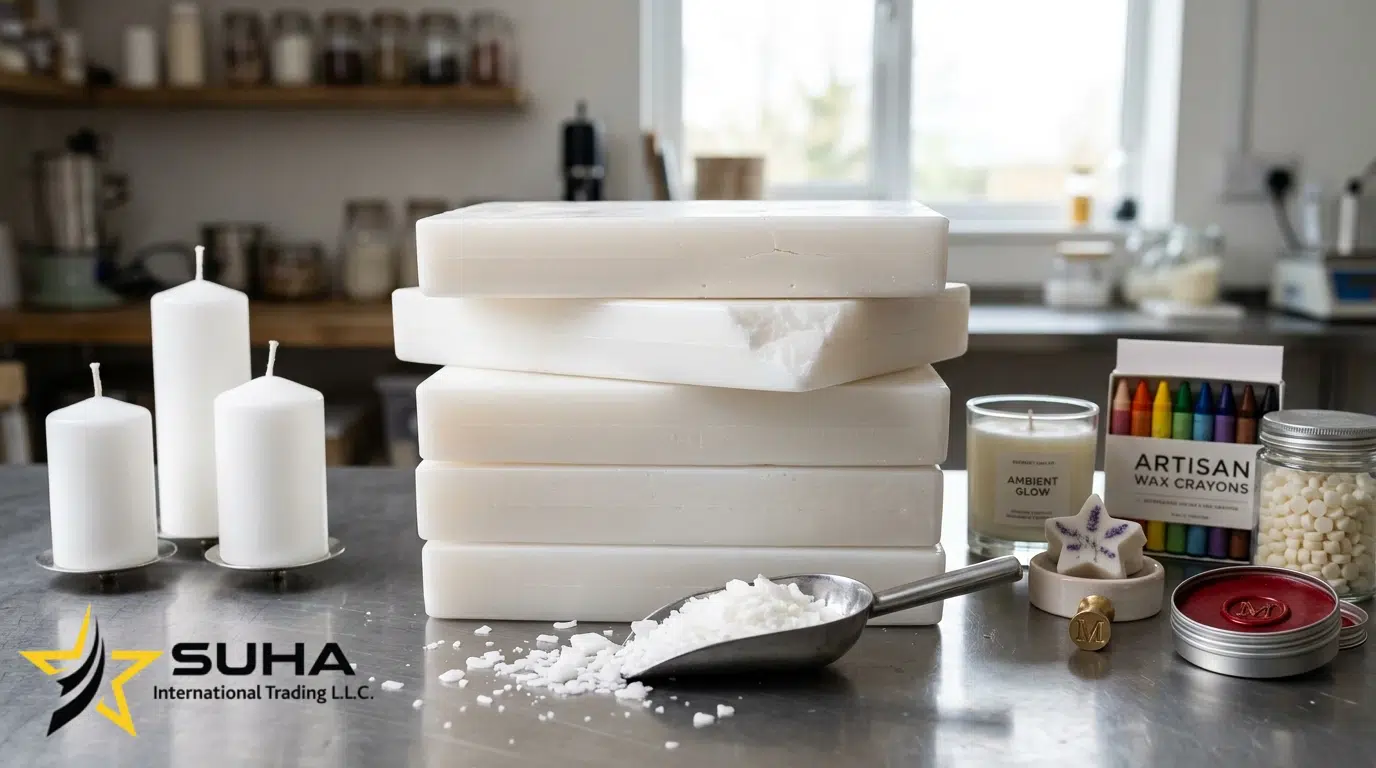
The main paraffin wax uses are candle making, coating packaging and corrugated board, protecting rubber and tyres from ozone, and formulating hot melt adhesives. It is also used for crayons, matches, PVC lubrication, MDF wax emulsions, textile finishes, electrical insulation and polishes. Fully refined wax suits clean, white, low-odour products; semi refined wax suits cost-driven industrial uses.
- Candles
- Packaging & board coating
- Rubber & tyres
- Hot melt adhesives
- Matches
- Crayons
- PVC processing
- MDF & particle board
- Textiles & leather
- Electrical insulation & thermal storage
- Polishes, firelighters & anti-caking
- Investment casting
Paraffin wax is a white to slightly yellowish hydrocarbon wax (CnH2n+2), separated from lubricating-oil stocks during refining. It repels water, resists most chemicals, insulates electricity and melts at a low, predictable temperature. Those four properties explain almost every use of paraffin wax on this page.
This guide is written for buyers and production teams. For each industry it explains what the wax does, which oil-content grade usually fits, and which specs to check on the certificate of analysis (COA) before you order in bulk.
- CAS No.8002-74-2
- HS code2712.20 / 2712.90
- Typical melting range≈ 46–68 °C
- Bulk MOQ1 FCL, 20ft or 40ft
Find the Right Paraffin Wax for Your Application
Pick your industry to see the grades usually specified, what the wax does, and which COA values matter most.
Typical grades
FR 0.5% · SR 1-2% · SR 3-5%
Why paraffin wax
Clean burn, good scent throw and colour stability. Fully refined for white pillar and container candles; low-oil semi refined for economy and coloured candles.
Specs to check on the COA
Melting point, oil content, colour (Saybolt), odour
Typical grades
FR 0.5% · SR 1-2%
Why paraffin wax
Moisture and grease barrier on corrugated board, waxed paper and cartons. Low oil content keeps the coating hard and non-tacky.
Specs to check on the COA
Oil content, melting point, hardness (penetration)
Typical grades
SR 1-2% · FR 0.5% · blended with microcrystalline wax
Why paraffin wax
Wax blooms to the rubber surface and forms a film that shields against ozone cracking; also works as a process aid and release agent.
Specs to check on the COA
Carbon-number distribution, congealing point, migration behaviour
Typical grades
FR 0.5% (high melt)
Why paraffin wax
Lowers melt viscosity and controls open and set time in EVA-based packaging and bookbinding adhesives.
Specs to check on the COA
Melting point, viscosity, colour, odour
Typical grades
SR 3-5% · SR 5-7%
Why paraffin wax
Impregnating wooden splints so the flame carries from the head to the stick evenly.
Specs to check on the COA
Melting point, oil content, consistent supply
Typical grades
FR 0.5% · SR 1-2%
Why paraffin wax
Hard, low-oil wax holds pigment, resists smearing and releases cleanly from moulds.
Specs to check on the COA
Hardness, melting point, oil content
Typical grades
FR 0.5% · SR 1-2%
Why paraffin wax
External lubricant: coats metal surfaces of extruders and calenders so PVC compound flows and releases.
Specs to check on the COA
Melting point, purity, consistency
Typical grades
SR 5-7% · SR 7-10% · slack wax
Why paraffin wax
Raw material for the wax emulsions that give MDF, HDF and particle board water resistance and lower swelling.
Specs to check on the COA
Oil content, emulsifiability, melting point
Typical grades
SR 1-2% · SR 3-5%
Why paraffin wax
Water-repellent finishes, batik resist, thread and yarn lubrication, leather waxing.
Specs to check on the COA
Melting point, oil content, colour
Typical grades
SR 7-10% · slack wax
Why paraffin wax
Floor and shoe polishes, firelighters, anti-caking coatings for fertilizer granules, rust-preventive coatings.
Specs to check on the COA
Price per tonne, oil content, melting point
Grade suggestions reflect common industry practice. Your formulation, climate and machinery decide the final choice, so send us your current spec or sample data and we will match a grade.
Main Uses of Paraffin Wax by Industry
These are the main industrial uses of paraffin wax traded in bulk, from high-volume applications to more specialised ones.
1. Paraffin wax for candles
Candle making is one of the largest and best-known uses of paraffin wax. It burns cleanly, carries fragrance and dye well and releases easily from moulds. Fully refined wax is the standard for white pillar, votive and container candles. Low-oil semi refined grades are widely used for coloured, church and economy candles, where a slight off-white tone is acceptable.
Melting point controls the candle type: lower-melt wax for containers, higher-melt wax for free-standing pillars.
2. Packaging, paper and corrugated board coating
A thin paraffin coating turns paper, cartons and corrugated board into a moisture and grease barrier. It is used for produce boxes, frozen-food cartons, waxed wrapping paper and paper cups. Low oil content keeps the coating hard, glossy and non-tacky in stacking and printing.
Converters often blend paraffin with microcrystalline wax or polymers to add flexibility and seal strength.
3. Rubber and tyre manufacturing
In tyres, hoses, belts, seals and footwear, paraffin wax (usually blended with microcrystalline wax) slowly migrates to the surface of the cured rubber. There it forms a thin film that shields the compound from ozone and slows surface cracking. It also works as a process aid and mould release agent.
Rubber technologists choose the blend by carbon-number distribution and congealing point, so the wax blooms at the right speed for the service temperature.
4. Hot melt adhesives
In EVA and polyolefin hot melts for case-and-carton sealing, bookbinding and woodworking, paraffin wax lowers melt viscosity. It also sets the open time and speeds up setting. High-melt fully refined grades are preferred because colour, odour and thermal stability show directly in the finished adhesive.
5. Match manufacturing
Match factories dip wooden splints in molten paraffin wax just below the head. The wax carries the flame from the match head to the stick, so the match burns evenly instead of going out. Semi refined grades with moderate oil content are the usual, cost-effective choice, and steady month-to-month supply matters as much as the spec.
6. Crayons and wax art materials
Crayons are mostly paraffin wax plus pigment, sometimes with stearic acid for hardness. A hard, low-oil wax holds pigment evenly, resists smearing and gives a clean release from crayon moulds.
7. PVC and plastics processing
In rigid PVC pipe, profile and sheet extrusion, paraffin wax acts as an external lubricant. It coats the hot metal surfaces of extruders and calenders, so the compound flows, fuses evenly and does not stick. It is typically used together with calcium stearate and PE wax in the lubricant package.
8. MDF, particle board and OSB
Panel mills add wax emulsion to wood fibres or chips before pressing to cut water absorption and thickness swelling. Paraffin and slack wax are the raw materials those emulsions are made from. Higher-oil grades are common here because the wax is emulsified and price per tonne drives the decision.
9. Textiles and leather
Paraffin wax is used for water-repellent finishes on canvas and waxed cotton, as the resist in batik dyeing, as a lubricant for yarn and thread, and in leather waxing and dressing.
10. Electrical insulation and thermal storage
Paraffin wax is one of the best electrical insulators available, so it is used to impregnate and pot cables, capacitors and coils. Because it absorbs a lot of heat as it melts, selected paraffin cuts are also used as phase-change materials in thermal energy storage, building materials and wax-element thermostats.
11. Polishes, firelighters and anti-caking
Floor, furniture and shoe polishes use paraffin wax for gloss and water resistance. Firelighters use wax as a slow-burning fuel. Fertilizer producers apply wax-based coatings to granules to reduce caking and dust. Rust-preventive coatings for steel use it too. Here price per tonne usually matters more than colour.
12. Investment casting
Foundries use paraffin-based pattern waxes, normally blended with resins and microcrystalline wax, to make the patterns in lost-wax precision casting. Pure paraffin alone is too brittle for patterns, so it is used as a blend component.
Paraffin Wax Applications and Grades at a Glance
Use this table as a starting point when you write an enquiry or compare quotations.
| Application | What the wax does | Typical grade | Key COA values |
|---|---|---|---|
| Candles | Fuel, fragrance carrier, mould release | FR 0.5%, SR 1-2%, SR 3-5% | Melting point, oil content, colour, odour |
| Packaging & board | Moisture and grease barrier, gloss | FR 0.5%, SR 1-2% | Oil content, melting point, penetration |
| Rubber & tyres | Anti-ozone film, process aid, release | SR 1-2%, FR 0.5% + micro wax | Congealing point, carbon distribution |
| Hot melt adhesives | Viscosity reducer, set-time control | FR 0.5% high melt | Melting point, viscosity, colour |
| Matches | Splint impregnation, flame transfer | SR 3-5%, SR 5-7% | Melting point, oil content |
| Crayons | Pigment binder, hardness | FR 0.5%, SR 1-2% | Penetration, melting point |
| PVC processing | External lubricant | FR 0.5%, SR 1-2% | Melting point, purity |
| MDF / particle board | Raw material for wax emulsion | SR 5-7%, SR 7-10%, slack wax | Oil content, melting point |
| Textiles & leather | Water repellency, batik resist, lubrication | SR 1-2%, SR 3-5% | Melting point, colour |
| Electrical / thermal | Insulation, phase-change heat storage | FR 0.5% | Melting point, purity |
| Polishes, firelighters, anti-caking | Gloss, fuel, granule coating | SR 7-10%, slack wax | Oil content, price per tonne |
FR = fully refined, SR = semi refined; the percentage is the maximum oil content. Always confirm against the COA of the actual lot.
Not sure which grade fits your line? Send your current spec or COA and we will match it.
Get a grade recommendationWhy Paraffin Wax Works: The Properties Behind Each Use
Every application above relies on one or more of these physical properties.
Hydrophobic barrier
Insoluble in water, so thin coatings stop moisture on board, paper, textiles and wood panels.
Electrical insulation
Resistivity is higher than almost any material except a few plastics such as PTFE, so the wax is used in cables and electrical components.
Heat storage
A high heat of fusion means the wax absorbs heat as it melts and releases it as it sets, which is the basis of phase-change uses.
Low, controllable melt
Grades are cut to a narrow melting range, so processors can match the wax to their candle, coating or adhesive line.
Stable and compatible
Paraffin is unaffected by most common reagents and blends with other waxes, resins and polymers once melted.
Light and easy to handle
A specific gravity below water and a solid form at ambient temperature make it simple to ship in bags or slabs and to melt on site.
Fully Refined vs Semi Refined vs Slack Wax: Which for Which Use?
The main difference between paraffin grades is oil content. Less oil means a harder, whiter, less odorous wax at a higher price. More oil means a softer, cheaper wax that suits industrial uses.
Refiners draw the lines differently: some call wax with about 1–4% oil "scale" or semi refined and anything above 4% slack wax. We sell by measured oil-content band (1-2%, 3-5%, 5-7%, 7-10%), so the COA always states the exact figure.
| Feature | Fully refined (≤ 0.5% oil) | Semi refined (1–10% oil) | Slack wax |
|---|---|---|---|
| Colour | White, translucent | White to off-white / light yellow | Yellow to brown |
| Odour | Nearly odourless | Slight | Noticeable |
| Hardness | Hardest | Medium, softer as oil rises | Soft, oily |
| Relative cost | Highest | Medium | Lowest |
| Best-fit uses | White candles, hot melts, premium packaging, electrical, crayons | Candles, rubber, matches, textiles, PVC, board coatings | MDF emulsions, firelighters, polishes, anti-caking, re-refining |
How to Choose a Paraffin Wax Grade for Your Process
- Start from the end product. Visible, scented or odour-sensitive products (white candles, adhesives) need fully refined wax. Functional, hidden uses (boards, matches, polishes) can use semi refined or slack wax.
- Set the melting point. Match it to your process temperature and climate: containers and coatings run lower, pillars and hot melts run higher.
- Fix a maximum oil content. More oil softens the wax and can cause sweating or tackiness. Choose the highest oil content your product tolerates to keep cost down.
- Check colour and odour. Specify Saybolt colour and odour limits if the wax shows in the finished product.
- Choose the form and packing. Slabs and flakes in bags suit most users. Confirm the packing and how many tonnes fit one container for your grade.
- Ask for the COA and a pre-shipment sample. Compare melting point, oil content, colour and penetration against your current material before you switch suppliers.
Food, Cosmetic and Pharmaceutical Uses
Paraffin wax also appears in food coatings, chewing gum base, cosmetics and tablet coatings. These uses require grades that are produced and certified to the specific food-contact, cosmetic or pharmacopoeia regulation in the buyer's market. This page covers industrial applications. If your use is regulated, tell us the exact standard you must meet before we discuss a grade.
Buying Paraffin Wax in Bulk from SUHA International
SUHA International supplies paraffin wax by the container to candle makers, packaging converters, rubber and tyre plants, match factories, panel mills, distributors and traders. We work from offices in Dubai and Ankara and export worldwide.
Grades we supply
- Fully refined paraffin wax, oil content up to 0.5%
- Semi refined paraffin wax 1-2%, 3-5%, 5-7% and 7-10% oil content
- Slack wax
- Microcrystalline wax for rubber and blending
Order terms
- Minimum order: 1 FCL, 20ft or 40ft
- Loading weight per container confirmed per grade on the quotation
- HS 2712.20 (oil < 0.75%) or 2712.90 (higher oil)
- COA supplied with every shipment
- Sea freight from Mersin, plus overland trucking from Türkiye to neighbouring markets
- Delivery across all 81 Turkish provinces, all 7 UAE emirates and worldwide export
Tell us your application, we'll match the grade
Send your end use, target melting point, monthly volume and destination port for a quotation.
Paraffin Wax Uses: Frequently Asked Questions
What is paraffin wax used for?
Paraffin wax is used mainly to make candles, to coat packaging, paper and corrugated board, to protect rubber and tyres from ozone cracking, and as a component of hot melt adhesives, crayons, matches, PVC lubricants, wood-panel emulsions, textile finishes, polishes and electrical insulation.
What is the most common use of paraffin wax?
Candle making is the best-known and one of the largest uses of paraffin wax. Packaging and board coating, rubber and tyres, and hot melt adhesives are the other major industrial outlets for bulk paraffin wax.
What are the industrial uses of paraffin wax?
Industrial uses include anti-ozone protection and release in rubber and tyre compounds, external lubrication in PVC processing, hot melt adhesive formulation, wax emulsions for MDF and particle board, match splint impregnation, textile water-repellent finishes, cable insulation, investment casting and phase-change thermal storage.
Which paraffin wax grade is used for which application?
As a rule, the lower the oil content, the harder and cleaner the wax. Fully refined (oil content up to 0.5%) suits white candles, hot melt adhesives and quality packaging. Semi refined 1-2% and 3-5% suit candles, crayons, rubber and textiles. Semi refined 5-7%, 7-10% and slack wax suit matches, board emulsions, polishes and firelighters.
What is the difference between fully refined and semi refined paraffin wax uses?
Fully refined paraffin wax has oil content up to 0.5%, so it is whiter, harder and nearly odourless, which suits candles, adhesives and premium packaging. Semi refined wax carries more oil (about 1% to 10%), costs less and is used where colour and odour matter less, such as matches, board emulsions, polishes and industrial candles.
Can semi refined paraffin wax be used for candles?
Yes. Semi refined paraffin wax with 1-2% or 3-5% oil content is widely used for coloured, economy and industrial candles. Higher-oil grades are softer and can sweat, so they are normally blended rather than used alone.
Why is paraffin wax used in tyres and rubber?
Paraffin wax, often blended with microcrystalline wax, migrates to the surface of the cured rubber and forms a thin film that blocks ozone and slows cracking. It also acts as a process aid and mould release agent.
Why is paraffin wax used in packaging?
Paraffin wax is hydrophobic, so a thin coating makes paper, cartons and corrugated board resistant to moisture and grease. It also adds gloss, improves printability and is low in cost compared with synthetic barrier coatings.
What is the difference between paraffin wax and microcrystalline wax uses?
Paraffin wax is made of mostly straight-chain hydrocarbons, forms large crystals and is relatively brittle, which suits candles and coatings. Microcrystalline wax is branched, finer-crystalled, more flexible and tacky, so it is preferred in rubber blends, cosmetics bases, laminating and hot melts that need flexibility. The two are often blended.
What properties of paraffin wax make it useful?
Paraffin wax repels water, is chemically inert, is an excellent electrical insulator, melts at a low and controllable temperature (typically about 46 to 68 °C depending on grade) and stores a large amount of heat when it melts, which is why it is used for coatings, insulation and thermal storage.
Is paraffin wax the same as paraffin oil or kerosene?
No. Paraffin wax is a solid wax. In the UK and some other markets the word paraffin also means kerosene, a liquid fuel, and liquid paraffin (paraffin oil or mineral oil) is a different, liquid product. All are hydrocarbons, but they have different uses, specifications and HS codes.
Where does paraffin wax come from?
Paraffin wax is a by-product of lubricating-oil refining. Waxy oil fractions are dewaxed to give slack wax, which is then de-oiled and refined. The more oil that is removed, the more refined the paraffin: semi refined grades keep a few percent oil, fully refined grades keep 0.5% or less.
Can industrial paraffin wax be used on skin or in cosmetics?
Not as supplied for industry. Spa treatments, lip balms and creams use cosmetic or pharmacopoeia grades produced and tested for those uses. Industrial semi refined and fully refined grades are sold for technical applications, so a cosmetic or pharmaceutical use needs a grade certified to the regulation in your market.
What is the HS code for paraffin wax?
Paraffin wax containing less than 0.75% oil by weight is classified under HS 2712.20. Higher-oil grades such as most semi refined paraffin and slack wax fall under HS 2712.90. Local tariff lines add further digits, so confirm the full code with your customs broker.
Is paraffin wax safe to handle in industry?
Solid paraffin wax is of low toxicity. The main workplace risk is fume from hot, molten wax: NIOSH sets a recommended exposure limit of 2 mg/m³ over an 8-hour shift for paraffin wax fume. Use ventilation, heat-resistant gloves and eye protection when melting wax.
What is the minimum order for bulk paraffin wax?
SUHA International supplies paraffin wax in full container loads: the minimum order is 1 FCL, 20ft or 40ft. Loading weight per container depends on the grade and packing, and the exact figure is confirmed on the quotation.