Soda Ash in Water Treatment:
The Complete Professional Guide
Soda ash in water treatment — sodium carbonate (Na₂CO₃) — is one of the most versatile and cost-effective alkaline chemicals available to municipal and industrial operators. This guide covers pH adjustment, lime-soda softening, heavy metal precipitation, dosage formulas, equipment selection, safety, and regulatory compliance — aligned with current EPA SDWA standards and WHO Drinking-water Quality Guidelines.
What Is Soda Ash and Why Does It Matter in Water Treatment?
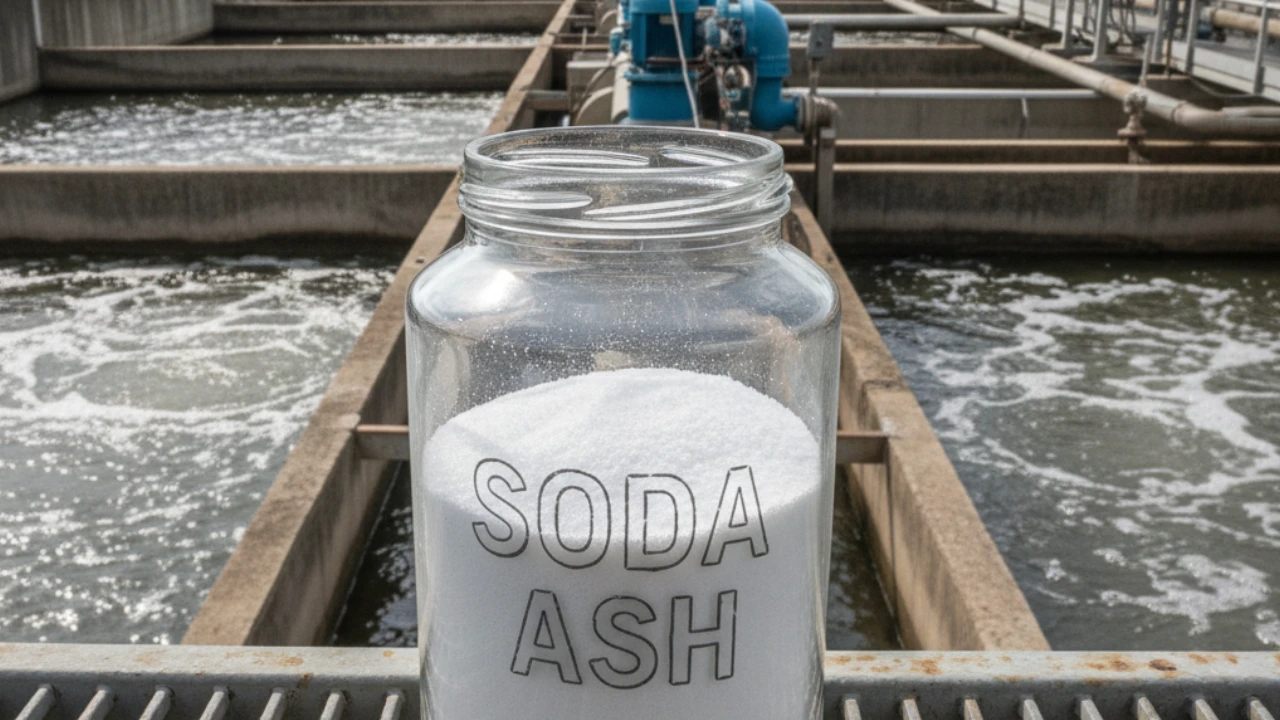
Soda ash (anhydrous sodium carbonate, Na₂CO₃) is a white, odorless, hygroscopic powder that dissolves readily in water. At a 1% concentration it produces a mildly alkaline solution with a pH of approximately 11.6 — strong enough to correct acid water conditions, but controllable enough for precise dosing in drinking water systems.
When soda ash dissolves in water, it undergoes the following dissociation reaction:
This reaction simultaneously releases hydroxide ions (OH⁻) for pH elevation and bicarbonate (HCO₃⁻) for buffering capacity. This dual action is what distinguishes soda ash in water treatment from single-function alternatives like caustic soda (NaOH) — and makes it uniquely effective for complex water matrices.
📊 Market Insight (2025–2026): The global soda ash market reached approximately USD 18–21.6 billion in 2025, with analysts projecting growth to USD 26–31 billion by 2034 at a CAGR of 3–4.5% (Grand View Research, 2025). Water treatment applications represent one of the fastest-growing demand segments, driven by stricter environmental regulations, aging infrastructure investment, and expanding industrial water reuse programs.
Source: Grand View Research 2025; United Nations Water Scarcity Projections 2026
How Is Soda Ash Produced? Natural Trona vs. Synthetic Solvay
Understanding production methods helps operators evaluate sustainability credentials and supply chain risk when sourcing treatment chemicals.
Natural Trona Mining
Natural production mines trona ore deposits — primarily in the U.S. Green River Basin (Wyoming) and Turkey. The United States produces approximately 12 million metric tons annually, exporting over 50% of output. Natural soda ash carries a significantly lower carbon footprint and typically costs less due to lower processing energy requirements.
Synthetic Solvay & Hou Processes
Synthetic production uses the Solvay process (ammonia-soda method) or the Hou process. China dominates global synthetic production at approximately 38 million metric tons per year. In 2025, global soda ash production exceeded 70 million metric tons annually.
Sustainability Innovations
Companies such as WE Soda and Solvay lead low-carbon process development aligned with net-zero goals. Carbon capture and utilization (CCU), renewable energy integration, and solution mining reduce surface disruption and Scope 3 emissions — increasingly relevant for utilities with sustainability procurement mandates.
Key Applications of Soda Ash in Water Treatment
The four primary applications of soda ash in water treatment each address distinct chemistry challenges. Most modern treatment plants employ soda ash for multiple purposes simultaneously, making it one of the highest-value chemicals per dollar in the treatment chemical portfolio.
1. pH Adjustment and Corrosion Control
Acidic source water (pH below 6.5) is one of the most common problems in groundwater and industrial effluents. Acidic water aggressively corrodes metal distribution infrastructure, leaching lead and copper into drinking water — a direct public health concern addressed by the EPA Lead and Copper Rule (40 CFR Part 141).
Soda ash reliably raises pH to the 7.5–8.5 range recommended by both EPA and WHO, without excessively increasing water hardness — a significant advantage over caustic soda for drinking water applications. In 2025–2026, modern smart plants deploy AI-driven pH sensors for dynamic dosing, reducing chemical overuse by 10–20% compared to manual programs.
2. Water Softening via the Lime-Soda Process
Hard water — containing elevated calcium (Ca²⁺) and magnesium (Mg²⁺) ions — causes scaling in pipes, boilers, heat exchangers, and appliances. Non-carbonate (permanent) hardness is the primary target of soda ash treatment.
Mg²⁺ + 2OH⁻ → Mg(OH)₂ ↓ (magnesium hydroxide precipitate)
The lime-soda process pairs lime Ca(OH)₂ (for carbonate hardness removal) with soda ash (for non-carbonate hardness), typically at a treatment pH of 10.3–10.6. The resulting calcium carbonate sludge is recyclable in construction applications, supporting circular economy principles.
3. Heavy Metal Precipitation in Wastewater and Mine Drainage
In industrial wastewater and acid mine drainage (AMD) systems, dissolved heavy metals including copper, zinc, iron, lead, and cadmium must be removed before discharge to comply with EPA Clean Water Act effluent limits. Soda ash precipitates these metals as insoluble carbonates, facilitating removal via sedimentation or filtration.
4. Alkalinity Control and Buffering Capacity
Low-alkalinity source water is vulnerable to pH swings during chlorination and coagulation — disrupting disinfection efficacy and aesthetic qualities. Soda ash increases total alkalinity, providing the buffering resilience needed to maintain stable treatment performance and improving taste and odor characteristics in finished drinking water.
Soda Ash Dosage Guidelines and Calculation Methods
Accurate dosage calculation is critical — underdosing fails to achieve treatment objectives while overdosing increases sodium in effluent and raises operating costs.
Practical Dosage Reference Table
| Application | Typical Dosage (mg/L) | Target Parameter | Primary Benefit |
|---|---|---|---|
| pH Adjustment | 50–150 | pH 7.5–8.5 | Corrosion prevention, lead/copper compliance |
| Water Softening | 100–200 | Hardness < 80 mg/L CaCO₃ | Scale prevention, equipment protection |
| Heavy Metal Precipitation | 75–150 | Metals below discharge limits | Regulatory compliance, toxin removal |
| Alkalinity Control | 50–100 | Alkalinity 80–120 mg/L CaCO₃ | pH stability, improved disinfection |
Dosage Formula for Non-Carbonate Hardness Removal
The standard formula for calculating soda ash dosage in permanent hardness removal is:
Soda Ash (mg/L) = NCH (as CaCO₃, mg/L) × 1.06
Where NCH = Non-Carbonate Hardness
Worked Example: Influent NCH = 120 mg/L → Soda Ash = 120 × 1.06 = 127.2 mg/L
This formula provides a starting point. Always validate with bench-scale jar testing using actual source water before implementing full-scale dosing. Automated feed systems with flow-paced control further refine dosing based on real-time pH and alkalinity sensor readings.
Step-by-Step Calculation Process
Measure Non-Carbonate Hardness (NCH)
Test your source water and determine non-carbonate hardness expressed as CaCO₃ in mg/L. Also measure total pH, alkalinity, and specific ion concentrations (lead, copper, iron, manganese).
Apply the Dosage Formula
Multiply NCH by 1.06: Soda Ash (mg/L) = NCH (as CaCO₃, mg/L) × 1.06. This gives the theoretical starting dosage for non-carbonate hardness removal.
Validate with Bench-Scale Jar Testing
Conduct bench-scale jar testing with your actual water sample to confirm the calculated dosage achieves target pH and hardness levels. Jar testing takes 2–4 hours and prevents costly full-scale dosing errors.
Implement Automated Feed System
Configure a flow-paced or residual-based automated feed system integrated with SCADA. Monitor effluent pH and alkalinity in real time. AI-driven systems reduce chemical overuse by 10–20% vs. manual dosing.
Soda Ash vs. Caustic Soda vs. Lime
Water treatment operators routinely evaluate three primary alkaline chemicals. The right choice depends on your specific water chemistry, operational goals, budget, and safety requirements.
| Parameter | Soda Ash (Na₂CO₃) | Caustic Soda (NaOH) | Lime Ca(OH)₂ |
|---|---|---|---|
| pH at 1% solution | ~11.6 | ~13.0+ | ~12.4 |
| Primary function | pH elevation + alkalinity + hardness removal | Strong, rapid pH elevation | Carbonate hardness removal |
| Non-carbonate hardness removal | Effective | None | Limited |
| Alkalinity contribution | High (HCO₃⁻) | Low | Moderate |
| Handling safety | Moderate (irritant) | High risk (corrosive) | Moderate (dust hazard) |
| Sludge generation | Moderate (CaCO₃) | Low | High |
| Cost per pound (USD) | $0.20–$0.30 | $0.40–$0.70 | $0.10–$0.20 |
| Best use case | Simultaneous pH / alkalinity / softening | Rapid pH correction, low-hardness water | High carbonate hardness at low cost |
Selection Guidance
Choose Soda Ash When…
You need simultaneous pH elevation, alkalinity buffering, and non-carbonate hardness removal — the most common scenario in groundwater treatment. Best value for multi-objective treatment.
Choose Caustic Soda When…
Rapid pH correction is critical in low-hardness waters where alkalinity buffering is not required and fast response time is essential. Note that caustic soda pricing is influenced by textile and chemical manufacturing demand.
Choose Lime When…
High carbonate hardness removal at the lowest chemical cost per unit is the priority and sludge handling infrastructure is already in place. Lime produces significantly more sludge than soda ash applications.
Equipment and Feed Systems for Soda Ash Dosing
Proper feed system design determines dosing accuracy, operational reliability, and operator safety. Two primary configurations serve different facility scales.
Dry Feed Systems
Suitable for small to medium facilities processing up to approximately 10,000 m³/day. A volumetric or gravimetric feeder dispenses dry powder into a dissolving tank before injection. Operators must design adequate dust collection systems and prevent arching in hoppers — common operational issues with dry soda ash handling.
Slurry Feed Systems
The preferred approach for large municipal and industrial plants. Soda ash mixes into a 5–15% slurry before metered injection. Slurry systems improve dosing accuracy, significantly reduce dust exposure, and allow higher-volume throughput. Industry standard for plants treating more than 5,000 m³/day. Slurry tanks require continuous agitation.
Key Equipment Components
- Dissolving tanks with slow-speed mixers (slurry) or volumetric feeders (dry)
- Progressive cavity or diaphragm metering pumps for accurate flow control
- pH and alkalinity sensors integrated with SCADA control systems
- Static in-line mixers for rapid dispersion into the process stream
- Dust collection systems for dry feed applications
- Secondary containment for chemical spill management
Safety, Handling, and Storage Requirements
Soda ash is significantly less hazardous than caustic soda, but proper handling procedures are essential for operator safety and regulatory compliance under the OSHA Hazard Communication Standard (29 CFR 1910.1200).
Required PPE
NIOSH-approved N95 dust mask or respirator (minimum) · Chemical splash safety goggles · Chemical-resistant gloves (nitrile or neoprene) · Long-sleeved chemical-resistant clothing. Always follow the manufacturer's SDS for site-specific first aid procedures.
Storage Requirements
Store in a dry, well-ventilated area isolated from acids and aluminum compounds. Use sealed containers — soda ash is hygroscopic and will absorb atmospheric moisture. Maintain storage temperature below 40°C to prevent caking. Store bags on pallets to avoid ground moisture absorption. Soda ash has an indefinite shelf life when kept dry.
Regulatory Certifications
For potable water applications: specify ANSI/NSF/CAN 60 certified grades only. Request current certification documentation from every supplier before procurement. Follow AWWA B201-2023 standard specification for soda ash used in water treatment.
Inventory Management
Maintain a 30-day minimum chemical inventory buffer to manage supply chain disruptions — critical for uninterrupted treatment operations. Supply chain volatility in global soda ash markets can cause delivery delays of 2–4 weeks without buffer stock in place.
Challenges in Soda Ash Application and Mitigation Strategies
| Challenge | Root Cause | Recommended Mitigation |
|---|---|---|
| Sodium buildup in effluent | Overdosing increases total dissolved solids | Implement AI-driven automated dosing; monitor TDS continuously |
| Scaling in treatment systems | High-hardness water with imbalanced chemistry | Use CO₂ recarbonation after softening; pair with lime for comprehensive treatment |
| Supply chain price volatility | Global commodity fluctuations and logistics | Diversify sourcing; maintain 30-day minimum inventory |
| Dust exposure during dry handling | Inadequate ventilation in feed system area | Upgrade to slurry feed systems; install enclosed dust collection |
Rigorous monitoring, pilot studies conducted per AWWA guidelines, and automated feed control systems resolve the majority of operational challenges encountered in soda ash water treatment applications.
Innovations and Emerging Trends in Soda Ash Water Treatment
AI-Driven Dosing Optimization
Real-time sensor networks and machine learning algorithms now optimize soda ash dosing based on continuous influent water quality monitoring. Predictive dosing models anticipating pH and hardness fluctuations before they occur have demonstrated chemical waste reductions of 10–20% in pilot installations at municipal facilities in the U.S. and Europe.
Sustainable Low-Carbon Supply Chains
Carbon-negative production methods and natural trona expansion continue to reduce Scope 3 emissions associated with treatment chemical procurement. Leading suppliers now offer carbon footprint certificates per batch — increasingly relevant for utilities with sustainability reporting obligations under ESG frameworks.
Integration with Advanced Treatment
Soda ash in water treatment shows strong synergy with membrane pre-treatment systems, electrocoagulation units, and desalination post-treatment stabilization. In reverse osmosis (RO) applications, soda ash stabilizes concentrate streams and adjusts permeate pH, extending membrane life and reducing scaling-related maintenance costs.
Regulatory Momentum
Tightening EPA and EU drinking water standards — including more stringent lead action levels under the revised Lead and Copper Rule and new PFAS maximum contaminant levels — are driving operators toward efficient, multi-function treatment chemicals. Soda ash's ability to simultaneously address pH, hardness, and metal removal makes it increasingly attractive.
Case Study: Municipal Implementation — 45,000 m³/Day Groundwater Facility
Plant Profile
Midwestern U.S. municipal water treatment facility, serving approximately 180,000 people. Source water: groundwater at pH 6.2, non-carbonate hardness 145 mg/L as CaCO₃, total hardness 220 mg/L as CaCO₃.
Treatment Objective
Achieve finished water pH of 7.8–8.2 and reduce total hardness below 80 mg/L as CaCO₃, in compliance with EPA SDWA secondary standards and the Lead and Copper Rule.
Implementation
Dual-tank soda ash slurry feed system (2 × 500-gallon dissolving tanks with redundancy). Calculated soda ash dosage: 154 mg/L (145 × 1.06 = 153.7, rounded). Lime at 85 mg/L for carbonate hardness. SCADA-controlled pH feedback loop for automated response.
Results — 6-Month Operational Average
| Metric | Before Treatment | After Implementation | Improvement |
|---|---|---|---|
| Effluent pH | 6.2 | 8.0 ± 0.2 | ✅ Target achieved |
| Total Hardness | 220 mg/L CaCO₃ | 92 mg/L CaCO₃ | 58% reduction |
| Pipe Scaling Incidents | Baseline | −42% | Significant improvement |
| Chemical Program Cost | Caustic soda baseline | −18% | Substantial cost saving |
The transition from caustic soda to a soda ash and lime combination reduced annual chemical costs by 18% while simultaneously improving alkalinity buffering and reducing scaling incidents across the distribution network.
Regulatory Compliance Framework for Soda Ash in Water Treatment
United States
EPA Safe Drinking Water Act (SDWA) — primary regulatory framework for public water systems.
Lead and Copper Rule (LCR) — 40 CFR Part 141 — pH and corrosion control requirements.
ANSI/NSF/CAN 60 — certification standard for drinking water treatment chemicals.
AWWA B201-2023 — standard specification for soda ash used in water treatment.
European Union
Drinking Water Directive (DWD) 2020/2184 — sets drinking water quality standards across member states.
EU REACH Regulation (EC) No 1907/2006 — chemical substance registration and safety requirements.
CLP Regulation — chemical classification, labeling, and packaging requirements.
International
WHO Guidelines for Drinking-water Quality, 4th Edition — the global reference standard for water quality.
ISO 9001 — quality management system certification for chemical suppliers.
Middle East and Africa standards generally reference WHO/EPA baselines with local regulatory overlay.
Best Practices for Implementing Soda Ash in Water Treatment
Following these eight best practices ensures safe, effective, and compliant soda ash application across drinking water, wastewater, and industrial treatment systems.
How to Source Soda Ash for Water Treatment Projects
Consistent chemical quality, appropriate certifications, and reliable logistics are non-negotiable requirements for large-scale water treatment procurement.
When evaluating any soda ash supplier, verify the following before committing to a contract:
- Current ANSI/NSF/CAN 60 or equivalent drinking water treatment chemical certification
- ISO 9001 quality management system certification
- Availability of both Light Grade (bulk density ~500 kg/m³) and Dense Grade (~1,000 kg/m³) for different feed system configurations
- Flexible packaging options: 25 kg bags, 50 kg bags, 1-tonne jumbo bags, or bulk pneumatic tanker
- Documented export logistics expertise and full compliance documentation for your region
- Batch-level quality certificates and carbon footprint certificates per shipment
Need Soda Ash for Your Water Treatment Facility?
SUHA International supplies Dense and Light Grade soda ash (Na₂CO₃) to water treatment plants, municipalities, and industrial operators in 40+ countries from Turkey and Dubai UAE. ISO 9001 certified. NSF 60-eligible grades available. FOB quote in 24 hours.
Speak Directly With
Our Technical Team
We respond to all soda ash procurement and water treatment chemical inquiries within 24 business hours. For urgent project timelines or large-volume tender participation, WhatsApp is the fastest channel.
Include in Your Soda Ash Inquiry for Fastest Quote
FAQ — Soda Ash in Water Treatment
What is the typical dosage of soda ash in water treatment for pH adjustment?
The standard dosage range for soda ash in water treatment pH correction is 50–150 mg/L, depending on source water starting pH, alkalinity, and target finished water specifications. Lower pH source water (pH 5.5–6.0) typically requires dosages toward the upper end of this range. Always verify dosage through bench-scale jar testing with your specific source water before full-scale implementation.
How does the lime-soda softening process work?
The lime-soda softening process uses two chemicals in combination. Lime (Ca(OH)₂) removes carbonate hardness by raising pH and precipitating calcium as calcium carbonate (CaCO₃). Soda ash then targets remaining non-carbonate (permanent) hardness by providing carbonate ions (CO₃²⁻) that precipitate additional calcium and magnesium as insoluble solids. The process typically operates at pH 10.3–10.6 in the reaction zone.
Is soda ash safe for potable water treatment?
Yes — soda ash is approved and widely used in potable water treatment when ANSI/NSF/CAN 60 certified grades are specified and EPA or WHO dosage guidelines are followed. It is considerably safer to handle than caustic soda (NaOH) due to its lower caustic hazard classification and more moderate pH in solution.
How does soda ash compare to caustic soda for pH adjustment in water treatment?
Soda ash provides moderate pH elevation, alkalinity buffering via bicarbonate generation, and non-carbonate hardness removal — all at $0.20–$0.30 per pound. Caustic soda offers stronger, faster pH rise but contributes no alkalinity buffering, removes no hardness, poses significantly greater handling safety risks, and costs $0.40–$0.70 per pound. For most drinking water pH correction applications, soda ash delivers superior operational value.
What is the shelf life of soda ash in storage?
Properly stored soda ash has an indefinite functional shelf life. The critical variable is moisture exposure — soda ash is hygroscopic and will absorb atmospheric moisture, leading to caking and flowability problems. Store in sealed containers in a dry, climate-controlled environment below 40°C, on pallets above ground level.
Can soda ash remove iron and manganese from well water?
Indirectly, yes. By raising source water pH and increasing alkalinity, soda ash creates conditions that significantly improve the efficiency of downstream oxidation-filtration processes (such as greensand filtration or manganese dioxide media) that target dissolved iron and manganese. Soda ash alone is not sufficient for iron and manganese removal — it functions as a conditioning chemical that optimizes conditions for subsequent removal steps.
What equipment is needed for soda ash dosing in a water treatment plant?
A complete soda ash dosing system requires: a dissolving tank with slow-speed agitator (slurry systems) or a gravimetric dry feeder (dry systems), a metering pump (progressive cavity type preferred for slurry), pH and alkalinity sensors integrated with SCADA for closed-loop control, static in-line mixers for rapid chemical dispersion, and dust collection equipment for any dry handling operations. Slurry feed systems are the industry standard for municipal plants treating more than 5,000 m³/day.
How do I calculate soda ash dosage for permanent hardness removal?
Use the standard formula: Soda Ash (mg/L) = NCH (as CaCO₃, mg/L) × 1.06, where NCH is non-carbonate hardness measured in your source water. For example, source water with 145 mg/L NCH requires 153.7 mg/L soda ash as a starting dosage. Always confirm this calculated dosage through bench-scale jar testing before implementing at full scale, and establish automated real-time monitoring for ongoing optimization.