Caustic Soda for Battery Recycling – Sourcing High-Purity Sodium Hydroxide for Hydrometallurgical Recovery
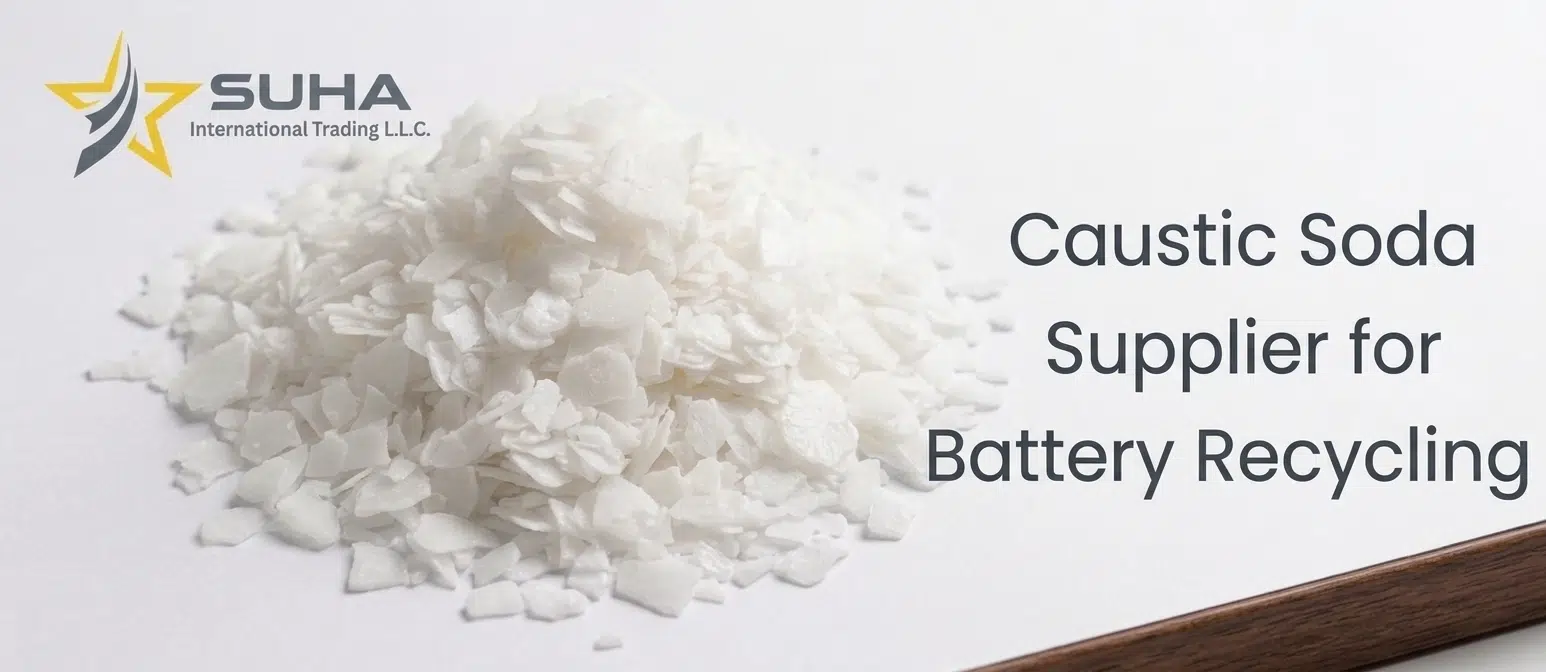
Caustic Soda for Battery Recycling — High-Purity NaOH for Black Mass Processing
SUHA International supplies membrane-grade caustic soda for battery recycling (Flakes 98-99% & Liquid 50%) for pH control and selective nickel/cobalt precipitation in hydrometallurgical Black Mass processing. Every shipment ships with a batch-specific Certificate of Analysis from our export hubs in Dubai (UAE) and Mersin (Turkey), with a firm FOB/CIF quote within 24 hours.
In short — Battery recyclers use caustic soda (NaOH) to control pH and selectively precipitate nickel, cobalt and manganese as high-purity hydroxides during hydrometallurgical Black Mass processing. Because iron and mercury impurities in the NaOH co-precipitate with the target metals, only membrane-grade caustic soda (Fe ≤ 10 ppm, Hg ≤ 0.1 ppm) is suitable. SUHA International supplies this grade in flakes (98-99%) and liquid (50%) from Dubai and Mersin, with a batch-specific COA and a 24-hour FOB/CIF quote.
Why Battery Recyclers Need a Reliable Caustic Soda Partner
With the global push toward electric mobility, lithium-ion battery recycling is evolving from a niche activity into a mainstream industry. Industry estimates put end-of-life lithium-ion battery volumes above 500,000 tonnes annually by 2030 — a surge that creates urgent demand for high-quality reagents.
Hydrometallurgical plants rely on sodium hydroxide to control acidity, precipitate metals, and purify leach solutions. Procurement teams need a supplier who treats industrial grade caustic soda as a critical process input — not a commodity — because purity directly impacts recovery yields and product quality. SUHA International bridges chemical manufacturing and the circular-economy battery recycling sector, providing supply chain security, technical specification support, and logistics tailored to the tight schedules of recycling plants.
📊 Market note: Buyers are increasingly consolidating around dual-origin (Turkey + UAE) suppliers to reduce supply-chain risk and secure consistent batch-to-batch quality.
Source: SUHA International trade desk & industry procurement trends, 2025–2026.
The Role of NaOH in Hydrometallurgical Battery Recycling
Buyers often need to justify their chemical choices to technical teams. Here is exactly why caustic soda is non-negotiable in the hydrometallurgical recycling route.
Black Mass is first leached with sulfuric acid (H2SO4) or hydrochloric acid (HCl) to produce a pregnant leach solution containing valuable ions (Ni2+, Co2+, Mn2+, Li+) alongside impurities (Fe3+, Al3+, Cu2+). Caustic soda is introduced at two critical stages:
- Impurity removal: pH is raised to 3.5–4.5 to precipitate iron as Fe(OH)3, and to 5.0–6.0 to precipitate aluminum as Al(OH)3.
- Selective precipitation (nickel and cobalt recovery): pH is increased to 8.0–8.5 for manganese, 9.0–9.5 for cobalt, and 10.0–10.5 for nickel, precipitating each as a high-purity hydroxide.
The underlying stoichiometry is straightforward: M2+ + 2NaOH → M(OH)2↓ + 2Na+. This is why purity matters — impurities in the NaOH (such as chlorides or iron) can co-precipitate or contaminate the recovered battery material, reducing the market value of the end product.
🔬 Research note: Published leaching studies report that caustic leaching with NaOH can show high selectivity toward lithium — with little to no detectable leaching of nickel, manganese, cobalt or copper — reaching lithium extraction efficiencies of roughly 80% in some trials. This positions caustic soda as a reagent with a role beyond pH control and precipitation, extending into selective lithium leaching.
Sources available on request — ask our technical desk for the published studies referenced here.
Critical Specs: What to Look for in Industrial Grade Caustic Soda
SUHA International supplies membrane-grade product that meets the strictest limits for battery applications. Using rayon-grade (low-chloride) caustic soda keeps chloride ions out of the system, eliminating the need for costly purge streams.
| Parameter | Flakes (98-99%) | Liquid (50%) | Critical Impact on Battery Recycling |
|---|---|---|---|
| NaOH Purity (min) | 98.0% | 50.0% | Directly impacts stoichiometric consumption and waste generation. |
| Chlorides (NaCl) | ≤ 0.02% | ≤ 0.02% | High chlorides corrode equipment and complicate downstream purification. |
| Iron (Fe) | ≤ 10 ppm | ≤ 10 ppm | Critical impurity; contaminates recovered cobalt/nickel, degrading cathode performance. |
| Mercury (Hg) | ≤ 0.1 ppm | ≤ 0.1 ppm | Regulated and highly toxic. Membrane-grade is essential; diaphragm-grade is unsuitable. |
| Carbonates (Na₂CO₃) | ≤ 0.8% | ≤ 0.5% | Causes scaling in pipes and can alter pH buffering capacity. |
★ All values verified by a batch-specific Certificate of Analysis (COA). SGS / BV inspection available on request.
Export Logistics — UAE & Turkey Hubs for Fast Delivery
Lead time matters in the recycling industry. A dual-origin strategy is designed to prevent downtime.
Jebel Ali, Dubai (UAE)
Primary export hub for Asia, the Middle East and Africa, with fast vessel connections to India, China and Southeast Asia.
Mersin, Turkey
Strategic hub for European and Balkan recyclers — 7–10 days transit to Germany, France, the Netherlands and Poland.
Flexible Shipping
Solid grades in 20' FCL (24 MT); liquid grades in ISO tanks. Incoterms: FOB, CFR, CIF, DAP.
Packaging Options
25 kg HDPE bags (palletized), 1,000 kg FIBC jumbo sacks, or bulk IBCs/ISO tanks for liquid NaOH.
Quality Assurance — COA on Every Production Lot
In lithium-ion battery recycling, trust is verified by documentation. Every shipment includes a comprehensive Certificate of Analysis covering all critical parameters: NaOH purity, chlorides, carbonates, iron, mercury and heavy metals.
This documentation supports full traceability for environmental permits and end-product certification (including EU Battery Regulation compliance). SDS/MSDS is also provided in English, German, French, Arabic, Turkish and Persian to support global operations.
🌱 Environmental note: Life-cycle assessment studies indicate that hydrometallurgical processes using caustic soda as the primary precipitant can have a lower environmental impact than routes requiring multiple specialized precipitants — supporting a more sustainable circular-economy battery recycling model.
Sources available on request — ask our technical desk for the published studies referenced here.
Why SUHA Is the Preferred Supplier for the EV Battery Industry
Secure Your Supply of Caustic Soda for Battery Recycling
Send your grade, volume (MT), destination port and Incoterm. Our export desk returns a bankable FOB/CIF offer with unit price, container value and shipping schedule in under 24 hours.
Speak With Our
Battery Recycling Supply Team
We respond to inquiries within 24 hours. For urgent procurement needs or large-volume orders, WhatsApp is the fastest channel.
Include These Details for the Fastest Quote
FAQ — Sourcing Caustic Soda for Battery Recycling
What grade of caustic soda is required for battery recycling?
Hydrometallurgical battery recyclers require high-purity membrane-grade sodium hydroxide (NaOH) at 98–99% purity for flakes, or 50% concentration for liquid. Critical specifications include Iron (Fe) ≤ 10 ppm and Mercury (Hg) ≤ 0.1 ppm to prevent contamination of recovered nickel and cobalt.
Can I use diaphragm-grade caustic soda instead of membrane-grade for battery recycling?
Diaphragm-grade NaOH contains significantly higher sodium chloride and mercury levels than membrane-grade. High chloride content can corrode hydrometallurgical equipment and introduce unwanted chloride into recovered metal salts, complicating downstream purification and reducing their market value for battery-grade applications.
How does caustic soda affect the purity of recovered cobalt and nickel?
The purity of caustic soda directly impacts the purity of recovered cobalt and nickel hydroxides. Impurities like iron and mercury co-precipitate with the target metals, contaminating the final product. Membrane-grade NaOH with Fe ≤ 10 ppm and Hg ≤ 0.1 ppm is essential for producing battery-grade metal salts.
What is the typical consumption rate of NaOH per tonne of Black Mass?
Consumption varies with the leaching acid used and the target metal recovery profile, but typically ranges from 0.5 to 1.5 tonnes of NaOH per tonne of Black Mass processed. Our technical desk can help optimize dosing for your specific circuit.
How should caustic soda be stored to prevent quality degradation?
Store in a cool (below 30°C), dry, well-ventilated area in sealed containers to prevent moisture absorption and carbonation. Keep solid NaOH off concrete floors using pallets. Store liquid NaOH in HDPE or stainless-steel tanks above 15°C to prevent crystallization.
What is the difference between caustic soda flakes and liquid for hydrometallurgical processes?
Flakes (98–99% NaOH) are cost-effective for solid handling and are dissolved on-site. Liquid NaOH (32–50%) is ready-to-use, eliminates dissolution time and dust exposure, and suits continuous dosing systems. Both are available at the same membrane-grade specification.
Do you provide third-party inspection and certification for caustic soda shipments?
Yes. We offer SGS, Bureau Veritas, or Intertek inspection on request at the buyer's cost. Every shipment includes a batch-specific Certificate of Analysis covering NaOH purity, chlorides, carbonates, iron, mercury and heavy metals.
🔗 Related Products & Resources
Research references on lithium selectivity and life-cycle impact are available from our technical desk on request — ask for the source list to be added here as clickable citations.