
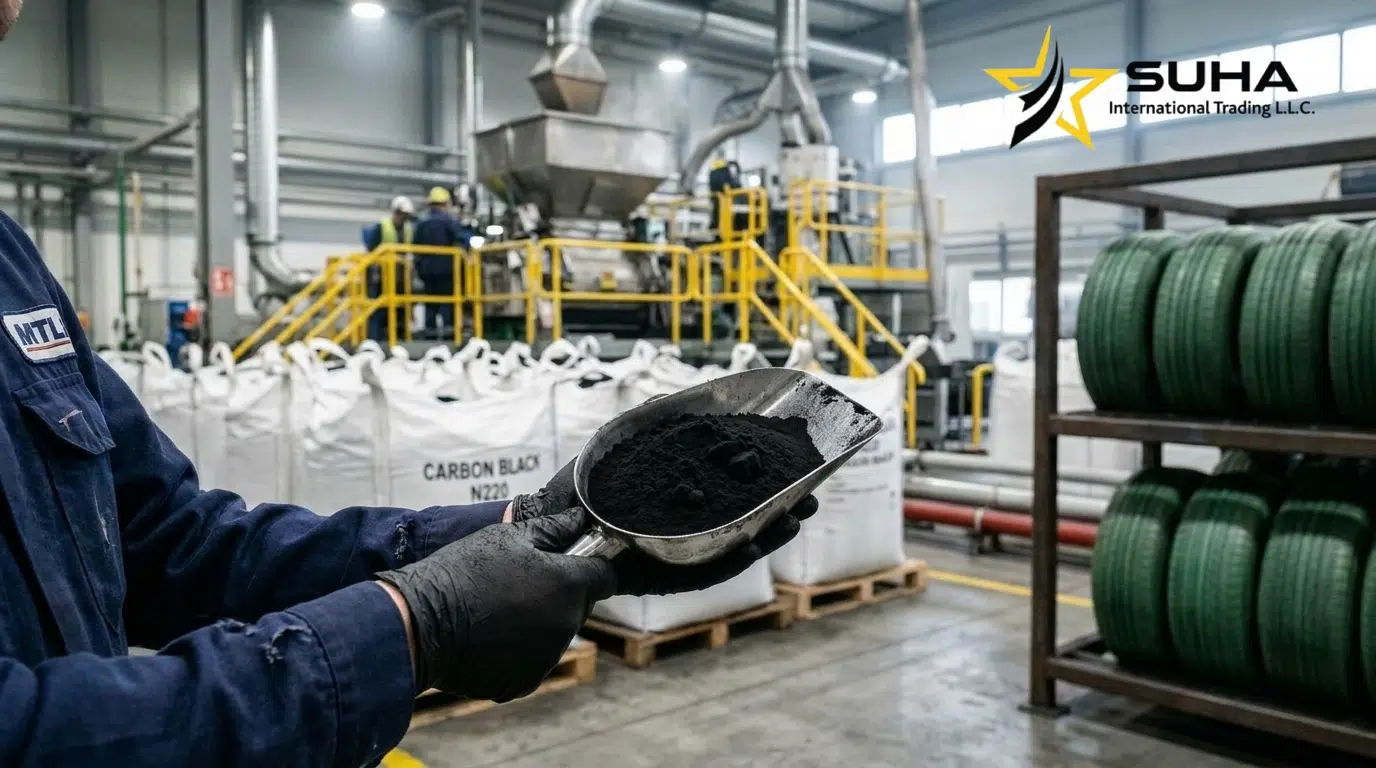
Rubber compounding raw materials · Bulk export from Türkiye & UAE
Carbon Black for Tires and Rubber: Grade Selection Guide for Tyre Makers
Carbon black for tires is the reinforcing filler that turns soft natural and synthetic rubber into a tyre that can carry load, resist abrasion and last for tens of thousands of kilometres. It also colours the tyre black, absorbs UV light and helps carry heat away from the tread. Around 70% of the world's carbon black goes into tyres, and most of the rest into belts, hoses and other rubber goods. This guide is for tyre plants, rubber compounders and distributors. It explains how the ASTM N-grades work, which carbon black grade fits each part of a tyre, and what to check before you order by the container.
Short answer
The right carbon black for tires depends on the tyre component. Treads need high reinforcement and abrasion resistance, so they use fine, high-surface-area grades such as N220, N234, N330, N339 or N375. Carcass, sidewall and inner-liner compounds need flex, low heat build-up and easy processing, so they use coarser grades such as N550, N660 and N772. Wire-coat compounds commonly use N326. Grades are chosen by surface area (iodine number) and structure (DBP absorption). Order against a lot COA that reports both. Carbon black makes up about 28% of a typical tyre's weight, so grade choice has a large effect on both performance and cost.
Fundamentals
Why Carbon Black Is Used in Tires
Rubber on its own is weak. Unfilled SBR, for example, has a tensile strength of only about 2 MPa and almost no abrasion resistance. Fine carbon black particles bond with the rubber chains during mixing and form a reinforcing network, which raises tensile strength, tear strength, stiffness and wear resistance many times over. That is why carbon black for tyres is, after the rubber itself, the largest ingredient in most tyre compounds.
In a finished tyre, carbon black does five jobs:
- Reinforcement. It gives the tread its abrasion resistance and the casing its strength.
- Wear and grip balance. Particle size and structure trade treadwear against grip and rolling resistance.
- Heat management. Coarser grades in the carcass and sidewall keep heat build-up and hysteresis low.
- UV and ozone protection. Carbon black absorbs UV light and slows surface ageing.
- Processing. The right grade gives smooth extrusion of treads and sidewalls and clean calendering of plies.
The use of carbon black in tires dominates the market: roughly 70% of global carbon black output goes into tyres and around 20% into belts, hoses, profiles and other rubber goods. Tyre makers are by far the largest buyers of rubber-grade carbon black.
Grade system
How ASTM Carbon Black Grades Work: Reading an N-Number
Rubber-grade carbon black is named under ASTM D1765 with a letter and three digits, such as N330:
- The letter describes cure rate. N means normal cure, which covers almost all modern furnace blacks. S means slow cure.
- The first digit gives the average particle-size range. A lower digit means finer particles, higher surface area and stronger reinforcement.
- The last two digits are assigned to individual grades within that size group.
| Series | Average particle size | Reinforcement | Typical tyre use |
|---|---|---|---|
| N100 | 11–19 nm | Highest | Off-road and heavy-duty treads |
| N200 | 20–25 nm | Very high | Passenger and truck treads |
| N300 | 26–30 nm | High | Treads, sidewalls, wire coat |
| N500 | 40–48 nm | Medium (semi-reinforcing) | Carcass, sidewall, extrusions |
| N600 | 49–60 nm | Medium-low | Carcass, inner liner |
| N700 | 61–100 nm | Low | Inner liner, tubes, mechanical goods |
Swipe the table sideways to see every column.
Two properties do most of the work. Surface area, measured by iodine number, drives reinforcement and abrasion resistance. Structure, measured by DBP absorption, drives stiffness, extrusion behaviour and dispersion. Two grades in the same series, such as N326 (low structure) and N347 (high structure), can behave very differently in a compound.
N220 vs N330 vs N550: the three most traded tyre grades
| Property | N220 | N330 | N550 |
|---|---|---|---|
| Iodine number (mg/g) | 116–125 | 77–87 | 38–48 |
| DBP absorption (ml/100 g) | 109–119 | 97–107 | 116–126 |
| Reinforcement | Very high | High | Medium |
| Heat build-up | Highest | Medium | Low |
| Processing / extrusion | Hardest to disperse | Balanced | Smoothest extrusion |
| Main tyre use | Truck and high-wear treads | Treads and sidewalls | Carcass, sidewall, extrusions |
Swipe the table sideways to compare.
Note that N550 is a coarse but high-structure grade: its DBP is higher than N330's even though its surface area is about half. That combination is what gives N550 its smooth extrusion and low heat build-up, and it is why tyre grade carbon black is never chosen on particle size alone.
Carbon Black Grade Decoder
Pick a grade to see what its number means and where it goes in a tyre.
Application
Which Carbon Black for Tires? Grade by Tyre Component
A tyre is not one compound but several. Each component gets a different rubber-grade carbon black because each does a different job. These are the grades tyre compounders most commonly use for each part:
Carbon Black for Tire Treads
The tread needs the highest abrasion resistance and the right grip balance, so it takes fine, high-surface-area grades. N220 and N234 suit truck and high-wear treads; N330, N339 and N375 suit passenger and general treads.
Carbon Black for Sidewalls
Sidewalls flex millions of times, so they need fatigue resistance, low heat build-up and good weathering. Semi-reinforcing grades give the right balance.
Carbon Black for Carcass and Ply Compounds
Carcass compounds need flex, dimensional stability and good calendering onto fabric or steel cord, with low hysteresis to keep the tyre cool.
Carbon Black for Inner Liners
Inner liners hold the air. Coarser, lower-cost grades, often in halobutyl compounds, give good processing and low air permeability.
Carbon Black for Wire-Coat Compounds
Low-structure N326 is commonly used in skim and wire-coat compounds that bond rubber to steel belts and cords.
Carbon Black for Tubes and Rubber Goods
Inner tubes, hoses, profiles, belts and moulded goods use semi-reinforcing grades for easy extrusion and smooth surfaces. N550 is a common extrusion grade.
| Tyre component | Common grades | What the grade must deliver |
|---|---|---|
| Tread | N220, N234, N330, N339, N375 | Abrasion resistance, reinforcement, grip |
| Sidewall | N330, N550 | Flex-fatigue resistance, weathering |
| Carcass / ply | N550, N660, N772 | Flex, low heat build-up, calendering |
| Inner liner | N660, N772 | Low permeability, processing |
| Wire coat / skim | N326 | Rubber-to-steel adhesion, low structure |
| Tubes, hoses, profiles | N550, N660 | Smooth extrusion, dispersion |
Swipe the table sideways to see every column.
Grade choices are typical industry practice. Your compound formula, rubber type and performance targets decide the final grade and loading, so confirm by lab mixing and testing.
Tyre Carbon Black Grade Finder
Choose the tyre type and component. The finder suggests the grades compounders usually start from and what to check on the COA.
Technical data
Carbon Black for Tires: Specifications to Check on Every COA
Two cargoes sold as "N330" can behave differently in your mixer. Check these ASTM properties on every lot certificate of analysis. The table shows typical values for all ten tyre grades we supply, from tread grades (N220, N234, N330, N339, N375) to wire-coat (N326) and carcass and inner-liner grades (N550, N660, N772):
| Test | ASTM | N220 | N234 | N326 | N330 | N339 | N347 | N375 | N550 | N660 | N772 |
|---|---|---|---|---|---|---|---|---|---|---|---|
| Iodine number (mg/g) | D1510 | 116–125 | 115–125 | 77–87 | 77–87 | 85–95 | 85–95 | 85–95 | 38–48 | 31–41 | 25–35 |
| DBP absorption (ml/100 g) | D2414 | 109–119 | 120–130 | 67–77 | 97–107 | 115–125 | 119–129 | 109–119 | 116–126 | 85–95 | 60–70 |
| CDBP absorption (ml/100 g) | D3493 | 93–103 | 97–107 | 63–73 | 83–93 | 94–104 | 94–104 | 91–101 | 80–90 | 69–79 | 54–64 |
| Nitrogen surface area (m²/g) | D6556 | 109–126 | 114–124 | 73–83 | 73–83 | 86–96 | 80–90 | 88–98 | 35–45 | 30–40 | 27–37 |
| Tint strength (%ITRB) | D3265 | 111–121 | 118–128 | 106–116 | 99–109 | 106–116 | 100–110 | 109–119 | 58–68 | 53–67 | — |
| Pour density (g/l) | D1513 | 335–375 | 300–340 | 435–475 | 360–400 | 325–365 | 315–355 | 325–365 | 340–380 | 420–460 | 500–540 |
| Heating loss, max (%) | D1509 | 0.75 | 0.75 | 0.75 | 0.75 | 0.75 | 0.75 | 0.75 | 0.75 | 0.75 | 0.75 |
| Ash content, max (%) | D1506 | 0.75 | 0.75 | 0.75 | 0.75 | 0.75 | 0.75 | 0.75 | 0.75 | 0.75 | 0.75 |
| Sulfur content, max (%) | D1619 | 1 | 1 | 1 | 1 | 1 | 1 | 1 | 1 | 1 | 1 |
| Toluene discoloration, min (%T) | D1618 | 90 | 90 | 90 | 90 | 90 | 90 | 90 | 85 | 85 | 85 |
| Sieve residue No. 35, max (ppm) | D1514 | 0 | 0 | 0 | 0 | 0 | 0 | 0 | 0 | 0 | 0 |
| Sieve residue No. 325, max (ppm) | D1514 | 200 | 200 | 200 | 200 | 200 | 200 | 200 | 200 | 200 | 200 |
| Fines in bags, max (%) | D1508 | 10 | 10 | 10 | 10 | 10 | 10 | 10 | 10 | 10 | 10 |
| Fines in jumbo bags, max (%) | D1508 | 7 | 7 | 7 | 7 | 7 | 7 | 7 | 7 | 7 | 7 |
| pH value | D1512 | 7.5–9 | 7.5–9 | 7.5–9 | 7.5–9 | 7.5–9 | 7.5–9 | 7.5–9 | 7.5–9 | 7.5–9 | 7.5–9 |
Swipe the table sideways to compare all ten grades.
Why these numbers matter: iodine number and nitrogen surface area drive reinforcement and abrasion resistance; DBP and CDBP (structure) drive stiffness, extrusion and dispersion; tint strength tracks particle fineness; sieve residue and ash show contamination that can start cracks; fines and pour density affect dusting and handling in the mixer. Full product data is on our carbon black supplier page.
Compounding
Carbon Black and the Other Raw Materials in a Tyre Compound
Carbon black is one part of a tyre compound and, after rubber, the largest single material in a finished tyre. Industry data from the Scrap Tire Management Council puts it at about 28% of the weight of both passenger and truck tyres. Tyre makers cite a range of roughly 20–30%.
| Material | Passenger tyre | Truck tyre | We supply |
|---|---|---|---|
| Carbon black | ≈ 28% | ≈ 28% | Carbon black |
| Synthetic rubber | ≈ 27% | ≈ 14% | SBR, BR |
| Natural rubber | ≈ 14% | ≈ 27% | SMR |
| Steel | ≈ 14–15% | ≈ 14–15% | — |
| Fabric, fillers, cure chemicals, waxes, antidegradants | ≈ 16–17% | ≈ 16–17% | Sulfur, stearic acid, waxes |
Swipe the table sideways to see every column.
Truck tyres use more natural rubber for tear strength and low heat build-up; passenger tyres use more synthetic rubber. Tyre plants that consolidate several of these materials with one supplier cut bookings and paperwork. We supply many of them:
Natural rubber
The base polymer for truck treads and carcasses, where tear strength and low heat build-up matter. Standard Malaysian Rubber (SMR)
Synthetic rubbers
SBR is the workhorse of passenger treads; polybutadiene adds abrasion and low-temperature resistance. SBR · Polybutadiene rubber
Sulfur
The classic vulcanising agent that crosslinks the rubber during curing. Sulfur
Stearic acid
An activator in sulfur cure systems, working with zinc oxide, and a processing aid. Stearic acid
Protective waxes
Paraffin and microcrystalline waxes bloom to the surface and form a barrier against ozone cracking in sidewalls. Microcrystalline wax · Paraffin wax
Processing aids
Low-molecular PE wax improves flow and mould release in rubber compounds. PE wax in rubber
Market trend
Virgin vs Recovered Carbon Black for Tires
Recovered carbon black (rCB) is made by pyrolysing end-of-life tyres. It attracts interest for its lower carbon footprint and price. Today it is mostly used as a partial replacement in non-tread compounds and rubber goods. Industry standards for rCB are still being developed, for example by an ASTM workgroup, and its properties vary more from source to source than virgin furnace black.
Virgin furnace carbon black
- Defined ASTM grades (N220–N772) with tight specifications
- Consistent surface area and structure lot to lot
- Required for high-performance treads
- Lower ash
Recovered carbon black (rCB)
- Made from end-of-life tyres; lower CO₂ footprint claimed by producers
- Higher ash and more variability
- Mostly a partial replacement in non-tread and mechanical goods
- No single ASTM grade system yet
The grades on this page are virgin rubber-grade carbon black produced to ASTM D1765 grades.
Procurement
Bulk Carbon Black for Tire Plants: Packing, Loading and Order Planner
Tyre plants consume carbon black continuously, so packing format and container schedule matter as much as price. We supply rubber-grade carbon black for tires in these formats:
| Packing | Net per unit | Per container | Best for |
|---|---|---|---|
| Jumbo bag (FIBC) | 1 MT | 20ft ≈ 16–17 MT · 40ft ≈ 25 MT | Tyre plants with bulk handling and silos |
| PP or paper bags | 25 kg or 50 kg | Confirmed on the packing list | Smaller compounders, manual charging, mixed loads |
Swipe the table sideways to see every column.
MOQ: one full container load (1 FCL). Lead time: depends on the destination port and is confirmed with each quotation. Loading: FOB Mersin (Türkiye) or FOB Jebel Ali (UAE), with CFR and CIF on request. Mixed-grade containers, for example tread and carcass grades together, are possible on request.
Carbon Black Order Planner
Enter your monthly consumption and container size to plan shipments in jumbo bags.
The planner uses about 25 MT per 40ft and 16.5 MT per 20ft in jumbo bags. Lead time depends on your destination, so keep at least one full lead time of stock on site.
Compliance
Carbon Black Handling, Storage and Export Documents
Handling and storage
- Store dry and covered. Moisture raises heating loss and affects dispersion
- Control dust with local extraction and closed conveying
- Use dust masks, goggles and gloves when handling open bags
- Keep away from ignition sources; carbon black dust is combustible
- IARC classifies carbon black as Group 2B (possibly carcinogenic, by inhalation); keep exposure below the local occupational limit
Identification and documents
- CAS 1333-86-4
- HS code 2803.00
- Lot COA with iodine number, DBP, ash, sieve residue and pellet hardness
- SDS, commercial invoice, packing list, bill of lading and certificate of origin
- Transport classification as stated on the SDS of each grade
Standards and references used in this guide
- ASTM D1765: standard classification system for carbon blacks used in rubber products
- ASTM D1510 (iodine number), D2414 (DBP), D3493 (CDBP), D6556 (surface area), D1513 (pour density), D1506 (ash), D1514 (sieve residue)
- Industry data on carbon black end use: about 70% of carbon black goes to tyres and about 20% to other rubber goods
- Scrap Tire Management Council: typical passenger and truck tyre composition by weight (carbon black ≈ 28%)
- IARC Monographs: carbon black, Group 2B
- Product data: SUHA International carbon black technical data sheet. Grade-by-component choices reflect common industry practice; final selection depends on each compound
Supplier
Carbon Black Supplier for Tyre Manufacturers, with Offices in Türkiye and Dubai
SUHA International Trading supplies carbon black for tires and rubber goods to tyre plants, compounders and distributors across Türkiye, the Middle East, Africa and South Asia. We work from two offices: our head office in Business Bay, Dubai, and our Türkiye office in Ankara. More about SUHA International
Dubai Office
Office 2305, Burlington Tower,Business Bay, Dubai, United Arab Emirates Open in Google Maps
Ankara Office
Karşıyaka District, 749 Street, No 30,Gölbaşı, Ankara 06830, Türkiye Open in Google Maps
Meetings at either office are by appointment. WhatsApp is monitored seven days a week, and enquiries are answered within one business day.
Tread and non-tread grades
Ten ASTM grades from N220 to N772 cover every tyre component on one contract.
Lot-level COA
Iodine number, DBP, ash, sieve residue and pellet hardness reported for every lot.
Two loading hubs
FOB Mersin for Türkiye, Europe and North Africa; FOB Jebel Ali for the Gulf, East Africa and South Asia.
Jumbo bags or bags
1 MT FIBC for bulk handling, or 25/50 kg bags for manual charging.
The rubber raw-material set
Carbon black, SBR, natural rubber, sulfur, stearic acid and waxes from one supplier.
Monthly schedules
Container programmes sized to your consumption and safety stock.
Related products for tyre and rubber compounding
FAQ
Carbon Black for Tires: Frequently Asked Questions
Why is carbon black used in tires?
Carbon black reinforces rubber. Fine carbon particles bond with the rubber chains and multiply tensile strength, tear strength and abrasion resistance, so the tyre can carry load and wear slowly. It also absorbs UV light, slows surface ageing, helps conduct heat away from the tread, and gives tyres their black colour.
Why are tires black?
Tyres are black because they contain carbon black, a reinforcing filler added to the rubber. Without it, a tyre would wear out far faster. The black colour is a side effect of the reinforcement.
Which carbon black grade is used for tire treads?
Tire treads use fine, high-surface-area grades for abrasion resistance: N220 and N234 for truck and high-wear treads, and N330, N339 and N375 for passenger and general treads. The final choice depends on the compound and the wear, grip and rolling-resistance targets.
What carbon black is used in tire sidewalls and carcass?
Sidewalls commonly use N330 or N550 for flex-fatigue resistance. Carcass and ply compounds use coarser N550, N660 or N772 for flexibility, low heat build-up and good calendering. Inner liners typically use N660 or N772.
What is the difference between N330 and N550 carbon black?
N330 is a finer, reinforcing grade (iodine number about 77–87 mg/g) used mainly in treads and sidewalls. N550 is a coarser, semi-reinforcing grade (iodine number about 38–48 mg/g) with high structure, used for carcass, sidewall and extrusion compounds where smooth processing and low heat build-up matter.
What does the N in N330 mean?
Under ASTM D1765, N stands for normal cure rate. The first digit gives the particle-size group (3 means about 26–30 nm), and the last two digits identify the individual grade within that group.
How much carbon black is in a tire?
Carbon black makes up about 28% of the weight of a typical passenger or truck tyre, according to Scrap Tire Management Council data, and tyre makers cite a range of roughly 20–30%. After rubber, it is the largest single material in a tyre.
What is tire grade carbon black?
Tire grade carbon black is rubber-grade furnace black made to ASTM D1765 grades for tyre compounds. Fine N100–N300 grades such as N220, N234 and N330 reinforce treads, while coarser N500–N700 grades such as N550, N660 and N772 are used in carcass, sidewall and inner-liner compounds.
Is carbon black toxic?
Carbon black is not acutely toxic, but its fine dust should not be inhaled. IARC classifies it as Group 2B, possibly carcinogenic to humans, based on inhalation studies in animals. Use dust extraction and respiratory protection when handling open bags, and follow the SDS.
What is recovered carbon black?
Recovered carbon black (rCB) is produced by pyrolysing end-of-life tyres. It has a lower carbon footprint but more variable properties and higher ash than virgin furnace black, so it is mostly used as a partial replacement in non-tread compounds and rubber goods.
What is the HS code and CAS number of carbon black?
Carbon black is generally classified under HS code 2803.00. Its CAS number is 1333-86-4.
What is the minimum order for carbon black?
Our minimum order is one full container load (1 FCL). A 40ft container carries about 25 MT and a 20ft about 16–17 MT in 1 MT jumbo bags. Lead time depends on the destination port and is confirmed with each quotation.
How is carbon black packed for export?
Carbon black is supplied in 1 MT FIBC jumbo bags or in 25 kg and 50 kg PP or paper bags. It is loaded FOB Mersin (Türkiye) or FOB Jebel Ali (UAE), with CFR and CIF available on request.
What should a carbon black COA include?
A carbon black certificate of analysis should report iodine number (ASTM D1510), DBP absorption (D2414), and ideally CDBP and nitrogen surface area, plus pour density, heating loss, ash, 325-mesh sieve residue, pH and pellet hardness for the actual lot.
Where are your offices?
SUHA International Trading has its head office at Office 2305, Burlington Tower, Business Bay, Dubai, UAE, and a Türkiye office at Karşıyaka District, 749 Street, No 30, Gölbaşı, Ankara 06830. Meetings at both offices are by appointment.
How do I get a carbon black quote?
Send us the grades you need, your monthly tonnage, packing (jumbo bags or bags) and destination port by WhatsApp at +971 50 720 9246 or by email at info@causticsodaco.com. We reply within one business day.
Request a Quote for Carbon Black for Tires
Send us five details and our desk in Ankara or Dubai will reply within one business day with a lot COA and a FOB Mersin or Jebel Ali offer.
- Grades (e.g. N330, N550, N660)
- Monthly tonnage per grade
- Jumbo bags or 25/50 kg bags
- Destination port or plant
- Incoterm and documents