
Calcium Hypochlorite for Water Treatment: Dosing, Grades and Bulk Supply
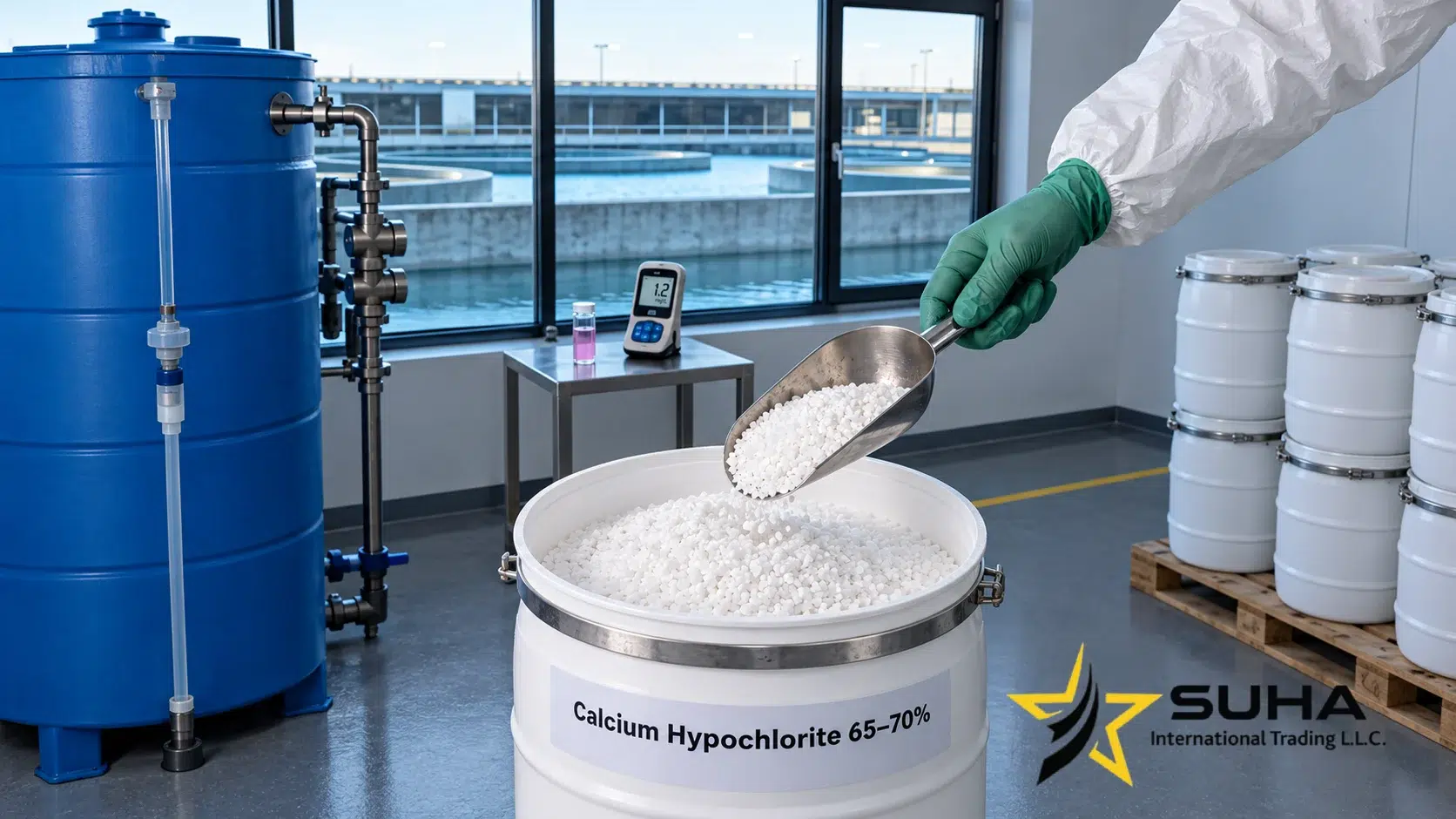
Water disinfection · Calcium hypochlorite 65–70% granules
Calcium Hypochlorite for Water Treatment: Granular Chlorine for Safe Water
Calcium hypochlorite for water treatment is a dry, granular chlorine disinfectant with 65–70% available chlorine. It is used to disinfect drinking water, wells, tanks and pipelines, to chlorinate swimming pools and to treat wastewater and cooling water. Because it is solid and concentrated, it carries five to seven times more chlorine per kilogram than liquid bleach and keeps its strength in storage, which makes it the chlorine source of choice for export, remote sites and emergency water supply. This guide is for water utilities, treatment contractors, pool chemical distributors and aid buyers, and explains how it works, how much to dose, which grade to buy and how to ship it safely.
Short answer
Calcium hypochlorite disinfects water by releasing free chlorine (hypochlorous acid). About 1.5 g of 65% granules adds 1 mg/L of chlorine to 1,000 litres of water. For drinking water, WHO advises a free chlorine residual of at least 0.5 mg/L after 30 minutes' contact at pH below 8, with 5 mg/L as the health-based guideline value. Use a drinking-water grade with heavy-metal limits for potable water, and store the product cool, dry and away from acids and organic materials.
Your supplier
SUHA International: Calcium Hypochlorite Supplier for Water Treatment
We supply calcium hypochlorite 65–70% granules in two grades, industrial and drinking-water treatment, to utilities, contractors, distributors and aid programmes. Packing is 25 kg plastic drums, 36 per pallet, with a certificate of analysis for every batch, loaded at Jebel Ali or Mersin.
Chemistry
How Calcium Hypochlorite Disinfects Water
When calcium hypochlorite dissolves, it releases hypochlorite that forms hypochlorous acid in water:
Ca(OCl)₂ + 2 H₂O → Ca(OH)₂ + 2 HOCl
Hypochlorous acid (HOCl) and hypochlorite ion (OCl⁻) together are measured as free chlorine. Hypochlorous acid is by far the stronger disinfectant. It dominates below about pH 7.5, which is why chlorination is most effective in slightly acidic to neutral water and why WHO links its residual target to pH below 8.
- Chlorine demand: part of the dose is used up by organic matter, iron, manganese, ammonia and hydrogen sulfide before any residual remains.
- Contact time: disinfection depends on concentration × time; WHO's target assumes at least 30 minutes.
- Turbidity: particles shield micro-organisms, so water should be clarified first, for example with aluminum sulfate coagulation.
- Side effects: calcium hypochlorite is slightly alkaline and adds a little calcium hardness.
Applications
Calcium Hypochlorite Uses in Water Treatment
Drinking water disinfection
Final disinfection in municipal and small community plants, often after coagulation, settling and filtration.
Rural, remote and emergency water
Stable dry chlorine for tank, well and household chlorination where liquid bleach is hard to ship or store.
Wells, tanks and new pipelines
Shock chlorination of new or repaired mains, reservoirs and boreholes before they go into service.
Swimming pools
Routine chlorination and shock treatment of public and private pools.
Wastewater and cooling water
Effluent disinfection and biofouling control in cooling towers and process water.
Sanitation and hygiene
Disinfecting surfaces, equipment and containers in food plants, farms and health facilities.
Water plants use calcium hypochlorite as one step in a chain: coagulation with aluminum sulfate, pH correction with caustic soda, soda ash or lime, filtration, then chlorination.
Dosing
Chlorine Dose and Residual: How Much Calcium Hypochlorite to Use
The dose has two parts: enough chlorine to satisfy the water's chlorine demand, plus the residual you want to remain after the contact time. Measure the free chlorine residual with a DPD test kit or meter and adjust the dose.
| Application | Typical target | Reference |
|---|---|---|
| Drinking water, after treatment | ≥ 0.5 mg/L free chlorine after ≥ 30 min, pH < 8 | WHO Guidelines for Drinking-water Quality |
| Drinking water, maximum | 5 mg/L chlorine | WHO health-based guideline value |
| Distribution network | A few tenths of a mg/L residual | WHO chlorine fact sheet |
| Swimming pools | About 1–3 mg/L free chlorine | Common pool practice; follow local rules |
| New mains, tanks and wells | High-strength shock dose, then flush | Per AWWA or national procedures |
Swipe the table sideways to see every column.
Rule of thumb: 1 mg/L of chlorine in 1 m³ (1,000 L) of water needs 1 g of available chlorine, which is about 1.54 g of 65% or 1.43 g of 70% calcium hypochlorite.
Calcium Hypochlorite Dose Calculator
Enter the water volume, the chlorine dose you need and the product strength.
The calculator gives the chlorine added. The dose needed to reach a target residual depends on the water's chlorine demand; confirm it by testing. 1% stock solution assumes 10 g of available chlorine per litre.
Grades and analyses
Calcium Hypochlorite Grades for Water Treatment: Specifications and Analyses
We supply calcium hypochlorite 65–70% as white granules in two grades. The tables show the specification limit and the typical result of our product.
Drinking-water treatment grade
| Property | Specification limit | Our product |
|---|---|---|
| Active chlorine (% w/w) | 65 min | 65 min |
| Soluble active chlorine (% w/w) | 45.5 min | 50 min |
| Insoluble in water (% w/w) | 6 max | 6 max |
| Water (% w/w) | 16 max | 2–8 |
| Residue on 425 µm sieve (% w/w) | 75 min | 75 min |
| Residue on 2 mm sieve (% w/w) | 20 max | 20 max |
| Cadmium (mg/kg active chlorine) | 5 max | Nil |
| Lead (mg/kg active chlorine) | 15 max | 8 max |
| Nickel (mg/kg active chlorine) | 8 max | 8 max |
| Chromium (mg/kg active chlorine) | 15 max | 12 max |
| Arsenic (mg/kg active chlorine) | 5 max | 2 max |
| Mercury (mg/kg active chlorine) | 5 max | 2.5 max |
| Antimony (mg/kg active chlorine) | 15 max | 7 max |
| Selenium (mg/kg active chlorine) | 20 max | 10 max |
| Appearance | White granules | Conforms |
Swipe the table sideways to see every column.
Industrial grade
| Property | Specification limit | Our product |
|---|---|---|
| Active chlorine (% w/w) | 65 min | 65 min |
| Moisture (% w/w) | 2–8 | 2–8 |
| Residue on 425 µm sieve (% w/w) | 75 min | 75 min |
| Residue on 2 mm sieve (% w/w) | 20 max | 20 max |
| Iron as Fe (% w/w) | 0.5 max | 0.2 max |
| Appearance | White granules | Conforms |
Swipe the table sideways to see every column.
Which grade to buy: use the drinking-water grade, with its heavy-metal limits, for any water people will drink. The industrial grade suits pools, cooling water, effluent and general sanitation. Both grades are 65–70% available chlorine granules. Product data is also on our calcium hypochlorite supplier page.
Chlorine sources
Calcium Hypochlorite vs Sodium Hypochlorite vs TCCA for Water Treatment
| Property | Calcium hypochlorite | Sodium hypochlorite | TCCA |
|---|---|---|---|
| Form | Dry granules | Liquid | Tablets or granules |
| Available chlorine | 65–70% | About 10–15% | About 90% |
| Storage stability | Good when cool and dry | Loses strength over weeks | Good |
| Effect on water | Slightly raises pH; adds calcium | Raises pH; adds sodium | Lowers pH; adds cyanuric acid |
| Drinking water | Widely used | Widely used | Used mainly for pools and emergency tablets |
| Freight per kg of chlorine | Low | High (mostly water) | Low |
Swipe the table sideways to compare.
For plants that prefer liquid dosing, we also supply sodium hypochlorite. For long-distance export and remote sites, calcium hypochlorite usually gives the lowest cost per kilogram of chlorine delivered.
Good practice
How to Make a Chlorine Stock Solution from Calcium Hypochlorite
- Use a clean plastic tank. Polyethylene or fibreglass, covered and out of direct sunlight.
- Add granules to water, never water to granules. About 15 g of 65% product per litre gives a 1% chlorine solution.
- Stir, then let it settle. Calcium hypochlorite contains some insoluble matter; let it settle and dose the clear solution.
- Dose and test. Feed with a dosing pump or proportional doser and check the free chlorine residual after the contact time.
- Make it fresh. Prepare stock solution regularly; it slowly loses strength, especially in heat and light.
Procurement
Bulk Calcium Hypochlorite for Water Treatment: Packing and Shipping
| Item | Detail |
|---|---|
| Packing | 25 kg plastic drums, 36 drums (900 kg) per wooden pallet |
| Container load | Limited by carrier rules for calcium hypochlorite, typically about 14 MT net per container; confirmed on each offer |
| MOQ | One full container load (1 FCL) |
| Loading | FOB Jebel Ali (UAE) or Mersin (Türkiye); CFR or CIF on request |
| Transport class | UN 2880 or UN 1748, Class 5.1 oxidiser, PG II, as stated on the SDS |
| Codes | HS 2828.10 · CAS 7778-54-3 |
| Documents | Certificate of analysis, SDS, DG declaration, invoice, packing list, bill of lading, certificate of origin |
Water plants usually buy more than a disinfectant. We also supply aluminum sulfate, liquid caustic soda, soda ash, lime and sulfuric acid, so a plant can consolidate its chemicals on one contract.
Storage and safety
Calcium Hypochlorite Storage, Handling and Safety
Storage
- Keep in closed drums in a cool, dry, ventilated store, out of direct sun
- Keep away from acids, reducing agents, oils, organic materials and other combustibles
- The product is unstable at high temperature; avoid heat sources
- Never let water or moisture into the drum
Handling
- Wear goggles, gloves and a dust mask; it is corrosive to eyes and skin
- Not flammable itself, but a strong oxidiser that can ignite oils and organic material
- Never mix with acids or other chemicals: chlorine gas can be released
- Collect spills in clean, compatible containers; do not return them to the original drum
Supplier
Your Calcium Hypochlorite Supplier for Water Treatment in Dubai and Ankara
SUHA International Trading supplies calcium hypochlorite for water treatment to utilities, treatment contractors, pool chemical distributors and aid programmes across the Middle East, Africa, Central Asia and Europe. Our head office in Dubai serves the UAE and Gulf; our Ankara office serves Türkiye and exports through Mersin. More about SUHA International
Dubai Office
Office 2305, Burlington Tower,Business Bay, Dubai, United Arab Emirates Open in Google Maps
Ankara Office
Karşıyaka District, 749 Street, No 30,Gölbaşı, Ankara 06830, Türkiye Open in Google Maps
Related water treatment chemicals and guides
FAQ
Calcium Hypochlorite for Water Treatment: FAQ
What is calcium hypochlorite used for in water treatment?
Calcium hypochlorite is a solid chlorine disinfectant. In water treatment it is used to disinfect drinking water, wells, storage tanks and pipelines, to chlorinate swimming pools, to treat wastewater effluent and cooling water, and to sanitise surfaces and equipment. It kills bacteria and viruses and controls algae and other micro-organisms.
How does calcium hypochlorite disinfect water?
When calcium hypochlorite dissolves, it forms hypochlorous acid (HOCl) and hypochlorite ions (OCl−). Hypochlorous acid is the stronger disinfectant and dominates at lower pH, which is why chlorination works best at pH below 8. The free chlorine attacks the cell walls and enzymes of micro-organisms.
How much calcium hypochlorite do I need per 1,000 litres of water?
To add 1 mg/L of chlorine to 1,000 litres (1 m³) of water you need about 1.5 g of 65% calcium hypochlorite or 1.4 g of 70% product. The real dose must also cover the chlorine demand of the water, so check the free chlorine residual after the contact time and adjust.
What chlorine level is safe in drinking water?
WHO sets a health-based guideline value of 5 mg/L for chlorine in drinking water. For effective disinfection WHO advises a free chlorine residual of at least 0.5 mg/L after at least 30 minutes of contact at pH below 8, and most distribution systems carry a residual of a few tenths of a milligram per litre.
What is the difference between 65% and 70% calcium hypochlorite?
The percentage is the available (active) chlorine content. 70% product contains about 8% more chlorine per kilogram than 65%, so you need less of it for the same dose. Both are white granules used the same way; the right choice depends on price per kilogram of available chlorine.
Is calcium hypochlorite better than sodium hypochlorite?
Calcium hypochlorite contains 65–70% available chlorine as a dry solid, compared with about 10–15% for liquid sodium hypochlorite (bleach), so it is far cheaper to ship and store and keeps its strength much longer. Sodium hypochlorite is easier to dose as a liquid and adds no calcium hardness. Remote, export and emergency supply usually favour calcium hypochlorite.
Does calcium hypochlorite raise pH?
Yes, slightly. Calcium hypochlorite is alkaline and also adds calcium hardness. In drinking water the effect at normal doses is small; in swimming pools it is controlled by adjusting pH and monitoring calcium hardness.
Can calcium hypochlorite be used for drinking water?
Yes. Calcium hypochlorite is widely used to disinfect drinking water. For potable water use a grade made and tested for drinking water treatment, with limits on heavy metals, and keep the treated water within the WHO guideline value of 5 mg/L chlorine.
How do I make a chlorine stock solution from calcium hypochlorite granules?
Add the granules to water, never water to the granules, in a clean plastic tank, and stir until dissolved. A 1% chlorine stock solution needs about 15 g of 65% product per litre of water. Let the insoluble matter settle and dose the clear solution, which should be prepared fresh and kept covered and out of sunlight.
How much calcium hypochlorite for a swimming pool?
Pools are normally kept at about 1–3 mg/L free chlorine. To raise a pool by 1 mg/L you need about 1.5 g of 65% calcium hypochlorite per cubic metre of water. Dissolve it in a bucket of water first and keep pH in the recommended range.
Is calcium hypochlorite dangerous?
Calcium hypochlorite is a strong oxidiser (Class 5.1) and is corrosive to eyes and skin. It is not flammable itself, but it can ignite oils, organic materials and other combustibles, and it releases chlorine gas with acids. Store it cool, dry and away from incompatible materials, and wear goggles, gloves and a dust mask.
What are the UN number and HS code of calcium hypochlorite?
Calcium hypochlorite is shipped as UN 2880 (hydrated, 5.5–16% water) or UN 1748 (dry), Class 5.1 oxidiser, packing group II, as stated on the SDS. Its HS code is 2828.10 and its CAS number is 7778-54-3.
How is calcium hypochlorite packed for export?
We pack calcium hypochlorite granules in 25 kg plastic drums, 36 drums on a wooden pallet. Because it is an oxidiser, container loads follow carrier guidelines for calcium hypochlorite, typically about 14 MT net per container, and the exact load is confirmed on each offer.
Who supplies calcium hypochlorite for water treatment in bulk?
SUHA International Trading supplies calcium hypochlorite 65–70% granules for water treatment, in industrial and drinking-water grades, to water utilities, pool chemical distributors, contractors and aid programmes, from offices in Dubai and Ankara with a certificate of analysis for every batch.
Sources
Sources Used in This Guide
- World Health Organization, Guidelines for Drinking-water Quality: free chlorine residual of at least 0.5 mg/L after 30 minutes at pH below 8
- World Health Organization, chlorine chemical fact sheet: guideline value 5 mg/L; residual of a few tenths of a mg/L in distribution
- UN Recommendations on the Transport of Dangerous Goods: UN 1748 and UN 2880, Class 5.1
- Product data: SUHA International analyses of drinking-water and industrial grade calcium hypochlorite
Calcium hypochlorite in other languages: kalsiyum hipoklorit (Turkish), هيبوكلوريت الكالسيوم (Arabic), гипохлорит кальция (Russian), hipoclorito de calcio (Spanish), hypochlorite de calcium (French).
Request a Quote for Calcium Hypochlorite for Water Treatment
Send these details and we will reply within one business day with a certificate of analysis and a FOB Jebel Ali or Mersin offer.
- Grade: drinking-water or industrial
- Strength: 65% or 70%
- Quantity and number of containers
- Destination port
- Tender specification, if any