
Sodium Sulfide vs Sodium Hydrosulfide (Na₂S vs NaHS): Differences, Uses and How to Choose
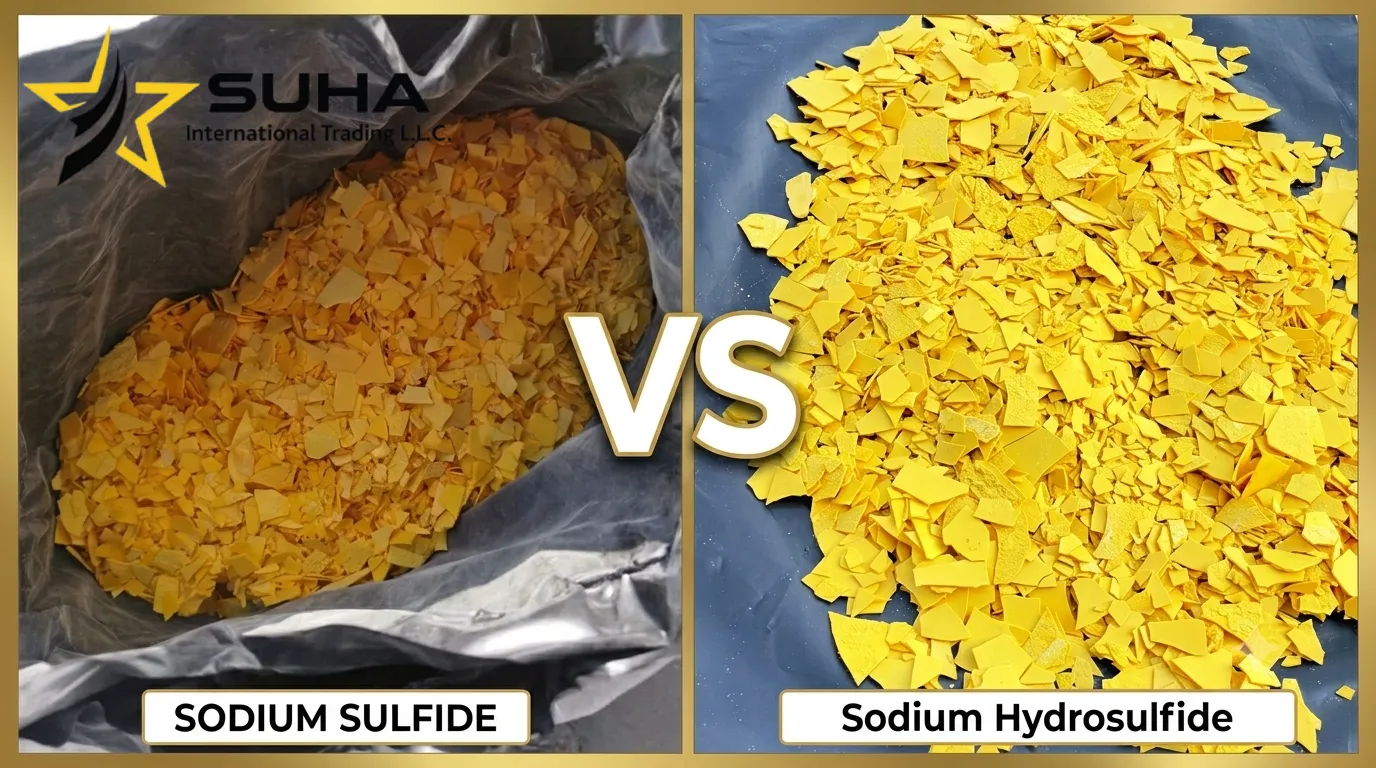
Sodium Sulfide vs Sodium Hydrosulfide: The Short Answer
Sodium sulfide (Na₂S) and sodium hydrosulfide (NaHS) are both sodium salts of hydrogen sulfide. Na₂S carries a sulfide ion (S²⁻) and is strongly alkaline; NaHS carries a hydrosulfide ion (HS⁻), is milder (solution pH ≈ 11.5)[1] and, per kilogram, carries more sulfur. Dissolve Na₂S in water and you get NaHS plus caustic soda; add caustic soda to NaHS and you get Na₂S. Choose Na₂S when the process needs sulfide and alkalinity, NaHS when it needs sulfide with tight pH control.
- Na₂S
- CAS 1313-82-2 · 78.0 g/mol
- NaHS
- CAS 16721-80-5 · 56.1 g/mol
- Sulfur, pure basis
- Na₂S ≈ 41% · NaHS ≈ 57%
- Commercial grades
- Na₂S 60% flakes · NaHS flakes or solution
- UN number
- Na₂S 1849 · NaHS solution 2922
- Shared hazard
- Toxic H₂S with acids
Sodium sulfide 60% flakes, standard and low-iron (Fe ≤ 10 ppm) · COA with every lot
What Is Sodium Sulfide and What Is NaHS?
The two names are often confused because they differ by a single hydrogen atom. That hydrogen changes alkalinity, sulfur content, the form the product is sold in and, in practice, which job each one does best.
Sodium sulfide
Sodium sulphide · disodium sulfide
An ionic salt of two sodium ions and one sulfide ion (S²⁻). It dissolves readily in water to a strongly alkaline solution, because the sulfide ion takes a proton from water and releases hydroxide.
Traded mainly as yellow flakes of about 60% Na₂S, a lower hydrate than the crystalline nonahydrate Na₂S·9H₂O. Full product data: sodium sulfide 60% flakes.
Sodium hydrosulfide
Sodium hydrogen sulfide · sodium bisulfide · sodium sulfhydrate
One sodium ion and one hydrosulfide ion (HS⁻). Made by absorbing hydrogen sulfide into caustic soda solution, which is why it is closely linked to caustic soda.
Sold mostly as a solution of about 22–60% NaHS, which must be kept warm because it crystallises, and also as flakes[1].
Na₂S vs NaHS: Comparison Table
| Property | Sodium sulfide (Na₂S) | Sodium hydrosulfide (NaHS) |
|---|---|---|
| Formula · molar mass | Na₂S · 78.0 g/mol | NaHS · 56.1 g/mol |
| CAS number | 1313-82-2 | 16721-80-5 |
| Sulfur ion | Sulfide, S²⁻ | Hydrosulfide, HS⁻ |
| Sulfur content, pure compound | ≈ 41% | ≈ 57% |
| Usual commercial form | Yellow flakes, ≈ 60% Na₂S (≈ 25% S) | Solution 22–60%, or flakes (70% flakes ≈ 40% S) |
| Alkalinity | Strong: S²⁻ + H₂O → HS⁻ + OH⁻ | Milder: solution pH ≈ 11.5 |
| Made from | Reduction of sodium sulfate, or NaHS + NaOH | H₂S absorbed in caustic soda |
| Transport | UN 1849, Class 8 | UN 2922 (solution), Class 8 |
| Main hazard | Corrosive; toxic H₂S with acids | Corrosive; toxic H₂S with acids or heat[1] |
Sulfur figures are calculated from molar masses. Grades and impurity limits vary by producer; the certificate of analysis for each lot governs.
The Chemistry That Links Na₂S, NaHS and Caustic Soda
Five reactions explain almost every practical difference between the two products.
Na₂S + H₂O → NaHS + NaOHSodium sulfide in water behaves like NaHS plus caustic soda: that is where its extra alkalinity comes from.NaHS + NaOH → Na₂S + H₂OAdding caustic soda turns NaHS into Na₂S, about 0.71 kg NaOH per kg NaHS on a pure basis.H₂S + NaOH → NaHS + H₂OHow NaHS is made: hydrogen sulfide absorbed into caustic soda solution.2 NaHS + 2 S → Na₂S₃ + H₂SHydrosulfide and sulfide solutions dissolve elemental sulfur to form sodium polysulfides; note the H₂S released.Na₂S or NaHS + acid → H₂S↑Highly toxic hydrogen sulfide gas. Never let either product meet an acid.
Caustic soda for sulfidity and pH adjustment: caustic soda flakes or liquid caustic soda. Elemental sulfur: sulfur supply.
Na₂S and NaHS Equivalence Calculator
Compare the two products on the basis that matters, sulfur delivered, and see how much caustic soda turns NaHS into Na₂S. Runs in your browser only.
Sulfur-equivalent quantities
Enter the NaHS quantity you use today and the purities on your COAs.
- Sulfur in it
- 400 kg S
- Na₂S product, same sulfur
- 1,624 kg
- NaOH to convert NaHS → Na₂S
- 499 kg100% basis
- As caustic soda flakes 98%
- 510 kg
Stoichiometric estimate. A real switch also changes process pH and sodium load; confirm with a plant trial.
Sodium Sulfide vs Sodium Hydrosulfide by Industry
Both serve pulp and paper, mining, leather, chemicals and dyes[1]. What differs is the role each one plays.
Leather unhairing
Sodium sulfide with lime is the traditional beamhouse unhairing system. NaHS is gentler and is used alongside it to protect the grain. Low-iron Na₂S avoids iron stains on the hide.
Sodium sulfide for leather dehairingPulp and paper
Kraft white liquor is caustic soda plus sodium sulfide. Mills make up lost sulfidity with sodium sulfide, NaHS or sodium sulfate, and make up alkali with caustic soda.
Sodium sulfide in pulp and paperMining flotation
Na₂S sulfidises oxidised lead, zinc and copper minerals so collectors can attach. NaHS is widely used to depress copper in copper–molybdenum separation without a large pH rise.
Caustic soda in miningWastewater and metals
Both precipitate dissolved heavy metals as very insoluble metal sulfides. NaHS adds less alkalinity, so less acid is needed to bring the effluent back to discharge pH.
Caustic soda for water treatmentDyes and textiles
Sulfur dyes are reduced to their soluble form before dyeing cotton. Sodium sulfide brings its own alkali; NaHS systems need alkali added.
Caustic soda for textile processingChemical manufacture
Both are sulfur sources for dyes, rubber chemicals, polysulfides and other sulfur compounds; the choice depends on whether the reaction needs base.
Caustic soda in chemical manufacturingHow to Choose Between Na₂S and NaHS
Compare on delivered cost per kilogram of sulfur, then add the cost of the alkalinity you need or must neutralise.
| If you need… | Usually choose | Why |
|---|---|---|
| Sulfide and high alkalinity together | Na₂S | One product supplies both; no caustic soda to add |
| Sulfide with tight pH control | NaHS | Adds much less alkalinity |
| Most sulfur per tonne shipped | NaHS flakes | ≈ 40% S at 70%, against ≈ 25% S for Na₂S 60% |
| Solid product, simple storage, no heated tanks | Na₂S flakes | NaHS solution needs heating to avoid crystallisation |
| Liquid metering with no dissolving | NaHS solution | Sold ready to dose |
| Clean, stain-free leather | Low-iron Na₂S | Iron causes stains on the grain |
The cost trap. Comparing price per tonne of product is misleading: NaHS carries more sulfur, Na₂S carries more alkalinity. If your process adds caustic soda after NaHS, or acid after Na₂S, include that chemical in the comparison. Current sodium sulfide levels: sodium sulfide price.
Sodium Sulfide and NaHS Safety: Hydrogen Sulfide
The most serious hazard of both products is the large amount of deadly hydrogen sulfide they release when they react with an acid. The US Chemical Safety Board’s bulletin on NaHS sets out the controls[1].
Keep acids away
Separate storage, separate bunds, separate waste streams. Treat drains and sewers as part of the process: an acid in the same drain can release H₂S.
Detect and ventilate
Fixed H₂S detectors and alarms where sulfides are stored and transferred. Odour is not a warning: high H₂S concentrations deaden the sense of smell.
Right materials
No copper, zinc or aluminium in equipment that handles sulfide solutions. Label lines and use fittings that cannot be connected to acid.
Heat and storage
Keep away from heat and ignition sources. Store flakes sealed, dry and cool; air and moisture degrade them.
Spills
Do not let a spill meet acid or flush it to a sewer; recover it on sand or vermiculite and dispose of it as hazardous waste.
First aid
Flush skin and eyes with plenty of running water and get medical care. Move anyone exposed to H₂S to fresh air; rescuers need breathing apparatus.
Bulk Sodium Sulfide Supplier: Grades, Packing and Terms
SUHA International Trading supplies sodium sulfide 60% yellow flakes for tanneries, pulp mills, mines, dye makers and water treatment plants, together with the caustic soda that sulfide users usually need. If your process runs on NaHS today, send the specification: our team will tell you whether sodium sulfide, alone or with caustic soda, can do the job.
| Item | Detail |
|---|---|
| Grades | Na₂S 60% yellow flakes, standard · low-iron, Fe ≤ 10 ppm |
| Identity | CAS 1313-82-2 · HS 2830.10 · UN 1849, Class 8 |
| Packing | 25 kg bags · 150 kg drums · 1 MT jumbo bags |
| Minimum order | One full container load, 20ft or 40ft |
| Loading | Mersin, Türkiye · Jebel Ali, UAE |
| Terms | FOB · CFR · CIF · payment by T/T or L/C at sight |
| Documents | COA per lot, SDS, invoice, packing list, B/L, certificate of origin, dangerous-goods declaration |
Send these five facts for a firm sodium sulfide quotation
- Grade: standard or low-iron (Fe ≤ 10 ppm)
- Application: leather, pulp, mining, dyes, wastewater or chemicals
- Quantity: tonnes per shipment and per year
- Packing: 25 kg bags, 150 kg drums or jumbo bags
- Destination and Incoterm: port and country; FOB, CFR or CIF
Full specification: sodium sulfide supplier · current FOB levels: sodium sulfide price.
Sodium Sulfide vs Sodium Hydrosulfide: FAQ
Related Products and Guides
Sodium sulfide
Used with sulfides
Industries
References
- [1] US Chemical Safety and Hazard Investigation Board, Sodium Hydrosulfide: Preventing Harm, Safety Bulletin 2003-03-B. csb.gov (PDF)
- [2] PubChem CID 28015, Sodium hydrosulfide. pubchem.ncbi.nlm.nih.gov
- [3] PubChem, Sodium sulfide. pubchem.ncbi.nlm.nih.gov
- [4] IMO, International Maritime Dangerous Goods (IMDG) Code. imo.org
Prepared by the SUHA International Trading export desk, Dubai and Ankara. Technical figures are general; follow the SDS and COA supplied with your lot.